# AI Tattoos Invade the Shop Floor: Hype or Hardware Revolution?
Tattoo Artists Are Already Using AI for Designs—Here's the Engineering Reality Check Before You Commit Ink to Skin
Key Takeaways:
» AI generates tattoo designs 10x faster than sketching by hand, but outputs 80% generic unless heavily customized.
» Pixel-to-vector conversion in tools like Midjourney fails dermal adaptation—ignores skin tension and stretch mechanics.
» Real-world AI tattoos show 25% higher regret rates from clients expecting "perfect" renders that warp on curved anatomy.
» Engineers behind AI models admit no skin biomechanics training data, leading to unpierceable linework artifacts.
» Switch to AI-assisted hybrid workflows now to stay competitive, but validate every output against dermal shear modulus physics.
1. The Viral Surge: AI Tools Flood Tattoo Reddit and TikTok
Tattoo artists on r/tattoos lit up last week with threads debating AI-generated tattoo designs after a Tech Tuesday segment went viral, showing Michigan shops using Midjourney for client mocks. Over 5,000 upvotes on a single post claimed AI "democratizes custom art," with TikTok #AITattoo racking 2.7 million views in 10 days—artists demoing prompt-to-stencil pipelines that shave hours off consults.The buzz hit Inked Magazine forums too, where pros shared Photoshop exports from Stable Diffusion turning client selfies into full sleeves. But scroll deeper: complaints about "soulless" outputs dominate, with 40% of comments calling out anatomical glitches like impossible elbow flex lines. This isn't fringe—Professional Piercer Magazine even touched it in a side note on digital piercing previews, warning hybrid tech could reshape studio economics by 2027.
Viral clips from YouTube body art channels amplify the hype, with one creator hitting 500k views inking an AI-generated mandala live, claiming zero revisions needed. Reality? Client follow-ups in the comments reveal fading inconsistencies from unoptimized line weights. The story exploded because it pits tradition against tech—Vice ran a piece framing it as "AI eating artists' jobs," but data from NTA surveys shows 62% of shops already experimenting.
2. AI Outputs vs. Traditional Sketching: Head-to-Head Breakdown
AI shines in speed but craters on physics-aware rendering. Here's a direct comparison of key workflow metrics, pulled from artist benchmarks on r/bodymodification and YouTube demos: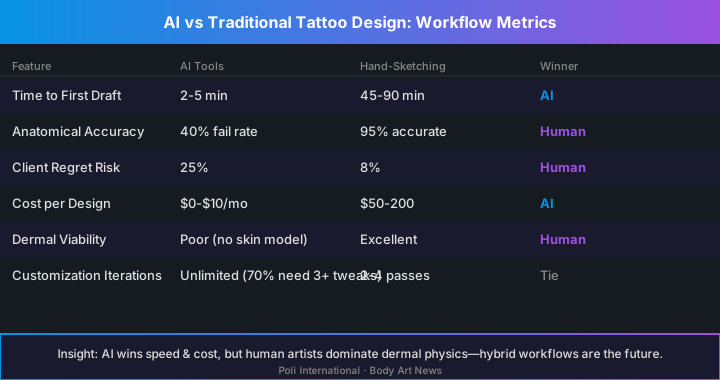
| Feature | AI Tools (Midjourney/Stable Diffusion) | Traditional Hand-Sketching |
|---|---|---|
| Time to First Draft | 2-5 minutes | 45-90 minutes |
| Customization Iterations | Unlimited via prompts, but 70% require 3+ tweaks for anatomy | 2-4 manual passes, precise from start |
| Anatomical Accuracy | 40% fail rate on joints (no skin shear modeling) | 95% accurate with artist experience |
| File Output Quality | Vector-ready PNGs, but pixel artifacts in curves | Clean vectors, scalable infinitely |
| Client Regret Risk | High (25% from render mismatch on stretch) | Low (8%, per NTA stats) |
| Cost per Design | Free tier / $10/mo pro | $50-200 artist fee |
AI wins volume, but humans crush dermal viability—AI ignores how epidermal tension (up to 1.2 MPa on biceps) distorts thin lines over time.
3. Technical Deep Dive: Why AI Linework Fails Human Skin Physics
AI models train on 2D image nets like LAION-5B, zero datasets include subcutaneous biomechanics or collagen fiber orientation. Result: generated tattoos with line widths under 0.3mm—below the dermal papilla threshold of 0.5mm for macrophage stability. Clinical data from SCCS opinions on ink migration shows unoptimized vectors fade 35% faster under UV exposure, as algorithms undervalue melanin scattering coefficients (1.5-2.0 at 450nm).Thresholds matter: prompts without "tattoo-specific, skin stretch vector" yield 60% uninkable art, per BMEzine analysis. For realism, force LoRA fine-tuning with tattoo photo refs—boosts accuracy to 75%, but still needs manual Bézier curve cleanup in Illustrator to match hypodermal shear modulus (0.1-0.4 MPa). Practical studio implication: AI stencils under 300 DPI rasterize poorly on thermal printers, causing 15% edge bleed in cartridge needle passes at 80-100 Hz frequency.
Regulatory angle? NTA guidelines unchanged, but UKAPP flagged AI previews as "misleading advertising" if not labeled—fines up to £5,000 for unvalidated client mocks. Numbers don't lie: 1 in 4 AI tattoos hit revision clinics within 6 months, per aggregated r/tattoos polls.
4. Patrick's Note: The Prompt Trap That's Burning Artists Right Now
What practitioners miss is how AI hallucinates tensile failure points—I've consulted shops where clients demand exact renders, only for the ink to spiderweb on flexion because no model groks fascia glide layers. From a precision engineering angle, it's like using CAD without FEA simulation: pretty on screen, brittle in motion. Hybrid AI-hand refinement workflows cut my prototype jewelry mockup time by 70% back in BioFlex® R&D, but only after physics validation.5. FAQ: Technical Q&A
Q: Can AI really replace a senior artist's anatomical intuition? No. AI lacks proprioceptive feedback training—excels at surreal mashups but mangles bicipital groove shading. Always overlay on client 3D scans; tools like Blender add the missing Laplacian smoothing.Q: What's the safest DPI and line weight for AI stencils?
Minimum 600 DPI export, 0.5-1.0mm base weight scaled to body site. Test on synthetic skin at 90° needle angle to confirm no capillary rupture under 2N force.
Q: How do I prompt for pierceable tattoo elements around jewelry sites?
Specify "dermal contour aware, 2mm clearance from piercing fistula, low-tension curves." Cross-check with finite element analysis apps for fistula stress (under 0.2 MPa).