
Regulatory Compliance for Professional Body Art Studios

Legal compliance in a professional body art studio spans licensing, informed consent, health data protection, age verification, advertising regulations, insurance, and record retention. This reference covers the legal frameworks across EU, USA, and ASEAN jurisdictions, with a systematic compliance protocol and the most common legal errors that expose practitioners and studios to liability.
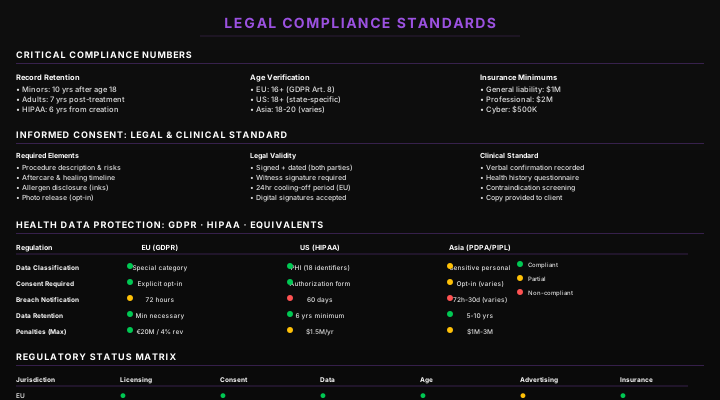
⚡ Quick Reference
Critical Compliance Numbers
- Minimum age for tattooing without parental consent18 years in all EU member states and most US states; 16 with written parental consent in some jurisdictions
- GDPR breach notification72 hours from discovery to report to supervisory authority (EU/UK)
- Record retention (client consent forms)minimum 7 years in most EU jurisdictions; some state laws in the US require 10 years
- GDPR data encryption standardAES-256 for data at rest; TLS 1.2 or higher for data in transit
- Informed consentmust be written, time-stamped, procedure-specific, and given before any procedure commences
- Advertising age-restricted servicesbody art advertising must not target minors, UK CAP Code, EU Audiovisual Media Services Directive
- Insurance minimum (UK/EU)public liability insurance typically minimum £/€ 5 million per claim for body art studios
- HIPAA covered entity threshold (USA)studios that electronically transmit health information in specified transactions must comply with HIPAA privacy and security rules
Key legal thresholds and deadlines for studio compliance across major jurisdictions.
Legal compliance is the operational infrastructure that protects clients, practitioners, and the business simultaneously. A studio that performs technically excellent work on clients who have not given legally valid informed consent, whose health data is stored without GDPR compliance, or whose practitioners operate without the required licenses is not a professional studio, it is a liability waiting to be activated. The legal obligations of body art practice have grown significantly over the past decade: GDPR in the EU (2018), tighter age verification enforcement, expanding product liability frameworks, and increasing regulatory scrutiny in most major markets. Staying ahead of these obligations is not bureaucracy, it is the foundation of a defensible professional practice.
The legal framework for body art practice is fragmented, regulation occurs at national level in the EU, at state level in the USA, and at a mix of national and local levels across ASEAN. This means a studio operating across multiple jurisdictions faces multiple, sometimes inconsistent compliance obligations. The principles below represent the common core that applies in virtually every jurisdiction, supplemented by the jurisdiction-specific regulatory table.
Informed Consent: The Legal and Clinical Standard
Informed consent is both a legal requirement and a clinical standard of care. It is the documented proof that a competent adult received sufficient information about a procedure to make a voluntary, knowledgeable decision to proceed. A consent form that is signed but not understood does not constitute valid informed consent under most legal frameworks.
- »Elements of valid informed consent: The client must be informed of: (1) what the procedure involves, (2) material risks and expected outcomes, (3) aftercare requirements, (4) the right to withdraw consent at any time before the procedure begins. Verbal consent without written record is legally insufficient in virtually all jurisdictions.
- »Competence to consent: The client must be an adult of legal age for the jurisdiction. Minors may consent in some jurisdictions with specific parental/guardian conditions, this must be researched and documented for each jurisdiction where the studio operates. Clients who appear impaired (intoxicated, under the influence of substances, or in evident emotional distress) must not receive services, they cannot give legally valid consent.
- »Time of consent: Consent must be given before the procedure, not during or after. Presenting a consent form to a client who is already in the chair with equipment in hand creates implicit coercive pressure. Best practice: consent forms are completed before the client enters the procedure area.
- »Procedure-specific consent: A general studio consent form does not satisfy the specific consent requirement for each procedure. A client who consented to a helix piercing has not consented to a nostril piercing at the same session. Each procedure requires its own documented consent.
- »Right to withdraw: Clients must be informed they can withdraw consent at any point before the procedure begins without penalty. This right must be stated explicitly in the consent documentation.
- »Digital consent records: Electronic consent records must be stored with the same security controls as any other health data. A photograph of a paper form sent to an unsecured email address is not compliant storage.
Health Data Protection: GDPR, HIPAA, and Equivalents
Body art studios collect health-related information routinely, medical history, allergy declarations, bloodborne pathogen disclosure, and complication records. In most jurisdictions, this data attracts the highest level of data protection obligation. In the EU, it is explicitly 'special-category personal data' under GDPR Article 9.
- »GDPR (EU/UK) key obligations: Lawful basis for processing health data must be documented (typically explicit consent under Article 9(2)(a)). Data minimisation, only collect what is strictly necessary. Storage limitation, do not retain data beyond the documented retention period. Right to erasure, clients can request deletion, subject to legal retention obligations. Breach notification, 72-hour window to notify the supervisory authority if a breach is likely to risk individuals' rights.
- »Data encryption requirements: At rest, AES-256 minimum. In transit, TLS 1.2 or higher. Cloud storage providers must be GDPR-compliant with documented data processing agreements (DPAs). A studio using a US-based cloud storage service without a DPA covering EU data transfer is in violation of GDPR Chapter V.
- »Retention periods: Consent records and procedure records should be retained for the standard legal minimum in the applicable jurisdiction (typically 7 years). However, if a minor client is involved, records must be retained until the individual reaches 21 (or the applicable limitation period from adulthood) to cover potential future claims. Consult local legal advice for jurisdiction-specific requirements.
- »HIPAA (USA): Studios that meet the definition of a "covered entity" (generally, those that electronically transmit health information in specific standardised transactions) must comply with HIPAA Privacy and Security Rules. Many small body art studios do not meet the covered entity threshold, but any studio using a health records platform or insurance billing system should verify their HIPAA status.
- »Consent form storage security: Physical forms must be stored in a locked cabinet accessible only to authorised staff. Digital forms must be stored in encrypted systems with access logging. Consent forms must never be visible on screen in the client-facing area of the studio.
Licensing, Age Verification, and Insurance
The administrative compliance layer, licenses, age verification procedures, and insurance, is the first thing a regulatory inspector checks and the first thing a lawyer examines after a client complaint.
- »Studio licensing: Most jurisdictions require a specific body art studio licence from the local health authority or equivalent. This licence is typically tied to: annual inspections, infection control compliance, practitioner qualifications, and equipment standards. Operating without a valid licence is a criminal offence in most jurisdictions and invalidates professional insurance.
- »Practitioner licensing and qualification: Many jurisdictions now require individual practitioner licences separate from the studio licence. In countries where there is no mandatory qualification, professional certification from recognised bodies (APP, UKAPP, ESTP) provides evidence of competency relevant to insurance and negligence defence.
- »Age verification: A signed declaration on a consent form that a client is 18 or older is legally insufficient as the sole age verification measure in many jurisdictions. Required practice: request government-issued photo ID with date of birth for all clients who appear under 25. Retain a record that ID was checked (not a copy of the ID, data minimisation applies). Failure to verify age is strict liability in many jurisdictions, "they told me they were 18" is not a defence.
- »Insurance requirements: Public liability insurance is mandatory in most jurisdictions and required by all professional landlords. Professional indemnity insurance is strongly recommended, this covers claims arising from the professional service itself (poor outcome, complications, alleged negligence), as distinct from public liability (third-party injury in the premises). Body art-specific insurers have specific exclusions, review policy terms for: amateur-grade equipment exclusions, unlicensed practitioner exclusions, and specific procedure exclusions (microblading, semi-permanent make-up, and PMU often require separate cover).
- »Advertising and consumer protection: Advertising of age-restricted services (tattooing, piercing) must not target or be likely to appeal to minors. In the EU, the Audiovisual Media Services Directive and national consumer protection laws apply. In the UK, the CAP Code governs. Claims in advertising ("permanent," "painless," "hypoallergenic") that cannot be substantiated expose studios to consumer protection enforcement action.
Studio Legal Compliance Protocol
Systematic checklist for establishing and maintaining legal compliance in a professional body art studio.
- 1Step 1, Obtain and maintain all required licences: Identify all applicable licences in your jurisdiction (studio licence, practitioner licence, business registration). Set calendar reminders for renewal dates, operating on an expired licence is non-compliant even if the original application was made.
- 2Step 2, Document your GDPR/data protection framework: Create a Privacy Notice describing what data you collect, why, how long you keep it, and client rights. Create a data retention schedule. Identify all software/cloud providers and obtain signed DPAs where required. Appoint a Data Protection contact (required if you handle special-category data in the EU).
- 3Step 3, Create procedure-specific informed consent forms: Each procedure type (tattoo, body piercing, cartilage piercing, microblading, PMU, ear lobe) requires its own consent document. Review consent forms with a legal professional familiar with body art or healthcare consent in your jurisdiction. Update forms whenever procedures, materials, or regulations change.
- 4Step 4, Implement an age verification procedure: Create a written policy requiring photo ID check for all clients appearing under 25. Train all staff on the policy. Maintain a log that ID was checked (not a copy of the ID). Post a notice in the studio that age verification is required.
- 5Step 5, Review and document insurance coverage: Obtain and read your policy schedule in full. Confirm cover for all procedures performed. Confirm all practitioners are named or covered under the policy terms. Keep proof of insurance accessible for inspection. Review annually and at every new procedure introduction.
- 6Step 6, Establish an incident and complaint log: Document all client complaints, adverse events (infections, allergic reactions, embedding, rejection), and near-misses. Record: date, procedure, outcome, response taken. This record is essential for insurance claims, regulatory inspections, and demonstrating a culture of continuous improvement.
- 7Step 7, Conduct annual compliance review: Review all licences, insurance, consent forms, data protection framework, and staff training records once per year. Update as required. Document the review. This annual review demonstrates a proactive compliance culture, valuable both in regulatory inspections and in any future legal proceedings.
Critical Legal Errors
Common legal and compliance failures with documented consequences.
- ✕Using a single generic consent form for all procedures: A general "I consent to body art services" form does not constitute valid procedure-specific informed consent. It fails to inform the client of the specific risks of the specific procedure. In negligence claims, courts regularly disregard generic consent forms as insufficient.
- ✕Storing client health data in unencrypted email, SMS, or unsecured cloud: A client photograph of a consent form sent to the studio's Gmail account, stored photos in an unencrypted WhatsApp chat, or a client database in a shared Google Sheet without access controls are all GDPR breaches. The fine framework under GDPR is up to 4% of global annual turnover, potentially existential for a small studio.
- ✕Relying on verbal ID confirmation without a documented check: "She said she was 18" is not a legal defence against performing a procedure on a minor. Courts and regulatory bodies require documented evidence that a reasonable verification step was taken. Without a written record of an ID check, the studio has no defence.
- ✕Not informing clients of the right to withdraw consent: Failure to explicitly communicate the right to withdraw before a procedure begins can render the consent obtained potentially coerced. Any subsequent complication, however minor, becomes a more complex legal situation.
- ✕Operating without studio liability insurance: An uninsured studio that causes a client injury faces direct personal liability for damages, legal costs, and regulatory penalties, without the financial buffer of an insurer. In most jurisdictions this is also a regulatory breach that can result in licence revocation.
- ✕Not updating consent forms after procedure or material changes: A consent form approved in 2020 for a procedure using different equipment, different inks (pre-EU 2020/2081), or different aftercare protocols may not accurately describe the current procedure. Using outdated consent forms for current procedures creates a gap between what the client was told and what was done.
Regulatory Frameworks by Jurisdiction
Key legal and regulatory instruments governing body art studio compliance.
- GDPR (EU) 2016/679: General Data Protection Regulation. Governs all personal data processing including health data (special-category, Article 9). Applies to all studios in the EU/EEA. Maximum fine: 4% of global annual turnover or €20M.
- EU Consumer Rights Directive 2011/83/EU: Governs pre-contractual information obligations and the right to withdraw from service contracts. Applies to body art services as consumer services.
- EU Regulation (EU) 2020/2081: Chemical restrictions on tattoo inks, compliance is a legal obligation for EU studios, not a choice. Non-compliant inks create direct product liability exposure.
- National body art licensing: Implemented at member state level. Germany (NiSV), Netherlands (NVWA licensing), France (arrêté préfectoral), Italy (regional health authority licensing). No single EU-wide body art licence framework exists.
- EU Audiovisual Media Services Directive (AVMSD) 2018/1808: Prohibits advertising of age-restricted services to minors across audiovisual and online platforms operating in the EU.
- State body art licensing: All 50 states regulate body art at state level. Requirements vary from minimal (some states require only a business licence) to comprehensive (California, New York, Florida have detailed licensing, inspection, and practitioner qualification requirements).
- HIPAA (Health Insurance Portability and Accountability Act): Applies to studios that are covered entities. Health records, including consent forms noting medical conditions, allergies, and bloodborne status, require HIPAA-compliant storage and access controls if the studio is a covered entity.
- FTC Act Section 5: Prohibits unfair or deceptive acts in commerce. Applies to advertising claims. "Permanent" tattoos that visibly fade within 2 years, "painless" procedures, or "hypoallergenic" claims that cannot be substantiated risk FTC enforcement.
- State consumer protection laws: Each state has its own consumer protection statute. Typically prohibits deceptive trade practices and provides client remedies including damages and attorney fees, often more accessible than federal FTC enforcement.
- Minors and consent: Most states prohibit tattooing minors under 18 regardless of parental consent. Piercing laws vary significantly. California, New York, Texas: strict age 18 minimum for tattooing, with varied piercing ages. Check state law before any minor procedure.
- Thailand: Personal Data Protection Act (PDPA) B.E. 2562 (2019), Thailand's GDPR-equivalent. Effective enforcement began 2022. Health data is sensitive personal data under Section 26. Studios collecting medical history and consent information must comply with PDPA consent requirements and data subject rights.
- Singapore: Personal Data Protection Act (PDPA) 2012, amended 2021. Health data receives heightened protection. Body art studios must appoint a Data Protection Officer if processing personal data as part of their business activities.
- Malaysia: Personal Data Protection Act (PDPA) 2010. Commercial data processing of personal data requires compliance with seven data protection principles. Health data falls under sensitive personal data.
- Australia: Privacy Act 1988 and Australian Privacy Principles (APPs). Health information is sensitive information under APP 3. Body art studios are likely to be covered if their annual turnover exceeds AUD 3M, but many smaller studios voluntarily comply as a client trust standard.
Patrick's Note
"I hear practitioners complain about consent forms, GDPR, and licensing as if they are bureaucratic obstacles invented by regulators who have never held a needle. I understand the frustration. But I want to offer a different perspective. Every piece of documentation we create, every consent form, every data protection notice, every incident log, is a record of the professional care we took. When a client has a complication (and in a career of any length, some will), that documentation is the difference between a practitioner who can demonstrate they informed the client of this specific risk in advance, and one who cannot. It is the difference between a regulatory inspection that results in a commendation and one that results in a suspension. The GDPR specifically, I have come to see as a client rights framework, not a penalty framework. The right to know what you hold about them. The right to have it deleted. The right to be notified if it is compromised. These are reasonable rights for anyone whose intimate health history is stored in a studio's filing cabinet or cloud account. Treating data protection as optional is not defiance, it is negligence."
Founder & Piercing Expert
Poli International
Technical Specifications
| Parameter | Standard / Value |
|---|---|
| GDPR Breach Notification | 72 hours from discovery to supervisory authority |
| Data Encryption (at rest) | AES-256 minimum |
| Data Encryption (in transit) | TLS 1.2 or higher |
| Record Retention (consent) | 7 years minimum (jurisdiction-dependent) |
| Consent Type | Written, procedure-specific, time-stamped, pre-procedure |
| Minimum Age for Tattooing (EU) | 18 years (all EU member states) |
| ID Verification Trigger | Any client appearing under 25 |
| Public Liability Insurance (UK/EU) | Typically minimum £/€5M per claim |
| GDPR Maximum Fine | 4% of global annual turnover or €20M (higher applies) |
| GDPR Special-Category Data | Health data = Article 9, highest protection tier |
| Thailand PDPA Effective | 2022, health data requires explicit consent |
| Singapore PDPA DPO Requirement | Data Protection Officer required if processing personal data commercially |
| Annual Compliance Review | Recommended minimum, all licences, insurance, consent forms |
References
- [1]EU General Data Protection Regulation (GDPR) 2016/679. https://eur-lex.europa.eu/legal-content/EN/TXT/?uri=CELEX%3A32016R0679https://eur-lex.europa.eu/legal-content/EN/TXT/?uri=CELEX%3A32016R0679
- [2]GDPR Article 9, Processing of special categories of personal data. https://gdpr.eu/article-9-processing-special-categories-of-personal-data/https://gdpr.eu/article-9-processing-special-categories-of-personal-data/
- [3]EU Consumer Rights Directive 2011/83/EU. https://eur-lex.europa.eu/legal-content/EN/TXT/?uri=CELEX:32011L0083https://eur-lex.europa.eu/legal-content/EN/TXT/?uri=CELEX:32011L0083
- [4]ICO (UK Information Commissioner's Office), Guide to GDPR. https://ico.org.uk/for-organisations/guide-to-data-protection/https://ico.org.uk/for-organisations/guide-to-data-protection/
- [5]HIPAA Privacy Rule (45 CFR Parts 160 and 164). https://www.hhs.gov/hipaa/for-professionals/privacy/index.htmlhttps://www.hhs.gov/hipaa/for-professionals/privacy/index.html
- [6]FTC Act Section 5, Unfair or deceptive acts and practices. https://www.ftc.gov/legal-library/browse/statutes/federal-trade-commission-acthttps://www.ftc.gov/legal-library/browse/statutes/federal-trade-commission-act
- [7]Thailand Personal Data Protection Act (PDPA) B.E. 2562 (2019). https://www.pdpc.or.th/enhttps://www.pdpc.or.th/en
- [8]Singapore Personal Data Protection Act 2012 (amended 2021). https://www.pdpc.gov.sg/Overview-of-PDPA/The-Legislation/Personal-Data-Protection-Acthttps://www.pdpc.gov.sg/Overview-of-PDPA/The-Legislation/Personal-Data-Protection-Act
- [9]Australia Privacy Act 1988 and Australian Privacy Principles. https://www.oaic.gov.au/privacy/the-privacy-acthttps://www.oaic.gov.au/privacy/the-privacy-act
- [10]CAP (Committee of Advertising Practice) Code, Age-restricted products. https://www.asa.org.uk/type/non_broadcast/code_section/15.htmlhttps://www.asa.org.uk/type/non_broadcast/code_section/15.html
- [11]EU Audiovisual Media Services Directive (AVMSD) 2018/1808. https://eur-lex.europa.eu/legal-content/EN/TXT/?uri=CELEX%3A32018L1808https://eur-lex.europa.eu/legal-content/EN/TXT/?uri=CELEX%3A32018L1808
- [12]National Conference of State Legislatures (USA), Body Art Legislation. https://www.ncsl.org/health/body-art-legislationhttps://www.ncsl.org/health/body-art-legislation
Put Science Into Practice
This technical standard is the architectural foundation for our professional analytical tools.