
EU REACH Body-Art Regulation Statistics
16 cited figures on the EU rules that govern body-art safety: the nickel limit for piercings, the tattoo-ink restriction, lead and cadmium jewellery limits and the SVHC Candidate List. Every figure links to its primary source. Free to quote with attribution.
This page is a living reference for journalists, compliance officers, studio professionals and material buyers who need dependable numbers on how the EU regulates body art. REACH, the EU chemicals regulation, sets the global benchmark for jewellery and tattoo-ink safety, but the figures are scattered across ECHA pages and dense legal texts. Each statistic below links to the regulation, standard or study it comes from, so you can verify and cite the original.
Reporting on body-art regulation? Jump to the citation block for a ready-to-use reference, or email info@poliinternational.com for expert comment from a body-art material and compliance specialist.
The nickel rule for piercings (Annex XVII, Entry 27)
Nickel is the single most regulated material risk in body art. REACH sets a stricter migration limit for jewellery worn in a fresh piercing than for any other skin-contact item.
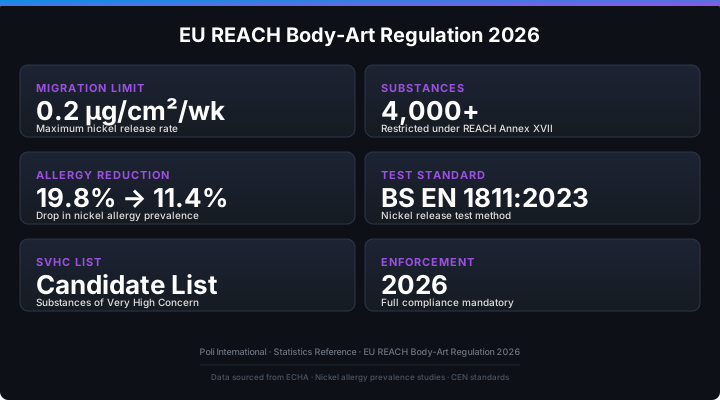
the REACH nickel-migration limit for post assemblies inserted into pierced body parts during the healing period. This is the strictest nickel limit in the regulation.
Jewellery metal-content rules (Business Companion) ↗the general nickel-release limit for any other article in direct and prolonged contact with the skin, such as worn-in jewellery, watch cases and fasteners.
Jewellery metal-content rules (Business Companion) ↗the date the original Nickel Directive was carried over into REACH Annex XVII as Entry 27, making nickel release an EU-wide chemical restriction.
Jewellery metal-content rules (Business Companion) ↗the reference test method for nickel release. Compliance is assessed over a simulated two-year wear period, not a single snapshot, so corrosion over time is captured.
Jewellery metal-content rules (Business Companion) ↗the fall in nickel-allergy prevalence among women aged 18 to 35 after nickel-release limits took effect. Direct evidence that the regulation works.
Ahlström et al., nickel allergy review (PubMed) ↗Tattoo inks and permanent make-up (Annex XVII, Entry 75)
The EU rewrote the chemistry of tattooing in 2022. Entry 75 is the most far-reaching restriction ever applied to body-art consumables.
the date Regulation (EU) 2020/2081 was published, adding Entry 75 to REACH Annex XVII and setting the rules for substances in tattoo inks and permanent make-up.
Amendment of Annex XVII, tattoo inks (TÜV Rheinland) ↗the date Entry 75 took effect across the EU and EEA, restricting hazardous substances in any ink placed in the skin.
Tattoo inks, ECHA hot topics ↗the number of substances restricted under Entry 75, including carcinogens, mutagens, reproductive toxicants, skin sensitisers and irritants, each with a strict concentration limit.
New Entry 75 of Annex XVII (BACL) ↗the date the one-year transition ended for two of the most-used pigments, Pigment Blue 15:3 and Pigment Green 7, removing them from compliant inks.
Banned pigments in EU tattoo inks (Chemistry World) ↗the estimated reduction in commercially available ink colours caused by the pigment restrictions, the largest disruption to the tattoo-supply chain on record.
Banned pigments in EU tattoo inks (Chemistry World) ↗Lead and cadmium in jewellery
Beyond nickel, two heavy metals carry their own REACH restrictions for jewellery and metal articles in skin contact.
the cadmium content limit for jewellery and metal beads under REACH Annex XVII, Entry 23. Cadmium is a known carcinogen and was historically used as a brightener and stabiliser.
Jewellery metal-content rules (Business Companion) ↗the lead content limit for jewellery articles and parts under REACH Annex XVII, Entry 63, protecting against a neurotoxic metal still found in cheap cast alloys.
Jewellery metal-content rules (Business Companion) ↗these limits apply to each individual part of an item, not an average across the piece, so a single non-compliant clasp or post fails the whole product.
Jewellery metal-content rules (Business Companion) ↗Substances of Very High Concern (SVHC)
The REACH Candidate List is the EU early-warning system for the most hazardous chemicals. It is the framework body-art material makers are measured against.
substances on the REACH SVHC Candidate List as of the November 2025 update, the list that flags chemicals as carcinogenic, mutagenic, reprotoxic, persistent or endocrine-disrupting.
ECHA Candidate List ↗the weight threshold above which an SVHC in an article triggers REACH communication duties and an entry in the EU SCIP database, so buyers and recyclers can be informed.
Candidate List obligations (ECHA) ↗the list is typically updated two to three times a year and only ever grows, so material compliance is a moving target that has to be re-checked, not certified once.
ECHA Candidate List ↗Track changes live
Regulation moves. We run a free REACH Monitor that tracks every update to the ECHA SVHC Candidate List and publishes a dated record, so you always know what changed and when. Read the latest entries in the REACH Monitor updates feed.
Cite this page
These figures are free to reference in articles, presentations and research with attribution. Suggested citation:
Poli International. “EU REACH Body-Art Regulation Statistics (June 2026).” Poli International.
https://poliinternational.com/reach-body-art-regulation-statistics/
Released under CC BY 4.0. See our full data methodology for how every figure is sourced, verified and licensed. For interviews, data requests or regulatory commentary, contact info@poliinternational.com.
Frequently asked questions
What is the EU REACH nickel limit for piercings?
For post assemblies inserted into pierced body parts the nickel-migration limit is 0.2 micrograms per square centimetre per week. For other items in prolonged skin contact the limit is 0.5 µg/cm²/week. Compliance is verified over a simulated two-year wear period using the BS EN 1811 test method.
What does REACH Entry 75 ban in tattoo inks?
Entry 75 of REACH Annex XVII restricts more than 4,000 hazardous substances in tattoo inks and permanent make-up, including carcinogens, mutagens, reproductive toxicants and skin sensitisers, each with a strict concentration limit. It took effect on 4 January 2022, with a further one-year transition for the pigments Blue 15:3 and Green 7 that ended on 4 January 2023.
What is the SVHC Candidate List?
The Candidate List of Substances of Very High Concern is the European Chemicals Agency register of chemicals identified as carcinogenic, mutagenic, reprotoxic, persistent, bioaccumulative or endocrine-disrupting. As of the November 2025 update it held 251 substances. When an article contains a listed substance above 0.1 percent by weight, the supplier has legal duties to communicate that and to notify the EU SCIP database.
Can I cite or reproduce these regulation figures?
Yes. Every figure links to its primary source, whether an ECHA page, an EU regulation or a peer-reviewed study. You are free to quote any statistic with attribution to Poli International and a link to this page. We track regulatory changes through our REACH Monitor, so the figures stay current.