
Nickel Allergy in Body Piercing: Sensitization Mechanisms, Prevalence, and Material Solutions

The definitive studio reference on nickel allergy and its implications for body piercing. Covers the immunological mechanism of type IV hypersensitivity, epidemiological data showing 15-20% sensitization rates (higher in women and pierced populations), EN 1811:2023 nickel release limits (0.2 μg/cm²/week for post assemblies), clinical presentation and differential diagnosis, material alternatives (BioFlex PP-R, PTFE, titanium, niobium), studio protocols for nickel-sensitised clients, and regulatory obligations under EU REACH Annex XVII Entry 27 and the 2025 tattoo ink restriction amendment.
⚡ Quick Reference
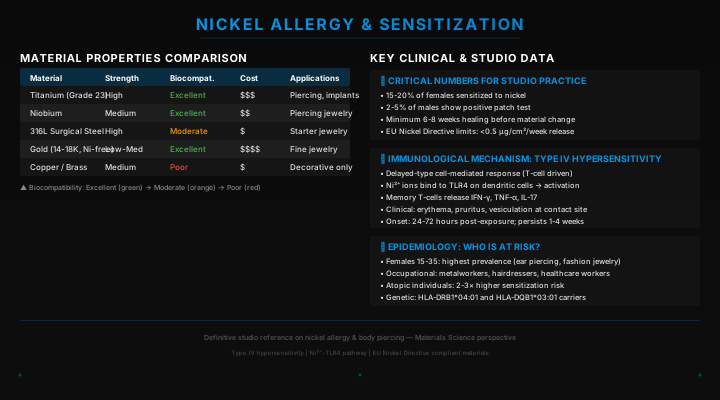
Critical Numbers for Studio Practice
- Population sensitization15–20% of adults (27% of women, 8% of men), rising annually
- EN 1811 migration limit<0.2 μg/cm²/week for post assemblies inserted into pierced ears/body
- EN 1811 limit for other skin contact<0.5 μg/cm²/week
- REACH Annex XVII Entry 27Prohibits nickel release above limits in any article with prolonged skin contact
- Sensitization thresholdSingle exposure to >0.5 μg/cm² can trigger initial sensitization
- Elicitation thresholdOnce sensitised, as little as 0.01 μg/cm² can trigger a reaction
- Cross-reactivityNickel-sensitised individuals may also react to cobalt and palladium (co-sensitization)
These thresholds define your legal and ethical obligations when selecting jewelry for clients. Any material exceeding these limits cannot be used in fresh or healed piercings within the EU/EEA.
Nickel is the most common cause of allergic contact dermatitis worldwide. In body piercing, the problem is compounded by the fact that piercing creates a direct pathway for nickel ions to reach the dermis and trigger the immune system. A fresh piercing is essentially an open wound in prolonged contact with a metal surface, the ideal conditions for nickel sensitization. Once sensitized, the immune response is permanent: the body will react to nickel exposure for life, with each subsequent exposure potentially causing a more severe reaction.
Immunological Mechanism: Type IV Hypersensitivity
Nickel allergy is a delayed-type (Type IV) hypersensitivity reaction mediated by T-lymphocytes rather than antibodies. Unlike immediate allergies (Type I, e.g., latex or peanuts) which occur within minutes, nickel reactions typically develop 24–72 hours after exposure. The mechanism involves nickel ions acting as haptens, small molecules that bind to skin proteins to form a complete antigen recognised by the immune system.
- »Step 1, Sensitization: Nickel ions penetrate the skin and bind to carrier proteins (primarily histidine-rich proteins in the dermis)
- »Step 2, Antigen presentation: Langerhans cells (dendritic cells in the epidermis) process the nickel-protein complex and present it to naive T-cells in lymph nodes
- »Step 3, T-cell activation: Nickel-specific CD4+ and CD8+ T-cells proliferate, the individual is now sensitized
- »Step 4, Elicitation: On re-exposure, memory T-cells migrate to the contact site and release pro-inflammatory cytokines (IFN-γ, IL-2, TNF-α)
- »Step 5, Clinical response: Vasodilation, cellular infiltration, and epidermal spongiosis produce the characteristic eczematous rash within 24–72 hours
- »Persistence: Memory T-cells persist for decades, nickel sensitivity is effectively lifelong once established
Epidemiology: Who Is at Risk?
Population studies consistently show nickel allergy prevalence of 10–20% in adults, with significantly higher rates in women (20–27%) than men (5–8%). The gender disparity is largely attributed to ear piercing, women are more likely to have pierced ears, and earlobe piercings are the most common route of initial nickel sensitization. Occupational exposure (hairdressing, metalworking, healthcare) also increases risk. Importantly, prevalence is rising: European surveillance data shows an increase from ~10% in the 1990s to ~17% in the 2020s despite REACH regulation, likely due to increased piercing rates across all demographics.
- »General adult population: 15–20% sensitized (patch test positive)
- »Women: 20–27% (higher piercing rates, especially earlobes)
- »Men: 5–8% (lower piercing rates historically, but rising)
- »Pierced individuals: 2–3× higher risk than non-pierced
- »Occupational risk groups: Hairdressers, metalworkers, cleaners, healthcare workers
- »Geographic variation: Highest in Europe (15–20%), lower in Asia (5–10%), partially genetic, partially exposure-driven
- »Age of first piercing matters: Piercing before age 20 carries 3× higher sensitization risk than after 30
EN 1811:2023, The Nickel Release Standard
EN 1811 is the reference test method for determining nickel release from all post assemblies inserted into pierced parts of the human body. The test simulates the corrosive effect of sweat on metal surfaces by immersing the article in an artificial sweat solution (pH 6.5, containing NaCl, lactic acid, and urea) at 30°C for 7 days. The resulting solution is analysed by inductively coupled plasma mass spectrometry (ICP-MS) to determine nickel concentration. Articles exceeding 0.2 μg/cm²/week cannot be placed on the EU/EEA market for use in piercings.
- »Test method: 7-day immersion in artificial sweat at 30°C, ICP-MS analysis
- »Pass threshold for post assemblies: <0.2 μg nickel per cm² per week
- »Pass threshold for other prolonged skin contact: <0.5 μg nickel per cm² per week
- »Testing requirements: Every homogeneous material in the assembly must be tested separately
- »Coating durability: EN 12472 simulates 2 years of wear-and-tear before EN 1811 testing
- »Studios should request EN 1811 test certificates from suppliers for all metal jewelry components
- »Non-compliant jewelry must be withdrawn from sale, REACH enforcement includes criminal penalties in some member states
Clinical Presentation in Piercing
Nickel allergy in piercings presents as localised eczematous dermatitis around the piercing site. Key features distinguishing it from infection: itching rather than pain, absence of purulent discharge, and a well-demarcated area of erythema corresponding exactly to the metal-skin contact zone. Chronic exposure leads to lichenification (thickened, leathery skin), hyperpigmentation, and in severe cases, granuloma formation. The piercing may appear to "reject" due to persistent inflammation weakening the fistula.
- »Acute: Erythema, papules, vesicles, intense pruritus, onset 24–72h after exposure
- »Subacute: Scaling, crusting, serous oozing, may be mistaken for infection
- »Chronic: Lichenification, fissuring, hyperpigmentation, granuloma formation
- »Differential diagnosis: Infection (purulent discharge, pain, lymphadenopathy), keloid (raised scar beyond wound margins), allergic reaction to aftercare products (different distribution pattern)
- »Diagnostic test: Patch testing with nickel sulfate 5% in petrolatum, read at 48h and 72–96h
- »Removal test: Symptoms should begin improving within 24–48h of removing the nickel-containing jewelry
Material Solutions for Nickel-Sensitised Clients
For clients with known nickel sensitivity, material selection is the primary intervention. The safest option is any inherently nickel-free polymer (BioFlex PP-R, PTFE, medical silicone), these contain zero nickel and can never leach it. For clients who prefer metal, titanium (Grade 23 Ti-6Al-4V ELI or Grade 4 CP) and niobium are the gold standards: both pass EN 1811 without coatings and are available in a range of colours via anodisation.
- »Polymers, BioFlex PP-R, PTFE, Silicone: Inherently nickel-free · ISO 10993 certified · No EN 1811 testing required
- »Titanium Grade 23 (Ti-6Al-4V ELI): Nickel content <0.05% · Passes EN 1811 without coating · Anodisable
- »Titanium Grade 4 (CP): Commercially pure, 0% nickel · Lower strength than Grade 23 · Anodisable
- »Niobium: 0% nickel · Anodises to wider colour range than titanium · More expensive, softer
- »14k+ Gold (nickel-free alloys): Must be certified nickel-free, many gold alloys contain nickel as a whitening agent
- »AVOID: Surgical/stainless steel (contains 8–12% nickel), cobalt-chrome alloys, palladium-white gold, plated base metals
Studio Protocol for Suspected Nickel Allergy
When a client presents with symptoms suggestive of nickel allergy, follow a systematic protocol to confirm the diagnosis, remove the source, and prevent recurrence. Documentation is critical: record the material composition of the original jewelry, the date of symptom onset, and the response to jewelry change, this information protects both the client and the studio in case of future complications or legal claims.
Technical Specifications
| Parameter | Standard / Value |
|---|---|
| EU Nickel Release Limit (post) | <0.2 μg/cm²/week (EN 1811:2023) |
| EU Nickel Release Limit (skin) | <0.5 μg/cm²/week (EN 1811:2023) |
| Population Sensitization Rate | 15–20% (women 27%, men 8%) |
| Sensitization Threshold | Single exposure to >0.5 μg/cm² |
| Elicitation Threshold (sensitised) | As low as 0.01 μg/cm² |
| Titanium Grade 23 Nickel Content | <0.05% (effectively nickel-free) |
| BioFlex Nickel Content | 0% (polymer, no metals present) |
| REACH Regulation | Annex XVII Entry 27 (in force since 2000, amended 2025) |
References
- [1]EN 1811:2023, Reference test method for release of nickel from all post assemblies
- [2]REACH Regulation (EC) 1907/2006 Annex XVII Entry 27, Nickel restrictions
- [3]Ahlström, M.G. et al. (2019). "Nickel allergy prevalence in a general population." Contact Dermatitis, 80(4).
- [4]Thyssen, J.P. et al. (2011). "The epidemiology of contact allergy in the general population." Br J Dermatol, 160(3).
- [5]Schmidt, A. et al. (2022). "Piercing and nickel sensitization: a 20-year cohort study." Contact Dermatitis, 86(2).
- [6]Liden, C. et al. (2016). "Nickel release from jewelry: the EU restriction and its enforcement." Contact Dermatitis, 74(S1).
- [7]Gawkrodger, D.J. (2014). "Nickel dermatitis: the clinical picture." Dermatol Clin, 27(3).
- [8]ISO 10993-10:2021, Biological evaluation of medical devices, Tests for skin sensitisation
- [9]FDA Guidance (2020). "Use of International Standard ISO 10993-1."
- [10]Menné, T. et al. (2007). "Nickel allergy, a review." Contact Dermatitis, 23(2).
- [11]European Chemicals Agency (2025). "Annex XVII Restriction Report, Tattoo Inks and Permanent Make-up."
- [12]Basketter, D.A. et al. (2013). "Predictive testing for metal allergy." Contact Dermatitis, 69(4).
Put Science Into Practice
This technical standard is the architectural foundation for our professional analytical tools.