
REACH Compliance for Body Art Studios

The complete studio reference for EU REACH compliance, covering the SVHC Candidate List, Annex XIV Authorisation, Annex XVII Restrictions (including the 2022 tattoo-ink rules), Article 33 communication duties, the SCIP database, and how the regulation interacts with body jewelry, pigments, polymers, and aftercare.
⚡ Quick Reference
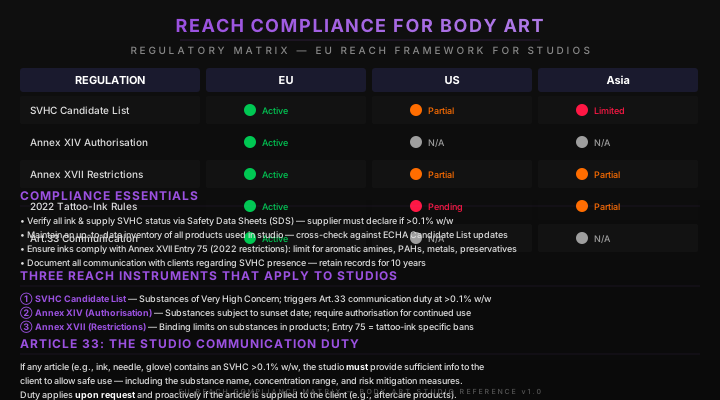
Compliance Essentials
- SVHC threshold0.1% w/w in any article
- Article 33 consumer response45 days maximum
- SCIP notificationmandatory from 5 Jan 2021
- Candidate List update cycle~6 months (Jan & Jun)
- Tattoo ink restrictionAnnex XVII Entry 75 (in force 4 Jan 2022)
- Nickel release limit (skin-contact jewelry)0.5 µg/cm²/week
- Nickel piercing post-assemblies0.2 µg/cm²/week
- AuthorityECHA (echa.europa.eu)
These are the load-bearing numbers and thresholds that decide whether a studio is REACH-compliant.
REACH, EU Regulation (EC) No 1907/2006 on the Registration, Evaluation, Authorisation and Restriction of Chemicals, is the umbrella law that governs every chemical placed on the EU market. For body art studios it is not optional background knowledge: REACH dictates which pigments may be tattooed, which metals may pierce, which plasticisers may be in disposable jewelry, and what a studio must tell a client who asks the right question. Tattoo and piercing studios are downstream users of chemical articles, and downstream users carry real legal duties under REACH, most of them flowing from a list that is updated twice a year by the European Chemicals Agency (ECHA).
This page is the studio-side technical reference: what the different REACH instruments are, how they interact, where the legal tripwires sit, and what to put in a compliance file. It is the regulatory companion to the live monitoring service at the REACH Monitor.
The Three REACH Instruments That Apply to Studios
REACH is often discussed as a single thing, but in practice three distinct mechanisms govern the substances a studio handles. They are easy to confuse, and confusing them is the single most common audit failure.
- »Candidate List (SVHC list): A public list of Substances of Very High Concern. Inclusion on this list triggers immediate communication duties (Article 33) and SCIP notification, but does NOT yet restrict the substance. Roughly 240 substances as of 2026, updated every six months.
- »Annex XIV (Authorisation List): Substances moved from the Candidate List into Annex XIV because ECHA has prioritised them for phase-out. After the listed "sunset date," the substance may not be placed on the EU market without an explicit Authorisation granted to the named user.
- »Annex XVII (Restriction List): Specific prohibitions on substances or use cases, for example Entry 27 (nickel release in skin-contact items), Entry 63 (lead in consumer articles), and Entry 75 (chemical limits in tattoo inks and permanent make-up). These are direct, enforceable bans that apply regardless of the substance's Candidate List status.
Article 33: The Studio Communication Duty
Article 33 is the section of REACH that turns the SVHC list into a studio-level obligation. If a studio supplies an article (a jewelry piece, a single-use disposable, a packaged aftercare product) that contains a Candidate List substance above 0.1% by weight, the studio must, without being asked, pass that information to the next professional recipient down the chain, and must respond to any consumer enquiry within 45 days. The threshold applies per article, not per total product, following the 2015 ECJ ruling in case C-106/14 ("once an article, always an article").
- »Trigger: SVHC present > 0.1% w/w in any individual article supplied by the studio.
- »Recipient (B2B): Information must be provided automatically, typically by Safety Data Sheet annex, supplier declaration, or product passport.
- »Recipient (consumer): Information must be provided on request, free of charge, within 45 days.
- »Minimum content: name of the SVHC, and sufficient information to allow safe use of the article.
- »Record-keeping: There is no fixed retention period in REACH itself, but most EU enforcement authorities expect a studio to be able to demonstrate due-diligence monitoring of the Candidate List from the date each article was supplied.
The SCIP Database: Article Notification Since 2021
SCIP (Substances of Concern In articles, as such or in complex objects, Products) is the ECHA database where suppliers of articles containing SVHCs above 0.1% w/w must notify the article and its substance content. The obligation has been in force since 5 January 2021 and flows from the Waste Framework Directive rather than REACH itself, but the trigger threshold is identical to Article 33. Most studios will not directly notify SCIP, that duty sits with the manufacturer or first EU importer, but a studio importing jewelry from a non-EU supplier should confirm in writing that SCIP notification has been completed.
Annex XVII Entry 75: The Tattoo Ink Restriction
Commission Regulation (EU) 2020/2081, which entered into force on 4 January 2022, added Entry 75 to Annex XVII of REACH. It is the most consequential single REACH action ever taken against the tattoo and PMU sector, and every ink in current use in the EU must comply with it.
- 1Scope: any mixture used in tattooing or permanent make-up, including pigments, inks, and ancillary preparations.
- 2Prohibited substances above the listed concentration limits: CMR substances, skin sensitisers, skin irritants, eye irritants, corrosives, and substances classified for specific organ toxicity.
- 3Banned aromatic amines from azo cleavage above 5 mg/kg (e.g. o-toluidine, p-chloroaniline, 2,4-toluenediamine).
- 4Banned polycyclic aromatic hydrocarbons (PAH) above 0.5 mg/kg total / 0.005 mg/kg benzo[a]pyrene.
- 5Banned specific colourants from 4 January 2023 (the second wave): Pigment Blue 15:3 and Pigment Green 7, which were the dominant blue/green pigments in EU tattoo ink before this rule.
- 6Labelling: every compliant ink must state "Mixture for use in tattoos or permanent make-up" and disclose its hazardous-ingredient inventory.
Annex XVII Entry 27: The Nickel Restriction for Jewelry
Entry 27 of Annex XVII has governed nickel release from skin-contact articles since 1994 and is the longest-running REACH restriction relevant to body art. It is misunderstood almost universally as a "nickel ban", it is not. It sets a maximum nickel release rate, measured by the EN 1811 dermatological test method, that the article surface may produce during prolonged skin contact.
- »General skin-contact items (earrings, necklaces, rings): 0.5 µg/cm²/week (EN 1811).
- »Items intended for insertion into pierced parts of the human body during epithelization: 0.2 µg/cm²/week.
- »Coated items: the coating must be sufficient to keep release below the limit for a minimum of two years of normal use.
- »BioFlex® position: as a polymer (PP-R random copolymer), BioFlex® contains no nickel, Entry 27 is structurally inapplicable, and the absence is documented in the compliance file rather than tested by EN 1811.
Patrick's Note
"Body art studios are not chemical manufacturers, but REACH treats them as the last link in the chain, which means they are the link that gets enforced. I have spent twenty-five years certifying body-jewelry materials in this regulation. The two failures I see most often are simple: studios that cannot tell an inspector when they last checked the SVHC list, and studios that confuse the Candidate List with Annex XVII and assume "it's not on the restriction list, so it's fine." It is not fine. The Candidate List triggers communication duties from the day a substance lands on it. That is why we built the REACH Monitor as a free service, the system that keeps the BioFlex® compliance file current, opened up to every studio that has to answer the same questions we do."
Founder & Piercing Expert
Poli International
Common Compliance Failures
These are the audit findings that show up repeatedly when a body-art studio is reviewed under REACH.
- ✕No monitoring record, Studio cannot show that the SVHC Candidate List has been checked since the products in stock were supplied.
- ✕Stale SDS, Safety Data Sheets in the file are older than the most recent Candidate List update.
- ✕Candidate vs Restriction confusion, Studio assumes a Candidate List substance is permitted because it is not in Annex XVII.
- ✕Article 33 silence, Studio has never responded to (or never received) a consumer enquiry and has no template ready.
- ✕Tattoo ink without Entry 75 statement, Ink in use does not bear the mandatory "Mixture for use in tattoos or permanent make-up" label or its ingredient inventory.
- ✕Imported jewelry without SCIP confirmation, Non-EU supplier has not confirmed SCIP notification in writing.
How REACH Sits Alongside Other Body-Art Regulations
REACH is the chemical framework, but it does not stand alone. Studios operating in the EU also live under the EU Cosmetics Regulation, the Medical Device Regulation, the Biocidal Products Regulation, and national-level public-health rules. The simplified comparison below shows where each framework sits.
- Substances and articles
- Candidate List + Annex XIV + Annex XVII
- Tattoo inks: Annex XVII Entry 75
- Body jewelry: Annex XVII Entry 27 (nickel)
- Enforcement: national chemicals inspectorate
- Aftercare products, numbing creams
- Annex II prohibited list
- Annex III restricted list
- CPNP product notification before market
- Responsible Person required
- Sterile invasive devices
- Single-use needles, cannulae
- CE mark required (Class IIa/IIb)
- Notified Body audit for non-self-certified classes
- EUDAMED registration
Studio Consumables Checklist, What Actually Falls Under SVHC
The SVHC Candidate List is substance-level, not product-category-level. That means every chemical a studio touches is potentially in scope, not just the jewelry that goes through skin. The most-missed categories below are where SVHCs typically hide in a working studio, and each one belongs in the materials inventory.
- 1Jewelry metals, implant-grade titanium, stainless 316LVM, niobium, gold alloys. SVHC risk: cobalt, nickel impurities, surface-treatment residues.
- 2Jewelry polymers, BioFlex® (PP-R), PTFE, TPE/TPU look-alikes, silicone, acrylic. SVHC risk: plasticisers (DEHP, DBP), antioxidants, residual monomers.
- 3Tattoo and PMU pigments, every ink in current use. SVHC risk: aromatic amines from azo cleavage, PAHs, heavy-metal impurities (already restricted under Entry 75, but Candidate List additions still flow through).
- 4Surface disinfectants and instrument cleaners, quaternary ammonium products, aldehyde-based sterilants, alcohol blends with surfactants. SVHC risk: glutaraldehyde (CAS 111-30-8), formaldehyde (50-00-0), 2-butoxyethanol/EGBE (111-76-2). Also regulated under the EU Biocidal Products Regulation 528/2012 in parallel.
- 5Sterile gauze, wipes, plasters, dressings, packaging, single-use consumables that touch the wound. SVHC risk: DEHP and other phthalates in PVC packaging (CAS 117-81-7), bisphenol A in adhesive cure (80-05-7), acrylate monomers in plaster adhesives (e.g. 2-ethylhexyl acrylate 103-11-7).
- 6Topical and aftercare creams, anaesthetic gels, lubricants, anything applied to skin around the procedure. SVHC risk: preservatives (MIT/MCI), parabens, fragrance allergens (e.g. Lilial, banned cosmetic ingredient with SVHC history). Also regulated under EU Cosmetics Regulation 1223/2009 with its own Annex II/III prohibited lists.
Building a Studio REACH File
A defensible REACH file does not need to be elaborate, but it must be complete and current. The structure below is what a competent inspector will look for, and what we use for the BioFlex® file.
- 1Materials inventory, every metal alloy, polymer grade, pigment, ink, biocide, and aftercare product currently in use, with supplier and batch reference.
- 2SDS / declaration set, current Safety Data Sheet or supplier declaration for each material, dated within the last 12 months.
- 3SVHC monitoring log, record of each Candidate List check (date, list version, outcome), the REACH Monitor email archive satisfies this.
- 4Annex XVII evidence, for nickel-bearing alloys, EN 1811 test report; for tattoo inks, Entry 75 labelling and ingredient inventory.
- 5Article 33 response template, a pre-prepared paragraph the studio will send when a client requests SVHC disclosure.
- 6Supplier audit notes, any written confirmation that non-EU suppliers have completed SCIP notification.
Beyond the EU: UK REACH and Adjacent Regimes
Studios operating across borders should be aware that EU REACH is not the only chemicals regime they meet. UK REACH, in force since 1 January 2021, mirrors the EU framework but maintains a separate Candidate List managed by the UK Health and Safety Executive (HSE), divergence has remained modest so far but is expected to widen. Switzerland operates under bilateral arrangements that largely mirror EU REACH. Norway, Iceland, and Liechtenstein apply EU REACH directly via the EEA Agreement. Outside Europe, broadly analogous regimes include TSCA in the United States (recently modernised in 2016), K-REACH in South Korea, and Taiwan TCCSCA, each with its own list and threshold structure.
Technical Specifications
| Parameter | Standard / Value |
|---|---|
| Regulation | EC 1907/2006 (REACH) |
| Authority | European Chemicals Agency (ECHA) |
| SVHC Threshold | 0.1% w/w |
| Article 33 Response | 45 days max |
| SCIP Trigger Date | 5 January 2021 |
| Annex XVII Entry 75 | Tattoo inks, in force 4 Jan 2022 |
| Annex XVII Entry 27 | Nickel release, 0.5 / 0.2 µg/cm²/week |
| Candidate List Updates | ~6 months (Jan & Jun) |
| Test Method (Nickel) | EN 1811 |
| BioFlex® Position | No SVHC > 1 ppm; nickel-free by construction |
References
- [1]Regulation (EC) No 1907/2006 (REACH). Consolidated texthttps://eur-lex.europa.eu/eli/reg/2006/1907/oj
- [2]ECHA Candidate List of SVHCshttps://echa.europa.eu/candidate-list-table
- [3]Commission Regulation (EU) 2020/2081, Annex XVII Entry 75 (tattoo inks)https://eur-lex.europa.eu/eli/reg/2020/2081/oj
- [4]Commission Regulation (EC) 552/2009, Annex XVII Entry 27 (nickel restriction).
- [5]ECHA SCIP databasehttps://echa.europa.eu/scip-database
- [6]ECJ Judgment C-106/14 (2015), Article 33 "once an article, always an article".
- [7]EN 1811:2011+A1:2015, Reference test method for nickel release.
- [8]UK HSE, UK REACH SVHC Candidate Listhttps://www.hse.gov.uk/reach/candidate-list.htm
- [9]Waste Framework Directive 2008/98/EC, Art. 9(1)(i), basis for SCIP.
- [10]Poli International (2026). REACH Monitor servicehttps://poliinternational.com/reach-monitor/
Put Science Into Practice
This technical standard is the architectural foundation for our professional analytical tools.
Compliance Suite
Need documented proof your materials comply?
REACH Guard PRO analyzes supplier safety data sheets against six regulation datasets (EU 2020/2081, EU + UK SVHC, CLP CMR, BPR Article 95, nickel-release) and issues a verifiable compliance certificate. From €9.50 per check.
Certify your products →