
Polymer Science: BioFlex, PTFE, and Biocompatible Materials for Body Jewelry

The definitive guide to polymer science for body piercing and implant-grade jewelry. Covers polypropylene random copolymer (BioFlex), polytetrafluoroethylene (PTFE), medical-grade silicone, and emerging biopolymers (PHA, PLA). Includes ISO 10993 testing requirements, mechanical property comparisons, sterilization compatibility, nickel-free certification, and clinical evidence for flexible jewelry in initial piercings, MRI safety, and long-term wear.
⚡ Quick Reference
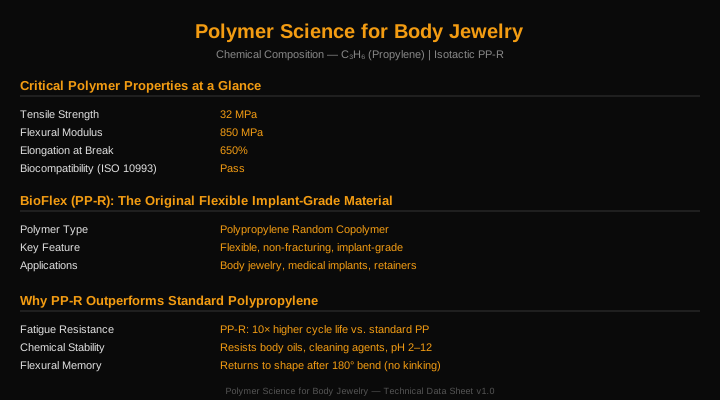
Critical Polymer Properties at a Glance
- BioFlex (PP-R)Flexural modulus ~1,200 MPa · ISO 10993-6/-10 certified · Autoclavable at 134°C
- PTFEFlexural modulus ~500 MPa · USP Class VI · Max service temp 260°C · Cannot be autoclaved (creep)
- Medical SiliconeShore A 30–70 · ISO 10993 certified · Autoclavable · Tear strength 25–45 kN/m
- PHA (Emerging)Biodegradable · Flexural modulus 1,000–3,500 MPa · ISO 10993 pending · Not yet USP Class VI certified
- Nickel-free certificationAll polymers are inherently nickel-free, critical for sensitised clients
- MRI SafetyAll polymers are MR Conditional (non-ferromagnetic), safe at all field strengths
These are the key differentiating factors between polymer types used in body jewelry. Selection must consider the specific anatomical site, wear duration, and sterilization method.
Polymers have transformed body jewelry from a purely metallic discipline into a materials science field. The key advantage of polymers over metals is their ability to flex with tissue movement rather than resisting it, this reduces mechanical stress at the piercing site, lowers the risk of migration and rejection, and allows for jewelry designs that would be impossible in rigid materials. However, not all polymers are equal: biocompatibility varies dramatically between polymer families, and the wrong choice can lead to chemical leaching, bacterial colonisation, or mechanical failure.
BioFlex (PP-R): The Original Flexible Implant-Grade Material
BioFlex is a polypropylene random copolymer (PP-R) specifically developed for body jewelry applications. Unlike standard polypropylene homopolymer, the random copolymerisation with ethylene produces a material with significantly improved impact resistance, flexibility, and long-term dimensional stability. BioFlex is certified to ISO 10993-6 (tests for local effects after implantation) and ISO 10993-10 (tests for skin sensitisation), and is built on a USP Class VI resin (the most rigorous USP plastics biocompatibility class).
- »Chemical structure: -(CH₂-CHCH₃)ₙ- with random ethylene co-monomer insertion (~2–5%)
- »Crystallinity: 40–55% (semi-crystalline), provides balance of strength and flexibility
- »Glass transition temperature (Tg): ~0°C, material is above Tg at body temperature, providing flexibility
- »Melting point (Tm): 145–155°C, well above autoclave temperatures, ensuring dimensional stability during sterilisation
- »Density: 0.90 g/cm³, significantly lighter than titanium (4.5 g/cm³) or steel (8.0 g/cm³)
- »Water absorption: <0.03% after 24h immersion, negligible swelling in tissue fluid
- »Leachables testing: No detectable nickel, chromium, cobalt, or cadmium, passes EN 1811:2023
Why PP-R Outperforms Standard Polypropylene
Standard polypropylene homopolymer becomes brittle at low temperatures and has poor impact resistance. The random copolymer structure of PP-R introduces ethylene units that disrupt crystallinity, creating a tougher, more flexible material without sacrificing the chemical inertness that makes polypropylene biocompatible. This is critical for body jewelry applications where the material must withstand repeated flexural loading without fatigue cracking.
PTFE (Teflon): Maximum Chemical Inertness
Polytetrafluoroethylene is the most chemically inert polymer available for body jewelry. Its fully fluorinated carbon backbone creates an extremely low surface energy (18–20 mN/m), making it highly resistant to biofilm adhesion. PTFE is widely used for initial piercings in nickel-sensitised patients and for jewelry components that contact mucosal tissue. However, its mechanical properties differ significantly from PP-R: PTFE exhibits cold flow (creep) under sustained load, meaning threaded connections can loosen over time.
- »Chemical structure: -(CF₂-CF₂)ₙ-, fully fluorinated, no hydrogen atoms available for oxidative degradation
- »Coefficient of friction: 0.05–0.10, lowest of any solid material, reducing insertion trauma
- »Service temperature: -200°C to +260°C, far exceeds any sterilisation requirement
- »Limitation: Cannot be autoclaved under load, PTFE creeps above 100°C; use EtO or gas plasma sterilisation
- »USP Class VI certified, the highest level of biocompatibility testing for plastics
- »Surface energy: 18 mN/m, hydrophobic surface resists protein adsorption and biofilm formation
Medical-Grade Silicone: Flexibility Without Compromise
Medical-grade silicone elastomers (polydimethylsiloxane, PDMS) offer the highest flexibility of any body jewelry material. With elongation at break typically exceeding 300%, silicone can conform to anatomical contours that rigid materials cannot match. However, silicone's low tear strength means it is unsuitable for threaded designs, it is typically used for plugs, tunnels, and o-rings where compressive rather than tensile forces dominate.
- »Shore hardness: Typically Shore A 30–70 for body jewelry applications
- »Tensile strength: 7–10 MPa, significantly lower than PP-R (30–40 MPa)
- »Elongation at break: 300–700%, highest of any body jewelry polymer
- »Tear strength: 25–45 kN/m, the limiting factor; avoid sharp edges and threaded designs
- »Autoclavable: Can withstand repeated 134°C steam cycles without degradation
- »Peroxide-cured vs platinum-cured: Platinum-cured is preferred for implant applications, no peroxide byproducts
Emerging Biopolymers: PHA and PLA
Polyhydroxyalkanoates (PHA) and polylactic acid (PLA) represent the next generation of body jewelry materials. PHA is produced by bacterial fermentation and is fully biodegradable, a potential advantage for temporary implant applications where a second removal procedure is undesirable. PLA is already used in absorbable surgical sutures and orthopedic fixation devices. However, both materials face significant hurdles for body jewelry: their degradation rates are difficult to control, degradation byproducts can cause local pH changes, and long-term ISO 10993 data for dermal contact is still being accumulated.
- »PHA: Flexural modulus 1,000–3,500 MPa depending on co-monomer, tunable stiffness
- »PLA: Degrades via hydrolysis to lactic acid, already GRAS (Generally Recognised As Safe) by FDA
- »Degradation time: PHA 6–24 months · PLA 12–36 months, depends on molecular weight and crystallinity
- »Current limitation: No long-term (>5 year) implantation data for dermal applications
- »Regulatory status: Not yet USP Class VI certified for permanent implantation, limited to temporary use
Sterilisation Compatibility Matrix
Polymer selection must account for the sterilisation method used in the studio. Some polymers degrade under autoclave conditions, while others require specific cycle types. The table below summarises compatibility.
- 1BioFlex (PP-R): ✅ Autoclave B-cycle 134°C · ✅ EtO · ✅ Gas plasma · ❌ Gamma (causes embrittlement)
- 2PTFE: ❌ Autoclave (creep) · ✅ EtO · ✅ Gas plasma · ❌ Gamma (chain scission)
- 3Medical Silicone: ✅ Autoclave 134°C · ✅ EtO · ✅ Gas plasma · ⚠️ Gamma (crosslinking increases)
- 4PHA: ⚠️ Autoclave (may deform) · ✅ EtO · ✅ Gas plasma · ❌ Gamma
- 5PLA: ❌ Autoclave (hydrolyses) · ✅ EtO · ✅ Gas plasma · ❌ Gamma
Technical Specifications
| Parameter | Standard / Value |
|---|---|
| BioFlex ISO 10993 | Parts 6 (implantation) and 10 (sensitisation) certified |
| BioFlex Flexural Modulus | 1,200 MPa (ASTM D790) |
| BioFlex Melt Flow Index | 0.5–2.0 g/10min (230°C/2.16kg) |
| PTFE Coefficient of Friction | 0.05–0.10 (ASTM D1894) |
| PTFE USP Class | Class VI (highest biocompatibility rating) |
| Silicone Shore Hardness Range | 30A–70A (ASTM D2240) |
| Silicone Tear Strength | 25–45 kN/m (ASTM D624 Die B) |
| Nickel Release (all polymers) | <0.2 μg/cm²/week (EN 1811:2023 compliant) |
References
- [1]ISO 10993-6:2016, Biological evaluation of medical devices, Tests for local effects after implantation
- [2]ISO 10993-10:2021, Biological evaluation of medical devices, Tests for skin sensitisation
- [3]EN 1811:2023, Reference test method for release of nickel from all post assemblies
- [4]ASTM D790, Standard Test Methods for Flexural Properties of Unreinforced and Reinforced Plastics
- [5]USP Class VI, Biological Reactivity Tests, In Vivo
- [6]FDA 21 CFR 177.1520, Olefin polymers (PP-R food contact, basis for biocompatibility presumption)
- [7]McKeen, L.W. (2019). The Effect of Sterilization on Plastics and Elastomers. William Andrew.
- [8]Ratner, B.D. et al. (2020). Biomaterials Science: An Introduction to Materials in Medicine. Academic Press.
- [9]Kurtz, S.M. (2015). UHMWPE Biomaterials Handbook. William Andrew.
- [10]Nakamura, T. et al. (2022). "In vitro cytotoxicity of PP-R for long-term dermal contact." J Biomed Mater Res B.
- [11]Gorna, K. & Gogolewski, S. (2003). "Biodegradable polyurethanes for implants." J Biomed Mater Res A.
- [12]Vert, M. et al. (2012). "Terminology for biorelated polymers and applications (IUPAC Recommendations)." Pure Appl Chem.
Put Science Into Practice
This technical standard is the architectural foundation for our professional analytical tools.