
Piercing Complications Statistics
16 cited statistics on piercing complication rates, cartilage healing risk, oral and dental damage by material, and bloodborne complications. Every figure links to its primary source. Free to quote with attribution.
Most piercings heal cleanly, but the complication data is clear about what raises the risk: the site, the hygiene, and the material left inside the healing wound. This page gathers the infection rates, the cartilage and oral findings and the serious-complication evidence in one place for journalists, researchers, educators and studio professionals. Each statistic below is linked to the study, review or clinical reference it comes from, so you can verify and cite the original.
Reporting on piercing safety or aftercare? Jump to the citation block for a ready-to-use reference, or email info@poliinternational.com for expert comment from a body-art material specialist.
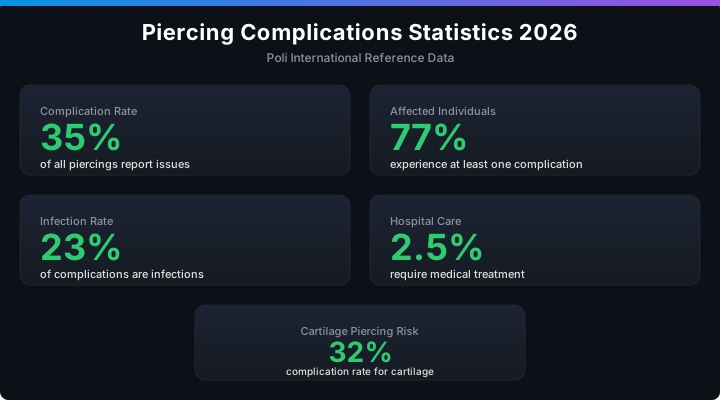
Overall complication and infection rates
Most piercings heal without serious incident, but minor complications are common, and the rate depends heavily on the site and the material left in the wound while it heals.
of people with pierced ears reported at least one complication in a clinical review, the headline figure for how common minor problems are.
AAFP, Complications of Body Piercing ↗of those complications were minor bacterial infections, with allergic reactions the next most common at 43%.
AAFP, Complications of Body Piercing ↗of piercings at sites other than the soft earlobe were reported to cause a medical complication, underlining that site choice drives risk.
StatPearls, Body Piercing Infections (NCBI) ↗each for keloid scarring and traumatic tearing of the piercing, the most common of the more serious local outcomes.
AAFP, Complications of Body Piercing ↗Cartilage piercings carry higher risk
Ear cartilage has a poor blood supply and heals slowly, so infections there are both more frequent and more serious than in the fleshy lobe.
total complication rate for cartilage piercings versus soft-tissue piercings in a study of 1,200 piercing sites among 552 nurses.
Simplot & Hoffman, Am J Otolaryngol (PubMed) ↗minor infection rate for cartilage versus soft-tissue piercings in the same cohort, the clearest signal of the cartilage healing penalty.
Simplot & Hoffman, Am J Otolaryngol (PubMed) ↗ear cartilage has little direct blood supply, so infections clear slowly and can progress to perichondritis and lasting deformity if untreated.
AAFP, Complications of Body Piercing ↗cartilage piercings are particularly associated with Pseudomonas infection, which is harder to treat and a leading cause of serious outcomes.
StatPearls, Body Piercing Infections (NCBI) ↗Oral and tongue piercings damage teeth and gums
A metal stud knocking against teeth and gums for years causes measurable, cumulative damage. The material matters: rigid metals do far more harm than soft polymers.
gingival recession with titanium jewellery versus flexible Teflon, with stainless steel at 23.5%, in a scoping review of oral piercing.
Malcangi et al., Oral Piercing review (PMC) ↗chipped teeth with stainless steel versus Teflon, with titanium at 35.7%. Flexible material consistently caused the least damage.
Malcangi et al., Oral Piercing review (PMC) ↗of people with tongue piercings showed at least one site of lingual gingival recession, which tends to appear after about two years of wear.
Plastargias & Sakellari, ISRN Dentistry (PMC) ↗of oral-piercing wearers experienced a complication, with one study reporting 63.3%. The review concluded flexible materials are the least harmful.
Malcangi et al., Oral Piercing review (PMC) ↗Serious and bloodborne complications
Rare but severe outcomes are the reason hygiene and material choice are not cosmetic concerns. A piercing is a wound, and any wound can become a route for serious infection.
pooled odds of hepatitis B transmission associated with body piercing, in a meta-analysis of 40 studies.
Yang et al., HBV/HCV transmission meta-analysis (PMC) ↗pooled odds of hepatitis C transmission associated with body piercing in the same meta-analysis, a measurable bloodborne risk.
Yang et al., HBV/HCV transmission meta-analysis (PMC) ↗piercing has been linked to infective endocarditis, especially in people with congenital heart conditions, among the most serious reported outcomes.
StatPearls, Body Piercing Infections (NCBI) ↗long healing periods and a retained foreign body multiply infection risk, which is why low-irritation, biocompatible jewellery matters most during healing.
StatPearls, Body Piercing Infections (NCBI) ↗Cite this page
These statistics are free to reference in articles, presentations and research with attribution. Suggested citation:
Poli International. “Piercing Complications Statistics (June 2026).” Poli International.
https://poliinternational.com/piercing-complications-statistics/
Released under CC BY 4.0. See our full data methodology for how every figure is sourced, verified and licensed. For interviews, data requests or material-safety commentary, contact info@poliinternational.com.
Frequently asked questions
How often do piercings get infected?
Minor problems are common and serious ones are rare. Clinical reviews report that around a third of people with pierced ears experience at least one complication, most often a minor bacterial infection. The rate rises sharply for sites other than the soft earlobe: roughly a quarter of non-lobe piercings were reported to cause a medical complication. Good aftercare and biocompatible jewellery lower the risk.
Are cartilage piercings riskier than earlobe piercings?
Yes. Ear cartilage has a poor blood supply, so it heals slowly and clears infection less effectively. In a study of 1,200 piercing sites, cartilage piercings had a higher overall complication rate (32% vs 29%) and a notably higher minor-infection rate (30% vs 21%) than soft-tissue piercings, and cartilage is particularly prone to Pseudomonas infection, which can progress to lasting deformity.
Can a tongue or lip piercing really damage teeth?
Yes, and the damage accumulates. A rigid metal stud repeatedly contacting teeth and gums causes chipped enamel and gum recession. A scoping review found gingival recession in 52.9% of titanium and 23.5% of steel wearers, versus 9% for flexible Teflon, and tongue-piercing studies show lingual gum recession appearing after about two years. Flexible, low-density materials consistently cause the least damage.
Can I cite or reproduce these statistics?
Yes. Every figure links to its primary source. You are free to quote any statistic with attribution to Poli International and a link to this page, under CC BY 4.0. We keep the dataset current so the citation stays accurate.