The Dental Bill Your Metal Jewelry Is Running Up Right Now
Key Takeaways:
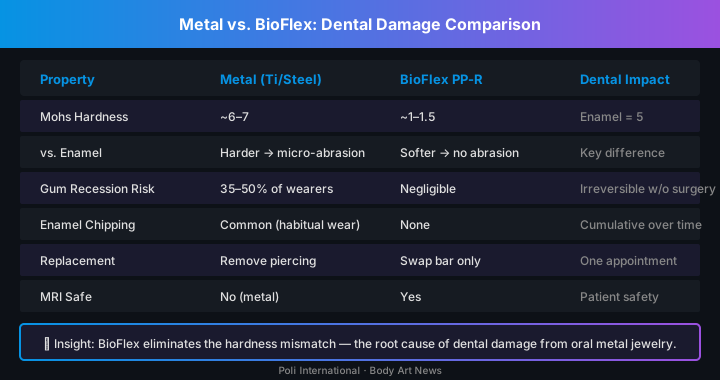
» Oral metal jewelry causes measurable enamel erosion and gum recession through a simple hardness mechanism, metal is harder than tooth enamel.
» BioFlex PP-R has a Mohs hardness of approximately 1–1.5 versus enamel at 5, contact between BioFlex and a tooth is not a micro-abrasion event.
» Switching an existing oral piercing to BioFlex does not require removing the piercing, it requires replacing the bar, which takes one appointment.
» Dentists see the damage but rarely know the cause. Piercers know the cause but rarely talk to dentists. BioFlex is the answer both should be recommending.
» Gum recession caused by metal labret discs pressing on gingival tissue is irreversible without surgical intervention, prevention is the only viable strategy.
1. What Happens to Your Teeth with a Metal Tongue Bar
The tongue bar is one of the most common oral piercings and one of the most consistent sources of preventable dental damage in long-term wearers. The mechanism is not mysterious.
A standard tongue bar is a straight or slightly curved barbell, 14–16 gauge, typically 16–19mm in length. The lower ball rests against the floor of the mouth, the tongue, or, most critically, against the lingual surface of the lower front teeth. Every contact between the titanium ball and the tooth surface is a harder material meeting a softer one. Every click, every unconscious movement of the tongue is a micro-abrasion event. Over months and years, the cumulative effect is measurable enamel loss on the lingual surfaces of the lower incisors.
Worse than enamel loss is gum recession. The lower ball of a tongue bar that rests habitually in the lingual gingival sulcus applies intermittent pressure against gum tissue and the alveolar bone beneath it. Gum recession is irreversible without surgical intervention. It creates sensitivity, increases cavity risk at the exposed root surface, and in advanced cases compromises the structural support of the tooth.
The same mechanism applies to labret posts, where the flat backing disc presses against the inner surface of the lip and the adjacent gum line, and to lip rings, where contact with the lower lip gum margin creates sustained localised pressure.
2. The Evidence: What the Numbers Show
The relationship between oral jewelry and dental damage has been documented in peer-reviewed dentistry literature for over two decades [1].
| Clinical Finding | Population | Source Type |
|---|---|---|
| Gum recession at lower incisors in 35–50% of long-term tongue bar wearers | Pierced adults, healed piercings | Clinical surveys, periodontal studies |
| Enamel chipping and cracking on lingual tooth surfaces | Habitual tongue bar wearers | Clinical case series |
| Gingival laceration from labret discs pressing on inner lip tissue | Labret wearers | Periodontal case reports |
| Alveolar bone loss in prolonged uninterrupted metal contact cases | Long-term lip piercing wearers | Radiographic case studies |
| Association between lip piercings and localised gingival recession | Prospective cohort | Periodontal journals |
The consistent recommendation in dental literature is removal of oral jewelry.
This is correct from a purely dental standpoint. But it ignores two realities: patients with established oral piercings are unlikely to remove them, and the specific damage mechanism, metal hardness, can be addressed without removal.
3. Why BioFlex Changes the Dental Equation
PP-R (polypropylene random copolymer) has a Mohs hardness of approximately 1 to 1.5. Tooth enamel is approximately 5. The relationship is inverted: BioFlex is significantly softer than enamel. Contact between a BioFlex ball end and a tooth surface is not a micro-abrasion event, it is contact where the jewelry is the softer party.
| Material | Mohs Hardness | vs. Enamel | MRI Safe | ISO 10993-6 |
|---|---|---|---|---|
| Implant Titanium (ASTM F136) | ~6 | Harder | Weak paramagnetic | No standard |
| Surgical Steel 316L | ~5.5 | Harder | Ferromagnetic | No standard |
| BioFlex PP-R | ~1–1.5 | Significantly softer | Yes | Yes |
| PTFE | ~1 | Significantly softer | Yes | No |
| Tooth Enamel (reference) | ~5 | , | , | , |
Beyond hardness, BioFlex is flexible. A rigid metal bar held between two fixed piercing points transmits force directly to any surface it contacts. A BioFlex bar flexes under load, when the tongue bar contacts the teeth during speech or swallowing, the bar absorbs part of that force rather than transmitting it entirely to the contact point.
The ball ends of BioFlex jewelry can be manufactured from the same PP-R material, meaning the entire contact face presented to the tooth is softer than enamel. No metal-on-enamel contact. No micro-abrasion. The dental damage mechanism is removed entirely.
4. Patrick's Deep Archive: A Problem I Saw 25 Years Ago
The dental argument was one of the first reasons I developed BioFlex. In the late 1990s, working with professional piercers in the UK, the feedback from clients with tongue piercings was consistent: dentist appointments were becoming more expensive. Enamel damage on the lower incisors. Gum line problems their dentists could not immediately explain.
I understood what was happening. The jewelry being used was surgical steel, correctly specified for piercing use, biocompatible by the standards of the time, but mechanically wrong for a placement where daily contact with tooth surfaces was unavoidable. The question was not whether steel was safe to pierce with. It was whether steel was the right long-term material for an oral environment.
PP-R answered that question. Softer than enamel. Flexible on impact. Autoclavable. Certifiable to ISO 10993-6 [2]. I introduced the BioFlex range for oral piercings precisely because the dental damage argument was so clear and so ignored.
What I did not anticipate was how thoroughly the industry would continue to sell metal tongue bars without ever raising the dental question. Twenty-five years later, the situation is largely the same. A patient can have a tongue piercing for a decade, sustain progressive enamel wear, and never once be told by their piercer or their dentist that a material change would eliminate the primary damage mechanism. The dentist blames the piercing. The piercer never mentions BioFlex. The client pays for the filling.
5. FAQ: Technical Q&A
Q: Can I switch my existing metal tongue bar to BioFlex without removing the piercing?
Yes. BioFlex tongue bars are available in standard gauges (14g, 16g) and lengths. As long as the gauge matches and the length is appropriate for your anatomy, you can swap the bar without removing the piercing or allowing the channel to close. Ask your piercer to size you for a BioFlex bar at your next appointment.
Q: Is the flexibility of BioFlex a disadvantage for tongue piercings?
No, it is a functional advantage. The flex absorbs impact force during speech, eating, and swallowing. Rigid metal bars transmit force directly to the exit points and to any surface they contact. BioFlex's lower Young's modulus means distributed rather than point loading.
Q: Does BioFlex have the same hygienic properties as metal for an oral environment?
BioFlex is certified to ISO 10993-6 for biocompatibility and can be autoclaved for initial sterilisation. The oral environment is bacterially active; the same cleaning routine as any oral jewelry applies. The key difference is that BioFlex does not corrode in the presence of saliva, metal jewelry, particularly steel, can exhibit micro-corrosion that releases trace ions over long wear periods.
Q: My dentist told me to remove my tongue piercing. Should I?
Your dentist's concern is valid in the context of metal jewelry. The damage they are seeing, enamel wear, gum recession, is caused by metal hardness and rigidity. Removing the piercing eliminates the source of damage. Switching to BioFlex achieves the same protective outcome without removal. Discuss both options with your dental professional and your piercer.
Q: Are BioFlex labrets and lip rings also better for gum health?
Yes. The disc or flat backing of a labret that rests against the inner lip presses on the gum tissue. A metal disc is rigid and creates sustained localised pressure on the gingival margin. A BioFlex disc is softer and flexible, it conforms rather than pressing as a rigid plate.
Conclusion: The Dentist's Bill You Don't Have to Pay
The dental damage caused by metal oral jewelry is not a myth, not a scare story, and not an argument for removing your piercing. It is a materials science problem with a materials science solution. PP-R jewelry, specifically BioFlex, the only oral-suitable polymer with ISO 10993-6 implant-grade certification, is softer than tooth enamel, flexible on impact, and eliminates the primary damage mechanism entirely.
If you have an oral piercing and a metal bar, your teeth are absorbing micro-abrasion events every day. They will continue to do so for as long as the bar is metal. Switching takes one appointment and costs less than a single dental filling.
For specifications, gauges, and ordering information, visit our BioFlex materials page.