
Implant-Grade Material Statistics
14 cited figures on the materials a piercing is made from: ASTM F136 titanium, 316L surgical steel, implant-grade polymers and ISO 10993 biocompatibility. Every figure links to its primary source. Free to quote with attribution.
This page is a living reference for journalists, studio professionals, educators and material buyers who need dependable figures on what body jewellery is actually made from. The phrase "implant-grade" is used loosely in marketing, so we have pulled the real standards together in one place. Each statistic below links to the specification, assessment or source it comes from, so you can verify and cite the original.
Reporting on body-art materials? Jump to the citation block for a ready-to-use reference, or email info@poliinternational.com for expert comment from a body-art material specialist.
Implant-grade titanium
Titanium is the benchmark for body jewellery in a fresh or sensitive piercing. The word that matters is "implant-grade", and it has a precise meaning set by standards, not marketing.
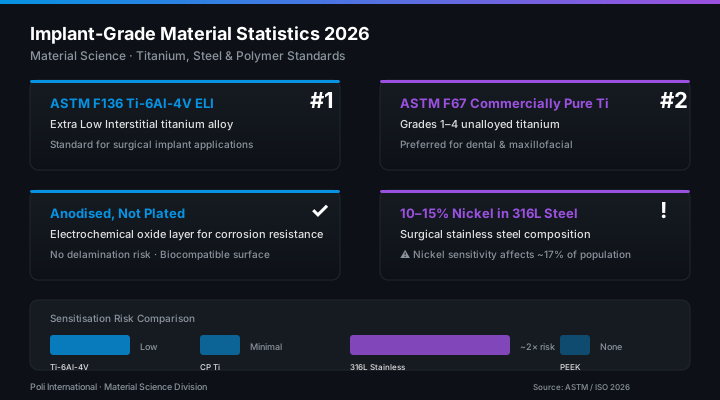
the implant-grade titanium specification (Ti-6Al-4V ELI, also called Grade 23). Only titanium meeting ASTM F136 or the equivalent ISO 5832-3 qualifies as genuinely implant-grade.
Implant-grade jewelry explainer ↗stands for Extra Low Interstitials. The reduced oxygen and iron content gives the alloy the fracture toughness and biocompatibility required for material left inside the body.
Implant-grade jewelry explainer ↗the specification for commercially pure (CP) titanium, an alternative implant-grade option used where maximum corrosion resistance matters more than alloy strength.
Implant-grade jewelry explainer ↗coloured titanium gets its colour from a grown oxide layer, not a coating, so there is no plating to wear off into the tissue channel. Colour is a property of the metal itself.
Implant-grade jewelry explainer ↗Surgical stainless steel and the nickel caveat
"Surgical steel" sounds inert, but it is a nickel-bearing alloy that relies on a thin passive layer to stay within legal limits. That distinction matters most during healing.
nickel content by weight in 316L surgical steel. "Surgical steel" is not nickel-free, it relies on a passive surface layer to keep nickel release below regulatory limits.
Stainless steel and the nickel question ↗more nickel is released from steel in blood plasma than in artificial sweat, which matters during the open-wound healing phase of a fresh piercing when plasma contact is highest.
EU risk-of-sensitisation assessment ↗the chromium-oxide film is what keeps a compliant steel under the limit. Scratches, wear and a low-quality melt all increase nickel release above the protective layer.
Stainless steel and the nickel question ↗Implant-grade polymers
For people who react to any metal, the answer is a biocompatible polymer. Not all plastics are equal, and the difference between a good one and a bad one is well documented.
polypropylene random copolymer is the base of BioFlex®, a flexible, metal-free, MRI-safe body-jewellery polymer engineered specifically for prolonged tissue contact.
BioFlex® material page ↗the biocompatibility certifications BioFlex® is built on. ISO 10993-6 is the local-effects-after-implantation test, the standard that matches a piercing’s prolonged tissue contact; USP Class VI is the most rigorous USP plastics biocompatibility class.
BioFlex® material page ↗the Substance of Very High Concern content of BioFlex® PP-R, comfortably inside EU REACH limits, with no nickel, no plasticisers and no leachable metals.
BioFlex® material page ↗PTFE is often sold as an interchangeable flexible option, but it creeps, deforms and is far harder to verify than a certified PP-R. The two are not the same material class.
BioFlex vs PTFE, why PP-R wins ↗Biocompatibility testing
A piercing is, in practice, a temporary medical implant. The jewellery sits in a tissue channel for months to years, so implant testing logic applies rather than ordinary product-safety logic.
the biological-evaluation framework for materials in tissue contact. It is the test series that determines whether a material is safe for prolonged contact, the same logic used for surgical implants.
Implant-grade jewelry explainer ↗the duration ISO classifies as long-term contact. A healing piercing is worn continuously for months, placing it firmly in the prolonged-contact category that triggers the strictest material requirements.
Implant-grade jewelry explainer ↗because the jewellery sits inside living tissue, the questions that matter are cytotoxicity, sensitisation and local implantation effects, not just surface skin-contact safety.
Implant-grade jewelry explainer ↗Check a material yourself
We build free material and safety tools for artists and studios, such as our nickel-release calculator, and maintain a technical knowledge base on body-art materials and standards, so you can look up a grade or a standard without wading through legal texts.
Cite this page
These figures are free to reference in articles, presentations and research with attribution. Suggested citation:
Poli International. “Implant-Grade Material Statistics (June 2026).” Poli International.
https://poliinternational.com/implant-grade-material-statistics/
Released under CC BY 4.0. See our full data methodology for how every figure is sourced, verified and licensed. For interviews, data requests or material-safety commentary, contact info@poliinternational.com.
Frequently asked questions
What does "implant-grade" actually mean?
Implant-grade is not a marketing word, it is a standards term. For titanium it means the metal meets ASTM F136 (Ti-6Al-4V ELI, Grade 23) or the equivalent ISO 5832-3, or ASTM F67 for commercially pure titanium. For any material it implies the biocompatibility testing in the ISO 10993 series, the same framework used for surgical implants.
Is 316L surgical steel nickel-free?
No. 316L stainless steel contains roughly 10 to 15 percent nickel by weight and relies on a passive chromium-oxide surface layer to keep nickel release below regulatory limits. Compliant 316L releases far less than the 0.2 µg/cm²/week EU REACH limit for piercings, but it is not nickel-free, which matters for highly nickel-sensitive wearers and during the open-wound healing phase.
Why does a piercing count as a medical implant?
Jewellery sits inside a channel of living tissue continuously for months during healing and often for years afterward. That is the same prolonged tissue contact that governs surgical implants, which is why implant-grade material standards such as ASTM F136 and ISO 10993 biocompatibility testing apply rather than ordinary skin-contact product rules.
Can I cite or reproduce these material figures?
Yes. Every figure links to its primary source, whether a materials standard, a peer-reviewed assessment or a manufacturer specification. You are free to quote any statistic with attribution to Poli International and a link to this page.