
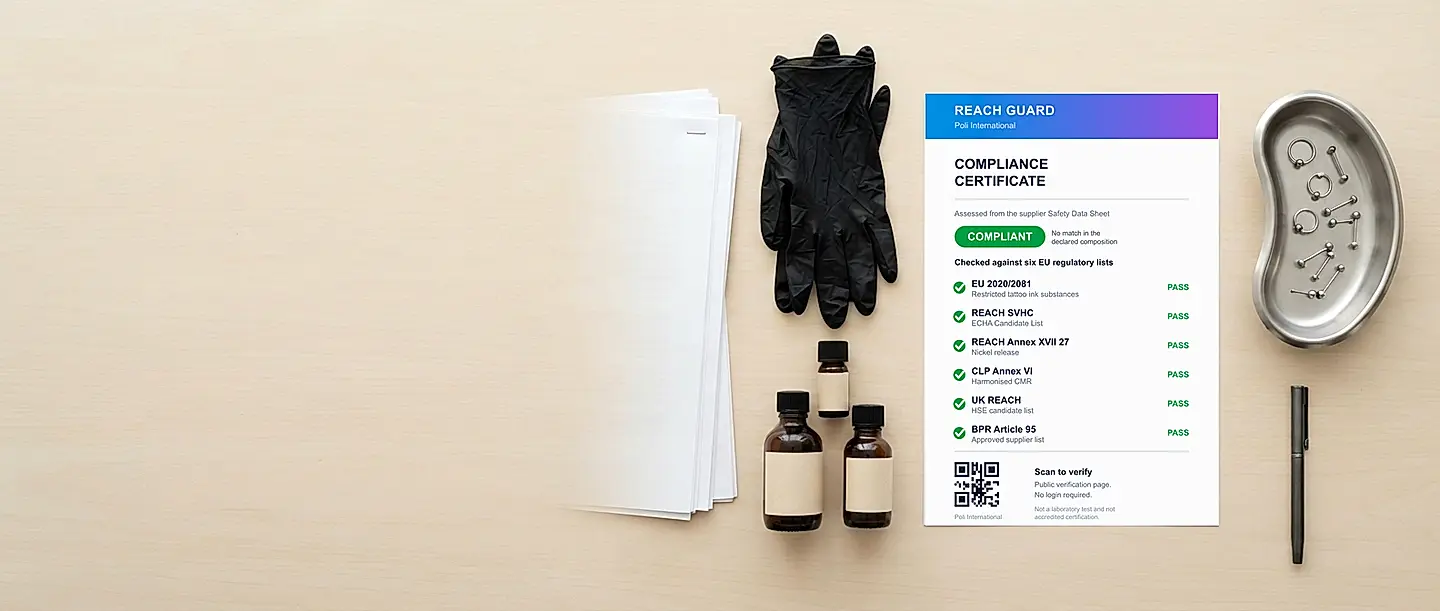
REACH and SVHC are a full-time headache, and you did not take up this trade to read chemical regulation. For a small yearly fee REACH Guard reads the Safety Data Sheets for the products you already buy and returns a dated report on each one, so you can get on with the work. Every report cross-references EU 2020/2081 (tattoo inks), the REACH SVHC Candidate List, the Nickel restriction and CLP hazard classes — keep them together and you have a journal to put in front of the next inspector.
- Email when a new SVHC affects your materials
- Browse the live ECHA Candidate List
- No card required
- Upload one SDS PDF, get one report
- EU 2020/2081 + REACH SVHC + Nickel + CLP cross-reference
- Branded PDF you can keep on file
- €9.50 credit toward Studio Annual within 30 days
- Unlimited reports for your whole inventory
- Customer dashboard with full history
- Re-run reports as regulations change
- Compliance Monitor across 4 EU regulations: REACH SVHC, BPR, Cosmetics, MDR
- Email + magic-link sign-in (no password)
- One account, every studio location you operate
- Volume pricing: 1 → €99 · 2–4 → €89 · 5–9 → €79 · 10+ → €69 each
- Centralise purchasing, dispatch reports to each studio
- Everything in Studio Annual, per location
- Adjust your location count any time
- Co-branded reports carrying your logo and name
- Unlimited reports across your whole product catalogue
- Every report reads “Checked against EU restricted-substance lists by Poli International”
- For pigment & ink makers, body jewellery, aftercare, janitorial and more
- Give studios a compliance document they can file and share
How it works
- Pay €9.50 (trial) or €99 (annual). Card or EU bank methods via Stripe.
- You receive an email with a secure upload link (trial) or a dashboard login (annual).
- Upload the SDS PDF for any tattoo ink, pigment, piercing item or aftercare.
- We extract the substances list and cross-reference against EU 2020/2081, the live REACH SVHC list, REACH Annex XVII entry 27 (Nickel) and CLP Annex VI.
- Branded PDF report is generated within a minute and emailed to you.
Honest limits
A report reflects what the manufacturer declared on the SDS. If a substance is not disclosed, no software can find it. For migration limits (e.g. nickel release under EN 1811) you still need lab testing. We surface every restricted, SVHC-listed and unidentified substance — but compliance ultimately sits with the manufacturer and the studio.
Frequently Asked Questions
What is a REACH Guard compliance report?
A REACH Guard report is a branded PDF document stating which EU regulatory lists the substances declared on a product’s Safety Data Sheet (SDS) were checked against, and the result. It covers EU Regulation 2020/2081 (tattoo inks), the ECHA REACH SVHC Candidate List, REACH Annex XVII Entry 27 (nickel), CLP Annex VI CMR classifications, the UK REACH candidate list and the BPR Article 95 list. Each report has a public verification page and QR code, so a studio, inspector or customer can confirm it is genuine.
Which regulations does REACH Guard check an SDS against?
Six lists: EU 2020/2081 restricted tattoo-ink substances (REACH Annex XVII Entry 75), the full ECHA SVHC Candidate List (443 substances, updated within days of each ECHA revision), REACH Annex XVII Entry 27 nickel restrictions, harmonised CMR classifications under CLP Annex VI, the UK REACH candidate list (HSE) and the EU Biocidal Products Regulation Article 95 supplier list.
Is a compliance report legally required for tattoo or piercing products?
No single report is mandated by EU law, but studios must be able to demonstrate that the products they use comply with EU 2020/2081 and REACH. Inspectors ask for documentation; an SDS cross-referenced against the current restricted lists, with a dated, verifiable report, is exactly the kind of evidence a compliance file needs.
Are you accredited to issue these reports?
No, and no accreditation exists for this kind of document. Accreditation covers three specific things and a document review is none of them. A notified body carries out third-party conformity assessment where EU law mandates it (medical devices under MDR, PPE, toys); it is designated by a member state and listed in NANDO, and cannot be self-appointed. An accredited certification body operates to ISO/IEC 17065 or 17021 under Regulation (EC) 765/2008 and is appointed by its national accreditation body. An accredited laboratory tests to ISO/IEC 17025 and issues results such as nickel release to EN 1811. REACH Guard is none of these and never claims to be. Restrictions under REACH Annex XVII — including entry 75, the tattoo-ink restrictions introduced by EU 2020/2081 — are self-declared by the manufacturer or importer: there is no licensed certifier for them, and no report anyone is obliged to hold. What REACH Guard does is read the Safety Data Sheet you were given, check the declared composition against six published lists, and put the result in writing with the date, the list versions used and a public verification page.
Can I show this to an inspector?
Yes, and that is what it is built for — as long as you are clear about what it proves. An inspector asking about EU 2020/2081 or REACH wants to see diligence: that you obtained the Safety Data Sheet, checked the declared composition against the restricted lists in force on a given date, and kept the result. The report is exactly that record, with the list versions and the date on its face and a public URL the inspector can check independently. It is not a permit, a licence or an approval — no document is, including one from an accredited body. If a product later turns out to contain something the supplier did not declare, the report shows you did the check; it does not move the liability off the manufacturer.
What can I actually do with the report?
Four things it does well. It goes in your compliance file as dated evidence that you checked a product rather than assumed. It answers a client who asks what is actually in the ink or the jewellery. It gives you a specific question to put to a supplier when something on the SDS is missing, vague or unidentifiable — which is where most real problems surface. And for manufacturers it is a document you can hand to your studio customers instead of a verbal assurance. What it cannot do is make a non-compliant product compliant, or stand in for a laboratory test.
Does the report replace laboratory testing?
No. The report reflects what the manufacturer declared on the SDS. Undisclosed substances cannot be detected by any software, and migration limits such as nickel release under EN 1811 still require laboratory testing. REACH Guard surfaces every restricted, SVHC-listed and unidentifiable substance in the declared composition.
What is an SDS and where do I get one?
A Safety Data Sheet is the standardised document EU suppliers must provide for hazardous chemical products, listing composition in Section 3. Every reputable ink, pigment or aftercare manufacturer supplies one on request; many publish them online.
How does the €9.50 trial work?
The €9.50 trial is a one-time payment for one SDS upload and one report, with no subscription. If you upgrade to Studio Annual (€99/year) within 30 days, the €9.50 is credited, so the first year costs €89.50.
What do manufacturers get for €490/year?
Unlimited co-branded reports across the whole product catalogue: the manufacturer’s logo and name lead the report, and every copy carries the line "Checked against EU restricted-substance lists by Poli International REACH Guard" plus a public verification QR. It is aimed at pigment and ink makers, body jewellery brands, aftercare and janitorial suppliers who want to hand their studio customers a compliance document.
Who is behind REACH Guard?
REACH Guard is built and operated by Patrick Poli, founder of Poli International and creator of BioFlex® body jewelry, who has spent over 25 years keeping body-art materials compliant under EU regulation. The same monitoring system keeps the BioFlex® compliance file current.