
Tattoo & Piercing Healing Statistics
12 cited statistics on how long tattoos and piercings take to heal, how often complications and infections occur, and where the risks cluster. Every figure links to its primary clinical source. Free to quote with attribution.
Aftercare advice is only useful with realistic timelines and risk figures behind it. Most piercings and tattoos heal without incident, but complications are common enough to matter, they cluster in the slow-healing cartilage and navel sites, and the true healing window is far longer than the surface suggests. This page gathers the clinical healing timelines, complication rates and infection data in one reference for journalists, clinicians and studio professionals. Each statistic links to its source.
Reporting on tattoo or piercing aftercare? Jump to the citation block for a ready-to-use reference, or email info@poliinternational.com for expert comment.
How often piercings go wrong
Most piercings heal without incident, but complications are common enough to be a routine clinical concern, and they cluster in the slow-healing cartilage and navel sites.
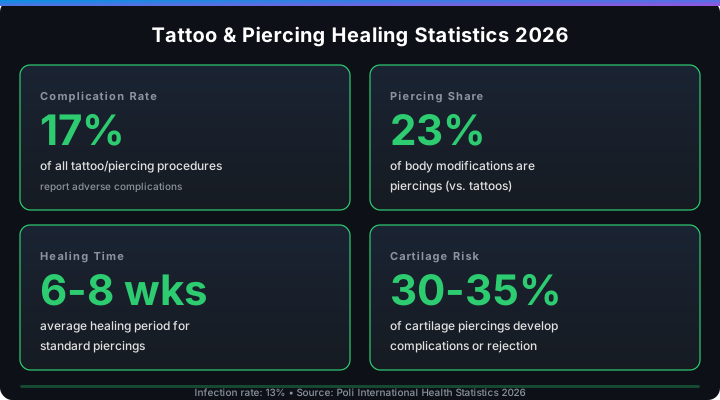
of pierced individuals reported a complication in a university cohort, the baseline rate for piercing problems across all sites.
StatPearls, body piercing complications (NCBI) ↗complication rate for non-earlobe piercings specifically, higher than the all-sites average because cartilage and soft-tissue sites heal slowly.
StatPearls, body piercing complications (NCBI) ↗complication rate reported for the slowest-healing cartilage and navel piercings, the placements where jewellery material and fit matter most.
StatPearls, body piercing complications (NCBI) ↗of complications were serious enough to prompt an emergency-department visit in the cohort data, a reminder that piercing problems are not always trivial.
StatPearls, body piercing complications (NCBI) ↗Real healing timelines
Aftercare fails when people stop caring for a piercing or tattoo before it has actually healed. These are the clinically recognised timelines, and the gap between the surface and full healing is large.
typical healing time for a standard earlobe piercing, the fastest-healing common site because it is soft tissue with good blood supply.
Association of Professional Piercers, healing guidance ↗healing time for cartilage piercings such as the helix or conch, many times longer than a lobe and the reason material choice matters throughout.
Association of Professional Piercers, healing guidance ↗healing time for a navel piercing, one of the slowest-healing common placements, during which the jewellery is in an open wound the entire time.
Association of Professional Piercers, healing guidance ↗a tattoo looks healed at the surface in 2–4 weeks, but the dermal wound underneath takes 3–4 months to fully repair, which is why early sun and friction still cause damage.
StatPearls, tattoo complications (NCBI) ↗Tattoo infection rates
Serious tattoo infections are uncommon when hygiene is sound, but the reported range is wide, and contaminated ink rather than poor technique is a recurring cause.
reported range of tattoo infection rates across the literature; the wide spread reflects differences in setting, technique and how infection is defined.
Dieckmann et al., tattoo infection review (PubMed) ↗is a documented source of tattoo-associated infection independent of studio hygiene, because the ink itself can carry bacteria before it reaches the skin.
Serup, tattoo infection and ink (PubMed) ↗the dermal healing window during which the tattoo wound is still repairing and most vulnerable to infection, well beyond the point most people consider it healed.
StatPearls, tattoo complications (NCBI) ↗laser removal of a simple black tattoo on fair skin can take about 5 sessions, while a dense multicolour piece on darker skin can need 15 or more, per the Kirby-Desai model.
Kirby & Desai, Kirby-Desai scale (PubMed) ↗Cite this page
These statistics are free to reference in articles, presentations and research with attribution. Suggested citation:
Poli International. “Tattoo & Piercing Healing Statistics (July 2026).” Poli International.
https://poliinternational.com/tattoo-aftercare-healing-statistics/
Released under CC BY 4.0. See our full data methodology for how every figure is sourced, verified and licensed. For interviews, data requests or clinical commentary, contact info@poliinternational.com.
Frequently asked questions
How long does a piercing really take to heal?
It depends heavily on the site. A standard earlobe heals in about 6 to 8 weeks, but cartilage piercings such as the helix take 6 to 12 months, and a navel piercing can take 9 to 12 months. Throughout that window the jewellery sits in an open wound, which is why material choice and not disturbing the piercing matter for the full healing period, not just the first few weeks.
How common are piercing complications?
In university-cohort data about 17 percent of pierced people reported a complication, rising to around 23 percent for non-earlobe piercings and 30 to 35 percent for the slowest-healing cartilage and navel sites. About 13 percent of complications were serious enough to prompt an emergency-department visit, so they are common and sometimes significant.
How often do tattoos get infected?
Reported tattoo infection rates range from roughly 0.5 to 6 percent, a wide spread that reflects differences in setting, technique and how infection is defined. Contaminated ink is a documented cause independent of studio hygiene, because bacteria can be present in the ink before it reaches the skin. A tattoo looks healed in 2 to 4 weeks but the dermal wound underneath takes 3 to 4 months to fully repair.
Can I cite or reproduce these statistics?
Yes. Every figure links to its primary clinical source. You are free to quote any statistic with attribution to Poli International and a link to this page, under CC BY 4.0. We keep the dataset current so the citation stays accurate.