
Body Art Safety Statistics
21 cited statistics on piercing prevalence, complication rates, nickel allergy, implant-grade materials and EU regulation. Every figure links to its primary source. Free to quote with attribution.
This page is a living reference for journalists, researchers, educators and studio professionals who need dependable numbers on body-art safety. We compiled it because credible figures are scattered across medical journals, EU regulatory texts and market reports. Each statistic below is linked to the study, standard or dataset it comes from, so you can verify and cite the original.
Reporting on piercing or material safety? Jump to the citation block for a ready-to-use reference, or email info@poliinternational.com for expert comment from a body-art material specialist.
How common body art is
Body piercing is mainstream, not fringe. That scale is why material safety matters at a population level.
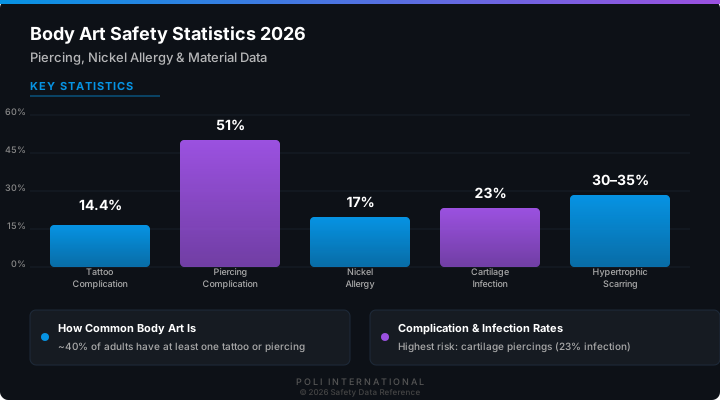
of US adults aged 18–50 have a body piercing somewhere other than the soft earlobe, per a nationally representative data set.
Laumann & Derick, national data set (PubMed) ↗body-piercing prevalence among undergraduate university students in a multi-year comparative study.
Young-adult body-art survey (PMC) ↗body piercing is consistently more common among women than men in general-population surveys.
Epidemiology of body piercing (JAAD) ↗Complication and infection rates
Reported complication rates vary widely by site and method. Honest ranges, not worst-case headlines.
incidence of medical complications after piercing (bleeding, tissue trauma and bacterial infection) in a university cohort.
Body-art complications study (PubMed) ↗of piercings at sites other than the soft earlobe were reported to cause a medical complication.
Body Piercing Infections, StatPearls (NIH) ↗of pierced sites develop some complication in systematic-review estimates, cartilage and navel sites being the most prone.
Body Piercing Infections, StatPearls (NIH) ↗of emergency-department visits for piercings were associated with infection in a recent analysis.
ED visits after body piercings (PubMed) ↗Nickel allergy: the core material risk
Nickel is the most common contact allergen, and piercing is a primary route of sensitisation. This is the case for implant-grade materials.
of adults in the European general population are nickel-allergic, with 8–10% among children and adolescents.
Ahlström et al., nickel allergy review (PubMed) ↗higher nickel-allergy prevalence in women than men, linked to earlier and more frequent piercing.
Ahlström et al., nickel allergy review (PubMed) ↗fall in nickel-allergy prevalence among women aged 18–35 after the EU Nickel Directive took effect. Regulation of release limits works.
Ahlström et al., nickel allergy review (PubMed) ↗is significantly associated with nickel sensitisation in the European general population.
EDEN Fragrance Study (PMC) ↗Materials and implant-grade standards
A piercing is, in practice, a temporary medical implant. The jewellery sits in a tissue channel for months to years, so implant logic applies.
is the implant-grade titanium specification (Ti-6Al-4V ELI / Grade 23). Only titanium meeting ASTM F136 or ISO 5832-3 qualifies as implant-grade.
Implant-grade jewelry explainer ↗nickel content by weight in 316L surgical steel. "Surgical steel" is not nickel-free, it relies on a passive layer to limit release.
Stainless steel and the nickel question ↗more nickel released from steel in blood plasma than in artificial sweat, which matters during the open-wound healing phase of a fresh piercing.
EU risk-of-sensitisation assessment ↗biocompatibility evaluation is the test framework that determines whether a material is safe for prolonged tissue contact.
Implant-grade jewelry explainer ↗Regulation: nickel and tattoo ink
The EU sets the global benchmark for body-art material safety through REACH. Two restrictions matter most.
EU REACH nickel-migration limit for post assemblies inserted into pierced body parts. The general skin-contact limit is 0.5 µg/cm²/week.
Jewellery metal-content rules (Business Companion) ↗date the Nickel Directive was folded into REACH Annex XVII, Item 27. Compliance is tested over a simulated two-year wear period (BS EN 1811).
Jewellery metal-content rules (Business Companion) ↗EU/EEA REACH restriction on thousands of hazardous chemicals in tattoo inks and permanent make-up took effect.
Tattoo inks, ECHA ↗of tattoo inks in use contained Pigment Blue 15:3 or Green 7, both restricted from January 2023, cutting available colours by an estimated 65–70%.
Banned pigments in EU tattoo inks (Chemistry World) ↗Market size
The commercial scale behind the safety story. Figures are vendor estimates and vary by methodology.
global body-piercing jewelry market in 2024, projected to reach roughly $81.7B by 2030 (≈5.8% CAGR).
Body Piercing Jewelry Market (Verified Market Research) ↗projected global tattoo-market size by 2030, up from about $2.04B in 2023 (≈9.9% CAGR).
Tattoo Market (Fortune Business Insights) ↗Cite this page
These statistics are free to reference in articles, presentations and research with attribution. Suggested citation:
Poli International. “Body Art Safety Statistics (June 2026).” Poli International.
https://poliinternational.com/body-art-safety-statistics/
Released under CC BY 4.0. See our full data methodology for how every figure is sourced, verified and licensed. For interviews, data requests or material-safety commentary, contact info@poliinternational.com.
Frequently asked questions
Can I cite or reproduce these statistics?
Yes. Every figure links to its primary source. You are free to quote any statistic with attribution to Poli International and a link to this page. We keep the dataset current so the citation stays accurate.
Why does a piercing count as a medical implant?
Jewellery sits inside a channel of living tissue continuously for months during healing and often for years afterward. That is the same prolonged tissue contact that governs surgical implants, which is why implant-grade material standards such as ASTM F136 and ISO 10993 biocompatibility testing apply.
Is 316L surgical steel nickel-free?
No. 316L stainless steel contains roughly 10 to 15 percent nickel by weight and relies on a passive surface layer to keep nickel release below regulatory limits. Compliant 316L releases far less than the 0.2 µg/cm²/week REACH limit, but it is not nickel-free, which matters for highly nickel-sensitive wearers.
What is the EU REACH nickel limit for piercings?
For post assemblies inserted into pierced body parts the migration limit is 0.2 micrograms per square centimetre per week. For other items in prolonged skin contact the limit is 0.5 µg/cm²/week. Compliance is verified over a simulated two-year wear period using BS EN 1811.