
Nickel Allergy Statistics
16 cited statistics on nickel-allergy prevalence, the link between piercing and sensitisation, the measurable effect of EU regulation, and where nickel hides in body jewellery. Every figure links to its primary source. Free to quote with attribution.
Nickel is the most common contact allergen in the world, and piercing is the route by which most people become sensitised. This page gathers the prevalence figures, the piercing-association odds ratios and the regulatory outcome data in one place for journalists, researchers, educators and studio professionals. Each statistic below is linked to the study, standard or dataset it comes from, so you can verify and cite the original.
Reporting on nickel allergy or material safety? Jump to the citation block for a ready-to-use reference, or email info@poliinternational.com for expert comment from a body-art material specialist.
Nickel: the most common contact allergen
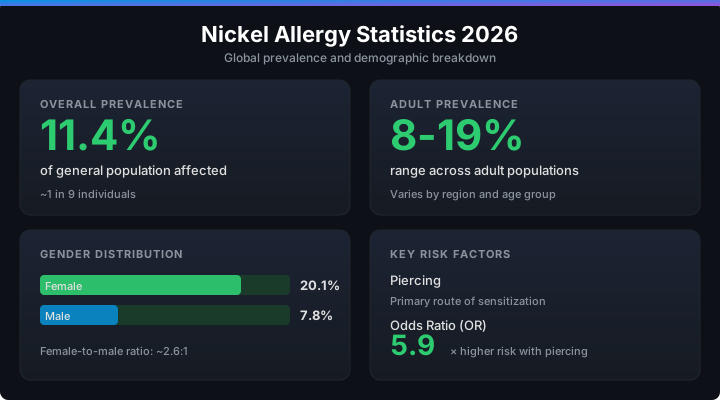
Nickel sensitisation is not a niche problem. Across the general population it is the single most frequently identified contact allergen, and it is markedly more common in women.
nickel-allergy prevalence in the general population, making nickel the single most common contact allergen in a meta-analysis of more than 20,000 patch-tested people.
Alinaghi et al., contact-allergy meta-analysis (PubMed) ↗of adults in the European general population are nickel-allergic, with 8–10% among children and adolescents.
Ahlström et al., nickel allergy review (PubMed) ↗nickel sensitisation in women versus men in an unselected Danish general population (Glostrup), confirming the strong sex difference.
Nielsen & Menné, Glostrup Allergy Study (PubMed) ↗of the general population has a contact allergy of some kind, with nickel the leading sensitiser and women affected far more often than men (27.9% vs 13.2%).
Alinaghi et al., contact-allergy meta-analysis (PubMed) ↗Piercing is the primary route of sensitisation
A piercing places a nickel-releasing object inside a fresh tissue channel. That breach of the skin barrier is why piercing is so consistently linked to becoming nickel-allergic.
odds of nickel allergy in adults with piercings versus those without, in a 2025 systematic review and meta-analysis.
von Spreckelsen et al., nickel allergy & piercings (PMC) ↗odds of nickel allergy in children and adolescents with piercings versus those without, in the same meta-analysis.
von Spreckelsen et al., nickel allergy & piercings (PMC) ↗nickel sensitisation in people with pierced ears versus unpierced ears, with an adjusted odds ratio of 4.5.
Nielsen & Menné, Glostrup Allergy Study (PubMed) ↗is significantly associated with nickel sensitisation in the European general population, a clear dose-response pattern.
EDEN Fragrance Study (PMC) ↗The EU Nickel Directive worked
Regulating how much nickel an item may release, rather than how much it contains, is one of the best-evidenced public-health interventions in dermatology. The prevalence fell where the rules applied.
fall in nickel-allergy prevalence among women aged 18–35 after the EU Nickel Directive took effect. Limiting release works.
Ahlström et al., nickel allergy review (PubMed) ↗EU REACH nickel-migration limit for post assemblies inserted into pierced body parts. The general skin-contact limit is 0.5 µg/cm²/week.
Jewellery metal-content rules (Business Companion) ↗of European earring posts still exceeded nickel-release limits in a 2025 review, so the rules only protect wearers when products actually comply.
von Spreckelsen et al., nickel allergy & piercings (PMC) ↗adjusted odds of nickel sensitisation associated with pierced ears in a pre-regulation general-population cohort, the baseline the Directive was designed to lower.
Nielsen & Menné, Glostrup Allergy Study (PubMed) ↗Where nickel hides, and the safer materials
Once sensitised, a person reacts to even tiny nickel exposure for life. That is why fresh piercings, an open wound holding metal for weeks, deserve the most careful material choice.
nickel content by weight in 316L surgical steel. "Surgical steel" is not nickel-free, it relies on a passive layer to keep release below the limit.
Stainless steel and the nickel question ↗more nickel released from steel in blood plasma than in artificial sweat, which matters during the open-wound healing phase of a fresh piercing.
EU risk-of-sensitisation assessment ↗implant-grade titanium (Ti-6Al-4V ELI / Grade 23) contains negligible nickel and is a standard safe choice for fresh and sensitive piercings.
Implant-grade jewelry explainer ↗BioFlex® is a medical-grade PP-R polymer with no metal content, removing nickel exposure entirely for healing, sensitive or allergic wearers.
Poli International — BioFlex® ↗Cite this page
These statistics are free to reference in articles, presentations and research with attribution. Suggested citation:
Poli International. “Nickel Allergy Statistics (June 2026).” Poli International.
https://poliinternational.com/nickel-allergy-statistics/
Released under CC BY 4.0. See our full data methodology for how every figure is sourced, verified and licensed. For interviews, data requests or material-safety commentary, contact info@poliinternational.com.
Frequently asked questions
Does getting a piercing cause nickel allergy?
Piercing does not guarantee sensitisation, but it is the most consistently identified risk factor. A fresh piercing holds metal inside an open tissue channel, and if that metal releases nickel the immune system can become sensitised. Meta-analysis puts the odds of nickel allergy in people with piercings at roughly six times those without, and the risk rises with the number of piercings.
Is 316L surgical steel nickel-free?
No. 316L stainless steel contains roughly 10 to 15 percent nickel by weight and relies on a passive surface layer to keep nickel release below regulatory limits. Compliant 316L releases far less than the 0.2 µg/cm²/week REACH limit, but it is not nickel-free, which matters for people who are already nickel-allergic or whose piercing is still healing.
Did EU regulation actually reduce nickel allergy?
Yes. After the EU Nickel Directive set release limits, nickel-allergy prevalence among women aged 18 to 35 fell from about 19.8 percent to 11.4 percent. It is one of the best-evidenced public-health interventions in dermatology. The remaining gap is enforcement: a 2025 review still found about a quarter of European earring posts exceeding the release limit.
Can I cite or reproduce these statistics?
Yes. Every figure links to its primary source. You are free to quote any statistic with attribution to Poli International and a link to this page, under CC BY 4.0. We keep the dataset current so the citation stays accurate.