
Tattoo Removal Statistics
12 cited statistics on laser tattoo removal, the Kirby-Desai session-prediction scale, why the session interval is fixed by physics, and which ink colours clear. Every figure links to its primary source. Free to quote with attribution.
Laser tattoo removal is elegant physics that is often oversold. The number of sessions a tattoo needs is predictable from the Kirby-Desai scale before the first pulse; the interval between sessions is set by how fast the immune system clears shattered pigment; and some colours, green, yellow and white, may never fully clear. This page gathers the session, interval and colour-clearability data in one reference for journalists, clinicians and anyone considering removal. Each statistic links to its source.
Reporting on tattoo removal? Jump to the citation block for a ready-to-use reference, or email info@poliinternational.com for expert comment.
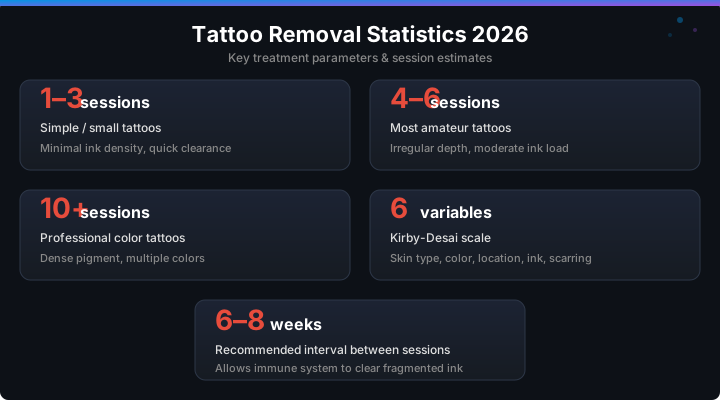
The Kirby-Desai scale predicts sessions before treatment
The only validated clinical tool for predicting laser-removal session counts is the Kirby-Desai scale, published in 2009. It scores six variables and translates the total into a session range.
Kirby-Desai score below 4: a simple black tattoo on fair (Type I–II) skin, trunk placement, amateur application, the easiest case to clear.
Kirby & Desai, Kirby-Desai scale (PubMed) ↗Kirby-Desai score 5–9: a single-colour professional design of moderate density on an extremity, a typical middle case.
Kirby & Desai, Kirby-Desai scale (PubMed) ↗Kirby-Desai score above 15: a dense multicolour cover-up on darker (Type IV+) skin with scarring can require 15 or more sessions across years.
Kirby & Desai, Kirby-Desai scale (PubMed) ↗the scale scores skin type, anatomical location, ink colour, ink density, scarring and whether the tattoo is a cover-up, then sums them to an estimated session range.
Kirby & Desai, Kirby-Desai scale (PubMed) ↗The 6-to-8-week interval is physics, not caution
The minimum interval between removal sessions is set by how long the immune system needs to clear shattered pigment, not by a conservative safety margin.
the standard minimum interval between laser sessions, the time the lymphatic system needs to clear the pigment fragments the previous session produced.
Poli Wiki, Laser Interaction Physics ↗longer intervals produce better fading with fewer total sessions, because the immune system has more time to remove debris between treatments.
Poli Wiki, Laser Interaction Physics ↗the Q-switched Nd:YAG pulse duration at 1064 nm, shorter than the pigment particle’s thermal relaxation time, creating the photoacoustic shockwave that shatters it.
Poli Wiki, Laser Interaction Physics ↗picosecond lasers deliver pulses 10–30× shorter than nanosecond devices, giving higher peak photoacoustic pressure with less thermal damage, most useful on resistant ink and darker skin.
Poli Wiki, Laser Interaction Physics ↗Which colours clear, and which never do
Laser removal is a wavelength-matching problem. Some colours absorb available wavelengths well and clear; others have no good wavelength match and resist even extended treatment.
carbon-based black absorbs all visible wavelengths and clears best, typically to over 90% in 4–8 sessions for amateur work, 6–12 for dense professional work.
Poli Wiki, Laser Interaction Physics ↗green ink absorbs red light, but red wavelengths penetrate deeper with lower targeting precision, so many green formulations fragment incompletely even after 15+ sessions.
Poli Wiki, Laser Interaction Physics ↗yellow has a narrow absorption window; standard Q-switched devices often produce negligible fading and even picosecond lasers give unpredictable results.
Poli Wiki, Laser Interaction Physics ↗titanium-dioxide white pigment can undergo a reduction-oxidation reaction under laser light and turn grey-black, an often-irreversible paradoxical darkening; many practitioners refuse to treat it.
Poli Wiki, Laser Interaction Physics ↗Cite this page
These statistics are free to reference in articles, presentations and research with attribution. Suggested citation:
Poli International. “Tattoo Removal Statistics (July 2026).” Poli International.
https://poliinternational.com/tattoo-removal-statistics-2026/
Released under CC BY 4.0. See our full data methodology for how every figure is sourced, verified and licensed. For interviews, data requests or clinical commentary, contact info@poliinternational.com.
Frequently asked questions
How many sessions does laser tattoo removal take?
It depends on the tattoo, and the Kirby-Desai scale is the validated tool for estimating it. A simple black tattoo on fair skin (score below 4) may clear in 1 to 3 sessions; a single-colour professional design (score 5 to 9) in 4 to 6; and a dense multicolour cover-up on darker skin (score above 15) can need 15 or more sessions across years. The scale scores skin type, location, colour, density, scarring and whether it is a cover-up.
Why do I have to wait weeks between removal sessions?
The 6-to-8-week minimum interval is physics, not caution. The laser shatters ink into fragments that the lymphatic system then clears over weeks. Treating sooner fires energy into pigment debris that is still mobile in the dermis, causing inflammation without extra clearance. Intervals of 8 to 12 weeks actually produce better fading with fewer total sessions because the immune system has more time to work.
Which tattoo colours are hardest to remove?
Black clears best because carbon absorbs all visible wavelengths. Green and yellow are the most resistant, often fragmenting incompletely even after 15 or more sessions, because there is no strong wavelength match for them. White pigments based on titanium dioxide carry a paradoxical darkening risk, they can turn grey-black under laser light, which is often irreversible, so many practitioners refuse to treat white ink.
Can I cite or reproduce these statistics?
Yes. Every figure links to its primary clinical source or to our sourced Laser Interaction Physics wiki entry. You are free to quote any statistic with attribution to Poli International and a link to this page, under CC BY 4.0. Session-count ranges are clinical estimates, not guarantees, and vary with the individual.