
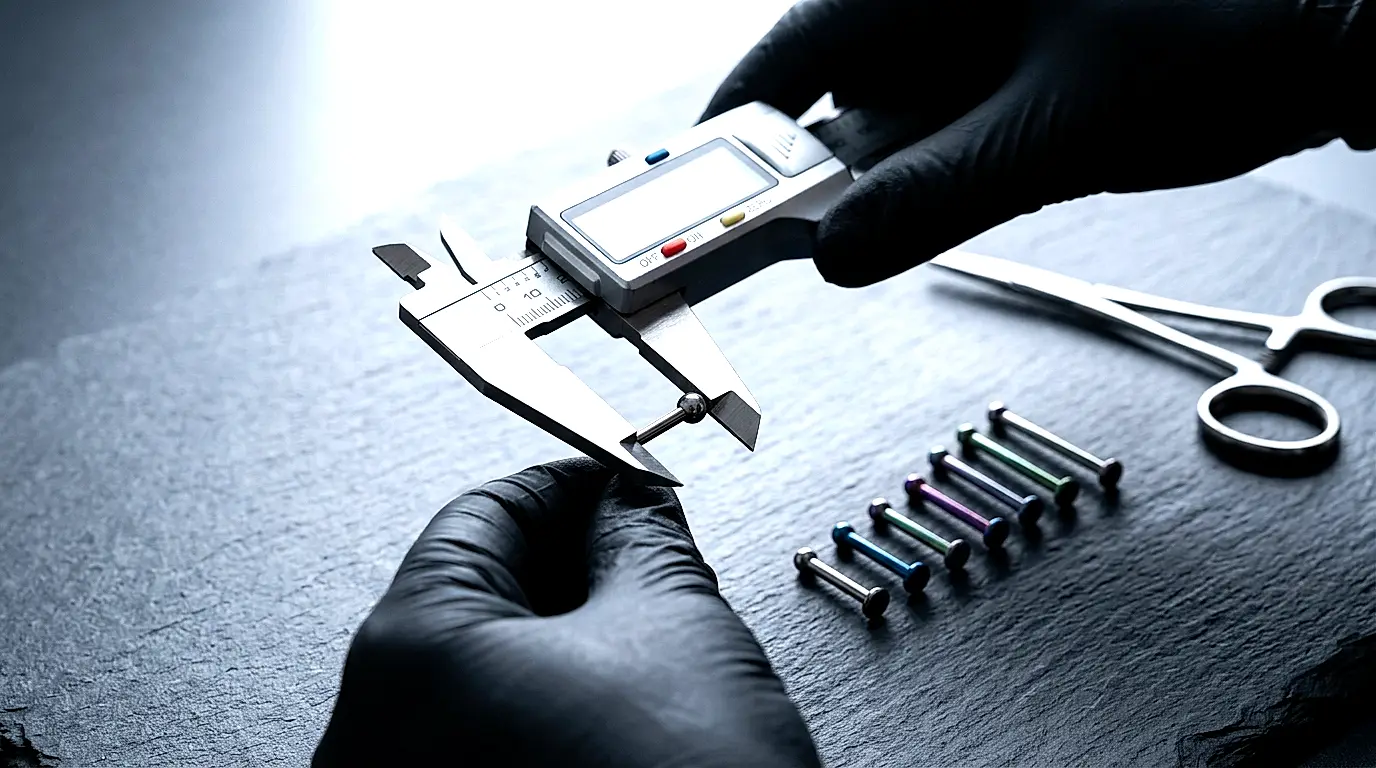
The piercer track
Working and training piercers
The piercer track
Twelve steps, in the order the work actually happens, beginning with whether it should happen at all: who you can safely work on, where the tissue is, how to enter it, what to fit in it, what that thing is made of, what it releases, how it heals, how the room stays clean, and what the chair is worth. Nothing here is new writing dressed up as a course. Each step points at the reference page that answers it and the tool that does the arithmetic, then checks it, because reading something and knowing it are different states and the gap between them stays invisible until something tests it.
18 steps, 146 questions. Free, and nothing here is gated.
What this is, and what it is not
This is a reading order with a check at the end of each step. Finishing it produces a dated record of what was covered. It is not a licence, a certification or a qualification, and no trade body accredits it, including us. Licensing is set by your local authority and nothing here substitutes for it.
Step 1 of 18
Screening and contraindications
Every other decision assumes the procedure should happen at all, and that is the one this topic makes. The published guidance is that screening is a structured set of questions rather than a single yes or no, because the answers that matter are the ones a client does not think to volunteer.
Read
Where each answer is found
Read first if you want to. Nothing here is timed, and every figure in the check comes from the page beside it.
Check: screening and contraindications
1. A client answers "no" to "are you on any medication?". Why is that not the end of the screening?
- ✓ Because screening has to be systematic: anticoagulants, retinoids, immunosuppressants and supplements each carry their own risk, and clients routinely do not count supplements as medication — The published guidance is explicit that a single yes/no question is not screening. High-dose fish oil, vitamin E, garlic, ginkgo and ginseng all affect bleeding and almost nobody volunteers them.
- • Because clients frequently lie about medication — Assuming dishonesty is neither necessary nor useful. The gap is in the question, not the client: ask about categories and they answer accurately.
- • It is the end of it, provided they sign the consent form — A signature records that you asked. It does not improve what you asked, and the consent form is not the screening.
- • Because you should require a letter from their doctor either way — Specialist clearance is the published requirement for specific drugs such as methotrexate, not a blanket rule for everyone.
2. A client on clopidogrel after a cardiac stent asks whether to stop it for a week before their appointment. What is the correct response?
- ✓ Never stop it without cardiology approval, and that decision is not yours or theirs to make — Stopping antiplatelet therapy after a stent risks stent thrombosis, which is a far graver outcome than any tattoo or piercing. The same principle covers biologics, which are not interrupted either.
- • Seven days is the standard washout, so yes — Seven to ten days is the aspirin figure, and even there the advice is not yours to give. Applying it to post-stent clopidogrel could kill someone.
- • Stop it for 48 hours, which is enough for any antiplatelet — Invented, and dangerous for the same reason. The published position is unambiguous: not without cardiology approval.
- • Decline the client outright — Over-correction. The medication is a factor to work with, in consultation with their prescriber; it is not automatically a refusal.
3. Which presentation is a published reason to decline the session outright?
- ✓ A client under acute high-dose opioids — Decline the session. Consent cannot be meaningfully given, and pain feedback, which is information you need during the procedure, is unreliable.
- • A client on long-term warfarin — Warfarin is continued for a minor cutaneous procedure per the published guidance. It changes how you work, not whether you work.
- • A client on a biologic for psoriasis — Biologics are not interrupted, and the client is not automatically refused. It is a conversation with their prescriber.
- • A client who had a glass of wine yesterday — The published window is 24 to 48 hours for alcohol, so yesterday is borderline rather than disqualifying. Judge it, do not reflex.
4. A client with a history of raised scars wants a helix piercing. What does the guidance require first?
- ✓ Complete the keloid risk assessment before any cartilage piercing on a client with a scarring history — Keloid and hypertrophic scarring have opposite treatment pathways, so the distinction is clinically critical and is worth establishing before you make a hole rather than after.
- • Proceed and monitor, since most raised scars settle by themselves — Hypertrophic scars often regress by 12 to 18 months. Keloids do not, and recurrence after excision alone runs 45 to 100%.
- • Refuse, because a scarring history rules out cartilage work — The requirement is assessment, not refusal. The assessment is what tells you which conversation to have.
- • Use a polymer retainer, which prevents keloids — Material choice helps with mechanical irritation and does not prevent a keloid, which is a fibroproliferative response rather than a friction problem.
5. Which anatomical sites carry the highest published keloid risk, and roughly how does prevalence vary?
- ✓ Sternum, deltoid, upper back and earlobes; 4.5 to 16% prevalence in people of African ancestry against about 1% of European ancestry — Site and ancestry are both real risk factors and both belong in the consultation. The defining feature remains the behaviour: a keloid extends beyond the original wound margin, a hypertrophic scar stays inside it.
- • Earlobes only, and prevalence is even across populations — Earlobes are on the list and are not alone, and prevalence differs by roughly an order of magnitude between the two groups cited.
- • The navel and wrist, at about 10% across all populations — Those are high-risk sites for migration and rejection, which is a different failure mode from scarring.
- • Any cartilage site, at 45 to 100% — 45 to 100% is the recurrence rate after excision of an existing keloid, not the chance of getting one.
Step 2 of 18
Medication, supplements and bleeding
Bleeding during a procedure is not only messy: in tattooing it dilutes the ink carrier as it is implanted, costing pigment retention and buying extra passes of trauma. The drugs and supplements that cause it clear at very different rates, so the timing of the pause matters as much as the pause.
Where each answer is found
Read first if you want to. Nothing here is timed, and every figure in the check comes from the page beside it.
Check: medication, supplements and bleeding
1. Of the common painkillers, which one affects bleeding for longest, and for how long?
- ✓ Aspirin, for 7 to 10 days, because it disables platelets permanently until new ones are made — That is what makes aspirin the outlier. Ibuprofen clears in roughly 24 hours and naproxen wants 48 to 72, but aspirin keeps working long after you stop taking it.
- • Ibuprofen, for about three days — Ibuprofen is the shortest of the three, at roughly 24 hours.
- • Naproxen, for about a week — Naproxen does last longer than ibuprofen, at 48 to 72 hours, and still nothing like aspirin.
- • Paracetamol, for 48 hours — Paracetamol is not an anti-platelet drug and is not on this list at all.
2. A client takes a DOAC such as apixaban. What does its half-life tell you about scheduling?
- ✓ It is 8 to 12 hours, so the drug level swings substantially across a day, which is a scheduling conversation with their prescriber rather than a decision you make — Short half-life is exactly why it is a prescriber conversation: the timing is manageable, and choosing to skip a dose is a clinical decision that belongs to the person who prescribed it.
- • It is 7 to 10 days, so the session must be deferred a fortnight — That is the aspirin figure. DOACs clear far faster.
- • It has no meaningful half-life, so timing is irrelevant — The published figure is 8 to 12 hours, which is short but real.
- • It means you should tell them to skip the morning dose — Not your instruction to give. The pattern across this whole topic is that you identify the factor and their prescriber decides what to do about it.
3. A client on long-term warfarin books a small piercing. What does the guidance say?
- ✓ Continue it. For a minor cutaneous procedure warfarin is not stopped — Interrupting anticoagulation carries thrombotic risk that far outweighs the bleeding from a small procedure. Plan for more bleeding, work accordingly, and leave the prescription alone.
- • Stop it 5 days before, which is the surgical standard — Borrowed from major surgery and inapplicable here, and in any case not a decision for a studio.
- • Decline the client — The published position is to continue and proceed, not to refuse.
- • Proceed only with a doctor letter for every session — Disproportionate for a minor cutaneous procedure where the guidance is simply to continue.
4. Which everyday supplements raise bleeding enough to matter, and at what doses?
- ✓ Fish oil above about 3 g a day, vitamin E above roughly 400 IU, and garlic, ginkgo and ginseng extracts — These are the ones clients never mention, because a supplement does not feel like a medication. Asking about them by name is what turns a yes/no question into screening.
- • Vitamin C and zinc, at any dose — Neither is on the published bleeding list.
- • Iron supplements, above 100 mg — Iron is not implicated in bleeding risk here.
- • None: supplements are not pharmacologically active at retail doses — Demonstrably untrue for these five, which is the entire reason they are named.
5. Why do immunosuppressants matter for piercing healing specifically, and what is the correct step?
- ✓ They attenuate the inflammatory phase of days 1 to 7, which is when white cells clear bacteria and start repair, so the client should speak to their prescribing physician before proceeding — The inflammatory phase reads as a nuisance and is doing essential work. Suppress it and infection thresholds drop while the move into the proliferative phase takes longer.
- • They slow the proliferative phase only, so healing simply takes longer — The published mechanism is the inflammatory phase first, and the consequence is lowered infection thresholds rather than only a longer timeline.
- • They have no effect on local wound healing — They have a specific, published effect on the phase that clears bacteria.
- • Advise the client to pause the drug for two weeks around the procedure — Never. Biologics in particular are not interrupted, and this is not a studio decision in any case.
Step 3 of 18
Pregnancy and breastfeeding
An existing piercing and a new one are completely different questions during pregnancy, and the trade habitually answers them as one. The timings are published and most of them hinge on a single hormone that peaks earlier than people expect.
Where each answer is found
Read first if you want to. Nothing here is timed, and every figure in the check comes from the page beside it.
Check: pregnancy and breastfeeding
1. Why is week 12 the retainer deadline rather than a later, more obvious point?
- ✓ Relaxin peaks at weeks 12 to 14, which is the point of highest migration risk, and abdominal expansion accelerates from there — The deadline is set by the hormone rather than by the visible bump. Waiting for the abdomen to look pregnant means acting after the tissue has already become most susceptible.
- • Because the navel everts at week 12 — Eversion begins at weeks 16 to 24 and completes by 28 to 32. The retainer deadline deliberately sits ahead of it.
- • Because blood volume peaks at week 12 — Blood volume rises 40 to 50% by week 32, not at 12. Real figure, wrong mechanism.
- • It is a convention with no physiological basis — It maps directly onto the relaxin peak at weeks 12 to 14, so the deadline is physiology rather than convention.
2. At what point does a pregnant client’s navel piercing stop being worth retaining, and what does a planned caesarean add?
- ✓ A tissue bridge under 2 mm: below that, tearing risk exceeds retention benefit. Separately, a piercing within 2 cm of a caesarean incision line must be removed — Two different 2s doing two different jobs. About 21% of deliveries globally are caesarean, so the incision question is worth raising rather than waiting to discover.
- • Under 5 mm, and caesarean makes no difference — The published threshold is 2 mm, and the incision proximity rule is explicit.
- • When the client reports discomfort, which is the only reliable signal — Discomfort lags the measurement. A caliper reading gives you the decision before the tearing does.
- • At week 32, regardless of tissue — Weeks 28 to 32 is when eversion completes. The retention decision is made on tissue thickness, not the calendar.
3. A pregnant client asks about numbing cream. What do the published pharmacokinetics say?
- ✓ Lidocaine crosses the placenta 2 to 5 minutes after dermal application, and the pregnancy-adjusted maximum drops about 30% to 2 to 3 mg/kg because absorption increases — Both halves matter: it reaches the fetus quickly, and the dose that gets there is higher per gram applied than in a non-pregnant client. It is classed FDA category B, with animal data showing no evidence of risk and limited human data.
- • Topical lidocaine does not reach the systemic circulation in meaningful amounts — Dermal absorption runs 3 to 45% of the applied dose depending on site and barrier, which is very far from nothing.
- • The maximum is unchanged at 3 to 5 mg/kg, since the dose is calculated by weight — Weight-based dosing does not account for the increased absorption of pregnancy, which is why the published figure is reduced by about 30%.
- • It is absolutely contraindicated in pregnancy — Overstated in the other direction. It is category B with an adjusted ceiling, not a prohibition, and overstating it makes the real caution easier to dismiss.
4. What is the published advice on nipple jewellery while breastfeeding?
- ✓ Remove it for every feed, and ideally for the whole period of breastfeeding — Jewellery in place during a feed is both a choking hazard and a route for tissue damage. Removing it for the duration avoids remembering every time.
- • It can stay in, since healed piercings do not interfere with feeding — The published recommendation is removal for each session, which is not the same as leaving it in.
- • Replace it with a smaller metal bar — Smaller does not address either hazard. The recommendation is removal rather than substitution.
- • Remove it only if the baby has difficulty latching — Reactive rather than preventive, and the advice is preventive.
Step 4 of 18
Topical anaesthetics
Numbing cream is the one substance in the studio with a published lethal mechanism, and clients apply it to themselves at home without a dose in mind. Absorption varies by a factor of fifteen across sites and by up to thirty times on mucosa.
Where each answer is found
Read first if you want to. Nothing here is timed, and every figure in the check comes from the page beside it.
Check: topical anaesthetics
1. A 60 kg client arrives having applied numbing cream generously at home. What ceiling were they working against, whether they knew it or not?
- ✓ About 300 mg of lidocaine, from a maximum of 5 mg/kg on intact skin — Nobody applying cream from a tube at home is counting milligrams, which is exactly why you ask what they used and how much. Prilocaine sits slightly higher at 6 mg/kg, about 360 mg for the same client.
- • About 3 g, since topical application is inherently safe — An order of magnitude over the ceiling. Dermal absorption reaches 45% of the applied dose at some sites.
- • There is no ceiling for topical preparations, only for injected ones — The published maxima are specifically for topical use on intact skin, and lipid rescue therapy exists because systemic toxicity from topical use is real.
- • About 30 mg, which is why cream is nearly useless — Ten times under the figure, and it would make the products pointless.
2. Why is numbing cream on a mucosal site a different proposition entirely?
- ✓ Mucosal absorption is 10 to 30 times that of intact forearm skin, so the same quantity delivers a far larger systemic dose — The dose is the quantity absorbed, not the quantity applied. A volume that is unremarkable on a forearm can approach the systemic ceiling on mucosa.
- • Mucosa is more sensitive, so it hurts more without cream — A comfort argument. The risk is pharmacokinetic.
- • Mucosa absorbs less, so more cream is needed — The exact inverse, and acting on it would be dangerous.
- • It does not differ; absorption is a property of the drug — Absorption ranges 3 to 45% of applied dose across sites on skin alone, before mucosa is considered.
3. A client becomes talkative, mentions a metallic taste and says their lips feel odd. What is this?
- ✓ Early CNS toxicity, above about 5 micrograms per millilitre of plasma: perioral numbness, metallic taste and tinnitus are the first signs — These are the warning signs that precede the dangerous ones. Cardiac toxicity follows above 10 to 15, and lipid rescue exists for that stage. Stop, do not add more cream, and get help.
- • Ordinary nerves before a procedure — Anxiety does not produce a metallic taste or perioral numbness. Reading this as nerves is how the next stage arrives unnoticed.
- • An allergic reaction to the anaesthetic — True allergy to amide anaesthetics is rare and presents differently. This triad is a dose effect.
- • A vasovagal response — A faint presents with pallor, sweating and bradycardia, not a metallic taste.
4. How long does EMLA need, and what does the timing depend on?
- ✓ 60 to 90 minutes under occlusion, lasting about 2 hours after removal — Occlusion is the part people skip, and without it the timing does not hold. A 7%/7% lidocaine-tetracaine peel formulation reaches effect in about 30 minutes instead.
- • 10 to 15 minutes, applied uncovered — Far too short and missing the occlusion that the published timing assumes.
- • 3 to 4 hours under occlusion — Well beyond the published window, and longer contact means more absorbed dose for no additional effect.
- • It works on contact; the wait is habit — It has to cross the stratum corneum, which is what the 60 to 90 minutes is for.
5. What is specific to prilocaine that lidocaine does not share?
- ✓ Methaemoglobinaemia risk from its o-toluidine metabolite, above a total dose of 600 mg — A different failure mode from the CNS and cardiac toxicity that dominates lidocaine, and one with its own threshold. It matters because EMLA contains both drugs.
- • A longer onset time, so it needs 3 hours — Onset time is similar between the two and is not what distinguishes them. The distinguishing risk is a metabolite, not a timing.
- • It cannot be used under occlusion — It is used under occlusion as half of EMLA.
- • Nothing: they are pharmacologically interchangeable — They differ in maximum dose, 6 mg/kg against 5, and in this metabolite-specific risk.
6. A client brings a 10% lidocaine cream bought online, and another brings one containing epinephrine. What do the published positions say?
- ✓ Above 4% is prescription or unapproved under the FDA OTC limit, and client-applied cream containing epinephrine is to be avoided — A 10% product sold over the counter is outside the OTC limit, which tells you something about the seller as well as the strength. Epinephrine adds vasoconstriction the client cannot judge, onset 5 to 10 minutes and peaking at 20 to 30.
- • Both are fine provided the client applies them at home rather than in the studio — Where it is applied does not change what is absorbed, and home application is precisely the uncontrolled case.
- • 10% is standard for professional use, and epinephrine improves safety by limiting absorption — Epinephrine does reduce systemic uptake, which is exactly why an unsupervised client using it is the problem: it masks how much has been applied.
- • Neither is regulated, so it is a matter of preference — The 4% OTC limit is explicit, and the epinephrine position is published.
Step 5 of 18
Anatomy and placement
Skin dimensions vary by a factor of two between body sites, so a fixed working depth produces systematic errors rather than occasional ones. Placement is decided before anything is marked, and the site is the variable that predicts the tissue, not the client.
Read
Where each answer is found
Read first if you want to. Nothing here is timed, and every figure in the check comes from the page beside it.
- Q1. Skin Histology and Dermal Depth
- Q2. Anatomical Geometry: critical parameters
- Q3. Anatomical Geometry: rejection risk zoning
- Q4. Anatomical Geometry: cartilage healing
- Q5. Skin Histology and Dermal Depth
- Q6. Anatomical Geometry for Safe Body Piercing
- Q7. Anatomical Geometry for Safe Body Piercing
- Q8. Anatomical Geometry for Safe Body Piercing
- Q9. Anatomical Geometry for Safe Body Piercing
- Q10. Anatomical Geometry for Safe Body Piercing
Check: anatomy and placement
1. You are judging working depth on a client’s upper back, then on their thigh. Which variable predicts the difference between the two sites?
- ✓ The body site itself — 20 MHz ultrasound across 342 subjects: total skin thickness is 2.54 mm at the suprascapular site and 1.55 mm at the thigh. Site explains most of the variation, which is why it is the primary variable in the assessment.
- • The client’s age — Measured histologically, epidermal thickness shows no correlation with age. Adjusting depth for age is a clinical error rather than a refinement.
- • The client’s Fitzpatrick type — Fitzpatrick was devised in 1975 for oral PUVA dosing. It is a sun-reactivity scale and carries no information about tissue thickness. Record it for sun reactivity and nothing else.
- • The client’s BMI — The 1.5 mm perpendicular depth that reaches dermis at the suprascapular, deltoid and waist sites holds independent of gender, age, ethnicity and BMI.
2. What is the minimum tissue depth between entry and exit for a piercing to be mechanically stable?
- ✓ 6 mm — Six millimetres between entry and exit is the published minimum. Below it there is not enough tissue to distribute load, and the piercing is being asked to hold in a bridge that cannot carry it.
- • 2 mm — Too shallow. 2 to 4 mm below the surface is the implant depth for a surface anchor’s footplate, which is a different measurement from the entry-to-exit tissue bridge.
- • 4 mm — Still short of the published minimum. A bridge this thin is why unstabilised surface work over bone fails so reliably.
- • 10 mm — More than required. 6 mm is the minimum, not the target, and many viable sites do not offer 10 mm.
3. Surface piercings are the highest-risk placement class. What is the mechanism, and what does the published rate depend on?
- ✓ The jewellery sits entirely in subcutaneous tissue without passing through a natural anatomical fold, so the fistula walls carry all the movement stress. Published rates run from over 50 percent within two years up to 70 to 90 percent where the placement is unstabilised and over bone — The mechanism is load with nowhere to go. That is why the quoted rate moves with the conditions rather than being one number: stabilising geometry, gauge, tissue depth and aftercare each shift it, and flat skin over a bony prominence is the worst case. Quote the range and the conditions in the consultation, not a single figure.
- • The material reacts with subcutaneous tissue more than with dermis, so rejection is immunological rather than mechanical — Material matters, and it is not what makes this placement class distinctive. The driver here is mechanical stress on the fistula walls, which is why gauge and stabilising geometry change the outcome so much.
- • Surface piercings are placed too shallow to epithelialise, so a fistula never forms — A fistula does form. Depth is a real constraint, with 2.5 to 3.0 mm below the dermal-epidermal junction the published minimum for anchors, but the failure is the channel being pulled apart after it forms rather than never forming.
- • The rate is essentially fixed at around 50 percent regardless of technique, so placement choices make little difference — The opposite, and it is the reason this step exists. Placement, gauge selection and aftercare are precisely what move the number, which is why the published figures are stated with conditions attached.
4. A client comparing a helix to a lobe asks why the timelines differ so much. What governs it?
- ✓ Cartilage heals 2 to 4 times longer than vascularised dermis — Cartilage is poorly vascularised, so repair runs on diffusion rather than perfusion. Helix cartilage is also only 1.0 to 2.5 mm thick and highly individual, so full maturation runs to 12 to 18 months.
- • Cartilage carries more nerve endings, so it hurts longer — Pain and healing duration are different axes. The timeline difference is vascular supply, not innervation.
- • The lobe is thicker, so it closes faster — Thickness is not what drives it, and the premise is backwards. The lobe heals faster because it is vascularised dermis.
- • Cartilage jewellery is heavier, so it migrates first — Mass matters for migration, and the guidance is under 2 g at sites like the eyebrow and navel. It is not what explains the cartilage healing multiplier.
5. A needle-length figure is quoted as reaching dermis at 1.5 mm perpendicular. What is it independent of, and what is it not?
- ✓ Independent of gender, age, ethnicity and BMI, and not independent of site: those four do not move it, but total skin thickness runs 1.55 mm at the thigh to 2.54 mm suprascapular — This is the single most useful result in the histology, because it says which of the things you can see about a client are irrelevant. The variable that matters is the one on the consent form as a location.
- • Independent of site, so 1.5 mm is a universal working depth — The exact reverse. Site is the variable the measurement was taken across, and it differs by a factor of well over one and a half between the sites measured.
- • Independent of age only; gender and BMI both shift it materially — All four were tested and none of them moved the figure. Cellular epidermis does differ by sex, at a scale of tens of micrometres rather than millimetres.
- • It is a modelled figure rather than a measured one — It comes from 20 MHz ultrasound across 342 subjects, which is a measurement with a sample size attached.
6. A client wants a lower lip placement. Which structure sets the limit, and how deep is it?
- ✓ The marginal mandibular nerve, immediately below the lower lip at less than 5 mm in most adults — Under 5 mm is inside the working range of an ordinary placement, which is exactly why it is worth knowing as a number rather than as a general caution. It is a motor nerve, so the consequence is not sensory.
- • The mental nerve, which runs at about 15 mm — A real structure in the region and not the one the published figure names. The depth quoted here belongs to the marginal mandibular.
- • The facial artery, and depth is not the relevant measure — Vasculature matters everywhere in the face, and the published constraint for this site is given as a nerve depth.
- • Nothing specific: the lower lip is soft tissue throughout — Soft tissue is not empty tissue. A structure under 5 mm down is the reason this site has a named constraint.
7. A client is unhappy that their two nostril piercings "do not match". What is the published tolerance, and at what viewing distance?
- ✓ ± 2 mm in the sagittal plane, assessed at 1 m viewing distance — Both halves of that matter. A tolerance without a viewing distance is not a tolerance, because anything is asymmetric in a mirror at 20 cm, and the face itself is not symmetric to start with.
- • ± 0.5 mm, assessed as closely as possible — Four times tighter than published and assessed at a distance nobody views a face from. It sets a standard that facial anatomy itself does not meet.
- • ± 2 mm, assessed at arm’s length in a mirror — The figure is right and the distance is not. The published reference is 1 m.
- • There is no tolerance; symmetry is judged against the client’s own anatomy — Anatomy is the reference and a numeric tolerance still exists against it. Both are used together rather than one instead of the other.
8. Why is the inner elbow a harder placement than its tissue depth alone suggests?
- ✓ Dermal stretch reaches 30% at high-mobility joints, and the inner elbow repeats that full cycle with every arm extension — It is not the size of the stretch, it is the number of repetitions. A fistula is being asked to absorb a 30 percent extension hundreds of times a day while it is still forming.
- • The skin there is thinner than anywhere else on the arm — Thickness is not the published constraint for this site. Cyclic stretch is.
- • Langer’s lines run unpredictably at joints — Langer’s lines follow collagen bundle orientation by region, which is a direction rather than an unpredictability. The named issue here is the stretch cycle.
- • It is closer to major vasculature than other arm sites — A reasonable general caution and not what the published figure describes. The 30 percent stretch cycle is the constraint given.
9. Two depth figures apply to a surface piercing: 6 mm and 2 to 4 mm. What does each one measure?
- ✓ 6 mm is the minimum tissue bridge between entry and exit; 2 to 4 mm is how far below the surface a surface anchor footplate sits — One is measured along the piercing and the other down from the skin, which is why they can both be right and look contradictory. Confusing them is how a placement ends up with a bridge that cannot carry it.
- • 6 mm is the barbell length and 2 to 4 mm is the tissue bridge — Neither figure is a jewellery dimension. Both describe tissue.
- • 6 mm applies to cartilage and 2 to 4 mm to soft tissue — Neither is a tissue-type figure. They are two different measurements of the same placement.
- • They are the same measurement quoted at different confidence levels — They are different axes. A bridge runs between two points on the surface; an implant depth runs down from it.
10. A 22-year-old wants a navel piercing they intend to keep for life. What does the published anatomy say about that timeframe?
- ✓ Breast and abdominal tissue repositions significantly over a 10 to 20 year timeframe, so the placement that suits today is not fixed in place relative to the body — The piercing does not move; the body around it does. Saying so at the consultation is a different conversation from explaining it in fifteen years.
- • Placement is permanent once the fistula has remodelled at 6 to 12 months — The fistula stabilises on that timescale, and the tissue it sits in keeps changing on a much longer one.
- • Repositioning only matters after pregnancy — Pregnancy is one driver and the published figure is a general 10 to 20 year timeframe.
- • It is unpredictable, so there is nothing useful to say — The direction and the timescale are both published, which is enough to set an expectation even though the amount is individual.
Step 6 of 18
Angle and depth
Piercing failure is overwhelmingly mechanical: entry angle that deviates from perpendicular, a gauge too thin to spread load, and downsizing done early or late. Every one of those is decided by you rather than by the client.
Read
Where each answer is found
Read first if you want to. Nothing here is timed, and every figure in the check comes from the page beside it.
- Q1. Piercing Migration and Rejection: entry angle
- Q2. Piercing Migration and Rejection: definitions
- Q3. Piercing Migration and Rejection: gauge and pressure
- Q4. Piercing Angle Placement Guide documentation
- Q5. Piercing Migration and Rejection: downsizing window
- Q6. Piercing Migration and Rejection
- Q7. Piercing Migration and Rejection
- Q8. Piercing Migration and Rejection
- Q9. Piercing Migration and Rejection
- Q10. Piercing Migration and Rejection
Check: angle and depth
1. What is the correct needle entry angle for a surface piercing, and why?
- ✓ 90 degrees to the tissue surface — Perpendicular entry loads both fistula walls equally. Any angled entry makes one wall carry more force than the other, which produces asymmetric migration from the first week.
- • 45 degrees, to lengthen the channel — A longer channel bought at the cost of asymmetric loading. The extra length does not compensate for the uneven force distribution.
- • Whatever angle follows the client’s skin fold — Skin tension lines govern the orientation of the placement, not the entry angle. Both matter, and they are separate decisions.
- • 60 degrees, as a compromise between depth and comfort — There is no published basis for this, and comfort during the procedure is not the constraint that decides whether the piercing survives.
2. How are migration and rejection defined, so that a follow-up note means something?
- ✓ Migration is a shift over 2 mm within 4 weeks; rejection is visible thinning with a tissue bridge of 1 mm or less — Both are measurable rather than impressionistic, which is the point of having the definitions. A note saying "looks like it is moving" cannot be compared to the next appointment; a measurement can.
- • They are the same process at different speeds — They share a cause in the foreign-body response at the implant-tissue interface, but they are distinct clinical states with distinct thresholds and distinct responses.
- • Migration is client-caused; rejection is material-caused — Neither attribution holds. Both are driven primarily by mechanics: placement, gauge, bar length and load.
- • Rejection is any piercing that has to be removed — Removal is an outcome, not a definition. Rejection has a specific tissue presentation, and plenty of removals have nothing to do with it.
3. A high-movement surface piercing keeps cutting into its own healing capsule. What does moving from 16G to 14G achieve?
- ✓ Roughly 36 percent less interfacial pressure per unit area for the same applied force — The wider cross-section spreads the same load, which is the direct counter to the cheese-wire effect. 14G to 12G, or 1.6 to 2.0 mm, is the published range for high-movement sites.
- • Nothing mechanical; it is a comfort and aesthetic choice — The pressure reduction is the entire clinical reason for the upsize. Treating gauge as cosmetic is what produces the failure.
- • It shortens the healing time — Gauge does not accelerate epithelialisation. The initial fistula lining takes 6 to 12 weeks regardless, with collagen remodelling out to 6 to 12 months.
- • It lets you skip downsizing — The opposite risk. Excess bar length still drives the piston effect whatever the gauge, so the downsizing window still applies.
4. Your marks look symmetrical, and then you clamp. What does the placement protocol require at that point?
- ✓ Re-check the marks after clamping, because the clamp itself can pull the anatomy out of line — Roughly 40 percent of clients do not match the textbook illustration, so the textbook is a starting point rather than a rule. Mark with the client in a natural sitting or standing position, run a range-of-motion test, adjust until the separation stays consistent through that movement, and re-check after clamping. The goal is an angle that suits this person in motion.
- • Nothing: marks made before clamping are the reference, and the clamp holds tissue still — The clamp is itself a force applied to soft tissue. Treating pre-clamp marks as final is how symmetrical marks become an asymmetric result.
- • Mark only after clamping, so the tissue is already in its final position — Clamped tissue is not in its final position either, it is in a distorted one. The natural position and the range-of-motion test are what the placement has to satisfy.
- • Defer to the textbook reference planes, which are the objective standard — Reference planes give you the sagittal, coronal and transverse framework and a +/- 2 mm symmetry tolerance to aim at. They do not tell you where this client’s anatomy actually sits, which is the 40 percent problem.
5. When should initial jewellery be downsized, and what is the failure being prevented?
- ✓ 4 to 8 weeks: after oedema resolves, before the fistula stabilises, to prevent the piston effect — Excess bar length mechanically disrupts the epithelial collar on every movement cycle. Downsize once the swelling is gone but while the channel can still adapt to the shorter bar.
- • At 2 weeks, as soon as the client says the swelling has gone — Premature downsizing compresses a fistula that is still forming. Fistula formation runs 2 to 12 weeks, and the client’s impression of the swelling is not the measurement.
- • At 6 months, once the piercing is fully healed — Far too late. By then the excess length has been levering the channel for months, which is exactly the snag-driven migration the protocol exists to prevent.
- • Only if the client reports catching or snagging — Waiting for a symptom means waiting for the damage. Downsizing is scheduled, not reactive.
6. A client reports their new navel piercing throbs under a waistband. What is the number behind that, and why does it matter?
- ✓ Capillary closing pressure in skin is about 32 mmHg; sustained pressure above it causes ischaemia, and ischaemic tissue cannot heal a fistula — Pressure stops the blood supply before it does anything visible. That is why a clothing problem is a healing problem and not merely a comfort one, and why it is worth naming the mechanism to a client who thinks they are being fussy.
- • It is friction rather than pressure, which is why looser clothing helps — Friction contributes and the published threshold is a pressure. Loose clothing helps by staying below it.
- • 32 mmHg is the pressure at which jewellery deforms — Nothing metallic deforms at 32 mmHg. It is a physiological threshold in the tissue.
- • Throbbing is normal in the first weeks and carries no information — Throbbing under a specific mechanical condition carries a lot of information. Dismissing it is how a preventable rejection proceeds.
7. What two figures define a correctly placed surface anchor?
- ✓ 2.5 to 3.0 mm below the dermal-epidermal junction, with a footplate over 3.5 mm in diameter — Depth decides whether it is anchored and footplate area decides whether the load is spread. Get the depth right with too small a footplate and it still works its way out.
- • 6 mm below the surface, with a footplate over 2 mm — 6 mm is the entry-to-exit bridge figure for a piercing, which is a different measurement. The footplate minimum is 3.5 mm.
- • 1.5 mm below the surface, footplate diameter unspecified — 1.5 mm perpendicular is the depth that reaches dermis, which is where a piercing starts rather than where an anchor sits. The footplate does have a published minimum.
- • Depth is not specified; only footplate diameter is — Both are specified, and depth is the one that decides whether it is in the sub-dermal layer at all.
8. A client wants a heavy decorative navel piece fitted at the procedure. What does the published limit say?
- ✓ Under 2 g for eyebrow and navel during healing, because mass adds a constant gravitational pull the fistula has to resist — Unlike movement, weight never stops. Two grams is not much jewellery, which is the point: the decorative piece is something to fit after the fistula has remodelled.
- • Under 10 g, which most decorative pieces meet — Five times the published limit, and it would let through exactly the pieces the limit exists to exclude.
- • Mass is irrelevant provided the gauge is 14G or heavier — Gauge spreads pressure across a cross-section and does nothing about a downward load. They are separate factors.
- • There is no published mass limit; it is a matter of client comfort — There is one, at 2 g, and it is given for healing rather than for comfort.
9. A client asks when their piercing is "done". What are the two timescales, and what does each one mean?
- ✓ Epithelialisation lines the fistula at 6 to 12 weeks; full collagen remodelling takes 6 to 12 months, and only the second means the channel is mechanically mature — The first is when it stops behaving like a wound and the second is when it stops being fragile. A client told only the shorter figure changes jewellery too early and does not know why it went wrong.
- • Both refer to the same process; 6 to 12 weeks is the optimistic figure — They are two distinct processes, an epithelial lining and a collagen remodel, and an order of magnitude apart in time.
- • 6 to 12 weeks is remodelling and 6 to 12 months is when it can be retired safely — Reversed. Epithelialisation comes first, remodelling second.
- • Only the 6 to 12 month figure exists; the shorter one describes oedema resolving — Oedema resolving is what opens the 4 to 8 week downsizing window. Epithelialisation is its own published stage.
10. Titanium and soft tissue differ in stiffness by four to six orders of magnitude. What does a polymer change about that, and what does it not?
- ✓ BioFlex at about 1 to 2 GPa is two orders closer to tissue than titanium near 110 GPa, so it flexes with movement rather than levering against it. It does not close the gap, since tissue is 0.1 to 10 MPa — Two orders closer out of four to six is a real mechanical difference and not a match. Stating it that way is accurate and avoids turning a modulus figure into a claim about which material is better.
- • A polymer matches tissue compliance, so mechanical stress at the fistula is eliminated — 1 to 2 GPa against 0.1 to 10 MPa is still two to four orders apart. Reduced is not eliminated.
- • The difference is immaterial, because the fistula adapts to whatever modulus it is given — Modulus mismatch is the published mechanism behind migration. It is what the fistula is adapting to rather than something it makes irrelevant.
- • Titanium is closer to tissue than a polymer, because its elastic modulus is quoted in GPa rather than MPa — Reading the unit rather than the value: 110 GPa is 110,000 MPa, against 1 to 2 GPa for the polymer.
Step 7 of 18
Sizing and fit
The gauge system counts wire-drawing passes, not millimetres, which is why its numbers run backwards and why it belongs in client conversation rather than in clinical decisions. Fit is arithmetic, and the arithmetic has published tolerances.
Where each answer is found
Read first if you want to. Nothing here is timed, and every figure in the check comes from the page beside it.
- Q1. Body Jewellery Sizing: gauge
- Q2. Body Jewellery Sizing: heal room
- Q3. Body Jewellery Sizing: curved bars
- Q4. Body Jewellery Sizing: industrials
- Q5. Anthropometry and Jewellery Sizing
- Q6. Anthropometry and Jewellery Sizing
- Q7. Anthropometry and Jewellery Sizing
- Q8. Anthropometry and Jewellery Sizing
- Q9. Anthropometry and Jewellery Sizing
Check: sizing and fit
1. Why does 14g mean 1.6 mm, when a higher number usually means more of something?
- ✓ The number counts wire-drawing passes, so more passes means thinner wire — Gauge is an industrial relic from wire manufacture. It counts the draws, not the diameter, which is why the scale runs backwards. Use millimetres clinically and gauge for the conversation with the client.
- • It is an arbitrary trade convention with no logic behind it — There is a logic, it just is not a dimensional one. Knowing it is a process count is what stops the scale feeling arbitrary.
- • The number refers to the wall thickness, not the diameter — Body jewellery bar stock is solid, so there is no wall thickness. That is a tube-gauge concept.
- • It is a fraction of an inch, inverted — A reasonable guess, and wrong. The inversion comes from counting manufacturing passes rather than from an inverted fraction.
2. How much extra length does an initial piercing need, and how does that change once healed?
- ✓ 2 mm extra initially, tightening to 0.5 to 1 mm once healed — Two millimetres is the clinical sweet spot: less compresses the forming fistula, more creates a leverage problem. The tolerance tightens once there is a stable channel to fit.
- • No extra length; fit it exactly to the calliper reading — An exact fit on fresh tissue compresses the fistula as soon as oedema begins. The allowance exists for the swelling.
- • 5 mm extra, to be safe through the swelling — Generous to the point of being the problem. Excess length is what drives the piston effect and snag-driven migration.
- • 2 mm initially, and leave it there permanently — The initial allowance is temporary by design. Leaving it is skipping the downsizing step.
3. You have measured a curved placement with callipers, entry to exit. Why is that number not the bar length?
- ✓ The straight-line distance is shorter than the arc the jewellery must follow, so multiply by 1.08 to 1.15 — Callipers measure a chord; the bar travels the arc. The correction factor depends on the placement, and skipping it produces a bar that is measurably too short.
- • Callipers compress the tissue, so add a fixed 1 mm — Compression is worth being careful about, but it is not the geometric problem here. The chord-versus-arc difference is.
- • It is the bar length; the curve is accounted for by the ball size — Ball protrusion is a separate dimension. It does not absorb the arc-path difference.
- • You should measure along the curve with a flexible tape instead — Sound instinct, but the published method is a calliper reading with the arc correction applied, which is repeatable in a way a tape on soft tissue is not.
4. What is the tolerance on industrial barbell angular alignment, and what happens past it?
- ✓ Beyond about 5 degrees of misalignment, the bar applies constant torque to both fistula tracks — An industrial has to satisfy hole-to-hole distance, angle alignment and ball protrusion at the same time. Past roughly 5 degrees the bar is permanently twisting two healing channels rather than one.
- • There is no meaningful tolerance; the bar flexes to fit — Implant-grade bar stock does not flex usefully at these dimensions. Titanium sits near 110 GPa, four to six orders of magnitude stiffer than the tissue.
- • Up to 20 degrees is acceptable if the client reports no discomfort — Absence of reported discomfort is not evidence of absence of load. The torque is continuous whether or not it is felt.
- • Only the hole-to-hole distance matters; angle is cosmetic — Three dimensions have to be satisfied simultaneously. Treating the angle as cosmetic is what makes industrials the geometry problem they are.
5. Heal room is quoted as three different buffers. What are they, and why is the oral one so much larger?
- ✓ 20 to 30% for soft tissue, 40 to 50% for oral sites and 15 to 20% for cartilage, over the resting measurement. Oral sites swell most, cartilage least — The buffer tracks how much the tissue can swell, and the tongue is the extreme case. Cartilage has the smallest buffer because it has the least capacity to swell and the least tolerance for a bar that is too long.
- • A flat 25% everywhere, adjusted by judgement — A single figure would be right for soft tissue and badly wrong at both ends: half of what an oral site needs, and well over what cartilage wants.
- • 40 to 50% for cartilage, because cartilage heals slowest — Healing time and swelling capacity are different things. Cartilage takes the smallest buffer at 15 to 20 percent despite healing 2 to 4 times longer.
- • The buffer is added to the jewellery diameter rather than the length — It is a percentage of the resting tissue measurement, which sets the length. Diameter is the gauge question.
6. Two suppliers both sell 14g bars. What tolerance are they working to, and when does it matter?
- ✓ ± 0.05 mm on all dimensions under ASTM, which is about 3% of a 1.6 mm gauge and enough to matter when a threaded end has to meet a bar from a different maker — Tolerance is why mixing brands on threaded work is a gamble even when both are compliant. Two parts at opposite ends of the same tolerance band are a tenth of a millimetre apart.
- • ± 0.5 mm, which is why gauge is treated as approximate — Ten times looser than published, and at ± 0.5 mm a 14g bar could pass as 12g.
- • There is no published tolerance; gauge is a nominal designation only — The designation is nominal and the dimension still carries an ASTM tolerance of ± 0.05 mm.
- • ± 0.05 mm, but only on length rather than diameter — It applies to all dimensions, which is what makes it useful as a single figure to remember.
7. What is the cheese-cutter threshold, and what is the failure it describes?
- ✓ Jewellery more than 0.5 mm narrower than the channel it sits in: the load concentrates on a smaller cross-section and the jewellery works through the tissue like a wire — It is the same force through less contact area, which is exactly how a wire cuts. Half a millimetre is a small enough mismatch to arrive by accident, through a downsize or a stretched channel.
- • Jewellery more than 0.5 mm wider than the channel, which compresses the tissue — Reversed. A wider piece stretches a channel; a narrower one concentrates load and cuts.
- • Any gauge below 16g, regardless of channel width — 16g is the absolute minimum surface gauge and the cheese-cutter threshold is relative to the channel rather than an absolute gauge.
- • A threading failure where the ball unscrews inside the channel — A real problem and a different one. The cheese-cutter effect is about cross-sectional mismatch.
8. A client wants to keep the same tongue bar they were pierced with. What does the published sizing say?
- ✓ 16 to 22 mm initial against 14 to 16 mm healed, so the initial bar is deliberately long and keeping it means carrying several millimetres of slack for good — The initial length is sized for the 40 to 50 percent oral swelling buffer, not for the healed anatomy. Slack on an oral bar is what meets teeth and gum recession.
- • The lengths are the same; only the gauge changes at downsize — The published figures differ by several millimetres, which is the whole reason downsizing exists.
- • Healed length is longer, since the channel settles wider — Inverted. Swelling makes the initial requirement larger and it resolves.
- • 16 to 22 mm is the healed range and 14 to 16 mm the initial one — The other way round, and the consequence of getting it this way round is an initial bar too short for the swelling.
9. What is the minimum gauge for a surface piercing, and what is the difference between the two figures published?
- ✓ 14g, 1.63 mm, is the minimum, and 16g is the absolute minimum: the first is what to work to, the second is the point below which it should not be done at all — Two figures with two jobs. Treating the absolute minimum as the working minimum removes the margin it was there to provide, and the pressure penalty is real: 16g to 14g is about a 36 percent reduction in interfacial pressure.
- • 16g is the minimum and 14g is a preference with no mechanical basis — The mechanical basis is published as a 36 percent pressure reduction going from 16g to 14g. It is not a preference.
- • 18g, since a thinner bar does less tissue damage on insertion — Insertion trauma is momentary and load distribution is permanent. A thinner bar concentrates force over a smaller cross-section for the life of the piercing.
- • 12g, and anything below it is outside the published range — 12g is the upper end of the optimal 14G to 12G band, not the minimum.
Step 8 of 18
Ear stretching and tissue remodelling
Stretching is collagen remodelling rather than mechanical pulling, and that single distinction explains why rushing does not produce faster progress, it produces scar tissue that makes the next size harder. The tissue has a tensile limit and a remodelling timeline, and neither is negotiable.
Where each answer is found
Read first if you want to. Nothing here is timed, and every figure in the check comes from the page beside it.
Check: ear stretching and tissue remodelling
1. Is stretching a matter of gradually pulling the tissue wider?
- ✓ No. It is collagen remodelling, which is why going faster produces scar tissue rather than faster progress — The tissue is rebuilding itself at the new size, and that takes as long as it takes. Peak remodelling is 3 to 6 months after a stretch, with full maturation at 12 to 18.
- • Yes: the skin stretches like elastic and holds its new shape — The mental model behind almost every blowout and torn lobe. Skin is not elastic in that sense.
- • It is mechanical, but the tissue needs rest between pulls — Closer on the timing and still the wrong mechanism, which matters because it makes the intervals look arbitrary.
- • It removes tissue rather than remodelling it — Nothing is removed. Collagen is reorganised.
2. How much should a single stretch increase the size by?
- ✓ 1.0 mm per session, reducing to 0.5 mm above 00g — The increment shrinks as the size grows because the same millimetre is a smaller proportional change but sits on thinner, more loaded tissue.
- • One standard gauge size each time, whatever that represents in millimetres — A gauge step is a different number of millimetres at different points on the scale, which is exactly why the published guidance is in millimetres.
- • 2 mm, halving above 00g — Twice the published increment at both ends.
- • Whatever the next available plug size is — Availability is not a clinical measure, and jewellery sizes jump unevenly.
3. A client is at 2g and wants to go to 0g. What minimum interval applies, and what does the word minimum mean here?
- ✓ 10 to 16 weeks, and minimum means a floor rather than a schedule: the lobe has to have recovered its thickness and the jewellery has to sit with no tension, whatever the calendar says — The bands run 4 to 8 weeks from 14g to 8g, 8 to 12 from 6g to 2g, 10 to 16 from 1g to 00g, 12 to 16 above that and 16 to 24 from 22 mm. They lengthen because the same millimetre lands on thinner, more loaded tissue.
- • 10 to 16 weeks, after which the next stretch can go ahead — Right number, wrong reading. Reaching the date is necessary and not sufficient; the tissue decides, and peak collagen remodelling runs 3 to 6 months.
- • 4 to 8 weeks, as at every size — That is the band for 14g to 8g. Intervals lengthen as size increases rather than staying flat.
- • 16 to 24 weeks, the longest band, to be safe — That band starts at 22 mm. Waiting longer than needed is not harmful, and quoting the wrong band means the guidance stops being trusted.
4. What is the tensile strength of the tissue being stretched?
- ✓ Dermal tensile strength is 2 to 3 MPa — For scale, BioFlex is around 1,200 MPa and titanium near 110,000. The jewellery is not the thing that gives, which is the whole reason a too-fast stretch tears.
- • Around 50 MPa, similar to cartilage — More than an order of magnitude above the published figure.
- • Around 0.1 MPa — An order below, and it would make lobes far more fragile than they are.
- • It is not measurable in a living lobe — It is published at 2 to 3 MPa. Dermal mechanics are measurable in living tissue, and treating the number as unknowable is what makes stretching feel like guesswork.
5. How thick is the tissue you are working with, and what is it made of?
- ✓ Epidermis 0.1 to 0.2 mm and dermis 1 to 2 mm, with dermal collagen about 80% type I and 20% type III — The dermis is the load-bearing layer, and the type I to type III ratio is what remodelling changes. A keloid, by contrast, runs about 17:1 against roughly 4:1 in normal skin.
- • Epidermis 1 mm and dermis 5 mm — Roughly five times too thick on both layers.
- • Mostly type III collagen, which is why it remodels readily — Type I dominates at about 80%. Type III is the minority component.
- • Predominantly elastin rather than collagen — Collagen is the structural majority. The page withdrew its elastic fibre density figure in August 2026 as unverifiable, so no claim is made about it here.
Step 9 of 18
Materials and certification
The phrases clients arrive with are marketing, and the phrases that carry legal and clinical weight are standards with numbers behind them. Knowing which document proves what is the difference between a claim and a certificate.
Read
Where each answer is found
Read first if you want to. Nothing here is timed, and every figure in the check comes from the page beside it.
- Q1. Material Safety: what the standards are
- Q2. Metallic Biocompatibility: alloy specifications
- Q3. Material Safety: the selection ladder
- Q4. Metallic Biocompatibility: surface finish
- Q5. Metallic Biocompatibility: testing standards
- Q6. Metallic Biocompatibility: passivation
- Q7. MRI Safety and Body Jewellery
- Q8. MRI Safety: susceptibility is process-dependent
- Q9. MRI Safety: RF heating and closed loops
- Q10. MRI Safety: material by material
Check: materials and certification
1. A supplier offers "surgical steel" bars. What have you been told?
- ✓ Nothing verifiable: it is a marketing term, not a material standard — No specification is named, so no composition is committed to. ASTM F136 for titanium and EN 1811 for nickel release are the documents that carry legal and clinical weight. Ask which one applies.
- • That it meets ASTM F138, the implant steel specification — ASTM F138 is a real specification, covering 316LVM at 13 to 15 percent nickel. But "surgical steel" does not invoke it, and assuming it does is how uncertified stock enters a studio.
- • That it is nickel free — Implant steels contain substantial nickel by design. What matters is release rather than content, and neither is established by the phrase.
- • That it is suitable for initial piercings — Suitability follows from a named standard and a test report. The phrase supplies neither.
2. Which specification covers implant-grade titanium for body jewellery?
- ✓ ASTM F136, Ti-6Al-4V ELI — F136 fixes the composition: aluminium 5.5 to 6.5 percent, vanadium 3.5 to 4.5 percent, oxygen no more than 0.13 percent, iron no more than 0.25 percent. That is what a mill test report is reporting against.
- • ASTM F138 — F138 is 316LVM implant steel, at 13 to 15 percent nickel. A different material and a different document.
- • ASTM F1537 — F1537 is cobalt-chromium, 26 to 30 percent chromium and 5 to 7 percent molybdenum. Also implant grade, also not titanium.
- • ASTM B392 — B392 is niobium, minimum 99.9 percent purity. It is the next rung of the selection ladder, not the titanium specification.
3. A client reacts to every metal they have worn. How does the published material selection ladder work?
- ✓ ASTM F136 titanium, then niobium, then BioFlex polymer or PTFE, and the right material is the one their immune system tolerates — The ladder is a search order, not a quality ranking. Its logic is tolerance: you are looking for the material this client does not react to, and where that search ends is individual.
- • Always titanium, because it is highest on the ladder — The ladder is not a ranking, and a client who reacts to titanium is not served by being told it is the best option. Tolerance decides.
- • Start with polymer, since it contains no metal at all — Understandable, but not the published order. The ladder begins at ASTM F136 titanium and steps down as tolerance requires.
- • Gold, because it is inert — Gold has a place, with 18ct or 750 parts per thousand the published minimum for an initial piercing, but it is not the ladder’s answer to metal sensitivity.
4. A supplier quotes a surface finish for their threadless ends. What figure should you be looking for, and why does it matter?
- ✓ Ra 0.4 µm or better, because surface texture is where a fresh fistula meets the material — Ra 0.4 µm is the published target. It is a manufacturing number with a tissue consequence: the smoother the surface presented to healing tissue, the less mechanical irritation it carries, and it is measurable rather than a matter of how polished something looks.
- • Ra 4 µm, which is the standard mirror-polish figure — Ten times rougher than the published target. A number an order of magnitude out is the most common way a specification gets quoted wrongly, which is why the unit and the figure are both worth reading.
- • There is no published figure; surface finish is judged by eye — There is one, and judging by eye is exactly what it replaces. Ra is measured, and a supplier who cannot quote it has not measured it.
- • Ra 0.4 mm, the machining tolerance — Wrong unit by a factor of a thousand. Ra is quoted in micrometres, and 0.4 mm would be visible ridging.
5. A supplier says their jewellery is "biocompatibility tested". Which standard should the report cite, and for what?
- ✓ ISO 10993, part 5 for cytotoxicity and part 10 for sensitisation — The series is what "biocompatibility tested" means when it means anything. Two parts matter here: whether the material kills cells in contact, and whether it sensitises. A report citing neither is a letterhead.
- • EN 1811, which is the biocompatibility standard — EN 1811 is the nickel release test method, measured by ICP-MS. It answers one specific question about one element and is not a biocompatibility assessment.
- • ASTM F136, which certifies biocompatibility for titanium — F136 is a composition specification. It says what the alloy is made of, which is upstream of biological testing rather than a substitute for it.
- • ISO 11135, the sterilisation standard — ISO 11135 covers ethylene oxide sterilisation and a sterility assurance level. Sterile and biocompatible are separate claims with separate evidence.
6. Why does titanium tolerate being scratched during insertion in a way that is hard to design around in other metals?
- ✓ Its TiO₂ passivation layer re-forms within milliseconds, so a scratch exposes bare metal only briefly — The tissue never really meets titanium; it meets titanium dioxide. Because that oxide rebuilds itself essentially instantly, a scratch does not leave a lasting window of reactive metal.
- • Titanium is chemically inert, so there is no reaction to passivate against — Titanium is highly reactive with oxygen, which is precisely why the oxide forms so fast. Inertness is the outcome of the oxide, not a property of the metal underneath.
- • It is harder than steel, so it does not scratch — It does scratch. The published mechanism is what happens after the scratch, not the absence of one.
- • The anodised colour layer seals the surface — Anodising thickens the same oxide to produce colour by interference. The self-healing behaviour belongs to the oxide whether or not it has been grown for colour.
7. A client with implant-grade titanium jewellery is booked for an MRI. What is the correct statement?
- ✓ It is MR Conditional, not MR Safe: safe only under defined conditions the radiographer confirms — Under ASTM F2503, MR Conditional means safe within stated limits on field strength, SAR, gradient and location. ASTM F136 titanium is conditional to 3.0 T. The decision belongs to the radiographer, with the material named.
- • Titanium is non-magnetic, so it is MR Safe in any scanner — MR Safe has a specific definition: non-conducting and non-magnetic, with no hazard in any MR environment. Titanium is paramagnetic and conducting, so it does not meet it.
- • All body jewellery must be removed, without exception — A defensible default in practice, but stated as a rule it is wrong and it removes the radiographer’s judgement. The useful contribution is to name the material and the standard.
- • It is safe at 1.5 T and unsafe at 3.0 T — ASTM F136 titanium is MR Conditional up to and including 3.0 T. Cold-worked 316LVM is the material whose susceptibility can rise far enough to be MR Unsafe.
8. Two bars are both sold as 316LVM. Why can one be MR Conditional and the other MR Unsafe?
- ✓ Cold working raises the susceptibility of 316LVM from below 0.01 to as much as 0.05, which is ferromagnetic behaviour; solution annealing does not — The composition is the same and the processing is not. Solution-annealed 316LVM is weakly paramagnetic; cold-worked material transforms enough austenite to behave ferromagnetically. The certificate names the alloy, so the process history is the question to ask.
- • One is counterfeit and does not meet ASTM F138 — A real risk in its own right, and not the mechanism here. Two genuinely compliant bars can differ this much on susceptibility because F138 fixes composition rather than process history.
- • Susceptibility depends on the polish, and a mirror finish couples less RF — Surface finish matters for tissue contact, not for bulk magnetic susceptibility. The variable is the metallurgy.
- • Only bar diameter matters; susceptibility is a fixed property of the alloy — Diameter matters for RF loop behaviour, and susceptibility is the property that is not fixed here. That is the point of the comparison.
9. Why is a closed ring a different RF proposition in a scanner from a straight barbell of the same material?
- ✓ A closed conductive loop can amplify SAR at its centre up to 100-fold, scaling with the square of its diameter and with frequency, against a whole-body limit of 2 W/kg — The geometry is the hazard, not only the metal. The scanner is held to 2 W/kg averaged over ten minutes, and a loop concentrates energy locally by up to two orders of magnitude, which is why diameter is worth reporting along with material.
- • A ring is magnetic and a barbell is not — Both are the same alloy with the same susceptibility. What differs is that one is a closed electrical circuit.
- • Rings are usually thinner, so they heat faster — Thickness is not the published mechanism. Loop area is, and it enters as the square of the diameter.
- • The difference is translational force at the bore entrance, not heating — Translational force is a separate hazard, up to a 40 T/m spatial gradient at a 3.0 T bore. It applies to both shapes and is not what distinguishes a loop.
10. Which material in the range is MR Safe under the ASTM F2503 definition rather than MR Conditional?
- ✓ BioFlex, a PP-R polymer: no ferromagnetism and no RF coupling — MR Safe requires non-conducting and non-magnetic, which a polymer meets and no metal does. It is the one entry in the range that clears the strict definition rather than the conditional one.
- • ASTM B392 niobium, because it is a pure element — Niobium is paramagnetic at about 2.4 × 10⁻⁴ and conducting. It is MR Conditional to 3.0 T, like titanium.
- • Solution-annealed 316LVM, because its susceptibility is below 0.01 — Low is not zero, and steel conducts. Below 0.01 is weakly paramagnetic, which is a conditional result rather than a safe one.
- • 18ct gold, because gold is diamagnetic — Gold conducts, so it can still couple RF regardless of its magnetic behaviour. Conduction alone rules out the MR Safe label.
Step 10 of 18
Nickel and allergy
How much nickel an alloy contains and how much reaches the skin are different quantities, and only the second is regulated. A quarter of EU earrings sold for piercing failed the release limit when tested, so the certificate matters more than the label.
Read
Where each answer is found
Read first if you want to. Nothing here is timed, and every figure in the check comes from the page beside it.
- Q1. Nickel Allergy and Sensitisation
- Q2. Nickel Allergy: the EN 1811 limits
- Q3. Nickel Allergy: test method edition
- Q4. Nickel Allergy: durability and EN 12472
- Q5. Nickel Allergy: prevalence
- Q6. Nickel Allergy: dose thresholds
- Q7. Contact Dermatitis and Patch Testing
- Q8. Contact Dermatitis: allergic against irritant
- Q9. Contact Dermatitis: co-sensitisation
- Q10. Contact Dermatitis: Type IV timeline
- Q11. Contact Dermatitis: granuloma against ACD
Check: nickel and allergy
1. A client refuses 316LVM because it contains nickel. What is the technically accurate response?
- ✓ Content and release are different quantities: a properly passivated 316LVM bar contains 13 to 15 percent nickel and can still release almost none — Only release is regulated, and only release reaches the skin. EN 1811 measures what comes off in a week, which is the quantity the limit is written against.
- • They are right: any nickel content is unsafe for a sensitised client — Content is not exposure. A sensitised client still needs a low-release material, and the way to give them one is a test report rather than a rule about composition.
- • 316LVM is nickel free, so the premise is wrong — It contains 13 to 15 percent nickel by design under ASTM F138. Denying that loses the client’s trust and is simply untrue.
- • Nickel only matters in cheap jewellery — Price is not the variable. 24.7 percent of EU earrings intended for piercing exceeded the limit when tested, across the market rather than at one end of it.
2. What is the EN 1811 nickel release limit for a post worn in a pierced part?
- ✓ Under 0.2 micrograms per square centimetre per week — Entry 27 sets two figures and this is the stricter one, for anything inserted in a pierced part. The reason it is stricter is that the tissue is broken and the exposure is continuous.
- • Under 0.5 micrograms per square centimetre per week — That is the other figure in the same entry, for prolonged contact with intact skin. Applying it to a post is the most common way this limit is quoted wrongly.
- • Under 0.01 micrograms per square centimetre per week — Not a regulatory limit. 0.01 µg/cm² is the published elicitation threshold in someone already sensitised, which is a clinical figure rather than a compliance one.
- • There is no numerical limit; the requirement is a declaration of conformity — There is a number, it is testable, and the declaration is supposed to rest on the test rather than replace it.
3. A supplier sends an EN 1811 report from 2019. What should you check before accepting it?
- ✓ Which edition it was run to: EN 1811:2023 was harmonised on 20 December 2023 and supersedes EN 1811:2011+A1:2015 — A test method has editions, and the harmonised one is what a conformity claim rests on. A report against a superseded edition is not nothing, and it is not current evidence either.
- • Nothing: EN 1811 is EN 1811 and the limits have not changed — The limits sit in Entry 27 and the method sits in the standard, and the standard was reissued. Treating the method as fixed is how a stale report gets accepted.
- • Only whether the laboratory is accredited — Worth checking, and not sufficient. An accredited laboratory running a superseded edition still produces a superseded result.
- • Whether it reports content as well as release — Content is not what the standard measures or what the limit governs. Asking for it invites the wrong number.
4. A release report passes today. What does the regulation additionally require of that result over time?
- ✓ It must still hold after at least two years of normal use, with wear and corrosion simulated by EN 12472 before the release test — A coating that passes when new and wears through in a year has not met the requirement. EN 12472 exists to age the sample first, which is why a plated item can pass unworn and fail as sold.
- • Nothing further: the test is a snapshot and conformity is assessed at placing on the market — Durability is written into the requirement rather than left to the moment of sale. That is precisely what the wear simulation is for.
- • Retesting every six months — No retest interval is specified. The obligation is on how long the result must hold, not on how often it is repeated.
- • A declaration that the item will not be worn for more than two years — The two years is the durability the product must demonstrate, not a limit imposed on the wearer.
5. How common is nickel sensitisation, and what is its association with piercing?
- ✓ 15 to 20 percent of the population, 27 percent of women and 8 percent of men, with an odds ratio of 5.9 for piercing in a 2025 meta-analysis — The confidence interval on that odds ratio runs 3.6 to 9.4, so the association is strong and the uncertainty is in its size rather than its existence. It is also why the first piercing is the one worth getting the material right on.
- • Under 5 percent, and mostly in occupational settings — An order of magnitude low. Nickel is the most common contact allergen in the general population, not an occupational niche.
- • Around half the population, which is why polymer is now standard — Overstated, and the conclusion does not follow from it either. Overstating prevalence damages credibility as much as understating it.
- • It is equally distributed between men and women — 27 percent against 8 percent is not an even split, and the gap tracks exposure history rather than anything intrinsic.
6. Why do the sensitisation and elicitation thresholds differ by a factor of fifty, and what does that mean for a returning client?
- ✓ Becoming sensitised can take a single exposure above 0.5 µg/cm², but once sensitised a reaction can be triggered by as little as 0.01 µg/cm², so a compliant item can still provoke someone already sensitised — This is the gap the regulation cannot close. The limits are set to prevent new sensitisation; they are not set at the level that protects everyone already sensitised, which is why an individual history changes the material choice.
- • The two thresholds are measurement artefacts of different test methods — They describe two different biological events, not two ways of measuring one. Induction and elicitation are separate phases of a Type IV response.
- • Elicitation requires a higher dose, since an established allergy needs more antigen — The reverse. An established memory response is triggered by far less antigen than it took to establish it.
- • It means a compliant item is safe for everyone, since 0.2 µg/cm² is below both — 0.2 µg/cm²/week is above the 0.01 µg/cm² elicitation threshold, which is exactly why compliance and individual tolerance are different questions.
7. A client arrives with a patch test result. What reading actually answers the question?
- ✓ The 72 to 96 hour reading, after patch removal at 48 hours — The delayed reading is the one that separates an allergic response from an irritant one. Metals additionally warrant a reading at 7 days, because some reactions appear late.
- • The 48 hour reading, taken when the patch comes off — That reading is taken, and on its own it cannot distinguish allergy from irritation. It is the baseline for the delayed reading rather than the answer.
- • Any visible reaction at any time point — Timing is the diagnostic information. A reaction that appears immediately and one that appears at 96 hours mean different things.
- • A negative test, which confirms permanent tolerance — A negative result describes today. Sensitisation can occur later, which is why history keeps being worth asking about.
8. A client says their earrings "always go red straight away". What does the timing tell you before any test?
- ✓ Immediate onset points at irritant contact dermatitis rather than allergy: an allergic response is delayed and needs prior sensitisation, appearing 24 to 72 hours after re-exposure — Timing is the cheapest discriminator available and it costs one question. It does not rule allergy out, and it does mean the story so far describes irritation.
- • It confirms nickel allergy, which is the common cause of earring reactions — Nickel allergy is common and this presentation is the wrong shape for it. Assuming the common diagnosis without checking the timing is how irritant cases get mislabelled.
- • It suggests infection rather than any dermatitis — Possible in a fresh piercing and not indicated by a recurring immediate redness on established sites.
- • Nothing: onset time carries no diagnostic information — It carries most of the available information here. The published distinction between the two conditions is largely a distinction in timing.
9. A client has a confirmed nickel allergy. Which other metals should the consultation cover, and which one is a separate question?
- ✓ Cobalt and palladium, which co-sensitise in 25 to 50 and 30 to 40 percent of nickel-allergic people; chromium is a separate sensitiser rather than a cross-reaction — Roughly a third to a half of nickel-allergic clients react to at least one of the other two, so asking about them is worth the time. Chromium belongs on the history for its own sake, not as a consequence of the nickel result.
- • Titanium, which cross-reacts with nickel in most cases — True titanium allergy is under 1 percent prevalence and is not a nickel cross-reaction. Treating it as one removes the material most likely to work.
- • Gold and silver, the other common jewellery metals — Reasonable to ask about in a history, and neither is a published nickel co-sensitiser. The co-sensitisation pattern is cobalt and palladium.
- • None: nickel allergy is specific to nickel — Co-sensitisation is well described and common enough to change the consultation. Specificity is the exception here, not the rule.
10. A client returns eleven days after a first piercing with no symptoms so far, worried they are reacting. What does the Type IV timeline say?
- ✓ Sensitisation to a first exposure takes 10 to 14 days and is asymptomatic while it happens, so an absence of symptoms now does not establish tolerance — The induction phase produces nothing to feel. What it produces is the memory response that shows up on the next exposure, in 24 to 72 hours, which is why "it was fine last time" is weak evidence.
- • Eleven symptom-free days rules out an allergic response to the material — It falls inside the induction window, which is exactly the period in which nothing is expected to be felt.
- • Any allergic reaction would have appeared within the first 24 hours — 24 to 72 hours is the latency on RE-exposure, in someone already sensitised. It does not describe a first exposure.
- • A reaction at this point would be irritant rather than allergic by definition — Irritant reactions are the immediate ones. A reaction emerging around now is the shape a first sensitisation takes.
11. A client has firm, non-itchy lumps at a piercing site that came up over two months. What does that presentation point at?
- ✓ A granuloma rather than allergic contact dermatitis: granulomas are firm, non-pruritic nodules over weeks to months, while ACD is itchy and papular or vesicular over days to weeks — Three features separate them and all three point the same way here: texture, itch and timescale. Sending this to a patch test first answers a question nobody asked.
- • Allergic contact dermatitis, since metal is the obvious exposure — The exposure is obvious and the presentation does not match. ACD itches, and this does not.
- • A keloid, which is the only nodular outcome at a piercing site — Keloids are a real nodular outcome and not the only one, and the published description here is of a granuloma.
- • Infection, given the timescale — Two months of firm, painless, non-itchy nodules is not the shape of an infection. Onset over weeks to months is part of what identifies a granuloma.
Step 11 of 18
Polymers in body jewellery
The polymer options are routinely discussed as one category when their specifications differ enormously, and the most common confusion is treating BioFlex and PTFE as the same material. Flexibility is a measurable property with a number attached, and it is the reason a polymer behaves differently in a moving site.
Where each answer is found
Read first if you want to. Nothing here is timed, and every figure in the check comes from the page beside it.
- Q1. Polymer Science for Body Jewellery
- Q2. Polymer Science for Body Jewellery
- Q3. Polymer Science for Body Jewellery
- Q4. Polymer Science for Body Jewellery
- Q5. Polymer Science for Body Jewellery
- Q6. Polymer Science for Body Jewellery
- Q7. Polymer Science for Body Jewellery
- Q8. Polymer Science for Body Jewellery
Check: polymers in body jewellery
1. What material is BioFlex, and how does it relate to PTFE?
- ✓ It is PP-R, a polypropylene random copolymer. PTFE is a different material with its own separate specifications — They are routinely conflated, including once on our own MRI page until it was corrected. They differ in surface energy, friction, biocompatibility certification and stiffness.
- • It is a trade name for medical-grade PTFE — The specific error worth unlearning. The polymer-science page lists them separately throughout.
- • It is a silicone elastomer — Silicone is a third distinct option, with Shore hardness and elongation figures of its own.
- • It is a polyurethane — PP-R is a polypropylene random copolymer.
2. Put BioFlex, titanium and soft tissue in order of stiffness. Why does the spacing matter?
- ✓ Soft tissue 0.1 to 10 MPa, BioFlex 1,200 MPa, titanium near 110 GPa. BioFlex is roughly two orders closer to tissue, so it flexes with movement instead of levering against it — A rigid bar in a moving site concentrates force at the entry and exit points on every cycle. That is a mechanical statement about compliance, not a claim that one material is better than another.
- • They are all within an order of magnitude of each other — Titanium is roughly 90 times stiffer than BioFlex and four to six orders above tissue.
- • BioFlex is stiffer than titanium, which is why it holds shape — Inverted, and by a factor of about ninety: titanium near 110 GPa against BioFlex at 1,200 MPa. Holding shape is the titanium behaviour.
- • BioFlex matches tissue stiffness exactly — Closer, not equal. 1,200 MPa against 0.1 to 10 MPa is still a wide gap, and overstating it invites the opposite correction.
3. Why is BioFlex flexible at body temperature specifically?
- ✓ Its glass transition is around 0 degrees, so at body temperature the material is above Tg — Above the glass transition a polymer is rubbery rather than glassy. Body temperature is comfortably above 0, so the flexibility is a property of use rather than a coating or a treatment.
- • It absorbs moisture from tissue, which plasticises it — Not the published mechanism. The glass transition explains it without needing water uptake.
- • It is manufactured with a plasticiser additive — Plasticisers are what REACH Entry 51 restricts. The flexibility here comes from the polymer itself sitting above its Tg.
- • Body heat anneals it over the first days of wear — No annealing step is described; the behaviour is immediate and reversible.
4. Which certifications does BioFlex actually hold, and what do they cover?
- ✓ ISO 10993 biological tests, on a USP Class VI resin — Naming the standard is what makes the claim checkable. "Biocompatible" without a standard behind it is the same sort of statement as "surgical steel".
- • ASTM F136, the implant titanium specification — That is a titanium alloy specification and cannot apply to a polymer.
- • FDA approval as a medical device — Not what the page cites. Body jewelry materials are not approved by the FDA as devices.
- • CE marking as a Class IIb medical device — Not what the page cites. ISO 10993 and USP Class VI are the certifications listed.
5. What is PTFE uniquely good at, by the numbers?
- ✓ The lowest surface energy of any body jewellery material, 18 to 20 mN/m, with a coefficient of friction of 0.05 to 0.10 and USP Class VI rating — Low surface energy means very little adheres to it, which is why it is chosen where you want nothing sticking to the jewellery. It is also why it bonds and prints poorly.
- • The highest tensile strength of the polymers — Not its distinguishing property here. Silicone is the one with the extreme elongation figures.
- • The closest stiffness match to tissue — The compliance argument on this page belongs to BioFlex, at 1,200 MPa.
- • The only polymer certified to ISO 10993 — BioFlex is certified as passing the ISO 10993 biological tests. PTFE’s cited rating is USP Class VI.
6. A client asks whether a polymer retainer could still release nickel. What is the answer?
- ✓ No: all the polymers measure under 0.2 micrograms per square centimetre per week, because there is no nickel present to release — This is why a polymer is the end of the material selection ladder for a client who reacts to everything metallic: there is nothing to passivate and nothing to leach.
- • Yes, in trace amounts from manufacturing catalysts — Catalyst residue is a real concern for a pigment such as copper phthalocyanine in ink, not for these polymers as specified.
- • Only if the surface is scratched — Surface damage matters for a passivated metal. There is no nickel in the bulk here to expose.
- • It is untested, so it cannot be ruled out — It can be ruled out: there is no nickel in the formulation to release.
7. Which phthalate restriction applies to plasticised body jewellery, and since when?
- ✓ REACH Annex XVII Entry 51: DEHP, DBP, BBP and DIBP below 0.1% by weight of plasticised material, in all articles since 7 July 2020 — Entry 51 covers articles generally rather than body art specifically, which is why it is easy to miss. It is a different entry from 27 for nickel release and 75 for tattoo inks.
- • Entry 27, the nickel release restriction — That governs nickel release at 0.5 and 0.2 micrograms per square centimetre per week.
- • Entry 75, the tattoo ink restriction — That covers substances in tattoo inks and permanent make-up, from January 2022.
- • Phthalates are unrestricted in body jewellery — Entry 51 applies, and it applies to articles generally.
8. How long do the bioresorbable polymers take to degrade?
- ✓ PHA in 6 to 24 months, PLA in 12 to 36 months — Which makes them interesting for a temporary application and unsuitable for anything meant to stay put, since the timescale overlaps how long a cartilage piercing takes to mature.
- • Both in under 3 months — Far faster than either published figure.
- • PLA faster than PHA — The other way round: PHA 6 to 24 months, PLA 12 to 36.
- • Neither degrades in the body — Both are bioresorbable by design, which is the point of them.
Step 12 of 18
Anodising and manufacture
Anodised colour is not a dye or a coating, which is why it behaves the way it does and wears the way it does. How a piece is made decides its density and its surface finish, and both are things you can ask a supplier to evidence.
Read
Where each answer is found
Read first if you want to. Nothing here is timed, and every figure in the check comes from the page beside it.
Check: anodising and manufacture
1. What actually produces the colour on anodised titanium?
- ✓ Thin-film interference in a TiO2 oxide layer whose thickness sets the colour, growing at about 2 to 3 nm per volt — No pigment is involved, which is why the colour cannot leach and why it changes if the oxide thickness changes. Same physics as the colours on an oil film.
- • A dye absorbed into the surface pores — That describes dyed aluminium anodising. Titanium body jewellery colour is interference.
- • A sputtered ceramic coating — That would be PVD, a different process with a different failure mode.
- • Heat treatment that changes the bulk alloy colour — The bulk alloy is unchanged. Only the oxide layer on the surface differs.
2. A client wants a specific blue. What voltage range produces it, and what does that imply about matching?
- ✓ About 55 to 65 V, giving 120 to 145 nm of oxide. Because colour is a function of thickness, matching two pieces means matching the process, not the batch — Gold and bronze sit at 15 to 25 V, purple at 30 to 40, green and teal at 80 to 100. A few volts moves the colour, which is why exact matches across separate runs are hard.
- • About 15 to 25 V — 15 to 25 V is the gold and bronze band, at a thinner oxide. Blue needs roughly 55 to 65 V and 120 to 145 nm.
- • About 100 to 120 V — Past blue, into the green and teal range and beyond.
- • Voltage sets intensity rather than hue — Voltage sets oxide thickness, and thickness sets hue. That is the whole mechanism.
3. Why does anodised colour wear off high-contact areas?
- ✓ The TiO2 layer is only about 5 to 6 Mohs and a few hundred nanometres thick, so abrasion removes enough thickness to shift or lose the colour — You are not wearing through a coating so much as thinning an interference film. Losing tens of nanometres is enough to change the colour before any metal is exposed.
- • The dye leaches out with body fluids — There is no dye. The colour is structural.
- • It oxidises further and darkens — The oxide does not keep growing in wear; it gets mechanically removed.
- • It does not wear; perceived fading is surface soiling — A film a few hundred nanometres thick at 5 to 6 Mohs does abrade in practice.
4. What substrate must sit under an anodised finish for implant-grade jewellery?
- ✓ ASTM F136 Ti-6Al-4V ELI — Anodising is a surface treatment and does not upgrade what is underneath. A beautifully anodised piece of unspecified titanium is still unspecified titanium.
- • ASTM F138 316LVM steel — Steel does not anodise to interference colours the way titanium does, and it is a different specification.
- • Any commercially pure titanium — Commercial purity grades are the ones substituted for F136 in the fraud the material-safety guide warns about.
- • Niobium, ASTM B392 — Niobium also anodises and is a separate material with its own standard; F136 is the titanium substrate cited here.
5. How does metal injection moulding compare with casting on density, and why does density matter?
- ✓ MIM exceeds 99.2% of theoretical density with hot isostatic pressing and 96 to 99% without, against 94 to 97% for casting. Residual porosity is where corrosion and failure start — A few percent of porosity sounds small and is a network of voids that can hold fluid and concentrate stress. It is a fair question to ask a supplier about.
- • Casting is denser, which is why it is used for threaded parts — Casting is the lower figure on this page, at 94 to 97%.
- • They are equivalent; density depends only on the alloy — Process determines how close to theoretical density you get for the same alloy.
- • Density is a cosmetic property with no clinical relevance — Porosity affects corrosion behaviour and mechanical strength.
6. Sintering shrinks a MIM part by 15 to 20% linear. What problem does that create?
- ✓ The mould has to be cut oversize by a predicted amount, so tolerance depends on predicting shrinkage rather than on machining accuracy — The feedstock is only 55 to 65% metal by volume, and the binder leaves during sintering. Everything dimensional is downstream of predicting that correctly, which is why a fine thread was a genuine achievement rather than a tooling exercise.
- • It limits the process to parts over 5 mm — The page records walls under 0.5 mm and threads at 0.8 mm, so small is precisely what it achieves.
- • Parts must be machined after sintering to reach size — Near-net-shape is the appeal of MIM. Post-machining would remove most of the advantage.
- • Shrinkage is uniform, so it creates no practical problem — Uniform enough to design for and still the thing the whole tolerance chain depends on.
7. What surface finish does MIM reach, and what does electropolishing add?
- ✓ As-sintered Ra below 0.8 micrometres, electropolished Ra below 0.1 — An order of magnitude, and it matters because surface roughness affects both what adheres to the piece and the integrity of the passive layer. The metallic-biocompatibility target for finished jewellery is Ra at or below 0.4.
- • As-sintered Ra below 0.1, with electropolishing purely cosmetic — Inverted. As-sintered is the rougher of the two, below 0.8.
- • Both around Ra 2 micrometres — Far rougher than either published figure.
- • Surface finish is not specified for MIM parts — Both states carry a published Ra figure: below 0.8 micrometres as sintered and below 0.1 electropolished.
8. What was the 2014 world first in body jewellery MIM?
- ✓ A 0.8 mm minimum thread diameter, from research by Patrick Poli and Frederic Poli with Dr Robert Sandford on sintering — A thread that fine has to survive 15 to 20% shrinkage and still gauge correctly, which is why it had not been done before in this industry.
- • The first use of 316L stainless steel in body jewellery — 316L was long established. 316L MIM compound was the material used in the 2014 trials, which is different from introducing the alloy.
- • The first anodised titanium threading — Anodising is a separate surface process, not the MIM milestone.
- • Achieving full theoretical density without hot isostatic pressing — Over 99.2% requires HIP; without it the figure is 96 to 99%.
Step 13 of 18
Wound healing and triage
The surface closes long before the tissue underneath finishes, and almost every avoidable aftercare failure lives in that gap. Telling ordinary inflammation from infection is a pattern rather than a single sign, and a few of the numbers decide whether someone goes home or to hospital.
Read
Where each answer is found
Read first if you want to. Nothing here is timed, and every figure in the check comes from the page beside it.
- Q1. Wound Healing Biology
- Q2. Wound Healing Biology
- Q3. Tattoo Engineering: the full guide
- Q4. Wound Healing Biology
- Q5. Health and Aftercare: the full guide
- Q6. Wound Healing Biology
- Q7. Health and Aftercare: the full guide
- Q8. Infection Triage and Microbiology
- Q9. Infection Triage and Microbiology
- Q10. Infection Triage and Microbiology
- Q11. Infection Triage and Microbiology
- Q12. Infection Triage and Microbiology
Check: wound healing and triage
1. How long is inflammation normal, and what turns it into a concern?
- ✓ Normal for 3 to 5 days, peaking at 24 to 72 hours; a concern beyond 7 days or if it worsens after day 3 — The direction of travel after day 3 is the signal rather than the presence of redness. Plasma weeping in the first 24 to 48 hours is expected too.
- • Any inflammation after 48 hours needs review — Far too tight, and it generates unnecessary intervention on a wound doing exactly what it should.
- • Up to 3 weeks is normal — Confuses the inflammatory phase with the proliferative one, which runs days 5 to 21. Three weeks of active inflammation is not normal.
- • It varies by site, so no timeline applies — Site changes total healing time. It does not change the inflammatory phase pattern the triage rests on.
2. A tattoo has stopped peeling at 10 days. What has and has not finished?
- ✓ Surface epidermal closure finished at 48 to 72 hours; deep dermal healing runs 6 to 12 weeks and is nowhere near done — The visible peel is an epidermal event that concluded over a week before the client noticed it stop. Everything that decides the final result is happening underneath.
- • Both are complete; peeling ending is the end of healing — This is the belief behind most premature touch-ups and most abandoned aftercare.
- • Neither: closure takes 2 weeks and the dermis 4 — Both wrong, and in opposite directions from the published figures.
- • Surface at 10 days, dermis at 3 weeks — Closure is far faster than 10 days and dermal healing far slower than 3 weeks.
3. A client wants a touch-up at six weeks because it looks completely healed. What is the rule, and why?
- ✓ Minimum 12 weeks regardless of surface appearance, because the dermis is still cross-linking collagen and encapsulating pigment — Working into actively remodelling tissue gives inconsistent pigment retention and raises scar risk. Surface appearance met the bar at 72 hours and has told you nothing since.
- • Six weeks is fine once the surface has closed — Closure happened at 48 to 72 hours, so it has been met for over five weeks.
- • Four weeks, once peeling has finished — Well inside the remodelling window and the earliest of the common mistakes.
- • Whenever the client is happy to proceed — Their comfort is not the clinical variable. The tissue is.
4. At three weeks a client says the colours look duller than on day one. What do you tell them?
- ✓ Colour clarification runs 4 to 8 weeks, so it is not yet showing its healed state — Judging a result before clarification completes is how a good tattoo gets an unnecessary touch-up, which then cannot happen for another nine weeks anyway.
- • The pigment was placed too shallow and is shedding — Possible in a genuinely shallow tattoo, and not what three-week dullness alone indicates.
- • It is permanent, so book a touch-up now — Two errors at once: judging before clarification, and touching up inside the 12-week window.
- • They have over-moisturised — Product use does not drive the clarification timeline.
5. What is the most common failure pattern in piercing outcomes, and when does it happen?
- ✓ Aftercare drift at weeks 4 to 8, when the surface looks healed and the client stops — Entirely predictable, which is what makes a dated schedule and a healing log worth more than another verbal instruction at the counter. The fistula is still forming, over 2 to 12 weeks.
- • Over-cleaning in the first week — A real problem and not the dominant one. Stopping too early beats doing too much.
- • Using the wrong product — Correct product abandoned at week four still fails. Adherence over the full timeline is what matters.
- • Choosing the wrong initial jewellery — A genuine failure mode with its own mechanics, and not the pattern this fact names.
6. A cartilage piercing looks settled at three months. What is the real state?
- ✓ Full maturation takes 12 to 18 months, and collagen is only at about 80% tensile strength at three months — Cartilage runs on diffusion rather than perfusion, so everything takes longer. Remodelling continues from month 3 to month 18.
- • Healed, and jewellery can be changed freely — The week-four failure arriving late. The channel is still remodelling.
- • Healed on the outside, complete by six months — Closer, still short of the 12 to 18 month figure.
- • Cartilage does not remodel, so it is fixed once the fistula forms — It remodels slowly on a poor blood supply, which is precisely why the timeline is long.
7. Which pattern distinguishes infection from ordinary inflammation?
- ✓ Spreading redness appearing after day 4, with purulent discharge and systemic symptoms — The pattern carries the information rather than any single sign. Localised redness fading after day 3 is healing; redness that arrives late and spreads is not.
- • Any discharge from the site — Plasma weeping in the first 24 to 48 hours is expected. Purulent discharge is the distinction.
- • Pain on movement — Common in normal healing and in mechanical irritation from bar length.
- • Redness in the first 48 hours — That is the inflammatory phase peaking, at 24 to 72 hours.
8. Which findings mean this client goes to a doctor now rather than coming back in a week?
- ✓ Fever above 38 degrees, rigors, lymphangitic streaking, or erythema expanding faster than 1 cm an hour — These are the thresholds that separate a piercing problem from a systemic one. The expansion rate is the one people do not think to measure, and it is the most actionable: mark the edge and look again in an hour.
- • Any redness wider than the jewellery — Far too broad, and it would send most normally-healing clients to a clinic.
- • Discharge that has turned from clear to cloudy — Worth watching and not an emergency threshold on its own. The published signs are systemic or rapidly spreading.
- • Pain that wakes them at night — Significant and non-specific. It is not one of the referral criteria.
9. A client returns at six weeks with a persistent lesion at a piercing site. Why does the timing itself matter?
- ✓ Non-tuberculous mycobacterial infection presents 2 to 8 weeks out, where S. aureus presents in 24 to 72 hours, so the latency is the diagnostic clue — A practitioner who does not know this reads a six-week problem as unrelated to the procedure. NTM needs 3 to 6 months of combination antibiotics, so recognising it early matters a great deal.
- • Six weeks is too late to be procedure-related, so it is coincidental — Exactly the wrong inference, and the one the latency figure exists to prevent.
- • It indicates a foreign body reaction rather than infection — A real differential and not what the timing points at. Rejection has its own presentation.
- • Timing is not diagnostic; only culture is — Culture confirms, and the timing is what tells you to ask for the right one. NTM is missed when nobody suspects it.
10. A helix piercing is red and painful at day 7. What is the specific danger and its clock?
- ✓ Pseudomonas perichondritis, which presents 4 to 10 days out; untreated, cartilage necrosis is irreversible within 2 to 3 weeks and cauliflower ear follows beyond 7 days without treatment — This is why a hot cartilage piercing is urgent rather than watchful. The deformity is permanent, and the window to prevent it is measured in days.
- • Ordinary irritation, since day 7 is within the normal inflammatory window — Normal inflammation resolves by about 72 hours and lasts 3 to 5 days. Day 7 with worsening is outside it.
- • S. aureus, which is the only realistic organism in cartilage — S. aureus presents at 24 to 72 hours. The 4 to 10 day window points at Pseudomonas, and cartilage is where it does permanent damage.
- • A keloid forming early — Keloid onset runs 3 to 12 months and is not painful and hot at day 7.
11. A client has been using an over-the-counter antibiotic ointment on an infected piercing for five days. What is wrong with that?
- ✓ Topical antibiotics reach the superficial epidermis only and are ineffective against an established dermal infection — Worse than useless here, because it feels like treatment and buys five days the infection uses. An established dermal infection needs systemic therapy.
- • Nothing, provided they also keep it clean — It cannot reach the tissue plane where the infection is, however diligently it is applied.
- • Only that it may cause contact sensitisation — A genuine secondary concern, and the penetration failure is the primary one.
- • It should be used under an occlusive dressing to work — Occlusion does not change the depth it penetrates to.
12. Why does MRSA prevalence change how an infection is treated empirically?
- ✓ Empirical beta-lactam therapy fails in 30 to 50% of cases in high-prevalence areas, and community MRSA runs 1 to 10% by region — It is the reason a client who is not improving on a first-line antibiotic needs review rather than patience. S. aureus nasal carriage in 20 to 30% of the population is also why hand hygiene and barrier technique are not theatre.
- • MRSA is untreatable, so prevention is the only option — It is treatable with appropriate agents. The issue is empirical choice.
- • It does not: antibiotic choice is the prescriber’s problem, not yours — The prescribing is theirs. Recognising that a non-improving client needs re-review rather than more time is yours.
- • MRSA only affects hospital patients — Community prevalence is explicitly cited at 1 to 10% by region, and up to 50% in high-risk populations.
Step 14 of 18
Aftercare products and what the evidence says
What a studio hands across the counter is mostly inherited habit, and some of it has been tested. One popular ingredient has trial evidence of delaying healing, and another that everyone avoids turns out to be a weak allergen at most.
Where each answer is found
Read first if you want to. Nothing here is timed, and every figure in the check comes from the page beside it.
- Q1. Aftercare Formulation Chemistry
- Q2. Aftercare Formulation Chemistry
- Q3. Aftercare Formulation Chemistry
- Q4. Aftercare Formulation Chemistry
- Q5. Aftercare Formulation Chemistry
- Q6. Aftercare Formulation Chemistry
- Q7. Aftercare Formulation Chemistry
- Q8. Aftercare Formulation Chemistry
- Q9. Aftercare Formulation Chemistry
Check: aftercare products and what the evidence says
1. Should a healing tattoo or piercing be kept dry so a scab can form?
- ✓ No. A moist environment closes the surface faster and scars less than a dry scab — Shown in 1962 and repeatedly since. A scab is not protection, it is an obstacle the new skin has to grow around.
- • Yes, a scab is the body’s natural dressing — Intuitive and wrong. Covered, slightly damp skin closes over faster than skin left to dry and scab, and it scars less.
- • Dry for tattoos, moist for piercings — The evidence is about wound biology and does not split by procedure.
- • It makes no measurable difference — It makes a measurable difference to both rate of closure and scarring.
2. A client asks whether aloe vera gel will help their healing tattoo. What does the evidence show?
- ✓ Across 7 randomised trials with 347 participants there is no high-quality evidence of benefit, and in surgical wounds healing by secondary intention healing was delayed by a mean of 30 days — The delay signal comes from surgical wounds rather than from tattoos, so it is a reason for caution rather than a proven harm here. But there is no benefit to weigh against it, which makes it a poor trade.
- • It is strongly evidence-based for wound healing — The opposite of what the trials found. Popularity is not evidence.
- • It is neutral: no benefit and no harm — The no-benefit half is right. The harm signal in secondary-intention wounds is substantial and specific.
- • It is harmful to tattoos specifically, and that is proven — Overstating it in the other direction. The 30-day figure is from surgical wounds, and claiming tattoo-specific proof would be inventing it.
3. Which aftercare ingredient class does petrolatum belong to, and what are the four classes?
- ✓ Occlusive, and the four are occlusive, humectant, emollient and active. Petrolatum is the reference occlusive — Knowing the class tells you what a product is for. Most arguments about aftercare products are really arguments about which class the situation needs.
- • Humectant; the four are humectant, emollient, active and preservative — A humectant draws water in; petrolatum keeps it from leaving. Preservative is not one of the four functional classes.
- • Emollient; the classes are emollient, occlusive and antiseptic — Petrolatum is the occlusive reference, and there are four classes, not three.
- • Active, because it changes the healing rate — Active means a pharmacologically acting ingredient such as dexpanthenol. Petrolatum works physically.
4. When should aftercare product be applied for the most benefit?
- ✓ On damp skin, not dry — An occlusive traps the water that is already there. Applied to dry skin it seals in the dryness instead, which is the same product doing the opposite job.
- • On fully dried skin, so it is not diluted — This is the common instruction and it works against the mechanism.
- • It makes no difference as long as the skin is clean — It is specifically called out because it does make a difference.
- • Only after the surface has fully closed — Would forgo moist healing during the phase it most affects.
5. A client reacted to an aftercare balm but tested negative to the standard fragrance markers. What does that tell you?
- ✓ A fragrance screen can miss it: 1.4% of patch-tested patients reacted to an essential oil while negative to all three fragrance markers — Overall, 18.6% of 62,354 patients reacted to at least one fragrance marker or essential oil, so this is common ground. A negative fragrance screen is not a clean bill for essential oils.
- • The reaction cannot have been allergic — A negative screen for three markers does not exclude allergy to something the screen does not contain.
- • It was almost certainly irritant rather than allergic — Possible and not established. The published gap in the screen is the more specific explanation.
- • The patch test was performed incorrectly — No need to assume error when the limitation is documented.
6. Which single essential oil accounts for most essential-oil-only reactions?
- ✓ Oxidised tea tree oil, at 0.3% overall prevalence but 45% of essential-oil-only reactors — Oxidised is the operative word: it becomes more sensitising as it ages in the bottle. 52.4% of those reactions were rated definite or probable relevance, so they were not incidental.
- • Lavender oil, because it is the most widely used — Widely used and not the one the data singles out.
- • Peppermint oil — Peppermint oil is not the published outlier. Oxidised tea tree oil is, at 45 percent of essential-oil-only reactors.
- • No single oil dominates; reactions are evenly spread — One accounts for 45% of that subgroup, which is very far from even.
7. Is lanolin worth avoiding in aftercare products?
- ✓ Not on allergy grounds: it is at most a weak contact allergen, with no successful human or animal sensitisation reported — Its reputation is worse than its record. Worth knowing, because avoiding it on reputation while recommending tea tree oil gets the risk exactly backwards.
- • Yes, it is one of the most common contact allergens — The widely repeated claim the published position contradicts.
- • Yes, because it is occlusive and traps bacteria — Occlusion is the mechanism moist healing depends on, not a hazard in itself.
- • Only for clients with a wool allergy, which is the same protein — Lanolin is a wax rather than wool protein, and the sensitisation record does not support the concern.
8. Which aftercare active has trial evidence of accelerating barrier repair?
- ✓ Dexpanthenol, which significantly accelerated barrier repair and reduced erythema after sodium lauryl sulphate irritation against vehicle — A vehicle-controlled comparison, which is what makes it more than a marketing claim. It is the clearest positive in a field with a lot of confident negatives.
- • Aloe vera — Seven trials and 347 participants produced no high-quality evidence of benefit, plus a delay signal.
- • Tea tree oil — Its published profile here is as a sensitiser rather than a healing active.
- • Vitamin E — Not among the ingredients with barrier-repair trial evidence on this page.
9. What regulatory category does a studio aftercare product sit in, and what does that require?
- ✓ A cosmetic. In the EU, Regulation 1223/2009 requires a Responsible Person and a safety report; in the US there is no FDA pre-approval except certain colour additives, and MoCRA 2022 added registration and adverse event reporting — It matters if you retail or rebrand one: a Responsible Person is a named legal role, not a formality. It also means nobody pre-approved the product you are recommending.
- • A medical device, requiring CE marking — Cosmetic rather than device, unless a product makes claims that push it into another category.
- • A medicine, requiring marketing authorisation — No, and a product making medicinal claims would have a problem.
- • Unregulated, since it is applied to intact skin — Both jurisdictions regulate cosmetics, and MoCRA tightened the US position in 2022.
Step 15 of 18
Infection control and records
This is the part of the trade that is actually inspected, and the part where a gap surfaces after an incident rather than before. A record you did not keep is indistinguishable from a step you did not take.
Read
Where each answer is found
Read first if you want to. Nothing here is timed, and every figure in the check comes from the page beside it.
- Q1. Autoclave Sterilisation
- Q2. Studio Operations: the full guide
- Q3. Studio Operations: the full guide
- Q4. Autoclave Sterilisation
- Q5. Autoclave Sterilisation
- Q6. Bloodborne Pathogens
- Q7. Bloodborne Pathogens
- Q8. Sharps and Medical Waste
- Q9. Sharps and Medical Waste
- Q10. Studio Operations: the full guide
- Q11. Studio Operations: the full guide
Check: infection control and records
1. What defines a B-cycle, and how does it differ from a gravity cycle?
- ✓ 134 degrees at 2.1 bar for 3.5 to 5 minutes on a porous load; a gravity cycle is 121 degrees at 1.1 bar for 15 to 30 minutes — Both reach a sterility assurance level of 10 to the minus 6. The B-cycle gets there faster because it actively removes air, which is why it also needs a daily Bowie-Dick test.
- • 121 degrees at 1.1 bar for 15 minutes, which is the only recognised cycle — Those are gravity-cycle parameters, and it is not the only cycle.
- • 134 degrees for 30 minutes — Mixes the B-cycle temperature with a gravity-cycle duration, which would be a long way past what the cycle needs.
- • Whatever the manufacturer specifies; there is no common standard — EN 13060 and EN ISO 17665-1 in the EU, ANSI/AAMI ST79 in the US. Manufacturer instructions sit inside those standards.
2. Your autoclave reaches temperature and holds it, and the chemical indicator passes. Is the load sterile?
- ✓ Not established. Sterilisation needs four parameters at once, and temperature plus time says nothing about pressure or air removal — Trapped air keeps steam off the instrument surface however hot the chamber reads. A drain temperature lagging the jacket by more than 2 degrees is the tell, and only a biological indicator proves lethality.
- • Yes: temperature and time are what kill spores — They are necessary and not sufficient. Steam has to reach the surface, which is what air removal is for.
- • Yes, because a passing chemical indicator is definitive — A chemical indicator shows conditions were met. It does not show that spores died, which is exactly why the biological indicator exists.
- • Only if the pouches were dry on removal — Wet packs are a real reason to reject a load, and dryness is not a proof of sterility either.
3. Your weekly spore test fails. What follows for the loads already used?
- ✓ Every load since the last passing test is non-sterile and must be treated as such — The indicator samples the process, not one pouch. That is why the interval is weekly at minimum and after every maintenance event: the interval is also the size of your worst case.
- • Only the load containing the indicator is affected — If the process failed, everything it produced since the last proof is in question.
- • Nothing, provided the chemical indicators passed — A passing chemical indicator beside a failed biological one is precisely the case the biological test exists to catch.
- • Re-run the test; if it passes, no further action — A retest describes the machine now. It does not retrospectively sterilise instruments already used on clients.
4. Which daily check applies to a B-cycle autoclave, and what water does it need?
- ✓ A Bowie-Dick test daily, and distilled or deionised water at 5 microsiemens per centimetre or below — The Bowie-Dick tests air removal specifically, which is the parameter a temperature reading cannot see. Conductivity matters because dissolved solids scale the chamber and foul the steam.
- • A spore test daily, with tap water — Biological indicators are weekly at minimum, not daily, and tap water will scale the chamber.
- • A Bowie-Dick test weekly, with any filtered water — Daily, and the conductivity limit is specific.
- • No daily check is required if the cycle printout is retained — The printout records what the machine believed. The Bowie-Dick independently tests whether air actually left.
5. How long must sterilisation logs, sealed pouches and waste manifests be kept or used by?
- ✓ Logs 5 years minimum, pouches 12 months shelf life, waste manifests 3 years minimum — Three different numbers doing three different jobs, and they are the ones an inspection asks for. A pouch past 12 months is reprocessed rather than used.
- • All three for 12 months — 12 months is the pouch shelf life and is far short for the records.
- • Logs 12 months, manifests 12 months, pouches indefinitely if the seal is intact — An intact seal does not extend shelf life indefinitely, and both retention periods are longer than a year.
- • There is no specified retention period for any of them — All three have specified periods: five years for logs, twelve months of pouch shelf life, three years for waste manifests.
6. Blood dried on a worktop overnight. Which pathogen sets the disinfection standard, and what product meets it?
- ✓ HCV, surviving 4 to 6 weeks; EN 14476 virucidal in the EU or an EPA-registered tuberculocidal product in the US — Hepatitis C is the outlier for environmental persistence: weeks rather than days. For spills specifically, a 1:10 dilution of 5.25% sodium hypochlorite, made up fresh daily because it degrades.
- • HBV, at up to 7 days, so a standard detergent suffices — Seven days is long and still far short of HCV, and detergent is not a virucide.
- • HIV, because enveloped viruses persist longest — The opposite. HIV survives under 24 hours on a surface, with drying causing a 90 to 99% reduction.
- • All three are equivalent once blood has dried — They differ by orders of magnitude, which is why the specification is written for the most persistent.
7. Rank the needlestick transmission risks for HBV, HCV and HIV.
- ✓ HBV around 30% in the unvaccinated, HCV 1.8%, HIV 0.3% — HBV is roughly a hundred times riskier per exposure than HIV, and it is the one with a vaccine. That asymmetry is the argument for the three-dose series, which is offered at no cost to employees under OSHA.
- • HIV highest, then HCV, then HBV — Exactly inverted. HIV is the lowest of the three per needlestick, at 0.3%.
- • All three around 1 to 2% — HCV is in that range. HBV is an order of magnitude higher and HIV lower.
- • HBV 30%, HCV 30%, HIV 3% — HCV is 1.8 percent, not 30. Putting it level with HBV overstates it roughly seventeen-fold and flattens the reason HBV vaccination matters.
8. An artist sustains a needlestick from a used needle. What are the two things that matter most?
- ✓ HIV post-exposure prophylaxis must begin within 2 hours, and the needle must never have been recapped — Two hours means the exposure protocol belongs on the wall, not in a search. Recapping is prohibited under EU Directive 2010/32/EU precisely because it causes these injuries. Documentation is required too, and it has no clock on it.
- • Complete the incident documentation first, then seek advice — Documentation is mandatory and can follow. Prophylaxis has the clock.
- • Start the hepatitis B vaccination series immediately — Preventive and should already be in place. It is not the acute response.
- • Recap the needle to make the area safe, then report — Never recap. It is the specific act the directive prohibits.
9. When is a sharps container replaced, and how long may it be stored?
- ✓ At 75% full, with storage limits of 30 days in the US and 7 days in most EU and UK jurisdictions — Two independent constraints: a level and a clock, and whichever arrives first governs. Past the fill line, closing and handling the container is where the injury happens.
- • When full to the neck, with no storage limit — Overfilled containers are a recognised injury mechanism, and both jurisdictions set a clock.
- • At 75% full, and it may be stored until collection whenever that is — The fill limit is right and the storage clock is real: 30 days US, 7 days most EU and UK.
- • At 50% full, replaced weekly — Stricter than the published limit on both counts.
10. What does an infection control plan have to contain, and does a sole operator need one?
- ✓ Seven sections: sterilisation protocol, surface barriers, cross-contamination controls, sharps handling, waste disposal, staff qualifications and emergency exposure response. A sole operator needs one too — If any section is missing it is the one an inspection finds. Working alone removes the staff-training logistics, not the requirement for a documented plan.
- • Three sections, and a sole operator is exempt — Seven, and there is no sole-operator exemption from having a written plan.
- • Whatever the local authority asks for at inspection — Writing it after they ask is how gaps are discovered in the worst way. The seven sections are known in advance.
- • Only a sterilisation protocol; the rest is good practice rather than required — All seven sections are part of the required plan, and the requirement does not depend on how many people work in the studio.
11. What must a consent form carry, and is a digital signature good enough?
- ✓ A GDPR-compliant privacy notice, procedure-specific risk disclosure and medical history screening. Timestamped digital signatures are legally valid and more defensible than paper — More defensible because the audit trail records when it was signed and what version was signed, which a paper file does not. Procedure-specific matters: a generic disclosure has not disclosed the risk of the procedure you did.
- • A signature and the date; anything more is optional — A signature records that you asked, not what you asked. All three elements are required.
- • The same three elements, but only a wet signature is defensible — The published position is the reverse: a timestamped digital signature is more defensible.
- • Only a medical history; privacy notices apply to marketing rather than records — Client health data is exactly the category GDPR treats most strictly.
Step 16 of 18
The room, and the body working in it
Layout and airflow decide how far contamination travels and how easily a surface can actually be cleaned, and both are set once when the room is built. Ergonomics is the only part of the curriculum about how long the practitioner lasts rather than how the client heals.
Read
Where each answer is found
Read first if you want to. Nothing here is timed, and every figure in the check comes from the page beside it.
Check: the room, and the body working in it
1. How far does contamination actually travel from the work you are doing?
- ✓ A tattoo machine throws aerosol up to 50 cm from the needle tip, and a running ultrasonic bath has a 1 to 2 metre aerosol radius — The ultrasonic figure is the one that surprises people, and it is why the bath belongs in the reprocessing area with the lid down rather than on the bench beside the chair.
- • Neither produces meaningful aerosol; contamination is contact only — Both have a published aerosol reach, which is exactly why barrier placement is not only about what you touch.
- • About 5 cm from the needle, and ultrasonic baths are sealed — An order of magnitude short on the machine, and an ultrasonic bath aerosolises whatever is in it while it runs.
- • Several metres for both, so the whole studio is a contaminated zone — Overstated, and treating everything as equally contaminated is functionally the same as treating nothing as contaminated.
2. A disinfectant label says 5 minutes contact time. What does that require in practice?
- ✓ The surface must remain visibly WET for the full five minutes, not merely wiped and left — The commonest infection-control failure in any studio, because a wiped surface looks done. If it dries in 90 seconds, it received 90 seconds of contact time.
- • Wipe it and wait five minutes before the next client — Waiting beside a dry surface achieves nothing. The chemistry needs contact with liquid.
- • Five minutes is the shelf-stability of the diluted product — That is a different figure: bleach loses 50% activity over 24 hours and is made fresh daily.
- • It is the time before the surface is safe to touch — It is the time the product needs to do its job, not a drying interval.
3. Which bleach dilution for a large blood spill, and how long does the solution last?
- ✓ 1:10, about 5,000 ppm available chlorine, made up fresh daily because it loses 50% activity in 24 hours — 1:100 is the routine disinfection dilution; a blood spill gets the stronger one. Yesterday’s bottle is half strength, which is the same as using the wrong dilution on purpose.
- • 1:100, and it keeps for a month — That is the routine dilution, and the shelf life is a day rather than a month.
- • Neat bleach, which does not degrade — Unnecessary, damaging to surfaces, and the published dilutions exist for a reason.
- • 1:10, and it is stable indefinitely once diluted — Right dilution, wrong shelf life. Half its activity is gone in 24 hours.
4. How should instruments and hand basins be arranged in a studio?
- ✓ A dedicated reprocessing area with one-directional flow, unclean to clean to sterile, and a hand basin used for handwashing only — One direction means a clean item never crosses the path of a dirty one. A shared basin re-contaminates the hands you just washed, which is why it is called out separately.
- • Any layout, provided everything is disinfected between uses — Layout is what makes correct practice the easy path. A bad layout means relying on perfect discipline forever.
- • A single sink is fine if instruments are cleaned first and hands after — The basin is specified as dedicated to handwashing. Sequencing does not fix a shared basin.
- • Clean to unclean flow, so sterile items are nearest the door — Inverted, and it routes sterile items back past contamination.
5. How long do the relevant organisms survive on a dry studio surface?
- ✓ Gram-positives including MRSA and VRE survive MONTHS on dry surfaces; HBV and HIV persist more than a week — Months is the figure that reframes surface cleaning from a courtesy into a control. A surface nobody has touched in three weeks is not therefore clean.
- • Hours at most, once the surface is dry — Drying reduces some viral loads substantially and does not sterilise a surface.
- • About 7 days for everything — Roughly right for the bloodborne viruses and an order out for the gram-positives.
- • Only in visible organic matter; clean-looking surfaces are safe — Visibility is not the variable, which is why contact time and product choice are specified rather than "clean it if it looks dirty".
6. What are the hand-arm vibration limits, and what happens if they are ignored long enough?
- ✓ Exposure action value 2.5 m/s2 A(8), exposure limit value 5.0 m/s2 A(8) under ISO 5349-1, and stage 3 or above neural damage is permanent — The only part of the curriculum where the injury is to you and is irreversible. The action value triggers risk management rather than a ban, which is the point at which it is still preventable.
- • There is no exposure standard for tattoo machines — ISO 5349-1 covers hand-transmitted vibration generally, and it applies whatever the tool is.
- • A single limit of 5.0 m/s2, below which there is no risk — The action value at 2.5 exists precisely because risk begins well below the hard limit.
- • Any damage reverses within months of reducing exposure — Early stages may improve. Stage 3 and above is permanent, which is why the thresholds matter before symptoms.
7. What light does precision body art work actually need?
- ✓ At least 1,000 lux, 1,500 to 2,000 for fine line, with a colour rendering index of 90 or above — CRI is the one people skip. Bright light with poor colour rendering makes pigment matching unreliable, and you cannot correct at the mixing stage for a colour you cannot see accurately.
- • Around 300 lux, standard office lighting — Roughly a third of the minimum for precision work.
- • As bright as possible; CRI is a photography concern — CRI is explicitly recommended at 90 or above for tattooing, because colour judgement is part of the work.
- • Lighting is a comfort preference with no specification — There are figures for both quantity and quality, and EN 12464-1 governs workplace lighting generally.
8. A long session leaves you leaning forward over the work. What does the loading actually do?
- ✓ About 5 kg of extra effective load per 10 degrees of forward head flexion, so keep sustained flexion under 20 degrees past 2 hours and break every 20 to 30 minutes — The load is multiplied rather than added, which is why a posture that feels mild becomes an injury over years. Loupes at 2.5 to 3.5x exist to let you see without leaning.
- • Nothing measurable; neck strain is a matter of conditioning — It is quantified, and conditioning does not change the lever arm.
- • It loads the lumbar spine rather than the neck — Lumbar support matters too, adjustable through 15 to 30 degrees of forward lean. The 5 kg per 10 degrees figure is about the head.
- • Break every 2 hours is sufficient — The published interval is every 20 to 30 minutes for static posture. Two hours is the point past which sustained flexion should already be limited.
Step 17 of 18
Legal, licensing and client data
Client health information is the most strictly protected category of personal data there is, and a studio holds it on every client it has ever seen. Age verification and consent are the two records an inspection or a claim will ask for first.
Where each answer is found
Read first if you want to. Nothing here is timed, and every figure in the check comes from the page beside it.
Check: legal, licensing and client data
1. What category does a client medical history form fall into under GDPR?
- ✓ Special-category data under Article 9, the highest protection tier, because it is health data — Which means the studio filing cabinet holds the most strictly regulated class of personal data, on every client it has ever seen. Most studios do not think of themselves as holding health records.
- • Ordinary personal data, like a name and address — Health data is singled out by Article 9 specifically for stronger protection.
- • Not personal data at all once the procedure is complete — It remains personal data for as long as it is held, and it must be held: 7 years minimum.
- • Commercial records, governed by tax law rather than data law — Both apply, and the data law is the stricter of the two here.
2. A laptop with the client database is stolen. What is the clock?
- ✓ 72 hours from discovery to notify the supervisory authority — From discovery, not from the theft, and three days is not long to work out what was on it. Maximum exposure is 4% of global turnover or 20 million euros, whichever is higher.
- • 30 days, in line with most reporting obligations — Far longer than GDPR allows. Thirty days is a common reporting period in other contexts, which is exactly why the 72-hour figure catches people out.
- • No obligation if the device was password protected — A password is not encryption. AES-256 at rest is the standard, and even then the assessment still has to be made.
- • Only if clients complain — The duty is proactive and runs from discovery.
3. What encryption is expected for client records at rest and in transit?
- ✓ AES-256 minimum at rest, TLS 1.2 or higher in transit — Worth checking against whatever booking or CRM system you actually use, because the obligation sits with you rather than with the vendor.
- • Any encryption is sufficient; the standard is not specified — Both are specified: AES-256 at rest and TLS 1.2 or higher in transit. Saying the standard is unspecified is how a booking system nobody checked becomes the weak point.
- • Encryption is only required in transit — At rest is the one that matters for a stolen device, which is the common scenario.
- • TLS 1.0 remains acceptable for small businesses — The floor is 1.2, and there is no small-business carve-out.
4. What makes a consent record defensible, and how long is it kept?
- ✓ Written, procedure-specific, time-stamped and taken pre-procedure, kept 7 years minimum — Procedure-specific is the one most often missed: a generic form has not disclosed the risks of the procedure you actually did. Time-stamped and pre-procedure is what proves the order of events.
- • A signature and date, kept 12 months — Missing the procedure-specific requirement, and far short on retention.
- • Verbal consent is sufficient if witnessed by a colleague — Written is specified, and a witness does not substitute for it. A colleague who remembers the conversation is not a record that survives seven years.
- • Written and kept indefinitely, with no other requirements — Indefinite retention is its own data-protection problem. Seven years minimum, and the content requirements still apply.
5. A client looks young. When does ID checking become necessary?
- ✓ Any client appearing under 25, against a minimum tattooing age of 18 across all EU member states — The 25 threshold exists because judging 18 by eye is unreliable, so the check is triggered well above the legal line. It is the same logic licensed premises use.
- • Any client appearing under 18 — Which requires you to correctly judge the boundary you are trying to protect. The published trigger is 25.
- • Only if the client cannot produce a booking confirmation — Unrelated to age. A booking confirmation proves an appointment exists, not who is sitting in the chair or how old they are.
- • The minimum age varies by member state, so it depends where you are — It is 18 across all EU member states, so there is no jurisdiction inside the EU where a younger client is lawful. What varies is piercing, not tattooing.
6. Which obligations apply to a studio operating in Thailand or Singapore?
- ✓ Thailand PDPA since 2022 requires explicit consent for health data; Singapore PDPA requires a Data Protection Officer for commercial processing — Data protection is not a European peculiarity. A named DPO is a role somebody has to hold, which is the kind of obligation that is easy to be unaware of rather than to refuse.
- • Neither has data protection legislation covering a small studio — Both do, and both are cited specifically.
- • GDPR applies globally, so local law is irrelevant — GDPR has extraterritorial reach in defined circumstances and does not displace local regimes.
- • Only if the studio serves EU citizens — The Thai and Singaporean regimes apply on their own terms, regardless of client nationality.
Step 18 of 18
Pricing and the chair
Pricing is a data problem rather than an instinct problem, and the booth-rent decision is arithmetic that people make on feel. Both are where a technically excellent practitioner loses money quietly.
Where each answer is found
Read first if you want to. Nothing here is timed, and every figure in the check comes from the page beside it.
Check: pricing and the chair
1. How do you find the weekly revenue at which booth rent beats a commission split?
- ✓ Weekly rent divided by the commission rate — Above that weekly revenue, booth rent wins on paper. On paper is the caveat: seven hidden costs can move the real break-even by 30% or more.
- • Weekly rent multiplied by the commission rate — Produces a number far too small. At 300 a week against a 40% split the formula gives 750, not 120.
- • Monthly rent divided by sessions per month — A per-session cost allocation. Useful for pricing a piece, not an answer to this question.
- • Match whatever the studio down the road charges — Benchmarking independently is worth doing and is not your break-even. Discussing pricing directly with local competitors also carries its own legal risk.
2. What reserve should exist before switching from commission to booth rent?
- ✓ Three months of total operating costs — Under commission a quiet month costs you income. Under booth rent it costs you income and still charges rent. Without the buffer, one quiet month turns a profitable decision into a debt spiral.
- • One month of rent — Covers the rent line only, and rent is not the only cost in a quiet month.
- • Nothing, if the break-even maths is comfortable — The break-even is an average. The reserve exists for the variance around it.
- • Twelve months, as with any new venture — Beyond the published guidance. Three months is the stated threshold.
3. How is equipment ROI calculated, and which revenue figure belongs in it?
- ✓ Purchase cost divided by net revenue per session divided by sessions per day, using net revenue — Net means after consumables and rent allocation. The result is a number of days, which is the only form of the answer that helps you decide. Gross makes every purchase look justified.
- • Purchase cost divided by gross revenue per session — Gross ignores what the session consumed, so the payback comes out optimistic every time.
- • Purchase cost divided by the depreciation rate — Depreciation is a tax treatment, not a payback calculation.
- • Annual revenue divided by purchase cost — A ratio rather than a payback period, and annual figures hide whether the item earns on the days you work.
4. How are a tattoo machine and an autoclave depreciated differently?
- ✓ Machines around 20% declining balance; autoclaves 10 to 15% straight-line over 7 to 10 years, jurisdiction-dependent — Declining balance front-loads the relief, which suits an item that loses value fastest early. An autoclave holds value across a longer service life, so straight-line fits it.
- • Both at 20% declining balance — The autoclave is the straight-line case over a longer life.
- • Both straight-line over 3 years — Neither matches, and three years understates an autoclave badly.
- • Neither can be depreciated; both are consumables — Both are capital items. Consumables are the 200 to 400 a month line, which is a different treatment entirely.
5. Which turnover figure should a growing UK studio watch, and what is the trap in it?
- ✓ 90,000 pounds of turnover on a ROLLING 12 months, so it can be crossed in any month rather than at year end — Rolling is the word that catches people. For comparison, Australian GST registration sits at A$75,000 annual turnover, and UK Self Assessment is due 31 January following the 6 April to 5 April year.
- • 90,000 pounds of profit in the tax year — Turnover, not profit, and rolling rather than the tax year. Both errors push the crossing point later than it really is.
- • 85,000 pounds, unchanged for years — The earlier figure. It moved to 90,000 for 2024/25.
- • There is no threshold for a sole trader — It applies regardless of trading structure.
6. Roughly what should a full-time artist budget for consumables and insurance, against what studio split?
- ✓ 200 to 400 pounds a month for consumables, 250 to 600 a year for professional indemnity, against a typical studio commission of 30 to 50% of piece revenue — Knowing the consumables line is what turns a commission percentage into a real hourly figure. Without it, a 50% split can look survivable when it is not.
- • 50 pounds a month, 100 a year, against a 10 to 20% split — All three below the published ranges, and the combination would make almost any pricing look profitable.
- • 1,000 pounds a month, 2,000 a year, against a 60 to 70% split — Every figure here is above the published range, and the split is inverted: 30 to 50 percent is the studio commission, not the artist share.
- • Too variable to budget, and splits are always 50/50 — There is a published range for each, which is what makes the arithmetic possible.
7. You work from home between studio days. What does the UK simplified expense allow?
- ✓ 26 pounds a month at 101 or more hours of business use per month — Simplified expenses trade precision for not having to apportion household bills. Worth comparing against the actual-cost method rather than assuming either is better.
- • 26 pounds a month regardless of hours — The rate is banded by hours of business use, and 101+ is the top band.
- • 10 pounds a week at any level of use — Neither the figure nor the structure matches: the UK simplified expense is a monthly amount banded by hours of business use, not a flat weekly one.
- • A proportion of rent and utilities, with no simplified option — That is the actual-cost method, which exists alongside the simplified one rather than instead of it.
8. The twelve tax deduction categories are well known. So where do people actually lose money?
- ✓ Workflow: log at point of purchase, categorise immediately, export for the accountant, rather than reconstructing from receipts in January — The categories are not the hard part and never were. What is lost is the expense nobody recorded, and it is lost permanently because the receipt is gone.
- • Not knowing which categories exist — They are well documented. Knowledge is not the gap.
- • Choosing the wrong depreciation method — It matters at the margin and is far smaller than the expenses that were never captured.
- • Paying an accountant rather than filing yourself — An accountant can only work with what you recorded, which is the point.
9. When is the right time to raise your rates?
- ✓ When waitlist, portfolio and market data all point upward together — Any one of the three on its own can mislead: a busy month is not a trend, and a strong portfolio without demand is not pricing power. Benchmark rates independently rather than asking competitors.
- • Annually, with inflation, regardless of the other signals — Defensible as a floor and it is not what the guidance describes, which is a data decision rather than a calendar one.
- • When you feel undervalued — The feeling is often correct and is not evidence. The three signals are what turn it into a decision you can defend to a client.
- • When a competitor raises theirs — Following a competitor cedes the decision, and coordinating on price with local competitors carries legal risk.
Finished all 18 steps?
Produce a dated record of what you covered. It is self-declared, it says so on its face, and it is printable.
Record of completion