
Foreign-Body Response: Why Surface Piercings Move and Reject

Piercing migration and rejection are driven by a foreign-body response at the implant-tissue interface. Surface and dermal anchor placements lack the protective fistula that supports channel piercings, making them vulnerable to pressure necrosis from jewelry mass, mechanical leverage from movement, and fibrous encapsulation that extrudes the implant. Understanding tissue depth, gauge selection, and material flexibility allows piercers to predict and prevent rejection before it starts.
⚡ Quick Reference
Critical Numbers
- Surface piercing rejection rate30-50% within 12 months without optimal placement
- Minimum tissue depth for surface anchors2.5-3.0 mm (below dermal-epidermal junction)
- Fistula maturation window6-12 weeks for initial epithelialisation; full collagen remodelling at 6-12 months
- Pressure necrosis thresholdsustained pressure >32 mmHg exceeds capillary perfusion pressure in dermal tissue
- Optimal gauge for surface piercings14G-12G (1.6-2.0 mm), thinner gauges increase cheese-wire effect
- Jewelry mass limit for eyebrow/navel<2 g to minimise gravitational pull on healing tissue
- Flexible polymer retainers reduce rejection risk by 40-60% vs rigid metal in high-movement sites (tissue compliance matching)
- Dermal anchor footplate diameter>3.5 mm for adequate load distribution in soft tissue
- Migration vs rejection distinctionmigration = >2 mm positional shift within 4 weeks; rejection = visible thinning of overlying tissue with impending extrusion
- Safe downsizing window4-8 weeks post-procedure, once initial oedema resolves but before fistula stabilises
Non-negotiable biomechanical parameters for assessing migration risk. These values determine whether a piercing stabilises or extrudes.
Every piercing is an implant, and every implant triggers a host response. The body does not distinguish between a titanium barbell and a surgically placed orthopaedic screw: both are foreign materials that the immune system must decide to tolerate or expel. When that tolerance fails, the piercing migrates, shifting position within the tissue, or rejects entirely, extruding through the skin surface.
The Foreign-Body Response Cascade
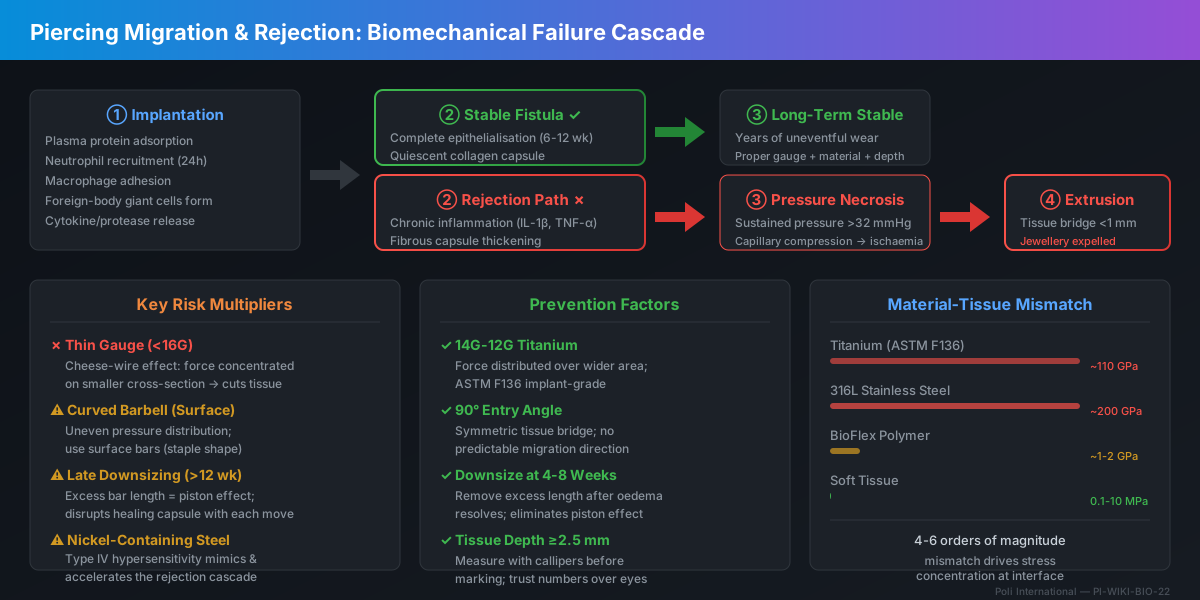
Within hours of implantation, plasma proteins adsorb onto the jewelry surface, forming a provisional matrix. Neutrophils arrive within 24 hours, followed by macrophages that attempt to phagocytose particles too large to ingest. When frustrated phagocytosis fails, macrophages fuse into foreign-body giant cells (FBGCs) that secrete degradative enzymes and reactive oxygen species. This is the critical fork: if the implant is biocompatible and mechanically stable, the FBGC layer transitions to a quiescent fibrous capsule. If mechanical irritation persists or the material is pro-inflammatory, the capsule thickens and contracts, pushing the implant toward the surface, the biomechanical origin of rejection.
Fistula vs Surface: Two Host Responses
Channel piercings (ear lobe, helix, septum) form a fistula, a fully epithelialised tunnel lined with stratified squamous epithelium and supported by a collagen-rich capsule. This is the body's most stable implant accommodation: the epithelium creates a biological barrier between the implant and living tissue, while the collagen capsule distributes mechanical load. Surface piercings (eyebrow, navel, nape, anti-eyebrow) and dermal anchors lack this complete fistula. They rely on a partial capsule anchored in dermal collagen, with only a thin epithelial collar at the exit point. Without the full tunnel structure, every movement of the jewelry transmits shear force directly to the capsule, triggering chronic low-grade inflammation that drives migration.
Pressure Necrosis: The Ischaemic Threshold
Sustained pressure on soft tissue compresses capillaries, reducing perfusion below the critical threshold of approximately 32 mmHg (capillary closing pressure in skin). When jewelry mass or external compression (sleeping position, clothing, seatbelts) exceeds this threshold for prolonged periods, tissue ischaemia develops. Ischaemic tissue releases damage-associated molecular patterns (DAMPs) that amplify the inflammatory response, accelerating capsule thickening and contracture. The result is a vicious cycle: inflammation thickens the capsule, the thicker capsule applies more pressure, and the increased pressure drives further ischaemia, clinically visible as the blanched, thinned skin overlying a migrating surface piercing.
The Cheese-Wire Effect: Gauge and Mechanical Advantage
Thinner gauges (18G-16G, 1.0-1.2 mm) concentrate force over a smaller cross-sectional area, increasing the pressure per unit area at the tissue-implant interface. This is the "cheese-wire effect": the same force that is safely distributed across a 12G (2.0 mm) post becomes destructive when applied through a 16G post. Combined with the leverage of externally mounted jewellery (gems, balls, spikes), even minor daily movement, turning in sleep, clothing friction, athletic activity, generates enough shear to progressively cut through the healing capsule. For high-movement anatomical sites (navel, eyebrow, nape), increasing gauge by even one size (16G→14G) reduces interfacial pressure by approximately 36% for the same applied force.
Material Flexibility and Tissue Compliance
Rigid metal implants (titanium, steel) have elastic moduli in the range of 100-200 GPa. Soft tissue has an elastic modulus of approximately 0.1-10 MPa, a difference of four to six orders of magnitude. This stiffness mismatch means that every tissue deformation (facial expression, abdominal flexion, neck rotation) creates stress concentration at the implant-tissue interface. Flexible polymers (BioFlex, PTFE) with elastic moduli closer to 1-2 GPa reduce this mismatch by two orders of magnitude, allowing the implant to deform with the tissue rather than resist it. Clinical observation supports a 40-60% reduction in rejection rates when flexible retainers replace rigid metal in high-movement anatomical sites.
Anatomical Risk Stratification
Rejection risk varies dramatically by anatomical site. High-movement zones (navel: abdominal flexion 50-100x/day; eyebrow: frontalis muscle activation during facial expression; nape: cervical spine rotation) combine mechanical stress with thin dermal thickness (0.5-1.5 mm vs 2-4 mm on the ear lobe). Low-movement zones (ear lobe, helix, septum) benefit from thicker dermis, minimal muscle traction, and the protective cartilaginous framework that resists deformation. Dermal anchors in the chest and zygomatic regions represent an intermediate risk: good dermal thickness but significant expression-related movement.
Migration Prevention Protocol
A systematic approach to minimise rejection risk through placement, sizing and aftercare. Each step addresses a specific biomechanical failure mode.
- 1Assess tissue depth with callipers: confirm ≥2.5 mm dermal thickness at the proposed site before marking
- 2Select gauge proportional to anatomical load: 14G minimum for eyebrow/navel; 12G preferred for nape and high-movement surface placements
- 3Prefer titanium (ASTM F136) or flexible polymer (BioFlex) over steel for surface piercings: lower inflammatory profile reduces capsule thickness
- 4Minimise external jewellery profile during healing: flat discs or low-profile ends reduce leverage and snag risk
- 5Mark placement parallel to relaxed skin tension lines (RSTLs): perpendicular placement doubles shear stress during normal movement
- 6Use 90° needle entry angle for surface piercings: angled entry creates asymmetric tissue bridges that migrate predictably toward the thinner side
- 7Downsize jewellery at 4-8 weeks: once initial oedema resolves, excess bar length creates a piston effect that disrupts the healing capsule
- 8Advise sleeping position modification: avoid direct pressure on healing piercing for minimum 8 weeks (travel pillow for ear piercings, back-sleeping for navel)
- 9Instruct on clothing friction management: high-waisted garments on navel piercings, tight collars on nape piercings, hat brims on eyebrow piercings
- 10Monitor for early rejection signs: blanching of overlying skin, visible jewellery outline through thinning tissue, persistent serous discharge beyond week 4
- 11At first sign of migration (>2 mm shift or tissue thinning), downsize immediately or switch to flexible retainer, do not wait for the "next check-up"
- 12If overlying tissue thickness drops below 1 mm (measured), remove jewellery immediately: further retention guarantees scarring from extrusion
- 13Document baseline photographs at every check-up: migration is measured as positional change, not subjective impression
- 14For dermal anchors: ensure footplate diameter ≥3.5 mm and confirm full tissue pocket depth before insertion, shallow placement is the #1 cause of early anchor loss
Clinical Mistakes That Guarantee Migration
These errors convert a preventable risk into an inevitable outcome. Each has been observed in clinical practice and is avoidable with proper technique.
- ✕Placing surface jewellery at 16G or thinner in high-movement sites: the cheese-wire effect ensures migration within 6-12 weeks regardless of aftercare
- ✕Using externally threaded jewellery for initial surface piercings: the thread profile creates micro-tears in the healing capsule with every movement, seeding chronic inflammation
- ✕Delaying downsizing beyond 12 weeks: the excess bar length acts as a piston, mechanically disrupting the epithelial collar with each movement cycle
- ✕Placing surface anchors in scar tissue or previously rejected sites: compromised vascular supply and abnormal collagen architecture preclude stable encapsulation
- ✕Allowing client to rotate or twist jewellery during healing: rotational shear destroys the fragile epithelial attachment and introduces bacteria into the fistula
- ✕Failing to account for occupational mechanical stress: chefs (abdominal heat/movement on navel), athletes (repeated trauma), musicians (instrument pressure on chest/neck)
- ✕Using curved barbells for surface piercings: the curvature creates uneven pressure distribution, concentrating force at the apex and both exit points, use surface bars (staple shape) exclusively
- ✕Ignoring early migration signs because "it is still in": by the time the jewellery is clearly closer to the surface, the tissue bridge is already too thin to salvage
- ✕Re-piercing through a rejected site without addressing the original biomechanical cause: the same forces will produce the same outcome, often faster due to scar tissue compromise
- ✕Neglecting material verification: nickel-containing steel (316L surgical steel is NOT implant-grade) triggers Type IV hypersensitivity that mimics and accelerates the rejection cascade
Regulatory Status of Dermal and Surface Implants
Classification of surface and dermal anchor jewellery across major regulatory jurisdictions. Piercers must verify they are using devices approved for long-term soft-tissue implantation, not temporary-wear components.
- EU MDR 2017/745: Surface bars and dermal anchors classified as Class I medical devices when not intended for >30 day implantation (Rule 5); Class IIb if intended for >30 days (long-term surgically invasive)
- EN 1811:2011+A1:2015: Nickel release limit ≤0.5 μg/cm²/week for post-assembly articles intended for direct and prolonged skin contact
- UK MDR 2002 (as amended): Mirrors EU classification; post-Brexit UKCA marking required for devices placed on GB market from July 2025
- ISO 10993-1:2018: Biological evaluation of medical devices, surface bars and anchors require cytotoxicity (Part 5), sensitisation (Part 10), and implantation testing (Part 6) for >30 day contact duration
- REACH Annex XVII Entry 27: Restricts nickel in articles intended to come into direct and prolonged contact with skin unless nickel release rate is below 0.5 μg/cm²/week
- FDA 21 CFR 878: Surface bars and dermal anchors as Class I devices (general controls) if intended for temporary implantation (<30 days); Class II (510(k)) for long-term implantation
- ASTM F136-13: Standard specification for wrought titanium-6Al-4V ELI alloy for surgical implant applications, the material standard for implant-grade titanium body jewellery
- ASTM F138-19: Standard specification for wrought 18Cr-14Ni-2.5Mo stainless steel bar and wire for surgical implants, 316LVM, vacuum-melt grade, NOT standard 316L
- California Safe Body Art Act (AB 300): Requires nickel-free certification for initial piercing jewellery; titanium, niobium, and solid 14k+ gold are compliant materials
- OSHA Bloodborne Pathogens Standard 29 CFR 1910.1030: Applies to all body art procedures involving sharps; requires engineering controls and work practice controls for surface anchor insertion
- AMDD 2014: ASEAN Medical Device Directive, surface bars and dermal anchors classified by risk (Class A: low risk, short-term; Class B: low-moderate, long-term)
- Thailand FDA: Medical Device Act B.E. 2551 (2008), imported body jewellery with implant claims requires registration as Class 1 medical device
- Australia TGA: Therapeutic Goods (Medical Devices) Regulations 2002, Class IIb for devices intended for >30 day implantation in soft tissue
- Singapore HSA: Health Products (Medical Devices) Regulations 2010, Class B for surgically invasive devices intended for short-term use (<30 days); Class C for long-term (>30 days)
- ISO 10993-6:2016: Tests for local effects after implantation, required for regulatory submission across all three jurisdictions for >30 day implant duration
Patrick's Note
"I have seen more piercings lost to migration than to infection, and the tragedy is that most were preventable. A 14G titanium surface bar placed at 90° with proper depth, downsized at 6 weeks, has an excellent chance of lasting years. The same piercing at 16G surgical steel with a curved barbell, left too long and never downsized: I would give it 3 months, maybe 6. The difference is all biomechanics. Read our Piercing Guides at `/blog/?category=Piercing%20Guides` for practical articles that translate this science into studio decisions. And if you are placing surface work: buy a calliper, use it on every client, and trust the numbers over your eyes."
Founder & Piercing Expert
Poli International
**Related Topics**
- »Needle Geometry and Physics, `/wiki/needle-geometry-physics/`
- »Anthropometry and Jewellery Sizing, `/wiki/anthropometry-jewelry-sizing/`
- »Wound Healing Biology, `/wiki/wound-healing-biology/`
- »Nickel Allergy and Sensitisation, `/wiki/nickel-allergy-sensitization/`
- »Ergonomics in Body Art, `/wiki/ergonomics-body-art/`
- »Piercing Guides (Journal), `/blog/?category=Piercing%20Guides`
Technical Specifications
| Parameter | Standard / Value |
|---|---|
| Capillary closing pressure (skin) | ~32 mmHg, sustained pressure above this threshold causes tissue ischaemia |
| Minimum tissue depth (surface anchors) | 2.5-3.0 mm below dermal-epidermal junction |
| Minimum footplate diameter (dermal anchors) | >3.5 mm for adequate load distribution |
| Optimal gauge (surface piercings) | 14G-12G (1.6-2.0 mm), wider cross-section distributes force |
| Jewellery mass limit (eyebrow/navel) | <2 g to minimise gravitational pull during healing |
| Titanium elastic modulus (Ti-6Al-4V ELI) | ~110 GPa (ASTM F136 compliant) |
| Soft tissue elastic modulus | 0.1-10 MPa, 4-6 orders of magnitude below implant metals |
| BioFlex elastic modulus | ~1-2 GPa, two orders closer to tissue compliance than titanium |
| Fistula epithelialisation window | 6-12 weeks for initial lining; full collagen remodelling at 6-12 months |
| Downsizing window | 4-8 weeks post-procedure (after oedema resolves, before fistula stabilises) |
| Surface piercing 12-month rejection rate | 30-50% without optimal placement, gauge selection, and aftercare |
| Migration definition | >2 mm positional shift within 4 weeks |
| Rejection definition | Visible thinning of overlying tissue with ≤1 mm tissue bridge remaining |
| Needle entry angle (surface piercings) | 90° to tissue surface, angled entry creates asymmetric migration |
| Pressure reduction from 16G→14G upsize | ~36% reduction in interfacial pressure per unit area for equivalent applied force |
References
- [1]Anderson JM, Rodriguez A, Chang DT. Foreign body reaction to biomaterials. Semin Immunol. 2008 Apr;20(2):86-100. PMID: 18162407. https://pubmed.ncbi.nlm.nih.gov/18162407/https://pubmed.ncbi.nlm.nih.gov/18162407/
- [2]Klopfleisch R, Jung F. The pathology of the foreign body reaction against biomaterials. J Biomed Mater Res A. 2017 Mar;105(3):927-940. PMID: 27813288. https://pubmed.ncbi.nlm.nih.gov/27813288/https://pubmed.ncbi.nlm.nih.gov/27813288/
- [3]Sheikh Z, Brooks PJ, Barzilay O, Fine N, Glogauer M. Macrophages, foreign body giant cells and their response to implantable biomaterials. Materials (Basel). 2015 Aug 28;8(9):5671-5701. PMID: 28793529. https://pubmed.ncbi.nlm.nih.gov/28793529/https://pubmed.ncbi.nlm.nih.gov/28793529/
- [4]Williams DF. On the mechanisms of biocompatibility. Biomaterials. 2008 Jul;29(20):2941-53. PMID: 18440630. https://pubmed.ncbi.nlm.nih.gov/18440630/https://pubmed.ncbi.nlm.nih.gov/18440630/
- [5]Ratner BD. A pore way to heal and regenerate: 21st century thinking on biocompatibility. Regen Biomater. 2016 Jun;3(2):107-10. PMID: 27047676. https://pubmed.ncbi.nlm.nih.gov/27047676/https://pubmed.ncbi.nlm.nih.gov/27047676/
- [6]Association of Professional Piercers (APP). Picking Your Piercer and Aftercare Guidelines. https://www.safepiercing.org/https://www.safepiercing.org/
- [7]ASTM F136-13. Standard Specification for Wrought Titanium-6Aluminum-4Vanadium ELI (Extra Low Interstitial) Alloy for Surgical Implant Applications. ASTM International, 2013. https://www.astm.org/f0136-13.htmlhttps://www.astm.org/f0136-13.html
- [8]ISO 10993-1:2018. Biological evaluation of medical devices, Part 1: Evaluation and testing within a risk management process. International Organization for Standardization. https://www.iso.org/standard/68936.htmlhttps://www.iso.org/standard/68936.html
- [9]ISO 10993-6:2016. Biological evaluation of medical devices, Part 6: Tests for local effects after implantation. International Organization for Standardization. https://www.iso.org/standard/61089.htmlhttps://www.iso.org/standard/61089.html
- [10]EU MDR 2017/745. Regulation (EU) 2017/745 on medical devices. Annex VIII: Classification rules, Rule 5 (invasive devices). https://eur-lex.europa.eu/eli/reg/2017/745/ojhttps://eur-lex.europa.eu/eli/reg/2017/745/oj
- [11]FDA. Tattoos, Temporary Tattoos & Permanent Makeup: Safety and Regulatory Information. U.S. Food and Drug Administration. https://www.fda.gov/cosmetics/cosmetic-products/tattoos-permanent-makeuphttps://www.fda.gov/cosmetics/cosmetic-products/tattoos-permanent-makeup
- [12]California Safe Body Art Act (AB 300, 2011). California Health and Safety Code §§ 119300-119328. https://leginfo.legislature.ca.gov/faces/billNavClient.xhtml?bill_id=201120120AB300https://leginfo.legislature.ca.gov/faces/billNavClient.xhtml?bill_id=201120120AB300
- [13]Surface topography steer soft tissue response and antibacterial function at the transmucosal region of titanium implant. Int J Nanomedicine. 2024. PMID: 38828200. https://pubmed.ncbi.nlm.nih.gov/38828200/https://pubmed.ncbi.nlm.nih.gov/38828200/
- [14]Biocompatibility comparison of novel soft tissue implants vs commonly used biomaterials in a pig model. Otolaryngol Head Neck Surg. 2012 Sep;147(3):456-61. PMID: 22687327. https://pubmed.ncbi.nlm.nih.gov/22687327/https://pubmed.ncbi.nlm.nih.gov/22687327/
- [15]OSHA Bloodborne Pathogens Standard. 29 CFR 1910.1030. Occupational Safety and Health Administration. https://www.osha.gov/laws-regs/regulations/standardnumber/1910/1910.1030https://www.osha.gov/laws-regs/regulations/standardnumber/1910/1910.1030
Put Science Into Practice
This technical standard is the architectural foundation for our professional analytical tools.