
Type IV Hypersensitivity Beyond Nickel: Reading the Allergen Panel

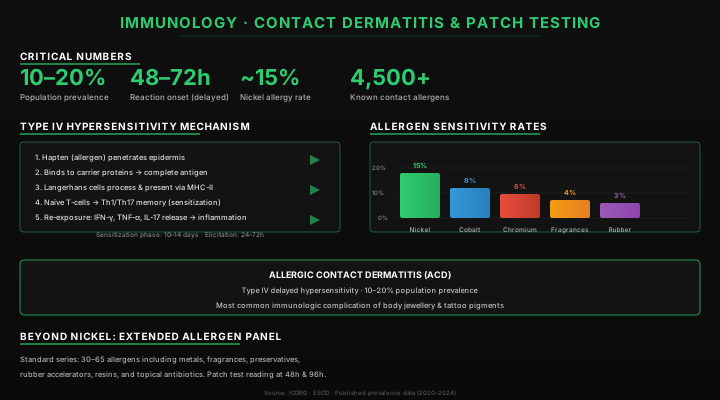
Allergic contact dermatitis (ACD) is a Type IV delayed hypersensitivity reaction that affects 10-20% of the general population and is the most common immunologic complication of body jewellery and tattoo pigments. While nickel is the best-known sensitiser, the clinical picture extends to cobalt, chromium, palladium, azo pigments (particularly reds and yellows), paraphenylenediamine (PPD in black henna), and acrylates in aftercare products. Patch testing, the application of standardised allergen panels to the back under occlusion for 48-96 hours, is the diagnostic gold standard. Understanding the immunology behind the reaction and the full allergen panel allows studios to select materials and pigments for sensitised clients and to recognise ACD when it presents days to weeks after the procedure.
⚡ Quick Reference
Critical Numbers
- Nickel allergy prevalence (general population)10-17% of adults; 15-25% of women (ear piercing is the strongest risk factor)
- Cobalt and chromium co-sensitisation25-50% of nickel-allergic individuals also react to cobalt; 10-20% to chromium
- PPD sensitisation from black hennaprevalence up to 15% in populations with henna tattoo exposure; reaction can be severe (bullous, systemic)
- Type IV reaction latency24-72 hours after re-exposure in sensitised individuals; 10-14 days for primary sensitisation
- Patch test reading schedule48 hours (first read), 72-96 hours (second read); late reactions at 7 days indicate metals (cobalt, gold)
- Titanium allergy prevalence<1%, true titanium allergy is extremely rare; most reactions attributed to titanium are actually mechanical irritation or nickel contamination
- Azo pigment ACDRed pigments (Pigment Red 22, 170) are the most common sensitisers; yellow and orange azo pigments also documented
- Tattoo granuloma vs ACDgranulomas are non-allergic foreign-body reactions (Type IV granulomatous, not hypersensitivity); misdiagnosis leads to unnecessary metal avoidance
- PPD cross-reactivityindividuals sensitised to PPD may react to azo dyes, benzocaine, sulfonamides, and para-aminobenzoic acid (PABA in sunscreens)
- Patch test TRUE Teststandard North American panel is 35 allergens + negative control; European baseline series is 30 allergens
Immunological and clinical benchmarks for contact dermatitis in body art contexts.
Nickel allergy gets the headlines, but the contact dermatitis story in body art is broader and more complex than one metal. Cobalt in blue tattoo pigments, chromium in green, PPD in black henna, acrylates in aftercare sprays, each has its own sensitisation profile, latency, and cross-reactivity pattern. And when a client presents with a red, pruritic, scaling rash around a piercing or within a tattoo two weeks after the procedure, the differential diagnosis includes ACD, irritant contact dermatitis, infection, and granulomatous reaction. Getting this right determines whether the solution is jewellery replacement, pigment avoidance, or antibiotics, three completely different paths.
Type IV Hypersensitivity: The Immunology
Unlike Type I (immediate, IgE-mediated) allergies, Type IV hypersensitivity is cell-mediated, involving sensitised T lymphocytes rather than antibodies. On first exposure to a hapten (a small molecule that becomes allergenic when bound to a skin protein), Langerhans cells in the epidermis capture the hapten-protein complex, migrate to regional lymph nodes, and present it to naïve T cells. This sensitisation phase takes 10-14 days and produces no visible symptoms. On re-exposure, memory T cells recognise the hapten-protein complex and release pro-inflammatory cytokines (IFN-γ, IL-17), recruiting macrophages and additional lymphocytes to the site. The clinical result, erythema, papules, vesicles, pruritus, and scaling, appears 24-72 hours after re-exposure. The key diagnostic feature that distinguishes ACD from irritant dermatitis: ACD requires prior sensitisation and has a delayed onset; irritant dermatitis occurs on first exposure and appears within hours. For piercings and tattoos, this means a client who has worn nickel-containing jewellery for years without symptoms can suddenly develop ACD, they were being sensitised, not immune.
Beyond Nickel: The Extended Allergen Panel
Cobalt (CI 77346, used in blue pigments) is the second most common metal sensitiser, with co-sensitisation in 25-50% of nickel-allergic individuals. Chromium (CI 77288, green pigments) is the third, with particular relevance to tattoo pigments containing chromium oxide green. Palladium, increasingly used in "nickel-free" white gold jewellery, cross-reacts with nickel in 30-40% of nickel-allergic patients, meaning "nickel-free" does not guarantee "hypoallergenic" for palladium-containing alloys. PPD (paraphenylenediamine), the primary sensitiser in black henna tattoos, is a potent contact allergen that can produce severe bullous reactions within 24-72 hours of exposure. The clinical danger of black henna is that it sensitises the individual to PPD, after which any future exposure, including to permanent hair dyes, textile dyes, and some tattoo pigments, can trigger progressively more severe reactions. Azo pigments in red, orange, and yellow tattoo inks are recognised sensitisers, with Pigment Red 22 and Pigment Red 170 being the most frequently implicated. The diagnosis of tattoo pigment ACD is challenging because the reaction onset (days to weeks) overlaps with normal healing and infection timelines.
Patch Testing: The Diagnostic Gold Standard
Patch testing involves applying standardised allergen preparations to the upper back under aluminium or plastic chambers (Finn chambers) secured with hypoallergenic tape. The patches remain in place for 48 hours and are read at 48 hours (removal), 72-96 hours (delayed reading), and sometimes at 7 days (late reactions to metals and corticosteroids). A positive reaction is graded from + (erythema, infiltration, discrete papules) to +++ (coalescing vesicles, bullous reaction). Patch testing must be performed and interpreted by a dermatologist or allergist with specific training, this is not a home test or a studio procedure. The referral path: when a client presents with suspected ACD, the studio should recommend dermatology referral with specific note of the suspected allergen (e.g., "suspected nickel ACD from piercing jewellery, request patch test including metal series and tattoo pigment series if available"). The dermatologist will determine whether the standard series or extended series (metals, acrylates, tattoo pigments) is indicated.
Studio Protocol: Recognising and Referring ACD
A systematic approach to identifying suspected allergic contact dermatitis and directing clients to appropriate medical care.
- 1Document the presentation: photograph the site, record onset date relative to procedure/brand change, describe the rash (papules, vesicles, scaling, distribution), note pruritus severity
- 2Distinguish ACD from infection: ACD is pruritic (itchy) with dry, scaling papules/vesicles; infection is painful with purulent discharge and warmth. ACD spares systemic symptoms; infection may cause fever.
- 3Identify the likely allergen: jewellery site ACD → metals (Ni, Co, Cr, Pd); tattoo site ACD → pigments (red azo, PPD); aftercare product ACD → acrylates, preservatives, fragrances
- 4Recommend jewellery removal or replacement: for suspected metal ACD, replace with ASTM F136 titanium or BioFlex polymer; do not simply replace with another metal without patch test confirmation
- 5Refer to dermatology: provide written summary including procedure date, symptom onset, suspected allergen, and request for patch testing with appropriate allergen series
- 6Document for studio records: allergen reactions are reportable adverse events; maintain records for liability protection and future client screening
- 7Screen future clients: ask about known metal allergies before piercing; document metal allergy status in client records; for tattoo clients with known PPD allergy, avoid azo pigments
- 8Distinguish granuloma from ACD: granulomas are firm, non-pruritic nodules appearing weeks to months post-procedure, these are foreign-body reactions, not allergies; referral is still indicated but path is different (dermatology for intralesional steroids vs patch testing)
Common Misdiagnoses
Errors that delay correct diagnosis and treatment of body art-associated contact dermatitis.
- ✕Assuming all metal reactions are nickel allergy: cobalt and palladium produce identical clinical presentations, patch testing is required for specific identification
- ✕Treating ACD with topical antibiotics: ACD is not an infection; antibiotics do nothing and may introduce additional sensitisers (neomycin is a common contact allergen itself)
- ✕Replacing jewellery with "hypoallergenic" or "surgical steel" without verifying composition: "surgical steel" has no legal definition; 316L steel contains 10-14% nickel
- ✕Dismissing delayed tattoo reactions as "normal healing": reactions appearing 2-3 weeks after tattooing are never normal healing, they require investigation
- ✕Ignoring PPD sensitisation risk from black henna: a single black henna tattoo can produce lifelong PPD allergy with cross-reactivity to multiple common chemicals
- ✕Confusing titanium allergy with mechanical irritation: true titanium allergy is so rare (<1%) that a reaction to titanium jewellery is almost always either nickel contamination or mechanical trauma
Allergen Labelling and Nickel Regulation
Regulatory requirements for allergen disclosure in body jewellery and tattoo pigments.
- EU Nickel Directive (REACH Annex XVII Entry 27): nickel release limit ≤0.5 μg/cm²/week for articles intended for direct and prolonged skin contact, this applies to all body jewellery
- EN 1811:2011+A1:2015: Standardised test method for nickel release from post-assembly articles; compliance with this standard is the only legally recognised demonstration of nickel compliance
- EU Cosmetics Regulation: PPD restricted to ≤2% in hair dyes; prohibited in skin-contact products, black henna containing PPD is illegal
- Labelling: no specific requirement for allergen labelling on body jewellery beyond nickel compliance; voluntary "nickel-free" claims must be verifiable
- No federal nickel restriction: the US has no equivalent to the EU Nickel Directive; nickel content in body jewellery is unregulated at the federal level
- California Safe Body Art Act (AB 300): requires nickel-free certification for initial piercing jewellery; the only US state-level nickel restriction
- FDA: PPD is not approved for skin application; black henna products containing PPD are adulterated cosmetics and subject to FDA enforcement
- ASTM F136 (titanium) and F138 (stainless steel): material specifications do not guarantee hypoallergenicity, they specify composition, not biological reactivity
- No unified ASEAN nickel restriction; individual member states may reference EU standards in national regulation
- Australia: no mandatory nickel restriction for body jewellery; voluntary compliance with EU Nickel Directive is industry best practice
- Thailand: jewellery export standards reference EU nickel limits but domestic regulation for body jewellery is limited
- Labelling gap: no jurisdiction currently requires allergen patch test data on body jewellery or tattoo pigment packaging
Patrick's Note
"I wish every studio had a dermatologist on speed dial, but the reality is that most clients with suspected allergies will come to you first. Your job is not to diagnose, it is to recognise the pattern, document it, and refer. Learn the difference between ACD (itchy, dry, papular) and infection (painful, purulent, warm). Learn that titanium allergy is almost never the answer, it is usually nickel contamination or mechanical irritation. And for the love of your clients: do not ever offer black henna tattoos. One temporary design can create a permanent PPD allergy that follows them for life. Our Allergy Patch Test Guide at `/tools/` has more detail. Read our Dermatology articles at `/blog/?category=Dermatology`."
Founder & Piercing Expert
Poli International
**Related Topics**
- »Nickel Allergy and Sensitisation, `/wiki/nickel-allergy-sensitization/`
- »Skin Optics and Pigment Appearance, `/wiki/skin-optics-pigment-appearance/`
- »Ink Toxicology, `/wiki/ink-toxicology-regulatory/`
- »Infection Triage, `/wiki/infection-triage-microbiology/`
- »Dermatology (Journal), `/blog/?category=Dermatology`
Technical Specifications
| Parameter | Standard / Value |
|---|---|
| Nickel allergy prevalence (adults) | 10-17%; 15-25% of women (ear piercing is #1 risk factor) |
| Cobalt/nickel co-sensitisation | 25-50% of nickel-allergic individuals |
| Titanium allergy prevalence | <1%, true titanium allergy extremely rare |
| PPD sensitisation from black henna | Up to 15% with henna tattoo exposure |
| Type IV sensitisation phase | 10-14 days on first exposure (asymptomatic) |
| Type IV reaction latency (re-exposure) | 24-72 hours |
| Patch test reading schedule | 48h (removal), 72-96h (delayed), 7 days (metals) |
| EU nickel release limit | ≤0.5 μg/cm²/week (EN 1811) |
| 316L steel nickel content | 10-14%, "surgical steel" is not nickel-free |
| Palladium/nickel cross-reactivity | 30-40% of nickel-allergic patients |
| TRUE Test panel size | 35 allergens + negative control (North American standard) |
| Red pigment ACD sensitisers | Pigment Red 22, Pigment Red 170 most frequently implicated |
| PPD cross-reactivity | Azo dyes, benzocaine, sulfonamides, PABA (sunscreens) |
| ACD vs irritant dermatitis distinction | ACD: delayed, requires prior sensitisation; Irritant: immediate, first exposure |
| Granuloma vs ACD | Granuloma: firm, non-pruritic nodules, weeks-months onset; ACD: pruritic, papular/vesicular, days-weeks |
References
- [1]Thyssen JP, Menné T. Metal allergy, a review on exposures, penetration, genetics, prevalence, and clinical implications. Chem Res Toxicol. 2010 Feb 15;23(2):309-18. PMID: 19831422.
- [2]Torres F, das Graças M, Melo M, Tosti A. Management of contact dermatitis due to nickel allergy: an update. Clin Cosmet Investig Dermatol. 2009 Apr 17;2:39-48. PMID: 21436967.
- [3]Liden C, Skare L, Vahter M. Release of nickel from coins and deposition onto skin from coin handling. Sci Total Environ. 2008;398(1-3):16-20.
- [4]Basketter DA, Angelini G, Ingber A, Kern PS, Menné T. Nickel, cobalt and chromium in consumer products: a role in allergic contact dermatitis? Contact Dermatitis. 2003;49(1):1-7.
- [5]Ortiz KJ, Yiannias JA. Contact dermatitis to cosmetics, fragrances, and botanicals. Dermatol Ther. 2004;17(3):264-71.
- [6]Sosted H, Johansen JD, Andersen KE, Menné T. Severe allergic hair dye reactions in 8 children. Contact Dermatitis. 2006;54(2):87-91.
- [7]Serup J, Hutton Carlsen K. Patch test study of 90 patients with tattoo reactions. Contact Dermatitis. 2014;71(5):255-63.
- [8]EU REACH Annex XVII Entry 27. Restriction on nickel and its compounds. https://echa.europa.eu/https://echa.europa.eu/
- [9]EN 1811:2011+A1:2015. Reference test method for release of nickel from post-assembly articles. CEN.
- [10]California Safe Body Art Act. AB 300, 2011. https://leginfo.legislature.ca.gov/https://leginfo.legislature.ca.gov/
- [11]FDA. Temporary Tattoos, Henna/Mehndi, and "Black Henna." https://www.fda.gov/cosmetics/https://www.fda.gov/cosmetics/
- [12]Mowad CM, Marks JG. Allergic contact dermatitis. In: Bolognia JL, ed. Dermatology. 4th ed. Elsevier, 2018.
- [13]Fonacier L, Bernstein DI, Pacheco K, et al. Contact dermatitis: a practice parameter update 2015. J Allergy Clin Immunol Pract. 2015;3(3 Suppl):S1-39.
- [14]Krob HA, Fleischer AB, D'Agostino R. Prevalence and relevance of contact dermatitis allergens. J Am Acad Dermatol. 2004;51(3):419-25.
- [15]Lachapelle JM, Maibach HI. Patch Testing and Prick Testing: A Practical Guide. 3rd ed. Springer, 2012.
Put Science Into Practice
This technical standard is the architectural foundation for our professional analytical tools.