
What Is Actually In The Tub: Aftercare Ingredients And The Evidence

Aftercare advice in body art is usually a brand name. This reference is the layer underneath it: what the four functional ingredient classes actually do to a healing wound, what the controlled evidence says about moist versus dry healing, which aftercare ingredients carry a measured sensitisation risk and which carry a marketed one, and which regulatory regime the tub in the client's hand is actually sold under. It deliberately does not restate the cellular healing phases, which belong to the Wound Healing Biology page, and it does not restate the day-by-day client protocol, which is in the Journal article on aftercare. What it adds is the chemistry, the numbers behind it, and an honest map of where the evidence runs out.
Ask ten artists what a client should put on a fresh piece and you will get ten brand names and very little chemistry. That is the gap this page fills. The healing itself is biology and it is covered elsewhere. What happens on top of the healing is formulation: a mixture of oils, waxes, water-binding molecules, preservatives and, frequently, fragrance, applied several times a day to skin whose barrier has been deliberately perforated. Every one of those components has a measurable effect on transepidermal water loss, on the microbial load the surface can support, and on the chance that the client returns with something that looks like an infection and is actually an irritant reaction to the product you recommended. None of that is visible from the label, because cosmetic labels are written for a retail shelf and not for a wound.
Why Moist Beats Dry, And What That Result Actually Says
The founding experiment is Winter's 1962 work on superficial wounds in young domestic pigs: wounds covered with an occlusive film re-epithelialised faster than wounds allowed to dry and scab [1]. Sixty years of clinical wound care have rested on that finding, and the modern reviews are consistent with it, reporting that moist and wet environments promote re-epithelialisation and result in less scarring than dry treatment [2]. For body art this matters in a specific way. A tattoo is a wide, shallow, uniformly distributed epidermal and papillary-dermal injury, which is close to the geometry Winter was studying. A piercing is a narrow, deep, tubular injury that must not close, which is not. Transferring a moist-healing conclusion from one to the other is the single most common category error in aftercare advice. Moist healing addresses the surface of a wound that is meant to close; a piercing channel is a wound that is meant to stay open and epithelialise inward. The evidence base for the first does not automatically license a regimen for the second, and this page does not pretend that it does. Note also what the moist-healing literature does not establish: it compares dressing environments, not product brands, and it does not settle how long a body-art client should keep applying anything.
Occlusives, Humectants, Emollients And Actives Are Four Different Jobs
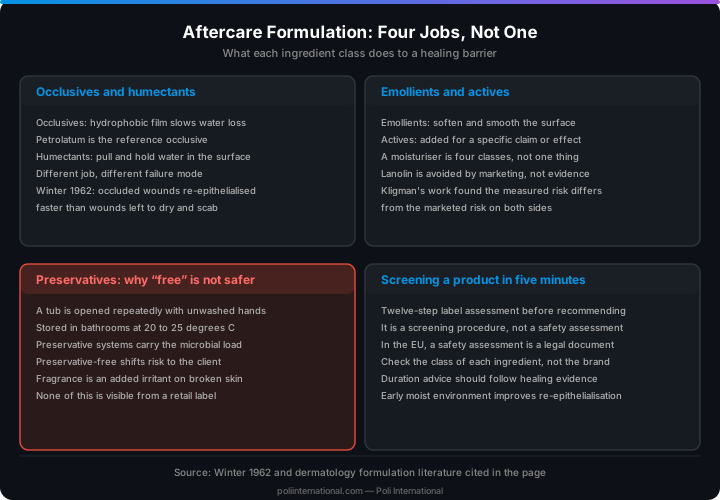
A moisturiser is not one thing. The dermatology literature divides the function into classes that behave differently on broken skin [3]. Occlusives form a hydrophobic film that physically slows transepidermal water loss; petrolatum is the reference compound and the benchmark against which the others are measured. Humectants, glycerol and urea among them, are hygroscopic and draw water both from the environment and from the deeper skin, which means that a humectant applied in dry air can move water the wrong way unless an occlusive holds it. Emollients are lipids that fill the spaces between corneocytes and change how the surface feels and reflects light, which is why a product can be judged excellent by a client on texture alone while doing very little for the barrier. Actives are the small group with a specific pharmacological claim, of which dexpanthenol has the clearest evidence in this context: in a controlled irritation model it significantly accelerated barrier repair and reduced erythema against both the vehicle and untreated skin [7]. The practical consequence is that 'which cream' is the wrong question. The right question is which class the healing site needs at that moment, and the answer changes between day two and week three. One more detail from the same literature is worth more than most product claims: applying on damp skin rather than dry skin materially increases what the client gets out of the same tub [3].
The Allergen Audit: Measured Risk Versus Marketed Risk
Two ingredients dominate aftercare marketing, and the evidence does not line up with the marketing. Lanolin is the ingredient the market avoids: 'lanolin free' is printed on products that never contained it. Kligman's review of that reputation concluded that lanolin is at most a weak contact allergen, that nobody has succeeded in sensitising animals or humans to lanolin or wool wax alcohols, and that most of the case reports are false positives associated with angry back syndrome [4]. That verdict is now contested. The American Contact Dermatitis Society named lanolin its 2023 Allergen of the Year: it remains a rare sensitiser on healthy skin, but people with chronic inflammatory skin conditions are at higher risk, and the right patch-test preparation is still disputed [14]. A healing wound is damaged skin, so lanolin is a low risk, not no risk. Essential oils are the ingredients the market promotes, and they carry the measured risk. In the largest patch-test series of its kind, covering 62,354 patients across North American and central European networks, 18.6% reacted to at least one fragrance marker or essential oil, and 1.4% reacted to an essential oil while testing negative to all three standard fragrance markers, meaning a routine fragrance screen misses them [5]. Within that group, oxidised tea tree oil, tested in the North American network only, is the standout: its prevalence there was only 0.3%, but it produced 45% of the reactions among the 140 North American patients who reacted to an essential oil and nothing else, half of those were strong (++ or +++), and 52.4% were judged of definite or probable clinical relevance [5]. Tea tree oil is the single most commonly recommended 'natural' aftercare addition in the piercing world. That is the inversion worth remembering: the ingredient the industry strips out is a rare sensitiser, and the ingredient the industry adds is the one with a documented, clinically relevant sensitisation signal. Aloe vera sits in a third category, neither risky nor useful: a Cochrane review of seven randomised trials in 347 participants found no high-quality evidence of benefit for acute or chronic wounds, and in one trial of surgical wounds healing by secondary intention aloe significantly delayed healing by a mean of 30 days [6].
Preservatives, And Why Preservative-Free Is Not The Safer Option
Preservative systems are the part of the formulation clients are most suspicious of and the part a healing wound most depends on. A tub of emollient is repeatedly opened with unwashed hands, stored in a bathroom at 20 to 25 degrees and dipped into for weeks. Without an effective preservative system that is a warm, nutrient-rich inoculation vessel applied directly onto broken skin, and the surface-persistence literature is a reminder that the relevant organisms survive on inanimate surfaces for very long periods rather than dying off between uses [12]. The dermatology reviews list the real adverse-effect profile of moisturisers as sensory irritation, allergic contact dermatitis and non-immunologic contact urticaria, all of which are formulation-dependent and none of which is avoided by removing the preservative [3]. The defensible position is neither 'preservative-free is safer' nor 'preservatives are harmless'. It is that the delivery format decides the risk: a single-use sachet or a pump that never admits a finger removes the contamination problem without removing the preservative, and that is the recommendation to make when a client is genuinely sensitised. A tub with a wide mouth and a long life is the format that forces the trade-off in the first place.
Placement Changes The Regimen, Not Just The Timeline
The formulation question has different answers by site, and the differences are mechanical rather than mystical. A large torso piece is a wide surface under clothing friction and sweat, where an occlusive film both protects against abrasion and traps warmth and moisture, so the class balance shifts with the season and the client's work. Extremities and high-flexion zones move, and a film that cracks at a joint is worse than a thinner layer applied more often. Head and neck sites carry high sebaceous output of their own, which means an added occlusive is frequently redundant and the realistic failure mode is folliculitis rather than dryness. Oral and mucosal sites do not take a topical emollient at all: saliva replaces the entire surface film within minutes, so the formulation question becomes a rinse question, and any product intended for skin is simply swallowed. Cartilage piercings are the site where nothing applied to the surface reaches the part that is healing, because the injury is through a poorly vascularised structure and the product sits on skin either side of it. Surface and dermal placements are the site where an occlusive film most reliably causes harm, by macerating a shallow channel that needs to stay dry enough to hold. The general rule that survives all of these: the product treats the skin around the wound, and the deeper and narrower the wound, the less any topical formulation can do for it.
? Open question, not established
How long should a client keep applying anything?
Aftercare instructions almost universally carry a duration: apply twice daily for two weeks, for a month, until healed. The wound-healing evidence supports the idea that an early moist environment improves re-epithelialisation [1] [2], and the in vivo imaging work shows that epidermal recovery over a fresh tattoo is still incomplete long after the surface looks finished, with pigment deposited around the incision still visible at 84 days in the one fresh tattoo followed [11]. What no study establishes is the point at which continued product application stops helping and starts being an unnecessary daily exposure of a sensitisation-capable formulation to skin that has closed.
Held by: Aftercare brands in their own instructions, and studio convention passed between artists. The two-week and four-week figures in circulation have no published derivation that could be found.
What would settle it: A trial comparing fixed application durations at matched placement and procedure size, with re-epithelialisation, pigment retention and contact-dermatitis incidence as endpoints. Until that exists, a duration in an aftercare sheet is a house convention and should be presented to the client as one.
Reading An Aftercare Label Before You Recommend It
A twelve-step assessment an artist can run on any aftercare product in about five minutes, before it goes on a shelf or into a client's hand. It is a screening procedure, not a safety assessment, which in the EU is a legal document produced by a qualified assessor [8].
- 1Identify the legal category: in the EU and UK this is a cosmetic under Regulation (EC) No 1223/2009, not a medical device, and the obligations that follow are the cosmetic ones [8]
- 2Find the Responsible Person or US distributor address on the pack; a product with no identifiable legal entity behind it has no accountable safety file [8]
- 3Read the full INCI list, not the front-of-pack claim. The front of pack is marketing copy and carries no regulatory meaning
- 4Classify the first five ingredients by function: occlusive, humectant, emollient, active, solvent. That tells you what the product is for far faster than the brand story does [3]
- 5Locate the preservative system and confirm one exists. An unpreserved tub with a wide mouth is a contamination format, whatever its ingredient list says
- 6Search the list for 'parfum', 'fragrance' or any named botanical oil. These are the components carrying the measured sensitisation signal [5]
- 7Check specifically for Melaleuca alternifolia (tea tree). It is the essential oil most frequently missed by a routine fragrance screen and most frequently clinically relevant [5]
- 8Treat 'hypoallergenic', 'dermatologically tested' and 'natural' as having no defined legal content. None of them is a specification
- 9Decide the delivery format: single-use sachet, pump, or open tub. Format decides in-use contamination more than the preservative does
- 10Match the class to the site: occlusive-heavy products for wide flat surfaces, lighter and more frequent for flexion zones, nothing topical for mucosal sites
- 11Record what you recommended, with batch or product name, in the client file. If a reaction follows, the alternative to a record is guesswork between infection and irritant dermatitis
- 12Give the duration as a house convention, not as a clinical fact, because no trial fixes it. Say what you do and why, and tell the client what a problem looks like

Aftercare Failures That Come From The Product, Not The Client
Failure modes where the formulation or the recommendation is the cause. Each is a case where blaming client compliance hides the real defect.
- Recommending a tea tree oil product to a healing piercing — this is the essential oil with the strongest clinically relevant patch-test signal and the one a standard fragrance screen most often misses [5]
- Stripping lanolin from a recommendation to avoid an allergy that is rare, and replacing it with a fragranced alternative that carries a measured risk [4] [5] [14]
- Treating aloe vera as an active — seven randomised trials support no benefit, and one showed significantly delayed healing in surgical wounds [6]
- Applying a heavy occlusive to a surface or dermal piercing, macerating a shallow channel that needs to stay dry enough to hold its position
- Recommending a skin emollient for an oral piercing, where saliva clears the film within minutes and the product is simply swallowed
- Applying product to dry skin rather than damp skin, discarding most of the hydration benefit the same tub could have delivered [3]
- Reading 'hypoallergenic' or 'natural' as a specification. Neither term has defined legal content, and the second is where the measured allergens live [5]
- Choosing a preservative-free open tub in the belief it is safer, producing a repeatedly finger-contaminated vessel applied to broken skin over weeks [3] [12]
- Stating an application duration as clinical fact. The figures in circulation are house conventions with no published derivation
- Calling an irritant contact reaction to the product an infection, then treating it as one. The distinguishing feature is that a product reaction is bounded by where the product was applied
An Aftercare Product Is A Cosmetic, Not A Device
The regime an aftercare product is sold under decides what evidence stands behind it. In every jurisdiction below, the answer is the cosmetics regime, which does not involve pre-market approval of efficacy claims.
- Regulation (EC) No 1223/2009 on cosmetic products governs aftercare creams, balms and washes sold in the EU; the UK operates a retained version of the same framework [8]
- A Responsible Person established in the territory must hold the Product Information File and the Cosmetic Product Safety Report before the product is placed on the market [8]
- The Regulation carries annexes of prohibited and restricted substances, and preservatives and UV filters are admissible only from the positive lists, so a formulation change is a regulatory event [8]
- EN 17169:2020 Tattooing, safe and hygienic practice sets hygiene requirements covering the period before, during and after tattooing, and is the European standard a studio's aftercare guidance should align with [10]
- There is no EU pre-market approval of a cosmetic's efficacy claim. 'Speeds healing' on an aftercare pack is a marketing claim the Responsible Person must be able to substantiate, not an approved indication [8]
- FDA does not pre-approve cosmetic products or ingredients, with the narrow exception of certain colour additives. The manufacturer carries responsibility for safety [9]
- The Modernization of Cosmetics Regulation Act of 2022 (MoCRA) added facility registration, product listing, adverse event reporting and mandatory recall authority, the largest expansion of FDA cosmetic authority since 1938 [9]
- MoCRA also requires safety substantiation to be held and supporting records to be maintained, and directs FDA to issue Good Manufacturing Practice regulations and fragrance allergen labelling rules [9]
- A product making a therapeutic claim can be regulated as a drug rather than a cosmetic, which is why compliant aftercare packs describe care rather than treatment [9]
- State body-art rules frequently require written aftercare instructions to be issued to the client, without specifying any product
- Cosmetic notification regimes in the region follow the ASEAN Cosmetic Directive model, which is built on the same ingredient annex structure as the EU Regulation rather than on pre-market efficacy approval
- Australia splits the question by claim: a product presented for general skin care is a cosmetic, while a therapeutic claim moves it into the therapeutic goods regime, so the wording on the pack decides the regulator
- NSW Health's body art and tattooing guidance requires the skin to be prepared with a skin antiseptic approved by the Therapeutic Goods Administration, and separates that from any aftercare product [13]
- The same NSW guidance draws a hard line on medicines: a tattooist may not supply a Schedule 2 product to a client at all, and injectable prescription anaesthetics (Schedule 4) can only be supplied by a medical practitioner and administered by a medical practitioner or nurse practitioner [13]
- Regional regimes are notification based, so a product being legally on sale is evidence of notification, never evidence that a healing claim was assessed
Patrick's Note
"I have spent twenty five years listening to people describe what they put on a healing piercing, and the pattern almost never changes: the product was chosen by smell, by price, or because a friend swore by it. Then when the site turns red, the assumption is infection. Very often it is the cream. I say this carefully, because I sell jewellery and not aftercare, and I have no product to push here. What I can tell you is the mechanical part I do know, from the material side. Whatever you apply sits on skin, and the deeper and narrower the wound, the less it reaches it. A cartilage piercing is healing inside a structure your cream never touches. What actually decides that outcome is what is in the channel for the months it takes, which is the jewellery, and whether it levers the tissue every time the client turns over in the night. That is the argument I have been making about flexible material in mouth, eyebrow and cartilage placements for a long time, and it is an argument about the bar, not about the tub. Two practical things. Read the ingredient list out loud to the client once; they will tell you immediately if they have reacted to something on it before, which is information no label gives you. And stop repeating the tea tree oil advice. The patch-test data on it is not ambiguous. Our Journal covers the day-by-day client-facing version of all this at `/blog/aftercare-science/`, and the Personalised Aftercare Schedule Generator at `/aftercare-schedule-generator/` will build the timeline."
Founder & Piercing Expert
Poli International
**Related Topics**
- »Wound Healing Biology, `/wiki/wound-healing-biology/`
- »Skin Histology and Dermal Depth Control, `/wiki/skin-histology-dermal-depth/`
- »Contact Dermatitis and Patch Testing, `/wiki/contact-dermatitis-patch-testing/`
- »Infection Triage Microbiology, `/wiki/infection-triage-microbiology/`
- »Aftercare Science (Journal), `/blog/aftercare-science/`
- »Clinical Physics (Journal), `/blog/?category=Clinical%20Physics`
Common Questions
▸What is aftercare formulation chemistry and why is it vital for a working professional tattooist or piercer?
▸What are the key quantitative benchmarks and biological timelines derived from clinical evidence?
▸How should the aftercare procedure be carried out and how does site geometry affect the regimen?
▸What is the specific failure mode involving essential oils and how can it be avoided?
▸What is the failure mode involving preservative-free products and open containers, and how can it be avoided?
▸What are the regulatory requirements for aftercare products in professional environments?
Anatomical Plates
Free Body Art Wall Posters
Print-ready reference posters for your studio or your own wall. Free to download and display, embed on your own site with attribution. Click any poster to preview it full size before downloading.
Page map · Aftercare Formulation Chemistry and Moist Wound Healing
- Aftercare Formulation Chemistry and Moist Wound Healing
- Critical Numbers
- Moist versus dry
- Moist and wet wound environments promote re-epithelialisation and reduce scar…
- Why Moist Beats Dry, And What That Result Actually Says
- Occlusives, Humectants, Emollients And Actives Are Four Different Jobs
- The Allergen Audit
- Preservatives, And Why Preservative-Free Is Not The Safer Option
- Placement Changes The Regimen, Not Just The Timeline
- How long should a client keep applying anything?
- Reading An Aftercare Label Before You Recommend It
- Identify the legal category
- Find the Responsible Person or US distributor address on the pack; a product…
- Aftercare Failures That Come From The Product, Not The Client
- Recommending a tea tree oil product to a healing piercing
- Stripping lanolin from a recommendation to avoid an allergy that is rare
- An Aftercare Product Is A Cosmetic, Not A Device
- EU / UK
- United States
- Patrick's Note
Built from this page's own sections, so it always matches what is below. It is a map of the page, not a set of claims, and carries no citations of its own.
Technical Specifications
| Parameter | Standard / Value |
|---|---|
| Founding moist-healing evidence | Winter 1962, porcine superficial wounds: occlusive film epithelialises faster than scab [1] |
| Modern moist vs dry conclusion | Moist and wet environments promote re-epithelialisation and reduce scar formation vs dry [2] |
| Functional ingredient classes | Occlusive, humectant, emollient, active. Petrolatum is the reference occlusive [3] |
| Application timing | On damp skin, not dry skin, to maximise hydration gained [3] |
| Documented moisturiser adverse effects | Sensory irritation, allergic contact dermatitis, non-immunologic contact urticaria [3] |
| Lanolin sensitisation | Rare on healthy skin, higher risk on inflamed skin; ACDS Allergen of the Year 2023 [4] [14] |
| Essential oil / fragrance reactivity | 18.6% of 62,354 patch-tested patients reacted to at least one fragrance marker or essential oil [5] |
| Missed by a fragrance screen | 1.4% reacted to an essential oil while negative to all three fragrance markers [5] |
| Oxidised tea tree oil | 0.3% prevalence (North American arm only), but 45% of that arm's essential-oil-only reactors; 52.4% definite or probable relevance [5] |
| Aloe vera evidence base | 7 randomised trials, 347 participants, no high-quality evidence of benefit [6] |
| Aloe vera harm signal | Surgical wounds by secondary intention: healing delayed by a mean of 30 days (95% CI 7.59 to 52.41) [6] |
| Dexpanthenol | Significantly accelerated barrier repair and reduced erythema after SLS irritation vs vehicle [7] |
| Epidermal recovery over a fresh tattoo | Carbon black still visible around the incision at 84 days post-application (one subject) [11] |
| Long-term pigment residence | Found in 75% of tattoos up to 9 years old (10 subjects), intracellularly, in non-inflamed skin [11] |
| EU legal category | Cosmetic under Regulation (EC) No 1223/2009; Responsible Person and safety report required [8] |
| US legal category | Cosmetic; no FDA pre-approval except certain colour additives; MoCRA 2022 added registration and adverse event reporting [9] |
Revision Deck
16 cards, taken directly from this page's specifications. Nothing here is generated: the deck is the same reviewed data as the table above. See the full table.
Printable wall chart (A4) — the critical numbers, the do-nots and the applicable standards on one page for the bench.
References
- [1]Winter GD. Formation of the scab and the rate of epithelization of superficial wounds in the skin of the young domestic pig. Nature. 1962;193:293-4.https://doi.org/10.1038/193293a0
- [2]Junker JP, Kamel RA, Caterson EJ, Eriksson E. Clinical Impact Upon Wound Healing and Inflammation in Moist, Wet, and Dry Environments. Adv Wound Care (New Rochelle). 2013;2(7):348-356.https://doi.org/10.1089/wound.2012.0412
- [3]Sethi A, Kaur T, Malhotra SK, Gambhir ML. Moisturizers: The Slippery Road. Indian J Dermatol. 2016;61(3):279-287.https://doi.org/10.4103/0019-5154.182427
- [4]Kligman AM. The myth of lanolin allergy. Contact Dermatitis. 1998;39(3):103-7.https://doi.org/10.1111/j.1600-0536.1998.tb05856.x
- [5]Warshaw EM, Zug KA, Belsito DV, et al. Positive Patch-Test Reactions to Essential Oils in Consecutive Patients From North America and Central Europe. Dermatitis. 2017;28(4):246-252.https://doi.org/10.1097/DER.0000000000000293
- [6]Dat AD, Poon F, Pham KB, Doust J. Aloe vera for treating acute and chronic wounds. Cochrane Database Syst Rev. 2012;2012(2):CD008762.https://doi.org/10.1002/14651858.CD008762.pub2
- [7]Proksch E, Nissen HP. Dexpanthenol enhances skin barrier repair and reduces inflammation after sodium lauryl sulphate-induced irritation. J Dermatolog Treat. 2002;13(4):173-8.https://doi.org/10.1080/09546630212345674
- [8]Regulation (EC) No 1223/2009 of the European Parliament and of the Council of 30 November 2009 on cosmetic products (recast). OJ L 342, 22.12.2009, p. 59-209.https://eur-lex.europa.eu/legal-content/EN/TXT/?uri=CELEX:32009R1223
- [9]US Food and Drug Administration. Cosmetics & U.S. Law (including the Modernization of Cosmetics Regulation Act of 2022).https://www.fda.gov/cosmetics/cosmetics-laws-regulations/cosmetics-us-law
- [10]EN 17169:2020. Tattooing, Safe and hygienic practice. European Committee for Standardization.https://standards.iteh.ai/catalog/standards/cen/275ed7ba-d629-4594-b34b-2adc90db4a86/en-17169-2020
- [11]Kröger M, Schleusener J, Lademann J, Meinke MC, Jung S, Darvin ME. Tattoo Pigments Are Localized Intracellularly in the Epidermis and Dermis of Fresh and Old Tattoos: In vivo Study Using Two-Photon Excited Fluorescence Lifetime Imaging. Dermatology. 2023;239(3):478-493.https://doi.org/10.1159/000529577
- [12]Kramer A, Schwebke I, Kampf G. How long do nosocomial pathogens persist on inanimate surfaces? A systematic review. BMC Infect Dis. 2006;6:130.https://doi.org/10.1186/1471-2334-6-130
- [13]NSW Health. Body art and tattooing businesses. Skin penetration infection control practices, November 2025.https://www.health.nsw.gov.au/environment/factsheets/Factsheets/tattooing.pdf
- [14]Johnson H, Norman T, Adler BL, Yu J. Lanolin: The 2023 American Contact Dermatitis Society Allergen of the Year. Cutis. 2023;112(2):78-81.https://doi.org/10.12788/cutis.0825
Put Science Into Practice
This technical standard is the architectural foundation for our professional analytical tools.