Aftercare Is Not Preference. It Is Applied Wound-Healing Biology.
Key Takeaways:
» All tattoos and piercings follow the same four-phase wound-healing cascade: haemostasis, inflammation, proliferation, and remodelling. Aftercare products either support these phases or interfere with them.
» Moist wound healing accelerates re-epithelialisation by approximately 50% compared to dry healing. The old advice to let a tattoo scab and peel is contradicted by decades of wound-care research.
» Fragrance, alcohol, hydrogen peroxide, and undiluted essential oils have no place on a healing tattoo or piercing. They are cytotoxic to fibroblasts or introduce unnecessary sensitisation risk.
» Tattoo aftercare and piercing aftercare are fundamentally different: an occlusive ointment that works on day-2 ink can trap bacteria in a piercing fistula.
» "Hypoallergenic" is an unregulated marketing claim. Look for fragrance-free products with transparent preservative labelling and patch-test on intact skin when a client has a sensitivity history.
1. The Four Phases Every Aftercare Protocol Sits On
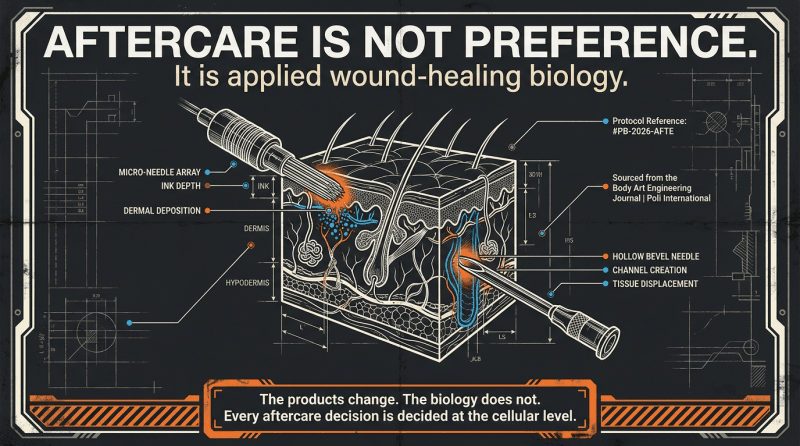
All skin breaks, whether from a tattoo needle or a piercing needle, follow the same wound-healing cascade. A tattoo is thousands of shallow punctures into the dermis with pigment deposited. A piercing is a single full-thickness channel kept open by a foreign body. The biology is the same; the timelines differ.
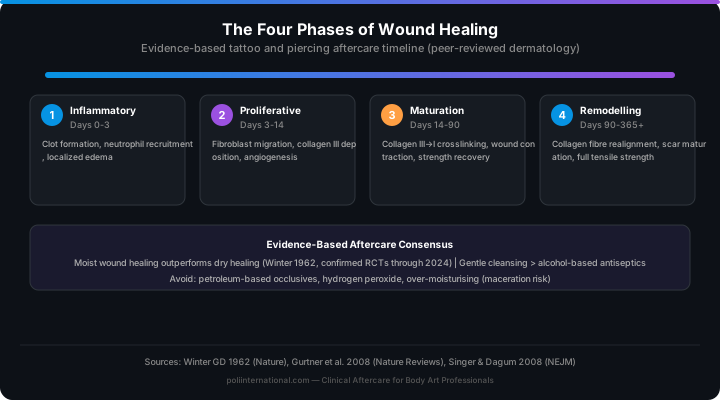
Haemostasis (minutes to hours): vasoconstriction, platelet plug formation, and fibrin clot. The clot provides the provisional matrix for incoming repair cells.
Inflammation (day 1 to 6): neutrophils then macrophages clear bacteria and debris. The wound is red, warm, swollen, and may produce clear exudate. This is normal, not infection. Macrophages are the master regulators; they release growth factors that trigger the next phase.
Proliferation (day 4 to 21 for tattoos, day 4 to week 8+ for piercings): angiogenesis, fibroblast migration, collagen III deposition, and re-epithelialisation. The wound contracts and the surface closes. In tattoos, the epidermis reseals over trapped pigment. In piercings, the fistula tract forms around the jewellery.
Remodelling (week 3 to months for tattoos, week 8 to 12+ months for piercings): collagen III is replaced with stronger collagen I. The scar matures. A piercing fistula reaches roughly 80% of its final tensile strength around week 12 but continues remodelling for a year or more.
The practical implication: aftercare is not one timeline. A tattoo needs protection during the first 3 to 5 days while re-epithelialisation occurs, then moisture management for the next 2 to 3 weeks. A piercing needs weeks of fistula formation support with jewellery that does not irritate the maturing tract. Applying the wrong product at the wrong phase prolongs inflammation or traps bacteria.
2. Aftercare Products: An Ingredient-by-Ingredient Analysis
Most commercial aftercare products are either petrolatum-based occlusives, water-based lotions, or saline solutions. Manufacturers add botanicals, vitamins, preservatives, and fragrances. Not all of these belong on broken skin.
| Ingredient | Function | Evidence for Wound Use | Risk |
|---|---|---|---|
| White petrolatum | Occlusive barrier, reduces water loss | Decades of wound-care use; moist environment accelerates re-epithelialisation | Can macerate skin if applied thickly; may trap heat and exudate |
| Lanolin (USP-modified) | Emollient, semi-occlusive | Used in medical-grade wound dressings; effective at reducing TEWL | Contact allergen in roughly 1.5 to 2.5% of patch-tested dermatitis patients |
| Panthenol (pro-vitamin B5) | Humectant, promotes fibroblast proliferation in vitro | Common in European aftercare products; clinical evidence specific to tattoo healing is sparse | Generally well-tolerated, low irritation potential |
| Dimethicone | Silicone-based occlusive | Used in scar gels and medical barrier creams; breathes better than petrolatum | Very low irritancy; does not support bacterial growth |
| Fragrance / parfum | Scent | No therapeutic benefit on wounds | Among the most common contact allergens; avoid entirely on fresh tattoos and healing piercings |
| Alcohol (isopropyl, ethanol) | Solvent, antimicrobial | Effective on intact skin | Cytotoxic to fibroblasts and keratinocytes; delays wound healing; do not apply to a fresh tattoo or piercing |
| Hydrogen peroxide | Antiseptic | Historically used for wound irrigation | Cytotoxic to fibroblasts; impairs re-epithelialisation; not recommended by current wound-care guidelines |
The rule is simple: if a product is not specifically formulated for wound care, it does not belong on a fresh tattoo or piercing.
3. Dry Healing vs Wet Healing: The Evidence
The old advice to let a tattoo dry out, scab, and peel is contradicted by decades of wound-care research. Winter's seminal 1962 study on partial-thickness wounds in a porcine model demonstrated that a moist environment accelerates re-epithelialisation by roughly 50% compared to air-exposed wounds. The mechanism: epithelial cells migrate more easily across a moist surface than under a dry scab.
For tattoos, the practical protocol is: a thin layer of petrolatum-based or dimethicone-based occlusive applied 2 to 3 times daily for the first 3 to 5 days after gentle cleansing. The wound should not feel greasy or suffocated. After re-epithelialisation, around day 4 to 7, switch to a fragrance-free, water-based moisturiser. Over-moisturising at this stage can clog pores and cause folliculitis.
Piercings are different. An occlusive ointment on a fresh piercing can block the fistula opening, trap moisture, and create an anaerobic environment favourable to bacteria. Piercing aftercare is simpler: sterile isotonic saline, applied twice daily, and keep the area dry. The Association of Professional Piercers recommends sterile saline as the primary aftercare solution for all piercings. It is isotonic with body fluids, non-cytotoxic, and preservative-free when packaged in single-use sterile ampoules or pressurised spray cans.