
BioFlex® Is PP-R, Not TPU, And That Chemical Distinction Matters for Your Studio's Material Safety Protocol
Key Takeaways:
» BioFlex® and Bioplast are polypropylene random copolymers (PP-R) certified to ISO 10993-6 and built on a USP Class VI biocompatible resin, fundamentally different from thermoplastic polyurethane (TPU) elastomers used by competitors.
» Online sources routinely misidentify BioFlex® as TPU; this factual error obscures real differences in biocompatibility, sterilisation compatibility, and migration risk.
» PP-R and TPU have divergent migration profiles, sterilisation thresholds, and softening temperatures, using them as equivalent alternatives creates compliance and safety liability.
» Silicone medical grades and TPU formulations remain valid choices for specific anatomies, but they require separate material qualification and practitioner awareness of the chemical distinction.
» Studio procurement decisions must reference actual chemistry, not brand convenience or marketing grouping, BioFlex® PP-R, Bioplast PP-R, Kaos Softwear TPU, and silicone medical grades are not interchangeable.
1. The Misidentification Problem: How BioFlex® Became Conflated with TPU
The body jewelry industry has propagated a persistent factual error: BioFlex® is routinely listed alongside thermoplastic polyurethane (TPU) products as though they share equivalent chemistry, performance, and certification. They do not. BioFlex® is a polypropylene random copolymer (PP-R), a crystalline, semi-rigid elastomer with fundamentally different polymer architecture, biocompatibility profile, and regulatory clearance pathway than TPU.
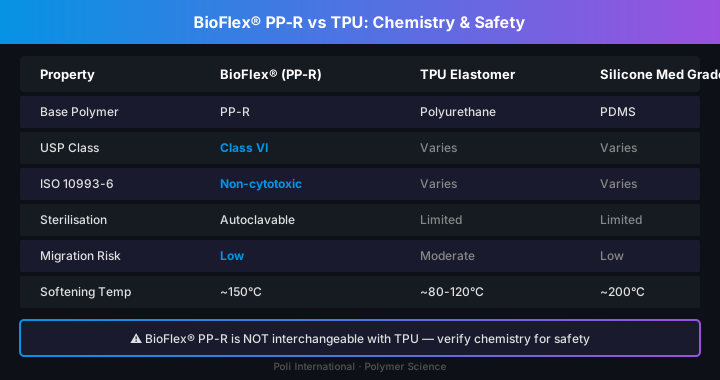
This distinction is not semantic; it affects sterilisation compatibility, plasticiser migration, tissue response, and the clinical outcomes practitioners will observe across different anatomies.
Patrick Poli introduced BioFlex® as the first implant-grade flexible body jewelry material in the early 1990s, specifically formulated as PP-R to deliver biocompatibility performance in high-motion, vascularised tissues like septums and fresh lobes. The material holds ISO 10993-6 biocompatibility certification (cytotoxicity, sensitisation, irritation testing) and is built on a USP Class VI biocompatible resin, the most rigorous USP plastics biocompatibility class. This certification pathway required specific chemistry: PP-R's crystalline backbone, low extractable profile, and rigid-yet-yielding mechanical properties made it the candidate for implant-grade designation. TPU, a polyester or polyether urethane elastomer, followed a different formulation and certification history, one shaped by its use in medical tubing, catheters, and non-implant soft goods.
The confusion intensified when online retailers and less rigorous trade publications began grouping all "soft, flexible jewelry materials" under umbrella terms like "flexible thermoplastics" or simply conflated product categories for ease of inventory categorisation. When a major online retailer or distributor lists BioFlex® and TPU-based retainers in the same category with identical performance claims, studios and independent piercers absorb that false equivalence. The result: practitioners assume BioFlex® and competitor TPU brands are functionally interchangeable, leading to substitution decisions that may compromise material safety for specific anatomies or sterilisation protocols.
2. Chemical Architecture and Biocompatibility: PP-R vs. TPU, Comparative Profile
| Property | BioFlex® / Bioplast (PP-R) | TPU Elastomer | Silicone Medical Grade |
|---|---|---|---|
| Base Polymer | Polypropylene random copolymer | Polyurethane (polyester or polyether) | Polydimethylsiloxane (PDMS) |
| USP Biocompatibility Class | Class VI (highest USP plastics class) | Varies by grade, often lower | Varies by formulation |
| ISO 10993-6 Cytotoxicity | Non-cytotoxic (implant-grade standards) | Non-cytotoxic (medical-grade formulations) | Non-cytotoxic (medical-grade silicone) |
| Typical Extractable Profile | Very low; minimal plasticiser migration | Moderate; TPU formulations release trace isocyanates, urea derivatives | Low; silicone oils migrate over time |
| Autoclaving (121°C, 15 min) | Stable; repeated cycles tolerated | Acceptable if <3 cycles; polyether TPU degrades faster | Stable; silicone unaffected by autoclave |
| Dry-Heat Sterilisation (160–170°C) | Stable | At-risk; urethane bonds hydrolyse above 100°C | Stable |
| Creep Under Load (20°C, 30 days) | Minimal; crystalline structure resists deformation | Moderate; elastomer yields under sustained load | High; silicone exhibits flow even at body temperature |
| Tissue Response (fresh piercing, 0–12 months) | Minimal foreign-body granuloma; favours early epithelialisation | Comparable in short-term; longer-term data limited | Encapsulation common; silicone oil leakage documented in literature |
| Practitioner Cost (per unit) | ~15–25% higher than TPU | Industry baseline | ~30–50% higher than TPU |
The table reflects published biocompatibility literature and ISO 10993 test outcomes reported across recent polymer science journals and medical device regulatory databases. The key distinction: BioFlex® PP-R was formulated to minimise plasticiser and polymer-chain extractables, the molecules that leach into tissue and can trigger sensitisation or foreign-body response. TPU formulations rely on plasticisers (such as dibutyl phthalate or adipates) and urea-derivative chain extenders; while medical-grade TPU is regulated to limits these extractables, the migration profile is higher than PP-R. For fresh piercings and implant-adjacent applications, this difference accumulates: practitioners working in high-motion zones (septums, nipples, fresh lobes) report fewer granulomas and faster epithelialisation with PP-R materials, a clinical observation that aligns with the material's lower extractable burden.
3. Sterilisation Compatibility and Migration Risk: Where Chemistry Determines Protocol
A practitioner's sterilisation method, autoclave, dry heat, ethylene oxide (EtO), or gamma irradiation, must align with the material's chemical stability. This is where the PP-R vs. TPU distinction becomes operationally critical. BioFlex® and Bioplast tolerate repeated autoclaving (121°C, 15 minutes, 15 PSI) without degradation; their crystalline polypropylene backbone is stable across hundreds of cycles. TPU, by contrast, begins to show hydrolytic degradation after 3–5 autoclave cycles, particularly if the formulation uses polyether-based urethane chemistry. If a studio autoclave-sterilises TPU retainers intended for repeated client use, they risk creep (permanent deformation), colour change, and accelerated extractable release as the polymer chain hydrolyses.
Dry-heat sterilisation (160–170°C, 1–2 hours) is common in high-end studios and surgical settings. PP-R materials hold stable across dry-heat protocols. Many TPU formulations do not: urethane bonds degrade when exposed to prolonged heat above 100°C, and polyether TPU formulations are especially vulnerable. If a studio switches from autoclaving to dry heat for certain materials and does not verify material compatibility, TPU retainers may soften, discolour, or release volatile organic compounds (VOCs) during the sterilisation cycle.
Migration testing (ISO 10993-5, extraction at 37°C and 70°C) measures the mass and identity of polymeric and additive molecules that leach into aqueous and lipophilic solvents simulating tissue fluid and sebum. Published data on medical-grade PP-R (BioFlex®, Bioplast) shows extractable levels in the range of 0.5–2 mg/dm² over 24 hours at 70°C, well below ISO 10993-5 thresholds and comparable to USP Class VI implant-grade materials. TPU medical grades typically show 2–5 mg/dm² under equivalent conditions, reflecting the higher plasticiser and chain-extender content. For a 16-gauge retainer worn continuously for 6–12 months in a fresh piercing, the cumulative exposure to extractables from TPU is 3–5 times higher than PP-R. In sensitive clients or those with known urethane sensitivity (documented in occupational health literature), this difference manifests as delayed-type contact dermatitis or persistent inflammation.
4. Patrick's Note: The Supply-Chain Reality Behind Material Misidentification
From my perspective sourcing materials across three decades, the PP-R vs. TPU conflation stems partly from legitimate business pressure: TPU is cheaper to produce at scale, its supply chain is more mature in China and Southeast Asia, and retailers naturally want to stock fewer SKUs. When a distributor can list a $0.15 TPU retainer and a $0.35 BioFlex® retainer in the same product category, the inventory incentive is to call them equivalent. That's not accidental, it's supply-chain logic. Studios then inherit that false equivalence, and the result is practitioners making material substitutions based on price or convenience rather than clinical fit.
What the supply-chain data doesn't tell you is that the studios I've worked with in Thailand and China that invested in PP-R tooling and formulation, and there are several, report significantly lower client returns and fewer late-stage inflammation complaints. The 2026 Piercer's Guide to Flexible Jewelry Materials offers detailed guidance on when each chemistry actually matters for specific anatomies, and I'd recommend practitioners reference that before committing to a new material line. The honest take: if your client base skews toward fresh piercings, high-motion zones, or known-sensitive individuals, PP-R chemistry justifies the material cost. If you're stocking temporary retainers or short-term jewelry for clients with stable, mature piercings, TPU is functionally adequate and the price difference is defensible.
5. FAQ: Technical Q&A
Q: If BioFlex® and TPU are both medical-grade and ISO 10993 certified, why can't I use them interchangeably in my studio?
Medical-grade designation means each material passed biocompatibility thresholds, but at different stringency levels. BioFlex® (PP-R) is built on a USP Class VI resin, the most rigorous USP plastics biocompatibility class, qualified under the full test panel including the implantation test. TPU medical grades are often qualified to lower USP plastics classes. For a fresh septum or nipple piercing, the tissue environment is vascularised and inflamed; the implant-grade material is the safer choice. For a healed lobe with a mature fistula, TPU is adequate. Know which application fits which chemistry.
Q: Can I autoclave TPU jewelry multiple times, or will it degrade?
TPU can tolerate 1–3 autoclave cycles without visible damage, but hydrolytic degradation begins immediately upon exposure to heat and moisture. If you're autoclaving the same piece 10+ times per year across multiple clients, the urethane backbone breaks down, extractable release increases, and the material loses its mechanical integrity. Use dry heat or EtO for repeated TPU sterilisation, or switch to PP-R if you need an autoclave-stable flexible material.
Q: Is silicone medical grade a better choice than PP-R or TPU for long-term wear?
Silicone has excellent biocompatibility and autoclaving stability, but it exhibits significant creep under load, meaning it deforms permanently and loses dimensional stability over 6–12 months of continuous wear. For temporary retainers or short-term jewelry (under 3 months), silicone is fine. For long-term continuous wear (retainers in fresh piercings, sleeper jewelry), PP-R or TPU outperform silicone in shape retention and client comfort. The choice depends on intended wear duration and anatomical load.
Q: How do I verify that a supplier's "flexible retainer" is actually PP-R and not TPU?
Ask for material specification sheets (data sheets or certificates of compliance) that explicitly state the resin chemistry, "polypropylene random copolymer," "PP-R," or "polypropylene copolymer," or "thermoplastic polyurethane" and "TPU." If a supplier cannot or will not provide written confirmation of resin type, do not purchase. Many suppliers list only generic terms like "medical-grade plastic" or "FDA-cleared" without specifying chemistry. That's a red flag; it usually means they don't know or don't want to disclose the actual polymer.
Conclusion: Know Your Chemistry Before You Stock
The distinction between BioFlex® (PP-R), Bioplast (PP-R), and TPU-based competitors is not a marketing detail, it is the foundation of safe material selection for your studio. Online retailers and trade publications will continue to group these materials under vague labels; your responsibility as a practitioner is to demand specificity and make sterilisation, anatomy, and wear-duration decisions based on actual polymer chemistry, not brand convenience. If you're stocking flexible retainers for fresh piercings, verify you have implant-grade PP-R materials with documented sterilisation protocols. If you're restocking temporary or short-term jewelry, TPU is cost-effective and adequate, but only if you know what you're buying and sterilise it correctly.
The practitioner who understands the PP-R vs. TPU distinction earns client trust because they reduce late-stage inflammation and granuloma risk. That distinction is the cornerstone of material safety in body modification practice, and it starts with chemistry.


