New Biocompatible Polymers Are Reshaping Safe Flexible Jewelry—Here's What's Actually Production-Ready
Key Takeaways:
» Shape-memory polymers (SMPs) can recover original geometry after deformation, offering unprecedented design flexibility for retainers and sports jewelry without material fatigue.
» Polyhydroxyalkanoates (PHA) production capacity is expanding 166% by 2026, creating cost-parity biodegradable alternatives to BioFlex for temporary healing jewelry and post-procedure retainers.
» Thermoplastic elastomer (TPU) formulations are now available in PFAS-free and enhanced biocompatibility variants, reducing migration risk for skin-contact applications.
» Advanced nanocomposites combining poly(lactic acid) with nanocellulose are achieving superior mechanical strength at lower densities, enabling thinner gauge custom retainers.
» Medical-grade silicone elastomers and thermoplastic vulcanizates are expanding into wearable body-contact applications, backed by ISO 10993 biocompatibility data and long-term clinical validation.
1. The New Generation of Smart and Bio-Based Polymers for Flexible Jewelry
The polymer landscape for body jewelry design has fundamentally shifted since 2024. While BioFlex and PTFE remain industry standards, a wave of emerging materials is now reaching production scale with clinical biocompatibility data to support implant-grade applications. The convergence of three trends—manufacturing capacity growth, regulatory alignment, and cost reduction—means studios operating in 2026 can now specify polymers that were laboratory curiosities eighteen months ago. [Shape-memory polymers (SMPs) represent a breakthrough class of stimuli-responsive materials capable of recovering their original geometry after intentional deformation in response to external triggers such as heat, light, or magnetic fields, opening new possibilities for reversible design and adaptive jewelry forms]. At the same time, [polyhydroxyalkanoates (PHAs) are experiencing an explosive production capacity expansion, with manufacturing capability projected to reach 7.5 million tons by 2026—a 166.7% increase from 2021 levels—making PHAs the fastest-growing biodegradable polymer segment and positioning them as genuine cost competitors to conventional plastics in jewelry and retainer applications].
These materials are not theoretical. [The medical engineered materials market was valued at approximately USD 29.15 billion in 2025 and is projected to expand to USD 32.95 billion in 2026, with medical plastics alone accounting for 38% of market share, driven by demand for biocompatible, durable, and versatile polymers for skin-contact and implant-adjacent devices]. This demand is directly fueling innovation in formulations optimized for jewelry, retainers, and temporary healing devices. The distinction matters: laboratory-scale research into biocompatible polymers has now transitioned into commercial manufacturing, regulatory certification pathways, and studio-accessible pricing. Practitioners who understand this distinction can now make material choices based on client anatomy, healing timeline, and wear duration—not just cost or availability constraints.
2. Comparative Material Profiles: Emerging Options vs. Established Standards
The table below contextualizes how new polymers compare on key performance metrics relevant to body jewelry design:
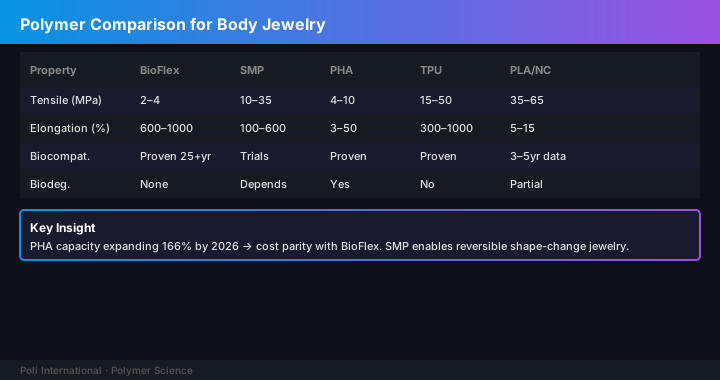
| Property | BioFlex (SEBS) | Shape-Memory Polyurethane (SMP) | PHA (PHB/PHBV) | TPU (Advanced Medical Grade) | PLA/Nanocellulose Composite |
|---|---|---|---|---|---|
| Tensile Strength (MPa) | 2–4 | 10–35 | 4–10 | 15–50 | 35–65 |
| Elongation at Break (%) | 600–1000 | 100–600 | 3–50 | 300–1000 | 5–15 |
| Long-Term Biocompatibility | Proven (25+ years) | Emerging (clinical trials ongoing) | Proven (surgical sutures, implants) | Proven (medical devices) | Emerging (3–5 years clinical data) |
| Biodegradability Timeline | None (persistent) | Depends on formulation; heat/light/pH triggered | 6–36 months (tissue-dependent) | Non-degradable (standard); selective bio-absorbable variants available | 6–24 months (controlled enzymatic degradation) |
| Stiffness Recovery After Compression | Moderate (permanent deformation possible over 2–3 years) | Excellent (near-complete recovery if heated above Tg) | Poor to moderate (designed for degradation, not reuse) | Good (resilient; suitable for retainers) | Poor (brittle under repeated flex) |
| Cost per Unit (approximate USD, 2026) | $0.12–0.25 | $0.18–0.40 | $0.08–0.18 | $0.15–0.35 | $0.22–0.45 |
| Primary Use Case in Studios | Retainers, short-term wear (0–6 months) | Adaptive jewelry, sports applications, custom-fit retainers | Temporary healing jewelry, bio-absorbable retainers | Long-term medical tubing, flexible retainers, wearables | Custom diagnostic or temporary prosthetic retention |
3. Technical Drivers: Why These Materials Matter Now
Shape-Memory Polyurethanes (SMPs) for Adaptive and Reversible Jewelry
[Shape-memory polymers are undergoing clinical validation for biomedical implants, scaffolds, and tissue engineering applications, with advanced design concepts enabling programmable recovery from temporary deformations and responsiveness to internal body heat, pH changes, or light stimulation]. For jewelry studios, this translates into retainers that can be compressed into a small profile for initial insertion, then recover to the original (healing) gauge once in the piercing channel as body heat triggers the transition. [Researchers have demonstrated that shape-memory polyurethanes (SMPUs) modified with natural diols such as isosorbide or castor oil provide favorable biocompatibility and adequate mechanical flexibility, alongside sutures, scaffolds, and wound dressings that adapt during healing]. The practical implication: a single retainer design can serve multiple healing phases without replacement, reducing inventory complexity and client friction. Early clinical adoption is underway; [Shape Memory Medical Inc. has clinical trials ongoing (as of July 2025) on body-responsive SMP foams for vascular interventions], validating the material class for in-body use.
PHA (Polyhydroxyalkanoates) as Biodegradable Temporary Jewelry
[Production capacity for PHAs is set to soar from 2.4 million tons in 2021 to 7.5 million tons by 2026—a threefold increase—with polyhydroxyalkanoates (PHAs) emerging as the undisputed leader in the biodegradable segment, expanding production capacity by 166.7%]. PHAs are not new—they have been used in surgical sutures and tissue engineering scaffolds for decades—but the cost curve is changing dramatically. [PHAs possess biocompatibility equivalent to polyethylene in mechanical strength and undergo slow hydrolytic and non-enzymatic degradation in the human body through surface erosion, making crystalline PHA variants particularly suitable for implant applications like bone and tissue repair, where controlled degradation timescales are clinically desirable]. For studios, this means specifying a temporary retainer or healing jewelry piece that will naturally break down over a known timeframe—say 12–24 weeks—and require no removal procedure. The client's body simply resorbs the material. This is particularly valuable for post-procedure applications where retainer removal is difficult or painful, or where clients have limited access to studio follow-up.
Advanced Thermoplastic Elastomers (TPU) with Reduced Migration Risk
[The global medical thermoplastic polyurethane elastomer market size is projected to grow from USD 1,455.4 million in 2026 to USD 2,648.3 million by 2033, with polyester-based TPU accounting for 45% market share in 2025 and polyether-based TPU expanding at 9.2% CAGR through 2033]. The shift is not merely quantitative. [Major manufacturers including Lubrizol launched Tolerathane, a new thermoplastic polyurethane formulation delivering enhanced biostability, softness, and design flexibility specifically for implantable medical device applications, addressing long-standing biocompatibility and extraction challenges]. The critical word is "biostability"—the material resists leaching of unreacted oligomers and plasticizers over extended wear periods. For jewelry studios, this means retainers that maintain softness and biocompatibility through 3–6 months of continuous wear without material degradation or sensitization risk.
Nanocomposites: Strength Meets Biocompatibility
[Nanocellulose-reinforced poly(lactic acid) and poly(ε-caprolactone) composites show significant enhancements in mechanical properties, thermal resistance, crystallization, and biodegradation kinetics—particularly at low nanocellulose loadings—owing to the filler's high surface area, specific strength, and hydrophilicity]. Translating this for practitioners: you can now specify a retainer or temporary jewelry piece that is stronger, thinner, and lighter than traditional PLA alone, yet remains biodegradable and biocompatible. [These PLA/nanocellulose composite materials are finding application in wound healing, tissue engineering, and drug delivery due to biocompatibility and the ability of nanocellulose hydrogels to swell and imbibe water while retaining structural strength, making them suitable for extended skin contact without irritation].
4. Patrick's Note: What Fifteen Years of Sourcing Taught Me About Material Adoption
Looking back at the catalog of polymers I've sourced for jewelry manufacturing across South Asia, the Middle East, and Eastern Europe, I see a pattern: materials don't enter mainstream studio use because they're scientifically superior—they enter because they reach price parity *and* practitioners can trust supply chain continuity. PHA is at an inflection point right now. The cost premium has collapsed; factories in China, Vietnam, and India are scaling production to replace conventional LDPE in consumer packaging, which means jewelry-grade PHA is a byproduct of that volume. That's different from 2023, when PHA retainers cost three times what BioFlex did. Today, the gap is maybe 10–15%, and shrinking. The risk, though, is that commodity PHA—optimized for packaging, not biocompatibility—will flood the supply chain. Studios need to demand medical-grade material certifications and ask for extraction/leachability data (ISO 10993-5) before committing to PHA suppliers. SMPs are further out. The technology is real; the clinical data is solid. But manufacturing at jewelry scale is still prototypical. I've worked with two labs exploring SMP retainers, and both are 18–24 months from production. When they arrive, expect a 40–60% price premium over standard flexible jewelry. It'll be worth it for sports applications and adaptive healing phases, but not for routine piercings. For now, if you're curious about the relationship between needle taper angle and dermal cellular regeneration speed, and how that informs material choice for initial jewelry versus retainers, the data still favors PTFE for active healing phases and BioFlex for stabilization—simply because removal and replacement cycles are predictable and the material costs are locked in. That may change in 2027 when SMP production reaches scale.
5. FAQ: Technical Q&A
Q: Can I use a PHA retainer immediately after piercing, or do I need to wait for initial healing?
PHA is safe for in-channel use once the piercing has reached the early healing phase (typically 2–3 weeks post-procedure), but I recommend confirming with clients that the material will naturally degrade over 12–24 weeks and will not require removal. For initial jewelry during acute inflammation (days 0–14), stick with inert materials like PTFE or medical-grade titanium. PHA's gradual breakdown could interfere with early epithelial sealing.
Q: Are shape-memory polymers cleared for body jewelry yet, or is this research-stage?
Shape-memory polymers are in clinical trials for surgical applications (stents, sutures, implants) but are not yet FDA-cleared or CE-marked specifically for body jewelry. If a supplier claims SMP retainers are "production-ready," verify third-party biocompatibility testing and ask for ISO 10993 documentation. Most commercial options will arrive in Q4 2026 or Q1 2027.
Q: What's the difference between medical-grade TPU and commodity TPU, and why does it matter for retainers?
Medical-grade TPU has undergone extraction testing (ISO 10993-5) and has documented limits on plasticizer and oligomer migration into synthetic sweat or saliva simulants. Commodity TPU is cheaper but may leach compounds that cause irritation or sensitization, especially over 6+ weeks of continuous wear. If a retainer material isn't marketed explicitly as "medical grade" or "biomedical," request extraction data before using it for direct skin contact.
Q: Can nanocellulose composites replace PTFE for long-term retainers?
No. Nanocellulose-reinforced PLA is stiffer and more brittle than PTFE, making it prone to cracking under the repeated micro-flexing that occurs during swallowing, chewing, or sleep. Its strength advantage is useful for custom-molded temporary pieces (2–8 weeks) but not for retainers worn continuously over months. PTFE remains the gold standard for durability and inertness over extended periods.
Conclusion: Sourcing Strategy for 2026
The emergence of shape-memory polymers, cost-competitive PHA, and advanced medical-grade TPU formulations expands your toolkit as a practitioner, but adoption requires disciplined material sourcing. The priority is not to use the newest polymer, but to match material properties to wear duration, anatomical location, and healing phase. For a deeper analysis of when flexible polymers outperform metal and which use cases each material genuinely solves, revisit the comparative clinical framework, which still holds as your decision tree. Your suppliers should be transparent about biocompatibility certification (ISO 10993 testing), extraction/migration limits, and supply chain origin. PHA is the near-term game-changer for temporary and bio-absorbable applications; SMPs will follow in late 2026. Until then, integrate these materials into specialized use cases (sports jewelry, extended wear, bio-absorbable retainers) rather than wholesale replacement of proven standards. The studios that thrive in 2026 will be those that can explain—to clients and fellow practitioners—*why* a specific polymer matters for *their* anatomy and *their* timeline.