Isotretinoin Does Not Just Dry Your Skin Out. It Changes How You Heal.
Key Takeaways:
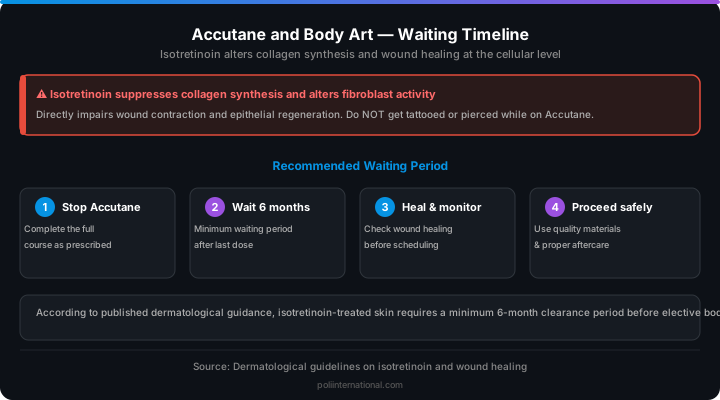
» Isotretinoin suppresses collagen synthesis and alters fibroblast activity, directly impairing the wound-healing cascade that a tattoo or piercing depends on.
» The minimum wait after stopping Accutane is 6 months for any elective skin procedure. For tattoos and piercings, 12 months is the recommendation backed by dermatologic surgery guidelines.
» Healing while on isotretinoin carries elevated risk of hypertrophic scarring, keloid formation, patchy pigment loss, and, for piercings, persistent irritation bumps and delayed fistula formation.
» Isotretinoin-induced photosensitivity makes standard tattoo aftercare harder. Even brief UV exposure can trigger hyperpigmentation and prolonged erythema on healing ink.
» No reputable artist should proceed without a health screening that covers current and recent medications. A studio that skips this step is not safe, period.
1. What Accutane Does to Wound Healing at the Cellular Level
Isotretinoin, branded as Accutane or Roaccutane in the UK and sold under several generics, is a systemic retinoid prescribed for severe cystic acne that has not responded to other treatments. It works by shrinking sebaceous glands, reducing sebum output, normalising keratinisation inside follicles, and suppressing inflammation. Those mechanisms make it highly effective against acne, but they also alter how skin repairs after injury, and a tattoo is thousands of controlled micro-wounds.
The needle drives pigment into the dermis. The body responds with a clotting cascade, an acute inflammatory phase, and a weeks-long remodelling process in which fibroblasts encapsulate pigment particles in collagen. A piercing is a full-thickness puncture held open by a foreign body while granulation tissue slowly forms the fistula. Both procedures depend entirely on normal wound healing, and isotretinoin disrupts several parts of that sequence.
The central problem is collagen. Isotretinoin reduces collagen synthesis and alters fibroblast behaviour. Collagen is the scaffold for every wound repair. With less available and fibroblasts behaving abnormally, wounds close more slowly, scar more visibly, and are more prone to hypertrophy. A 2017 review in the Journal of the American Academy of Dermatology identified altered collagen metabolism and decreased wound contraction as the primary concerns for any invasive procedure during isotretinoin therapy.
2. Tattooing on Accutane: The Three Specific Risks
The risks of getting tattooed while on isotretinoin, or within the first few months after stopping, fall into three categories.
Healing disruption and pigment loss. When the skin cannot mount a normal wound-healing response, pigment retention suffers. Macrophages and fibroblasts must encapsulate and stabilise ink particles in the dermis. If collagen deposition is impaired, pigment may migrate, fade unevenly, or be partially extruded during scabbing. The result is a patchy, faded tattoo that does not match the artist's intended saturation, even when the application was technically correct.
Hypertrophic scarring and keloids. Isotretinoin is associated with an increased rate of hypertrophic scarring after skin procedures. For tattoos, this means raised, firm, sometimes itchy scar tissue within the lines or shading. In patients already prone to keloids, the risk is compounded. A hypertrophic tattoo scar cannot be fixed with a touch-up; it may require steroid injections, laser scar revision, or surgical excision, none of which fully restore the original artwork. If you know you are keloid-prone, read our separate guide on keloid risk and tattoo safety.
Photosensitivity complications. Isotretinoin makes skin more photosensitive. A healing tattoo exposed to UV light, even incidentally through windows or during short outdoor walks, is at greater risk of hyperpigmentation, prolonged erythema, and phototoxic reactions. Standard aftercare involves keeping the tattoo out of direct sun for weeks; on isotretinoin, even brief exposure can cause problems. This is particularly relevant for tattoos on the hands, neck, or other sites that are difficult to keep fully covered.
3. Piercings Face a Different but Overlapping Set of Risks
Unlike a tattoo, which is a broad superficial wound, a piercing is a full-thickness puncture that must heal around an implanted foreign body. The fistula-forming process is a delicate balance of epithelialisation and collagen deposition, and isotretinoin disrupts both.
The primary concern is delayed fistula formation and persistent irritation. If the healing tract does not epithelialise properly, the piercing may remain chronically inflamed, produce excess lymph, and develop irritation bumps that resemble pyogenic granulomas. These bumps can persist for months and may not resolve even after the jewellery is removed.
Isotretinoin also causes significant skin dryness and fragility. A dry, fragile earlobe or nostril is more likely to tear during the procedure itself, and the jewellery is more likely to cause friction injury during the healing phase. Thin, fragile skin makes migration and rejection more likely, particularly for surface piercings such as the navel, eyebrow, or nape, where the tissue barrier is already minimal.
| Procedure | Minimum Wait After Last Dose | Recommended Wait | Rationale |
|---|---|---|---|
| Laser resurfacing / dermabrasion | 6 months | 12 months | Deep wounding; high scarring risk |
| Tattooing | 6 months | 12 months | Multiple dermal micro-wounds; pigment retention depends on normal healing |
| Piercing | 6 months | 12 months | Fistula formation requires intact epithelialisation and collagen |
| Touch-up tattoo | 6 months | 12 months | Same mechanism as primary tattooing |
 style="width:100%;max-width:720px;height:auto;border-radius:12px;border:1px solid var(--border-color);margin:2rem auto;display:block" />