
Body Jewellery Materials & Allergy Statistics
12 cited statistics on the nickel content of body-jewellery materials, contact-allergy prevalence and MRI safety classifications. Every figure links to its primary source. Free to quote with attribution.
The material a piece of body jewellery is made from decides how much nickel it can release, whether it is safe in an MRI scanner and whether a nickel-allergic wearer will react to it. This page brings the contact-allergy prevalence figures, the nickel content of common materials and the ASTM MRI classifications together in one reference for journalists, clinicians and studio professionals. Each statistic links to the study or standard it comes from.
Reporting on body-jewellery materials or allergy? Jump to the citation block for a ready-to-use reference, or email info@poliinternational.com for expert comment from a material specialist.
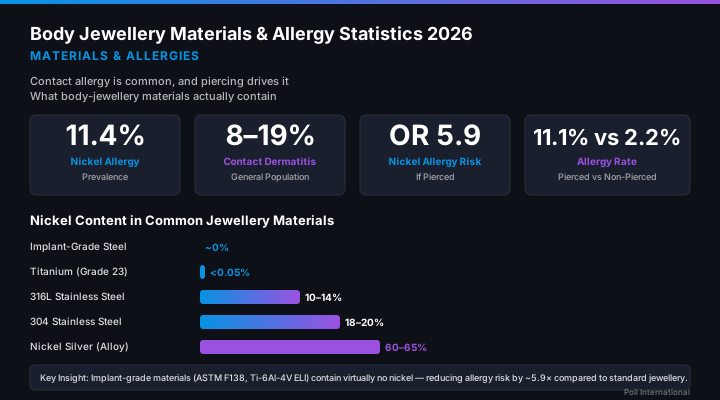
Contact allergy is common, and piercing drives it
Nickel is the most frequent contact allergen, and piercing is the most consistent risk factor for becoming sensitised. These are the population figures that make material choice matter.
nickel-allergy prevalence in the general population, the single most common contact allergen in a meta-analysis of more than 20,000 patch-tested people.
Alinaghi et al., contact-allergy meta-analysis (PubMed) ↗of adults in the European general population are nickel-allergic, with 8–10% among children, in a nickel-allergy review.
Ahlström et al., nickel allergy review (PubMed) ↗odds of nickel allergy in adults with piercings versus those without, in a 2025 systematic review and meta-analysis. In children the odds ratio is 4.7.
von Spreckelsen et al., nickel allergy & piercings (PubMed) ↗nickel sensitisation in women versus men in an unselected Danish general population (Glostrup), confirming the strong sex difference.
Nielsen & Menné, Glostrup Allergy Study (PubMed) ↗What body-jewellery materials actually contain
The safety of a material for a fresh or sensitive piercing comes down to what it is made of and how much nickel it can release. The ASTM implant standards define the safe end of that spectrum.
ASTM F136 implant-grade titanium (Ti-6Al-4V ELI) contains negligible nickel and is the benchmark metal for fresh and nickel-sensitive piercings.
ASTM F136 titanium implant standard ↗ASTM F138 316LVM implant-grade stainless steel contains 10–14% nickel by weight, kept below the release limit only by a passivated surface layer.
ASTM F138 stainless steel implant standard ↗BioFlex® is a medical-grade PP-R polymer certified to ISO 10993-6 for implantation, with no metal content, removing nickel exposure entirely for healing or allergic wearers.
Poli International — BioFlex® ↗nickel-silver alloy (~18% nickel) can release an estimated 3–6 µg/cm²/week, many times the 0.2 µg/cm²/week piercing limit; it should never be used in a fresh piercing.
Thyssen et al., nickel release from jewellery (PubMed) ↗MRI safety depends on the material
Metal body jewellery interacts with the strong magnetic field of an MRI scanner. The ASTM F2503 classification system, MR Safe, MR Conditional and MR Unsafe, tells you which materials can stay in.
BioFlex® and other non-metallic polymers (such as PTFE) are non-conductive and non-magnetic, classified MR Safe and posing no known MRI hazard.
ASTM F2503 MRI marking standard ↗implant-grade titanium is MR Conditional, generally safe in scanners up to 3 tesla under specified conditions, but not automatically safe in every field strength.
ASTM F2503 MRI marking standard ↗ferromagnetic materials such as some steels and nickel silver are MR Unsafe, posing heating, torque and displacement risks, and must be removed before scanning.
ASTM F2503 MRI marking standard ↗of the general population has a contact allergy of some kind, reinforcing why non-metallic, MR-safe polymer jewellery is a practical default for many wearers.
Alinaghi et al., contact-allergy meta-analysis (PubMed) ↗Cite this page
These statistics are free to reference in articles, presentations and research with attribution. Suggested citation:
Poli International. “Body Jewellery Materials & Allergy Statistics (July 2026).” Poli International.
https://poliinternational.com/body-jewelry-materials-allergy-statistics/
Released under CC BY 4.0. See our full data methodology for how every figure is sourced, verified and licensed. For interviews, data requests or material-safety commentary, contact info@poliinternational.com.
Frequently asked questions
Which body-jewellery material is safest for a fresh piercing?
For a fresh or healing piercing, the lowest-risk choices are implant-grade titanium (ASTM F136), which contains negligible nickel, and non-metallic polymers such as BioFlex®, which contain no metal at all and are certified to ISO 10993-6. Both keep nickel exposure at or near zero during the open-wound healing phase, when the risk of sensitisation is highest.
Is surgical steel nickel-free?
No. ASTM F138 316LVM implant-grade stainless steel contains roughly 10 to 14 percent nickel by weight. It stays below the EU release limit only because of a passivated surface layer. That makes compliant steel acceptable for many wearers, but not nickel-free, which matters for anyone already nickel-allergic or with a still-healing piercing.
Can I keep body jewellery in during an MRI?
It depends on the material, classified under ASTM F2503. Non-metallic polymers like BioFlex® and PTFE are MR Safe. Implant-grade titanium is MR Conditional, usually fine up to 3 tesla under specified conditions. Ferromagnetic materials such as some steels and nickel silver are MR Unsafe and must be removed before scanning because of heating and displacement risks.
Can I cite or reproduce these statistics?
Yes. Every figure links to its primary source. You are free to quote any statistic with attribution to Poli International and a link to this page, under CC BY 4.0. Where a figure is an estimate derived from alloy composition, we say so.