
Body Art Industry & Market Statistics
12 cited statistics on the tattoo and piercing market size, industry growth forecasts and population prevalence. Every figure links to its primary market report or peer-reviewed study. Free to quote with attribution.
Body art is now a mainstream consumer market. A third of US adults carry a tattoo, more than a third of people report a piercing, and independent research houses forecast the tattoo and piercing-jewellery markets growing faster than the wider consumer economy through the end of the decade. This page gathers the market-size, growth and prevalence figures in one place for journalists, analysts and studio professionals. Each statistic below links to the market report or study it comes from.
Reporting on the body-art industry? Jump to the citation block for a ready-to-use reference, or email info@poliinternational.com for expert comment from a body-art material specialist.
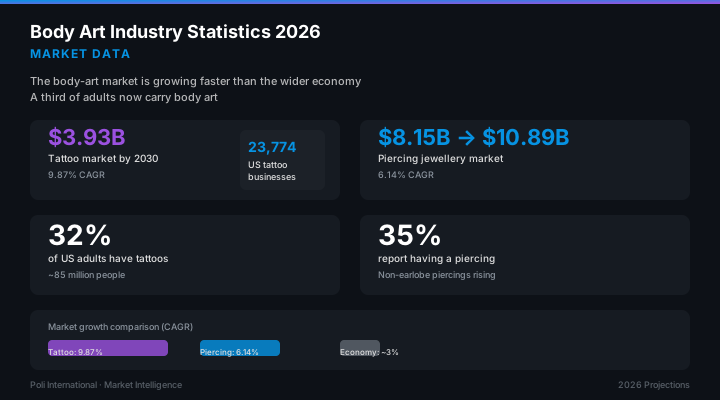
The body-art market is growing faster than the wider economy
Tattooing and body piercing have moved from subculture to a durable consumer-services and product market. Independent market-research houses forecast mid-to-high single-digit compound growth through the end of the decade.
projected global tattoo market by 2030, growing at a compound annual rate of 9.87% as tattooing normalises across age groups and geographies.
Fortune Business Insights, tattoo market forecast ↗body-piercing jewellery market size, from 2024 to 2032, a 6.14% compound annual growth rate driven by materials demand and rising piercing prevalence.
Verified Market Research, piercing jewellery market ↗US tattoo-and-piercing businesses in 2026, a fragmented services market of predominantly small studios generating an estimated $1.3B in annual revenue.
IBISWorld, tattoo artists industry (US) ↗forecast tattoo-market growth rate, well above typical consumer-discretionary categories, reflecting repeat demand, aftercare products and removal services layered on top of first-time procedures.
Fortune Business Insights, tattoo market forecast ↗A third of adults now carry body art
Market growth rests on prevalence: tattoos and piercings are mainstream. The most reliable prevalence data come from nationally representative surveys and peer-reviewed dermatology research.
of US adults have at least one tattoo, and 22% have more than one, in a nationally representative 2023 survey, up sharply from prior decades.
Pew Research Center, 2023 tattoo survey ↗of respondents report having a body piercing, with prevalence highest among younger adults, in peer-reviewed prevalence research.
Laumann & Derick, JAAD (PubMed) ↗of adults aged 18 to 50 have a piercing in a site other than the earlobe, the population that most often needs implant-grade jewellery for safe healing.
Laumann & Derick, JAAD (PubMed) ↗of US adults have more than one tattoo, evidence of repeat demand rather than one-off experimentation, which underpins the market growth forecasts.
Pew Research Center, 2023 tattoo survey ↗Where people get pierced
The distribution of piercing sites matters for materials: cartilage, oral and navel piercings heal slowly and are the placements where jewellery material choice most affects the outcome.
ear (beyond the standard earlobe) is the most common non-earlobe piercing site in prevalence research, followed by nose at 27%.
Laumann & Derick, JAAD (PubMed) ↗nose, the second most common non-earlobe site, a cartilage-adjacent placement with slower healing than a soft-tissue lobe.
Laumann & Derick, JAAD (PubMed) ↗lip, an oral piercing where jewellery is in constant contact with mucosa and saliva, raising the importance of low-release, biocompatible materials.
Laumann & Derick, JAAD (PubMed) ↗eyebrow, a surface piercing prone to migration and rejection, where a flexible biocompatible polymer can reduce mechanical irritation during healing.
Laumann & Derick, JAAD (PubMed) ↗Cite this page
These statistics are free to reference in articles, presentations and research with attribution. Suggested citation:
Poli International. “Body Art Industry & Market Statistics (July 2026).” Poli International.
https://poliinternational.com/body-art-industry-market-statistics/
Released under CC BY 4.0. See our full data methodology for how every figure is sourced, verified and licensed. For interviews, data requests or material-safety commentary, contact info@poliinternational.com.
Frequently asked questions
How big is the tattoo industry?
The global tattoo market is forecast to reach about $3.93 billion by 2030, growing at a compound annual rate of roughly 9.87 percent according to Fortune Business Insights. In the US alone, IBISWorld counts more than 23,000 tattoo-and-piercing businesses generating an estimated $1.3 billion a year, a fragmented services market of mostly small independent studios.
What percentage of people have tattoos or piercings?
A nationally representative 2023 Pew Research Center survey found 32 percent of US adults have at least one tattoo and 22 percent have more than one. Peer-reviewed prevalence research reports about 35 percent of respondents have a body piercing, and 14.4 percent of adults aged 18 to 50 have a piercing somewhere other than the earlobe.
Is the body-piercing jewellery market growing?
Yes. Verified Market Research values the body-piercing jewellery market at about $8.15 billion in 2024, rising to roughly $10.89 billion by 2032, a compound annual growth rate of about 6.14 percent. Growth is driven by rising piercing prevalence and demand for higher-grade, biocompatible materials.
Can I cite or reproduce these statistics?
Yes. Every figure links to its primary market report or peer-reviewed source. You are free to quote any statistic with attribution to Poli International and a link to this page, under CC BY 4.0. We keep the dataset current so the citation stays accurate.