Body Art by the Numbers: The Mid-2026 Statistics Drop
Key Takeaways:
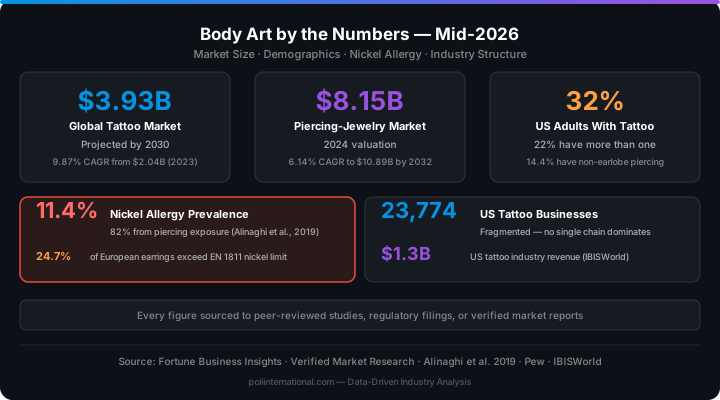
» The global tattoo market is headed toward $3.93 billion by 2030 at 9.87% CAGR, while the larger piercing-jewellery market ($8.15B in 2024) grows more slowly at 6.14%.
» Nickel allergy affects 11.4% of the general population, and 82% of those cases are attributable to piercing exposure.
» One in four European earrings (24.7%) still exceeds the EN 1811 nickel-release limit despite three decades of regulation.
» 32% of US adults have at least one tattoo and 14.4% of adults aged 18 to 50 have a non-earlobe piercing.
» Every figure here is sourced to a peer-reviewed study, a regulatory filing, or a verified market report, no estimates dressed as facts.
Halfway through 2026, the body-art industry sits at the intersection of steady market growth, evolving regulation, and a growing body of clinical data on safety outcomes. This is not a think-piece. It is the mid-year statistics round-up: the numbers that changed, the numbers that did not, and the ones every studio operator and supplier should have at hand.
1. Market Size: Bigger Than It Looks
The global tattoo market is projected to reach $3.93 billion by 2030, growing at a 9.87% compound annual growth rate from $2.04 billion in 2023 (Fortune Business Insights). The growth is driven by cultural normalisation, the expansion of studio businesses in Asia-Pacific, and rising demand for cosmetic and medical tattooing such as areola reconstruction and scar camouflage.
The piercing-jewellery market is larger still, at $8.15 billion in 2024, projected to reach $10.89 billion by 2032 at a 6.14% CAGR (Verified Market Research). The ear segment accounts for 46 to 50% of that market by product type; the nose segment follows at roughly 27%.
2. Industry Structure and Demographics
| Metric | Figure | Source |
|---|---|---|
| US tattoo businesses (2025) | 23,774 | IBISWorld |
| US tattoo industry revenue | ~$1.3 billion | IBISWorld |
| US adults with a tattoo | 32% (22% more than one) | Pew, 2023 |
| US adults 18 to 50 with a non-earlobe piercing | 14.4% | Laumann & Derick, 2006 |
| Nickel allergy prevalence (general population) | 11.4% (95% CI 9.4 to 13.5) | Alinaghi et al., 2019 |
The US tattoo industry is fragmented: no single chain dominates the 23,774 businesses. The UK, by contrast, has no central tally, licensing is administered by local authorities under the Local Government (Miscellaneous Provisions) Act 1982, with no national database.
3. Nickel Allergy: The Geometry of a Preventable Epidemic
Nickel allergy is the single most common contact allergen in the industrialised world. The 11.4% pooled prevalence masks a steep gender gradient, and body piercings are the dominant driver of sensitisation. The von Spreckelsen 2025 meta-analysis of 25,663 patients found an odds ratio of 5.9 for nickel allergy with piercings in the general population, with an etiological fraction of 82%. In other words, four out of five nickel-allergy cases would not exist without piercing exposure.
Enforcement remains the weak link: 24.7% of earrings sold in Europe still exceed the regulatory nickel-release limit of 0.2 micrograms per square centimetre per week for piercing posts, despite the EU Nickel Directive having been law since 1994 and REACH Annex XVII Entry 27 tightening it further.
4. Complications: What the Clinical Data Says
Roughly 23% of non-earlobe piercings develop a complication requiring some form of intervention (StatPearls/NIH). A university-cohort study found 17%. In a referred hospital cohort of 493 tattoo-complication patients, allergic reactions dominated at 37%, followed by bacterial infections at 11% (Serup et al., 2016). That is a selected population, so the rates are not generalisable; the general tattoo-infection rate is estimated in the 0.5 to 6% range across multiple studies.
5. Patrick's Deep Archive: Regulation That Actually Worked
I have watched the nickel numbers move over 25 years, and the EU Nickel Directive is the clearest example I know of regulation changing outcomes on the ground. Nickel-allergy prevalence in young European women dropped from roughly 19.8% in pre-Directive cohorts to 11.4% in pooled post-Directive estimates (Thyssen, 2011). The Directive, for all its enforcement gaps, cut nickel sensitisation in the highest-risk demographic roughly in half. The lesson for suppliers is not that regulation is a burden, it is that traceable material certification is the only defence that survives contact with a real client. Check our Nickel Allergy Statistics and Material Certification Checker for the underlying data and verification steps.
In the United States, regulation remains state-level. All 50 states regulate tattooing in some form, but no federal framework governs tattoo-ink ingredients or jewellery nickel content; OSHA's Bloodborne Pathogens Standard provides only a workplace-safety floor.
6. FAQ: Technical Q&A
Q: Where do these numbers come from?
Every figure links to its primary source: peer-reviewed articles indexed in PubMed, regulatory filings on EUR-Lex, and verified market reports. We do not cite blog posts, forum threads, or unsourced trade claims.
Q: Why is the piercing-jewellery market larger than the tattoo market?
Piercings generate ongoing jewellery spend (downsizing, replacement, material switches) over years, whereas a tattoo is largely a single-procedure purchase. Ear jewellery alone accounts for 46 to 50% of the piercing market.
Q: Is the EU Nickel Directive actually working?
Yes, with a qualification. Prevalence in young women fell from ~19.8% to 11.4%, a significant public-health impact, but 24.7% of earrings sold in Europe still exceed the release limit. The Directive worked where it was enforced; the enforcement gap is the remaining challenge.
Conclusion: Numbers You Can Cite
 style="width:100%;max-width:720px;height:auto;border-radius:12px;border:1px solid var(--border-color);margin:2rem auto;display:block" />
The body-art economy is growing, the safety data is maturing, and the regulatory gap between the EU and the US is now the defining structural fact. Explore the full dataset, all embeddable, on our Body Art Safety Statistics and Piercing Complications Statistics hubs.