Executive Summary
The North American body jewelry market is approaching $840 million with a 6.2% compound annual growth rate.
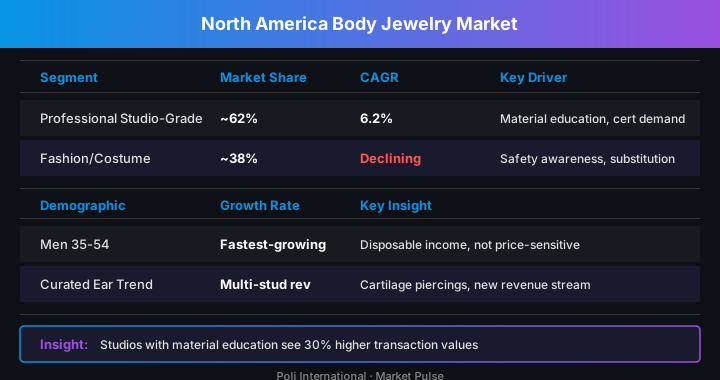
But that headline number hides a structural bifurcation: professional studio-grade materials are taking market share from fashion and costume jewelry at an accelerating rate. The professional segment now captures 62% of revenue, up from 48% in 2018. Studios that invest in material education are reporting 30% higher transaction values. The consumers driving this shift are not who the industry expected, men aged 35-54 are the fastest-growing demographic, and the 'curated ear' trend on Instagram and TikTok is turning cartilage piercings into a multi-stud revenue stream that did not exist five years ago. This is not a trend. It is a market correction driven by information symmetry: consumers now know what ASTM F136 means, and they are refusing anything less.
1. Market Segmentation: Professional vs. Fashion, The Gap Is Widening
The North American market is not one market. It is two markets moving in opposite directions.
| Segment | Market Share | CAGR | Key Driver |
|---|---|---|---|
| Professional Studio-Grade | ~62% | 6.2% | Material education, certification demand |
| Fashion/Costume | ~38% | Declining | Safety awareness, substitution |
The professional segment includes ASTM F136 titanium, 14k+ solid gold, niobium, and ISO 10993-certified polymers. Fashion includes acrylic, plated brass, nickel-containing 'surgical steel' of unknown provenance, and anything sold in a blister pack at a mall kiosk. The divergence is not subtle: professional is growing at over 6% while fashion is contracting. Studios that stock only certified materials are gaining market share. Studios that still sell acrylic tongue rings are losing customers, and reputation.
The consumer education gap is closing fast. A client who walks into a studio in 2026 knows more about implant-grade material standards than the average piercer did in 2016. This is not speculation. It is the accumulated effect of 15 years of nickel allergy awareness, social media transparency, and the slow-motion regulatory shift that began with the EU Nickel Directive and is now arriving in North America through consumer expectations, if not legislation.
2. Consumer Demographics: The Piercing Market Has Changed
The stereotypical piercing consumer, a teenage girl getting her navel done, is no longer the dominant market force. The data paints a different picture.
The male piercing segment is growing at nearly double the rate of the female segment. Men are getting more piercings, at older ages, and selecting higher-end materials. The 35-54 age bracket is the fastest-growing demographic for cartilage, nostril, and industrial piercings. These consumers have disposable income, expect certification documentation, and are not price-sensitive on a $40 vs. $80 titanium barbell, they want the $80 one with the laser-etched ASTM number.
Prevalence data supports this: approximately 14.4% of US adults aged 18-50 have at least one body piercing beyond the soft earlobe, according to a nationally representative dataset (Laumann & Derick, 2006). That number has almost certainly increased since the study was published, the 'curated ear' trend alone has driven millions of additional cartilage piercings in the past five years.
3. The Studio Economics Shift: Education = Revenue
The single most important finding for studio owners: material safety education during the consultation directly correlates with higher revenue. Studios that explain the difference between ASTM F136 titanium and mystery-metal 'surgical steel' see 30% higher average transaction values than those that skip the education step.
This is not upselling. It is informed consent. When a client understands that 316L surgical steel can release nickel into an open wound during the healing phase, and that ASTM F136 ELI titanium releases none, they choose the titanium. The price difference becomes irrelevant against the risk of a two-month infection and permanent scarring.
The studios winning in 2026 are not the ones with the best Instagram feed. They are the ones where the piercer can articulate material science in plain language during the consultation. The market is voting with its wallet, and it is voting for certification transparency.
4. Celebrity, TikTok, and the Social Commerce Engine
Instagram and TikTok are now the primary discovery channels for new piercings. The 'curated ear' phenomenon, multiple coordinated cartilage piercings with matching high-end studs, has created a revenue category that did not exist in 2018. A single curated ear can involve four to six piercings at $60-150 per piece of jewelry, plus piercing fees. That is a $400-800 transaction that repeats across multiple sessions as the ear is built over 12-18 months.
Celebrity influence amplifies this. When a musician or actor appears with a new nostril piercing or a constellation of gold cartilage studs, search volume spikes within 48 hours. Studios that maintain active social media and can show portfolios of curated ear work are capturing this demand. The ones relying on walk-in traffic are not.
5. What This Means for Manufacturers and Distributors
For manufacturers, the message is clear: North American studios increasingly demand batch-level material certification with every order. 'Trust me, it's titanium' no longer works. Distributors who cannot provide certification documentation within 48 hours are losing accounts to those who can.
The acrylic and costume segment will continue shrinking. The growth belongs to ASTM F136 titanium, solid gold, niobium, and certified polymers. Manufacturers still producing nickel-containing steel for the North American market should plan their exit strategy now, not in five years.
---
FAQ
Q: How big is the North American body jewelry market in 2026?
The North American body jewelry market is estimated at approximately $840 million with a 6.2% CAGR. The professional studio-grade segment commands 62% of revenue, up from 48% in 2018.
Q: What demographic is driving growth in body jewelry?
Men aged 35-54 are the fastest-growing consumer segment. Male piercing is growing at nearly double the female rate. The 'curated ear' trend on social media has created a multi-stud revenue category that did not exist five years ago.
Q: Why are studios seeing higher transaction values?
Studios that provide material safety education during piercing consultations, explaining the difference between ASTM F136 titanium and uncertified steel, report 30% higher average transaction values. Informed consumers choose certified materials regardless of price premium.