Shop
Market Pulse

Body Art Alliance Sale Signals Consolidation Wave in Tattoo Supply Chain

PP

Chief Engineer

Patrick Poli

Journal Date

2026-05-03

Last Reviewed

2026-10-28

$1B Valuation on Table: B2B Buyers Must Lock In Pricing Now Before Ownership Shift Disrupts Supply

Key Takeaways:
» Body Art Alliance, a major tattoo products supplier, is exploring a sale valuing it at nearly $1 billion including debt, with $250M revenue and $70M EBITDA.
» Studio owners and distributors should secure multi-year contracts immediately to hedge against post-sale price hikes or inventory shortages.
» This move underscores accelerating M&A in body art wholesale, pressuring independents to consolidate or partner up.
» Japanese regulatory crackdown risks banning traditional tattooing nationwide, chilling Asia-Pacific expansion for Western suppliers.
» B2B buyers: Prioritize certified suppliers like those offering ASTM F136 titanium jewelry to future-proof against market volatility.

1. Body Art Alliance Eyes $1B Sale Amid Supplier Consolidation

Body Art Alliance, the Hanover, Maryland-based powerhouse in tattoo inks, needles, and piercing supplies, has kicked off a sale process that could fetch nearly $1 billion including debt, per Reuters sources close to the deal.Reuters: Body Art Alliance explores sale Working with Jefferies Financial Group, the company projects $250 million in revenue and $70 million EBITDA for 2023—figures that highlight its dominance in the U.S. wholesale market, where it serves thousands of studios via brands like Eternal Ink and Kingpin Tattoo Supply.

This isn't isolated noise; it's a bellwether for M&A acceleration in body art B2B. With private equity sniffing around high-margin suppliers, expect ripple effects: acquirers often rationalize SKUs, hike prices 10-20% post-deal, and prioritize larger distributors. For studio owners, this means inventory risk if you're reliant on Body Art Alliance for bulk inks or disposables—lead times could stretch from 2 weeks to 8+ as new owners integrate systems. Distributors face margin compression unless they counter with exclusive deals.

Geographically, this U.S.-centric deal amplifies the split between mature markets like America (60%+ of global body art spend) and high-growth Asia-Pacific, where Chinese manufacturers undercut on price but lag in certifications. As explored in our analysis of Southeast Asia tattoo market penetration strategies, Western suppliers must leverage such consolidations to scale exports before local players solidify.

2. Financial Benchmarks: Body Art Alliance vs. Key Competitors

Body Art Alliance's metrics set a high bar, but how does it stack against other major players? Here's a snapshot of estimated scale based on public filings, trade intel, and industry benchmarks—critical for B2B buyers benchmarking vendor stability.
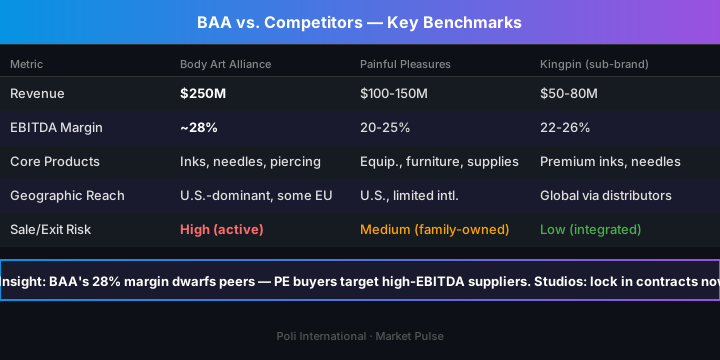
BAA vs. Competitors, Key Benchmarks
MetricBody Art AlliancePainful Pleasures (Est.)Kingpin (Body Art Sub-Brand)
Annual Revenue$250M$100-150M$50-80M
EBITDA Margin~28% ($70M)20-25%22-26%
Core ProductsInks, needles, piercingEquipment, furniture, suppliesPremium inks, needles
Geographic ReachU.S.-dominant, some EUU.S., limited intl.Global via distributors
Sale/Exit RiskHigh (active process)Medium (family-owned)Low (integrated)

Reuters sale report positions BAA as the prize asset, but its 28% margin dwarfs smaller peers, drawing PE buyers like Blackstone or KKR analogs who've circled beauty wholesale. Studios: If your supplier scores <20% margin, switch to high-EBITDA vendors for reliability—downtime from a distressed seller costs $500-2K/day in lost bookings.

3. Japan's Tattoo Ban Threat: Regulatory ppm Limits and Supply Impacts

Simultaneously, Japan's tattoo crackdown escalates, with a court challenge underway that could outlaw professional body art nationwide.The Times: Japan tattooist sues over crackdown Traditional irezumi artists face licensing hurdles under medical regs, mirroring 2023 ordinances classifying tattooing as "medical acts" requiring physician oversight. Fines hit ¥1M (~$6,500 USD), with bans on advertising and studio operations.

Technically, this slams imports: Japan's nickel release limits (0.5 µg/cm²/week per EN 1811) and cadmium ppm caps (0.1 mg/kg) already filter 70% of Chinese jewelry. Post-ban, expect zero tolerance—ASTM F136 Grade 23 titanium (ELI, <10 ppm impurities) becomes mandatory, spiking costs 30-50% for compliant stock. Studios eyeing Tokyo or Osaka: Stock niobium alternatives (ASTM F67, 99.5% pure) now, as lead times from certified EU/U.S. mills hit 12-16 weeks amid global titanium shortages (up 15% YOY per Bloomberg metals index).

For B2B, this fragments Asia supply: Thailand/Vietnam boom (20% CAGR) absorbs redirected volume, but Japan's 5-7% global market share vanishing redirects $500M+ spend to cert-compliant channels.

4. Patrick's Note: The Exit Math Suppliers Hide from Studios

From negotiating deals across three continents, I've watched these $1B valuations turn into 18% price bumps within 6 months—studios get blindsided while PE cashes out. Body Art Alliance's numbers scream overleveraged: $70M EBITDA on $250M top line means thin buffers if ink pigment costs (TiO2 up 12%) bite. Distributors, audit your vendor's debt load now; if it's BAA-heavy, diversify to 40/30/30 split across three suppliers.

The Japan angle? It's the wildcard—I've supplied Bangkok conventions where Japanese artists flock post-crackdown, boosting local demand 25%. But counterfeit floods follow, so verify what you buy. Check our Poli Journal titanium sourcing guide for vetted mills.

5. FAQ: Technical Q&A

Q: How will a Body Art Alliance sale affect ink pricing for U.S. studios? Expect 10-15% hikes within 9 months as new owners cut rebates and consolidate formulas. Lock 12-24 month contracts at current rates; top vendors offer volume tiers dropping per-unit to $0.08/ml on 5L Eternal Ink equivalents. Monitor Jefferies filings for bidder identities—avoid non-U.S. buyers if tariffs loom.

Q: Can Japanese studios still import EU/U.S. titanium jewelry under the crackdown?
Yes, if certified to JIS T 3999 (matches ISO 5832-3) with nickel <0.1 µg/cm²/week. Niobium or Grade 5 Ti ship now—ppm-tested lots clear customs 95% faster. Avoid China-origin; 40% rejection rate on heavy metal scans.

Q: What's the ROI threshold for switching suppliers pre-sale?
Switch if your current markup <35% on disposables—new vendors hit 42% with faster shipping. Calculate: $10K/mo ink spend at 12% hike = $14.4K/year loss; offset via bulk niobium at $45/g vs. steel $22/g.

Conclusion: Secure Contracts, Certify Stock—Act This Week

Body Art Alliance's potential sale crystallizes the consolidation imperative: studios lose if they don't diversify now, while savvy B2B buyers snag distressed inventory at 15-20% discounts pre-close. Japan's ban accelerates the pivot to certified, high-margin materials—prioritize ASTM/ISO suppliers to capture redirected Asia flow. Dive deeper into supply chain M&A survival tactics for your playbook. Run the numbers for your own studio with our booth-rent calculator, equipment payback and studio CRM.

Mind map · Body Art Alliance Sale Signals Consolidation Wave in Tattoo Supply Chain

  • Body Art Alliance Sale
    • Billion Dollar BAA Valuation

      Body Art Alliance is exploring a sale process that could value the company at nearly one billion dollars including debt.

      • BAA Revenue of $250M
      • BAA EBITDA of $70M
      • Jefferies Advising Sale
    • Private Equity Playbook

      Private equity firms acquire competitive brands to consolidate the market, cut costs, and raise product prices.

      • Ruthless Cost Cutting
      • Price Hikes up to 20%
      • Supply Chain SKU Rationalization
    • Japanese Regulatory Crackdown

      Japanese regulations treat tattooing as a medical act requiring physician oversight, risking nationwide bans on traditional studios.

      • Traditional Irezumi Under Threat
      • Ordinances Classifying Tattooing as Medical
      • Mandatory ASTM F136 Titanium
        • Grade 23 ELI Titanium
      • Stocking Niobium Alternatives
        • ASTM F67 Pure Niobium
    • Strategic Countermeasures for Studios

      Studio owners can protect their businesses by securing multi-year contracts and diversifying their supplier networks.

      • Secure Multi Year Contracts
      • Diversify Supplier Portfolio
      • Audit Vendor Debt Loads
StructureProcessMaterialHazard

4 branches, 0 sources. Each branch cites the article it came from; the labels beneath it are names, not claims.

Body Art Quiz

  1. 1. Based on the reported deal figures, what is Body Art Alliance's estimated EBITDA margin for 2023, and which financial advisory firm is managing its sale process?

    • ✓ 28% EBITDA margin (70 million on 250 million revenue), working with Jefferies Financial Group. — Body Art Alliance projected 70 million in EBITDA on 250 million in revenue for 2023 (~28% margin) and retained Jefferies Financial Group to handle the transaction.
    • • 20% EBITDA margin (50 million on 250 million revenue), working with Bloomberg Financial Group. — A 20% margin describes smaller competitors like Painful Pleasures rather than Body Art Alliance's reported figures.
    • • 35% EBITDA margin (87.5 million on 250 million revenue), working with Reuters Advisory Services. — Reuters is the news agency reporting on the deal rather than the financial advisory firm managing the process, and 35% exceeds the projected margin.
    • • 22% EBITDA margin (55 million on 250 million revenue), working with Blackstone Group. — Blackstone is mentioned as an analog for potential private equity buyers, not the advisory firm managing the sale process.
  2. 2. When private equity acquirers integrate major wholesale supply brands like Body Art Alliance, what operational and pricing adjustments should studios expect according to the source material?

    • ✓ Price increases of 10-20% and product lead times extending from 2 weeks up to 8 or more weeks. — Acquirers typically rationalize SKUs, raise prices by 10 to 20 percent, and stretch fulfillment lead times from 2 weeks to 8 or more weeks during integration.
    • • Immediate price reductions of 15% due to economies of scale and lead times dropping below 1 week. — Consolidation by private equity typically squeezes buyer margins and lengthens lead times rather than discounting prices or accelerating shipping.
    • • SKU expansion by 30% alongside a shift toward non-certified overseas manufacturing. — Acquirers generally eliminate lower-performing SKUs to streamline operations rather than expanding the product catalog.
    • • Mandatory transition to exclusive annual subscriptions with zero volume discount tiers. — The text notes that vendors offer tiered volume discounts for bulk ink purchases rather than eliminating them post-sale.
  3. 3. Under current Japanese import regulations and medical ordinances, what are the specific heavy metal threshold limits for body jewelry and the associated studio penalty?

    • ✓ Nickel release limit of 0.5 µg/cm²/week, cadmium cap of 0.1 mg/kg, and fines up to 1 million yen. — Regulations under EN 1811 enforce a nickel release limit of 0.5 µg/cm²/week, cadmium caps of 0.1 mg/kg, and studio penalties reaching 1 million yen (~6,500 USD).
    • • Nickel release limit of 1.0 µg/cm²/week, cadmium cap of 0.5 mg/kg, and fines up to 5 hundred thousand yen. — The stated fine threshold is 1 million yen rather than 5 hundred thousand yen, and the heavy metal limits are stricter.
    • • Nickel release limit of 0.1 µg/cm²/week, cadmium cap of 1.0 mg/kg, and mandatory studio closure without monetary fines. — Studio closures are accompanied by heavy monetary fines up to 1 million yen rather than non-monetary penalties alone.
    • • Nickel release limit of 2.5 µg/cm²/week, cadmium cap of 0.05 mg/kg, and fines up to 5 million yen. — These threshold figures overestimate the allowable nickel release and understate allowable cadmium levels.
  4. 4. What specific titanium material standard is identified as mandatory for post-crackdown compliance in body piercing stock, and what are its chemical characteristics?

    • ✓ ASTM F136 Grade 23 titanium (ELI) with less than 10 ppm impurities. — ASTM F136 Grade 23 Extra Low Interstitial (ELI) titanium contains under 10 ppm impurities and represents the baseline for compliant stock.
    • • ASTM F67 Grade 1 titanium with up to 50 ppm heavy metal impurities. — ASTM F67 refers to unalloyed commercially pure niobium alternatives (99.5% pure) rather than Grade 23 titanium.
    • • ISO 5832-3 Grade 5 standard industrial titanium with 95% metal purity. — ISO 5832-3 aligns with Japanese standard JIS T 3999, but general industrial Grade 5 titanium lacks the ELI purity parameters required for body art.
    • • ASTM F136 Grade 24 titanium with active niobium alloy coating. — The article specifies Grade 23 titanium under ASTM F136 rather than a Grade 24 designation.
  5. 5. According to the financial benchmark analysis provided in the article, how does Painful Pleasures compare to Body Art Alliance in estimated revenue and sale risk?

    • ✓ Painful Pleasures generates 100-150M in annual revenue with Medium sale risk, while Body Art Alliance generates 250M with High sale risk. — Painful Pleasures is estimated at 100-150M revenue with Medium risk due to being family-owned, whereas Body Art Alliance leads at 250M revenue with High exit risk due to an active sale process.
    • • Painful Pleasures generates 50-80M in annual revenue with Low sale risk, while Body Art Alliance generates 100M with High sale risk. — 50-80M revenue describes Kingpin Tattoo Supply, which is an integrated sub-brand of Body Art Alliance.
    • • Painful Pleasures generates 250M in annual revenue with High sale risk, while Body Art Alliance generates 100-150M with Low sale risk. — This option reverses the comparative scale and risk profile of the two suppliers.
    • • Painful Pleasures generates 100-150M in annual revenue with Low sale risk, while Body Art Alliance generates 50-80M with Medium sale risk. — Body Art Alliance's revenue is 250M, making it the largest asset in the comparison table rather than the smallest.
  6. 6. To hedge against vendor leverage and inventory disruption if a studio relies heavily on Body Art Alliance, what supply strategy does the author recommend?

    • ✓ Diversify inventory across three vendors using a 40/30/30 spend allocation split. — The author advises auditing vendor debt loads and splitting supply spend across three suppliers in a 40/30/30 proportion to minimize dependency.
    • • Consolidate 100% of inventory purchases with a single local distributor under an exclusive contract. — Single-sourcing increases vulnerability to price hikes and lead-time delays during corporate buyouts.
    • • Shift all metal inventory to uncertified overseas suppliers to maximize profit margins. — Sourcing uncertified goods increases customs rejection rates, especially with scanning enforcement in key markets.
    • • Maintain a 1-week buffer of stock while placing daily spot orders directly with manufacturers. — Daily spot ordering leaves studios vulnerable to extended lead times that can stretch from 2 weeks to over 8 weeks.
  7. 7. What regulatory standard and testing threshold must imported titanium jewelry satisfy to pass Japanese customs clearance with a 95% faster approval rate?

    • ✓ Certification to JIS T 3999 (matching ISO 5832-3) with nickel release under 0.1 µg/cm²/week. — Imports clearing Japanese customs rapidly must match JIS T 3999 / ISO 5832-3 standards and maintain a nickel release below 0.1 µg/cm²/week on ppm-tested lots.
    • • Certification to ASTM F67 with cadmium content under 0.5 mg/kg. — ASTM F67 applies to niobium stock rather than the JIS T 3999 standard required for rapid titanium customs clearance.
    • • Certification to EN 1811 with raw titanium purity of at least 90%. — EN 1811 establishes the general European standard limit of 0.5 µg/cm²/week, which is less stringent than Japan's 0.1 µg/cm²/week customs threshold.
    • • Certification to JIS T 2000 with nickel release under 0.5 µg/cm²/week. — The specific Japanese Industrial Standard cited in the text for matching ISO 5832-3 is JIS T 3999.
  8. 8. How does the article calculate the annual financial impact of an expected 12% ink price increase on a studio spending 10,000 monthly on ink?

    • ✓ An annual loss of 14,400, which can be offset by switching disposable markups or sourcing bulk niobium. — A 12% increase on 10,000 monthly (1,200 additional cost per month) equates to a 14,400 annual loss to the studio's bottom line.
    • • An annual loss of 1,200, which can be absorbed through standard studio supply fees. — 1,200 represents the monthly cost increase rather than the cumulative annual loss calculated in the text.
    • • An annual loss of 24,000, which requires raising service rates by 35% immediately. — This figure overstates the total annual increase resulting from a 12% adjustment on 120,000 in annual spend.
    • • An annual loss of 8,600, which is fully covered by vendor volume rebates at 0.08/ml. — Volume rebates reduce unit costs but do not eliminate the explicit 14,400 yearly loss calculated in the example.
  9. 9. How is the regional Asian body art supply landscape shifting in response to Japan's legal crackdown on tattooing?

    • ✓ Market growth is accelerating in Thailand and Vietnam at a 20% CAGR, while Japanese artists expanding to Bangkok boost local convention demand by 25%. — The crackdown redirects market demand to Southeast Asia, where Thailand and Vietnam grow at 20% CAGR and Japanese artists in Bangkok drive a 25% surge in local event demand.
    • • Overall Asian supply demand has dropped by 50% as European manufacturers completely exit the region. — European and Western suppliers continue seeking export opportunities in high-growth Southeast Asian markets rather than exiting the region.
    • • Chinese manufacturers have captured 90% of the Japanese market by meeting strict JIS certification standards. — Chinese jewelry imports face a 40% rejection rate on heavy metal scans and fail strict certification limits.
    • • Studio spend in Japan has grown by 15% due to government subsidies for medical tattoo licensing. — Japan's market is shrinking due to enforcement, fines, and studio closures rather than expanding through subsidies.
  10. 10. What underlying raw material cost pressures are driving price inflation for ink pigments and compliant jewelry stock?

    • ✓ Titanium dioxide (TiO2) pigment costs are up 12%, and global raw titanium prices are up 15% year-over-year. — Raw material pressures include a 12% rise in titanium dioxide (TiO2) pigment costs and a 15% year-over-year increase in global titanium metal indices.
    • • Titanium dioxide (TiO2) pigment costs are up 30%, while raw niobium prices have dropped 20%. — TiO2 pigment costs rose by 12% rather than 30%, and titanium raw material prices escalated rather than dropped.
    • • Stainless steel raw material prices have doubled, while titanium pigment costs have stabilized. — The text highlights cost inflation in titanium and TiO2 pigment rather than steel stabilization or price doubling.
    • • Organic ink pigments are up 40%, and raw nickel costs have risen 15% year-over-year. — The article specifically points to titanium dioxide (TiO2) increases and global titanium index surges rather than organic pigment or nickel raw costs.

Extended Reference Table

8 of 8 rows

Extended reference table generated from the article and its verified research sources. Bracketed numbers jump to the matching entry in the Technical References below.

SafetyItem or Practice Category Material or Compliance Detail Key Function or Usage Regulatory or Standard Status Source
✅Implant-Grade TitaniumMedical-Grade MaterialsASTM F136 / ASTM F1295 / ISO 5832-3 (Ti6Al4V ELI)Initial piercing jewelry for biocompatibility and safety; ideal for nickel sensitivityIndustry standard for medical implants material; JIS T 3999 compliant[4]
✅Implant-Grade SteelMedical-Grade MaterialsASTM F-138 / ISO 5832-1 (316L Stainless Steel)Initial piercings for people without hypersensitivity; heavier than titaniumBiocompatible for medical implants material
✅BioFlex®Medical-Grade MaterialsMedical polymer; tested to ISO 10993 and USP Class VIImplant-grade flexible material for body jewelry to avoid counterfeit risksIndependently certified medical polymer standard
✅NiobiumMedical-Grade MaterialsElemental metal (99.5% - 99.9% pure); ASTM F67Biocompatible alternative to titanium for initial piercings; can be anodizedNo specific implant-grade designation; widely used
✅Gold (14k or Higher)Medical-Grade Materials14k or 18k solid gold; nickel-free and cadmium-freeDecorative jewelry for initial and healing piercingsMust be alloyed for biocompatibility
✅Autoclave SterilizationProfessional Studio Hygiene PracticesSaturated steam under pressure; Class B autoclaveEnsuring jewelry and tools are free of pathogens before insertionRequired for healing piercings
✅Tattoo Ink Regulation (MoCRA)Regulatory RequirementMandatory FDA facility registration and product listing; renewed bienniallyEstablishes traceability and confirms manufacturer formulation disclosureMandatory under Modernization of Cosmetics Regulation Act (MoCRA)
✅REACH ComplianceIndustry StandardsRegulation (EC) No 1907/2006; Annex XVII Entry 75Restricts ~4,000 hazardous substances (e.g., Pigment Blue 15:3) in inksBinding European and UK regulatory standard

Free Body Art Wall Posters

Print-ready reference posters for your studio or your own wall. Free to download and display, embed on your own site with attribution. Click any poster to preview it full size before downloading.

Choose and download all 27 posters

Technical_References_Archive

About the Author

PP

Patrick Poli

Chief Engineer, Poli International · Creator of BioFlex® body jewelry

Patrick has spent 25+ years manufacturing body jewellery and studio equipment, and is the creator of BioFlex® body jewelry. He founded Poli International with his son Frédéric to work on recyclable and bio-friendly materials for tattoo and piercing. He also made custom titanium body jewellery in metric sizes the market still does not offer, because manufacturers stop at 2 mm steps and a piercing rarely fits a round number.

More about Patrick →

Last reviewed: 2026-10-28 · Published: 2026-05-03

Related Tools & Reading

Continue Reading