Executive Summary
ASTM F136 titanium anodization physics (Ti-6Al-4V ELI) is the gold standard for implant-grade body jewelry, the same alloy used in hip replacements, dental implants, and spinal fusion cages. But the supply chain that transforms raw titanium sponge into a laser-etched, internally threaded 16G curved barbell is remarkably opaque. China dominates raw production and semi-finished bar stock. Thailand has emerged as a metal injection molding (MIM) hub. And a single world-class MIM production line requires over $1 million in capital investment. Understanding this supply chain is not academic, it is how studios verify that the 'implant-grade' claim on a jewelry bag is backed by material provenance, not marketing copy.
1. What ASTM F136 Actually Means
ASTM F136 is not a brand. It is a material specification published by ASTM International that defines the chemical composition, mechanical properties, and metallurgical requirements for wrought Ti-6Al-4V ELI (Extra Low Interstitials) alloy for surgical implant applications. The 'ELI' designation is the critical differentiator: it specifies reduced oxygen and iron content compared to standard Ti-6Al-4V (ASTM Grade 5), which improves fracture toughness and biocompatibility for material that remains inside the human body.
Standard Grade 5 titanium is used in aerospace, automotive, and sporting goods, applications where biocompatibility is irrelevant.
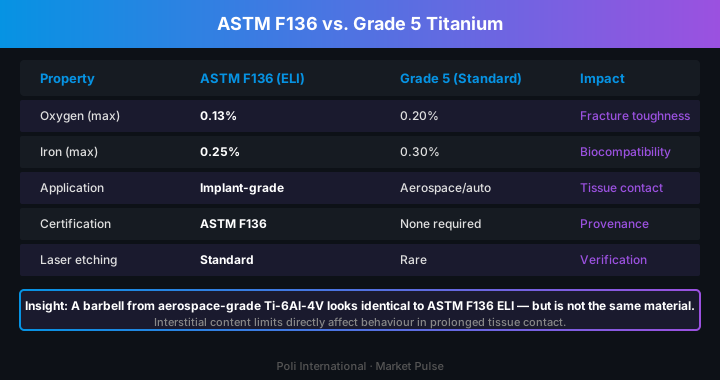
A barbell machined from aerospace-grade Ti-6Al-4V may look identical to one machined from ASTM F136 ELI. It is not the same material. The interstitial content limits for oxygen (0.13% max for ELI vs. 0.20% for standard) and iron (0.25% max vs. 0.30%) directly affect the material's behaviour in prolonged tissue contact.
Reputable manufacturers laser-etch the ASTM number directly onto the jewelry, typically on the bar or the underside of a threaded end. This is not decoration. It is provenance. If a piece of 'titanium' jewelry has no laser etching, assume it is not ASTM F136.
2. The Production Geography: China, Thailand, and the Certification Gap
The global titanium body jewelry supply chain has three geographic centres:
| Region | Role | Key Characteristics |
|---|---|---|
| China | Raw material + semi-finished stock | Largest producer of titanium sponge and bar stock; quality varies dramatically by mill certification |
| Thailand | MIM manufacturing hub | Home to world-class MIM facilities using Arburg molding and Elnik sintering; Poli International's production base |
| United States/Europe | Finishing + distribution | Machining, anodising, autoclave packaging, certification documentation |
The critical quality control point is the transition from raw bar stock to finished component. Chinese bar stock can be certified to ASTM F136, or it can be commercial-grade Ti-6Al-4V sold with documentation that does not hold up to independent assay. A manufacturer buying uncertified bar stock at 40% less than certified material is producing jewelry that looks identical but is not implant-grade, regardless of what the packaging says.
Thailand's MIM facilities operate at a different tier. The Poli International production line, using German Arburg molding machines ($148,000 each) and German Elnik sintering furnaces ($625,000), represents over $1 million in capital investment before a single barbell is produced. This level of investment creates a moat: the barrier to entry for new competitors is high, and the quality differential between MIM-produced components and CNC-machined parts from generic bar stock is measurable.
3. Anodising: The Oxide Layer That Proves the Material
Titanium's characteristic colours, blue, purple, gold, teal, are not a coating. They are a grown oxide layer produced by controlled anodisation: passing an electric current through the titanium in an electrolyte bath, which thickens the naturally occurring titanium dioxide surface layer. Different voltages produce different oxide thicknesses, which refract light at different wavelengths.
This matters for biocompatibility. A coating, paint, plating, PVD deposition, can wear off, exposing the underlying metal to the tissue channel. An anodised oxide layer IS the titanium. It cannot wear off because it is not on top of the metal; it is the metal, transformed at the surface. This is why anodised ASTM F136 titanium jewelry maintains its biocompatibility regardless of colour, the oxide layer that produces the colour is the same TiO₂ that makes titanium biocompatible in the first place.
4. Thread Types and Manufacturing Precision
The quality difference between MIM-produced and CNC-machined internal threads is a proxy for overall manufacturing precision. Internally threaded jewelry, where the bar has female threads and the end has a male threaded post, eliminates the thread-on-bar design that can irritate healing tissue. But internal threads at 0.9mm or 1.2mm diameter require manufacturing precision that cheap tooling cannot achieve.
MIM production achieves this precision through the molding process itself, the thread geometry is formed in the mold, not cut afterwards. The result is thread consistency across production batches that CNC-machined components from low-cost suppliers cannot match. A barbell that cross-threads during insertion is a manufacturing defect, not a user error.
5. What Studio Buyers Should Verify
For studio owners and piercers purchasing titanium jewelry, three verification steps separate certified product from marketing claims:
1. Laser etching: ASTM F136 should be etched on the jewelry itself, not just the packaging.
2. Batch certification: Request the mill test certificate for the specific batch. Accept no delay beyond 48 hours.
3. Thread quality: Internally threaded jewelry from MIM production will thread smoothly and consistently. Rough or inconsistent threading suggests lower-tier manufacturing.
The titanium market is growing at ~7.1% CAGR as consumers and regulators demand implant-grade material for body contact. Manufacturers who invest in certification will capture this growth. Those who do not will be relegated to the shrinking fashion segment, the segment where 'titanium-coloured' means a coating on mystery metal, and no one checks.
---
FAQ
Q: What is the difference between ASTM F136 titanium and standard Grade 5?
ASTM F136 specifies Ti-6Al-4V ELI (Extra Low Interstitials) with tighter limits on oxygen (0.13% max) and iron (0.25% max) compared to standard Grade 5. The ELI designation ensures biocompatibility for implant applications. Standard Grade 5 is used in aerospace and is not certified for prolonged tissue contact.
Q: How can I verify that titanium jewelry is actually implant-grade?
Look for laser-etched ASTM F136 on the jewelry itself. Request batch-level mill test certification from the supplier. If the supplier cannot produce certification within 48 hours, assume the material is not implant-grade.
Q: Is anodised titanium safe for healing piercings?
Yes. Anodising grows a titanium dioxide oxide layer on the surface, it is not a coating or plating. The colour comes from light refraction through the oxide, and the underlying biocompatibility of the titanium is unchanged regardless of colour.