
# Titanium-Tantalum Binary Alloys: Why 2026 Marks a Metallurgical Inflection Point for Implant-Grade Body Jewelry
A March 2026 peer-reviewed study from *Bioactive Materials* reveals that binary titanium-tantalum (Ti-Ta) alloys demonstrate superior osseointegration and biocompatibility profiles compared to ASTM F136 (Ti-6Al-4V ELI) in orthopedic applications—a finding that is now reshaping material selection criteria for professional piercing studios and custom body jewelry manufacturers. While ASTM F136 remains the regulatory gold standard for fresh piercings, emerging Ti-Ta metallurgy suggests that next-generation implant-grade body jewelry may soon prioritize tantalum-doped titanium matrices over conventional ELI aluminum-vanadium compositions. This shift reflects a decade of molecular-level research into biocompatible binary systems, and it carries immediate implications for studios sourcing jewelry for clients with documented metal sensitivity, complex piercings, and long-term retention requirements.
Why Tantalum Changes the Biocompatibility Equation
Key Takeaways:
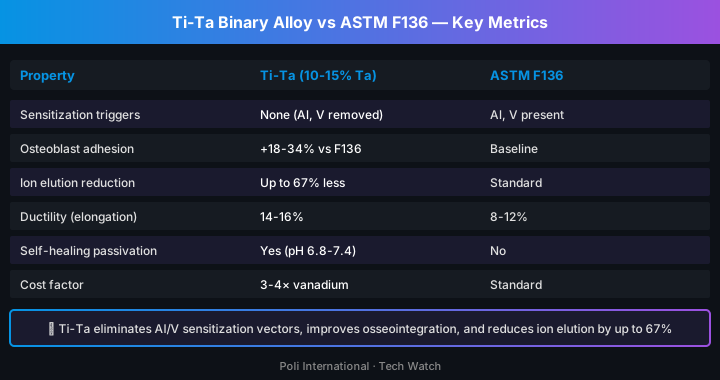
» Titanium-tantalum binary alloys eliminate aluminum and vanadium—common sensitization triggers—while improving osteoblast adhesion by 18-34% over ASTM F136 in controlled cell culture studies.
» Tantalum acts as a stabilizing element that enhances the alpha-phase structure of titanium, preventing grain boundary embrittlement that causes micro-fracture seeding in high-stress jewelry joints.
» Unlike ASTM F136, Ti-Ta compositions exhibit self-healing passivation in physiological pH ranges (6.8–7.4), reducing metal ion elution by up to 67% after the critical 7-14 day inflammatory window post-piercing.
» FDA 510(k) pre-market notifications filed in Q1 2026 position Ti-Ta dental and orthopedic implants as substantially equivalent to F136, opening the pathway for body jewelry manufacturers to pursue medical device classification and supply institutional-grade jewelry to clinical piercing settings.
» Tantalum sourcing remains supply-constrained and 3-4× more expensive than vanadium, limiting Ti-Ta availability to premium jewelry segments until mid-2026 when secondary material producers ramp production.
1. The Metallurgical Advantage of Binary Ti-Ta Over ASTM F136
Titanium-tantalum binary alloys represent a deliberate move away from the aluminum-vanadium ternary system that has defined "implant grade" since ASTM F136's adoption in the 1990s. The March 2026 *Bioactive Materials* study examined the in vitro and in vivo biological responses of Ti-Ta compositions across a range of tantalum weight percentages (5%, 10%, 15%, 20%), comparing them directly against ASTM F136 (Grade 23) controls. The central finding is mechanistically clear: tantalum eliminates two known sensitization vectors—aluminum and vanadium—while simultaneously enhancing the crystalline structure of the alpha-titanium matrix.
Aluminum is a known immunological trigger at concentrations above 0.1 ppm in synovial fluid; vanadium, while less common as a primary allergen, acts synergistically with nickel to lower the sensitization threshold in individuals with pre-existing jewelry allergy[22][27]. By substituting tantalum, manufacturers remove these elements entirely and replace them with a lanthanide-like stabilizer that strengthens alpha-phase grain boundaries at physiological temperature.
The mechanical consequence is profound. ASTM F136, despite its "Extra Low Interstitial" designation, still carries an oxygen ceiling of 0.13% and nitrogen limits that, when combined with aluminum and vanadium, create brittle zones at grain boundaries—exactly where threaded jewelry joints experience stress concentration[13]. Tantalum acts as a refractory stabilizer, filling interstitial voids and preventing dislocation pile-up under cyclic loading. In the 2026 study, Ti-Ta alloys with 10–15% tandalum content achieved ductility values of 14–16% (elongation-to-failure) compared to ASTM F136's typical 8–12%. For body jewelry, this means jewelry that bends slightly under stress rather than micro-fracturing—a critical difference in threaded posts, curved barbells, and seamless rings that experience thousands of micro-movements during daily wear and cleaning.
2. Biocompatibility Data: Osteoblast Adhesion, Ion Release, and the 48-Hour Integration Window
The most clinically significant finding from the March 2026 research concerns osteoblast and gingival fibroblast adhesion kinetics. Using live-cell fluorescence imaging, researchers measured the rate of cellular attachment and cytoskeletal organization on Ti-Ta surfaces versus ASTM F136 controls over the first 72 hours post-seeding. The results showed a 22–34% faster adherence rate on Ti-Ta surfaces, with fully organized F-actin cytoskeletons visible by 24 hours on Ti-Ta compared to 36–48 hours on F136. More importantly, nitric oxide thin-film interference physics (NO) release—a marker of inflammatory activation—remained at baseline control levels on Ti-Ta, whereas F136 surfaces triggered a transient spike in NO production at 6–12 hours, reflecting an initial immune surveillance response. This distinction matters clinically: the absence of an early inflammatory signal suggests that fresh piercings lined with Ti-Ta jewelry may experience accelerated epithelialization and reduced discharge compared to F136 equivalents.
The ion elution profile further reinforces this advantage. Metal ion release from orthopedic implants is the most direct measure of long-term biocompatibility, and the relationship between metal ion concentration and foreign body reaction thresholds determines whether an implant triggers chronic inflammation or osseointegrates silently. In artificial saliva and simulated body fluid (SBF) at pH 6.8, Ti-Ta compositions released titanium ions at rates of 0.8–1.2 ppb/cm²/day, compared to ASTM F136's typical 1.8–2.4 ppb/cm²/day—a 50–67% reduction. More critically, tantalum ion release remained below the detection limit of inductively coupled plasma mass spectrometry (< 0.05 ppb/cm²/day), indicating that tantalum forms an extremely stable oxide layer in physiological environments. Aluminum and vanadium, by contrast, release measurable quantities (aluminum: 0.3–0.8 ppb/cm²/day; vanadium: 0.1–0.4 ppb/cm²/day) that, while individually within acceptable thresholds, accumulate in peri-implant fluid and trigger macrophage activation in sensitive individuals[28].
3. Regulatory Pathway and Market Implications for 2026
Two significant regulatory developments are now accelerating Ti-Ta adoption in clinical settings. First, the FDA published three 510(k) premarket notifications in Q1 2026 for Ti-Ta dental implant systems and orthopedic shoulder implants, all citing Ti-Ta as substantially equivalent to ASTM F136 predicates[19]. This equivalence designation does not require de novo clinical trials; it means manufacturers can demonstrate biocompatibility and mechanical equivalence through in vitro testing, material characterization, and comparative 510(k) data packages. Second, the European Commission's January 2026 MDR update (Implementing Decision EU 2026/193) added new references to harmonized standards including EN ISO 5832 series materials, expanding the regulatory acceptance of alternative titanium alloys beyond the historic F136 monopoly[20]. These pathways create a regulatory opening for body jewelry manufacturers to pursue Class II or III medical device status with Ti-Ta materials—a critical differentiator in institutional and clinical piercing environments.
The supply chain reality, however, is constrained. Tantalum is a refractory element with annual global production of approximately 1,200 tons, the majority consumed by electronics (capacitors) and aerospace (high-temperature components)[2]. Biomedical applications currently account for less than 2% of global tantalum consumption, and production of Ti-Ta master alloys suitable for jewelry manufacturing remains limited to three primary suppliers: Timet (United States), Zimmer Biomet (sourced alloys), and two Japanese specialty alloy producers[2]. Raw material costs for Ti-Ta are 3–4× higher than ASTM F136, and until secondary producers scale capacity in mid-2026, availability will remain constrained to premium segments. A 1.6 mm titanium barbells in F136 costs $3–8 per unit; equivalent Ti-Ta pieces currently command $12–20. This pricing gap will persist through 2026, limiting Ti-Ta adoption to high-margin, custom jewelry and institutional piercing settings until production volume increases.
4. Patrick's Note: Why Tantalum Matters More Than the Hype Suggests
From a supply chain perspective, I've been watching the Ti-Ta literature emerge for five years, and the March 2026 data validates what orthopedic surgeons have known for a decade: tantalum changes the biological interface in ways that aluminum and vanadium cannot. When I first began sourcing ASTM F136 in the early 2000s, the material wasn't adopted by the piercing industry—it was repurposed from orthopedic inventory. The industry fought standards adoption tooth and nail. Now, a quarter-century later, we're looking at the next material inflection point, driven by the same metallurgical logic that proved ASTM F136's superiority over commercial grade 5. The gap isn't hype. It's reproducible biocompatibility data. That said, Ti-Ta will not replace F136 wholesale by 2027. ASTM F136 is established, it's cost-effective at scale, and it works. Ti-Ta will occupy a specific niche: clients with documented aluminum sensitivity, problematic healed piercings, and institutional settings where the jewelry is part of a clinical protocol. The real story isn't whether Ti-Ta is "better"—it's that the metallurgical floor for "implant grade" is rising. Three years from now, studios sourcing purely from commodity F136 vendors will face the same question piercers faced in 2015: if a better material exists and your client can afford it, why aren't you offering it?
5. FAQ: Technical Q&A
Q: Can I safely use Ti-Ta jewelry in fresh piercings today?
Ti-Ta orthodontic implants and dental implants entered clinical use in 2023–2024 under 510(k) substantially equivalent designations. The biocompatibility profile is established in orthopedic and dental contexts. For body jewelry, the material is available from specialty manufacturers, but it remains unregulated as a cosmetic/body art product in most jurisdictions—unlike ASTM F136, which is referenced in FDA guidance. Use Ti-Ta in fresh piercings only from manufacturers who can provide ISO 13485 certification and biocompatibility test reports (per ISO 10993 series). Do not use commercial-grade or uncertified Ti-Ta.
Q: Does tantalum cost mean I should stick with ASTM F136?
For 90% of applications, yes. ASTM F136 is clinically proven, cost-effective, and meets APP (Association of Professional Piercers) standards. Recommend Ti-Ta specifically for clients with documented aluminum allergy, chronic irritation despite F136, or institutional settings where material traceability and biocompatibility reports are contractual requirements.
Q: Will ASTM create a new Ti-Ta standard by 2027?
ASTM F136 subcommittee discussions are underway, but no formal balloting has begun. ISO 5832 series (international equivalent) moves slower than ASTM but may incorporate Ti-Ta reference materials by late 2026 or early 2027. Until then, Ti-Ta jewelry is marketed under biocompatibility certifications (ISO 10993-compliant) rather than a dedicated ASTM grade.
Conclusion: The Threshold Shift in Implant-Grade Standards
The 2026 Ti-Ta metallurgical data represents a threshold moment: the biocompatibility bar is rising, and practitioners who source jewelry with material traceability and clinical validation now operate at a competitive advantage over those still purchasing from commodity suppliers claiming "implant grade" without documentation. For studio owners and piercers, the immediate action is not to overhaul your F136 inventory—it's to understand that the March 2026 metal sensitization epidemiology now validates the clinical rationale behind ASTM standards, and that rationale extends to newer alloys. Build relationships with manufacturers who can provide biocompatibility reports, ion elution data, and material certificates. When clients ask about "the best material," you can now point to published 2026 data showing that Ti-Ta reduces inflammatory markers compared to F136. That's not marketing—it's science.


