Body Art Alliance’s sale process signals tighter pricing, fewer rebate games, and more pressure on independent buyers
Key Takeaways:
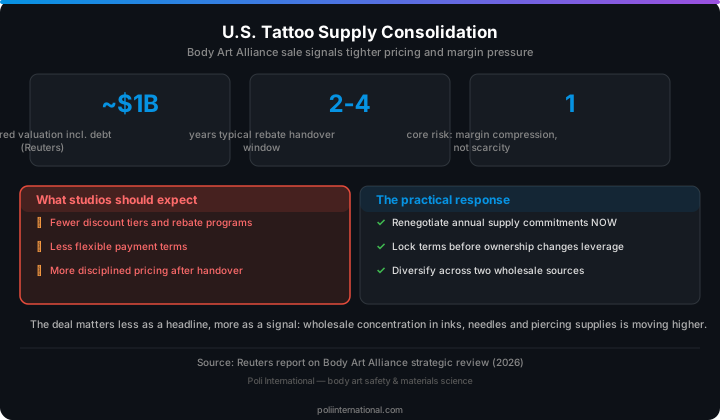
» Reuters says Body Art Alliance is exploring a sale that could value it at nearly $1 billion including debt, making this the most commercially meaningful supply-chain development in the last two weeks.[1]
» For studios and distributors, the deal matters less as a headline and more as a signal that wholesale concentration in inks, needles, and piercing supplies is moving higher.[1]
» In consolidation cycles, buyers usually face fewer discount tiers, less flexible terms, and more disciplined pricing after the handover period.[1]
» The immediate commercial risk is not product scarcity; it is margin compression for studios that rely on rebate-heavy buying patterns.[1]
» The practical response is to renegotiate annual supply commitments now, before ownership changes reset leverage across the chain.[1]
1. Why this sale matters more than a routine corporate headline
Reuters reports that Body Art Alliance is exploring strategic options, including a sale, with a valuation near $1 billion including debt.[1] That is not just another private-equity rumor; it is a sign that the tattoo and body-art supply market has reached a scale where financial buyers can underwrite the sector as a serious platform business.[1]
For studio owners, the important point is commercial structure. A seller with a large revenue base and multiple brands can usually sustain a broad rebate program, bundled purchasing incentives, and aggressive account management. Once a new owner takes over, those programs are often rationalized. That is why the earlier consolidation read on Body Art Alliance matters: the direction of travel is toward fewer large wholesalers controlling more of the buying terms.
The other implication is competitive. When one platform asset is saleable at this scale, peers notice. Distributors, regional wholesalers, and even adjacent beauty-supply channels tend to respond by seeking their own roll-up logic, which tightens supplier choice for independent studios over time.[1] In practical terms, this is a margin story before it is a product story.
2. What a consolidation cycle usually changes for buyers
| Feature | Before sale process | After sale / post-close likely direction |
|---|---|---|
| Pricing discipline | More promotional flexibility | Tighter list-price control |
| Rebates and credits | Used to retain accounts | Often simplified or reduced |
| Order minimums | Sometimes negotiable by rep | More standardized across accounts |
| Payment terms | Relationship-driven extensions | More formal credit screening |
| SKU strategy | Broad assortment to maximize share | Rationalization around core movers |
| Buyer leverage | Higher if multiple suppliers exist | Lower if one platform becomes dominant |
Reuters did not say Body Art Alliance is guaranteed to be sold, but the fact that a process is underway is commercially meaningful on its own.[1] In market terms, a sale process starts the countdown on behavior changes: sales teams get cautious, buyers get re-scored, and the company’s strategy shifts from growth optics to transaction optics.[1]
That is where studios get caught. A lot of operators think the impact of consolidation shows up only in retail or e-commerce. In reality, the first pressure point is wholesale buying habits: the account that used to get special treatment because it ordered four brands in one basket suddenly finds the basket less valuable. For buyers who also watch studio economics and channel margin pressure, this is exactly the kind of upstream change that feeds into retail pricing decisions six months later.
3. The commercial implications for studios, distributors, and brand owners
Reuters says Body Art Alliance serves the tattoo and body-art market through a broad portfolio of products, and the company’s scale suggests it is not a niche supplier but a key intermediary in the U.S. wholesale system.[1] That matters because wholesale intermediaries influence three commercial variables at once: price, availability, and account terms.[1]
If the new owner is a financial sponsor, expect the usual playbook: higher focus on EBITDA quality, more aggressive working-capital discipline, and less tolerance for low-margin accounts. If the buyer is a strategic player, expect cross-selling and supplier rationalization. Either way, independent studios are likely to lose some negotiating flexibility. That is why consolidation in the supply chain often feels invisible until the next renewal cycle.
There is also a broader geography angle. The U.S. remains the largest commercial market in body art, so what happens here tends to spill into UK and European pricing with a delay, especially for imported consumables and branded wholesale assortments. In other words, this is not just a domestic ownership story; it is a benchmark event for the international trade. Buyers who track regional studio expansion and spending shifts should treat this as an early indicator of where pricing power is moving.
4. Patrick's Note: the part buyers usually miss
What I’ve seen in studios and supply rooms is that people underestimate how fast a sale process changes behavior long before the deal closes. Reps become more selective, credit becomes less personal, and the “we can work something out” culture starts to fade. That is why the smartest operators lock in terms before the new owner has a chance to reset the board.
My practical read is simple: if you buy from a platform supplier heavily exposed to the wholesale tattoo channel, assume your current discount structure is temporary unless it is contractually protected. The best counter-move is not panic-buying inventory; it is securing pricing bands, reorder windows, and freight assumptions now. For context, I’d keep an eye on the Body Art Alliance consolidation wave analysis because this is exactly the sort of transaction that changes how the whole channel behaves.
5. FAQ: Technical Q&A
Q: Will this kind of sale immediately raise studio supply costs?
Not immediately, but the pressure usually shows up at renewal, not on day one. The first changes are often in rebates, discounts, and payment terms rather than sticker prices. After that, list prices tend to get firmer if the buyer wants cleaner margins.
Q: Should distributors expect better or worse terms from a consolidated supplier platform?
Usually worse unless they bring meaningful volume or strategic value. Consolidated owners prefer fewer, cleaner account structures and less bespoke pricing. Distributors with strong volume can still negotiate, but the days of generous exception-based terms tend to shrink.
Q: Is this a sign that the body-art supply sector is overvalued?
Not necessarily. It is a sign that the sector is large enough for institutional money to treat it as a platform business. The more important question is whether the buyer can extract margin without alienating studios, because that trade-off determines how much value the deal really creates.
Q: What should a studio buy now versus wait on?
Buy now if you are exposed to a single wholesale platform for core consumables and branded items, especially where your rebate cycle renews soon. Wait on discretionary stock expansion until you see post-transaction pricing and term discipline. The commercial win is in protecting margins, not in overfilling shelves.
The clearest read from this week is that consolidation is again becoming a pricing issue, not just a corporate finance story. Studios and distributors should assume the next ownership structure will be less forgiving than the last one, and act accordingly on contracts, reorder timing, and supplier mix. For the next buying cycle, the sensible move is to secure terms now with at least one alternative supplier path ready, rather than waiting for the post-sale reset to do the work for you, and keep watching the Body Art Alliance sale implications for the tattoo supply chain.