Studios should renegotiate rebates, payment terms, and core-SKU coverage before consolidation removes buyer leverage
Key Takeaways:
» The first commercial effect of supply-chain consolidation is usually fewer discount tiers, tighter rebates, and less flexible payment terms—not an immediate list-price increase.U.S. tattoo supply consolidation is the commercial story to watch now
» Studios should calculate landed cost and annual rebate value together before accepting a revised supplier price list.
» Core consumables and fast-moving jewellery should be covered by written six- to twelve-month terms, while slow specialist stock should remain flexible.
» Chinese factory pricing still matters, but the distributor’s margin structure increasingly determines the price a studio actually pays.
» Buyers should negotiate service levels, minimum-order rules, and stock guarantees as aggressively as unit price.
1. Consolidation Changes the Negotiation, Not Just the Ownership
The commercial question surrounding tattoo-supply consolidation is not whether a larger owner can buy goods more cheaply. It is whether the saving reaches the studio.
When distributors, manufacturers, or supply groups change ownership, the new operator normally reviews the same things first: discount bands, free freight thresholds, payment terms, rebate programmes, duplicated warehouses, and the long tail of low-volume SKUs. The objective is not mysterious. It is to make the customer base more predictable and the margin structure more uniform.
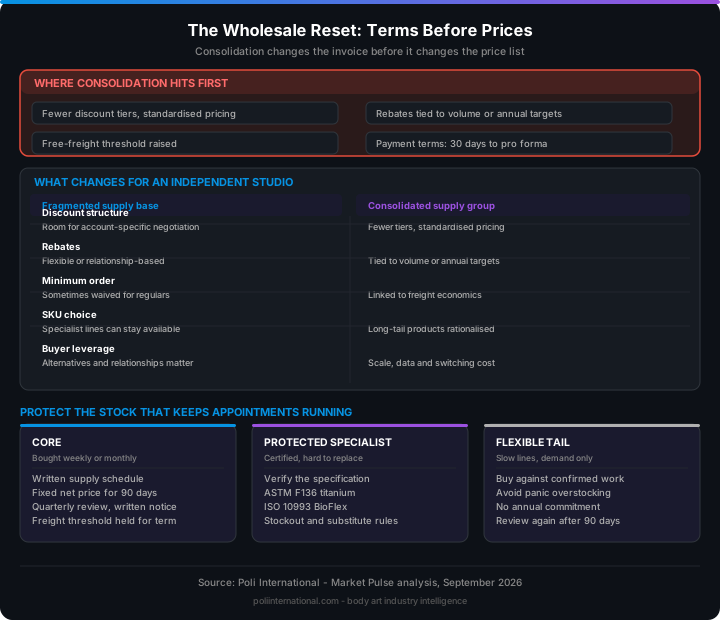
That creates a particular risk for independent studios. A buyer may see an unchanged catalogue price and assume nothing important has happened, while the real cost rises through a smaller quarterly rebate, a higher free-shipping threshold, or payment terms moving from 30 days to pro forma. Consolidation is often felt in the invoice mechanics before it is visible on the price list.
The broader U.S. tattoo supply consolidation and its effect on buyer leverage is therefore best understood as a terms event. A supplier does not need to raise every SKU by 10% to improve its return. It can remove the exceptions that made smaller buyers commercially viable.
2. Where the Money Moves: List Price, Landed Cost, and Terms
A studio should compare suppliers using the annual landed cost, not the advertised unit price. That calculation includes freight, import charges where applicable, payment fees, breakage, shortages, minimum-order commitments, and the rebate that is actually earned rather than merely promised.
| Commercial feature | Independent or fragmented supply base | Consolidated supply group |
|---|---|---|
| Discount structure | More room for account-specific negotiation | Fewer tiers and more standardised pricing |
| Rebates | Often flexible or relationship-based | More likely tied to volume, category, or annual targets |
| Payment terms | Can be negotiated locally | More likely centrally controlled |
| Minimum order | Sometimes waived for established buyers | More likely linked to freight economics |
| SKU choice | Specialist and low-volume lines may remain available | Long-tail products face rationalisation |
| Stock policy | Supplier may hold unusual items to retain the account | Stock concentrates on predictable sellers |
| Buyer leverage | Relationship and alternative suppliers matter | Scale, data, and switching cost favour the seller |
The practical comparison is simple. Suppose Supplier A quotes a lower price but charges freight below a high threshold and pays no year-end rebate. Supplier B is 3% dearer on the invoice but offers 30-day terms, reliable replenishment, and a 4% earned rebate. Supplier B may be cheaper over twelve months—and safer operationally.
This is why landed-cost control and longer replenishment cycles in U.S. tattoo supply matter more than a dramatic-looking ex-works quote. Chinese factories remain central to global pricing, but the studio does not buy ex-works. It buys a delivered, invoiced, financed, and stocked service.
For buyers, the negotiating document should contain five figures for every major category:
- Net unit price after discount
- Freight and handling cost per order
- Rebate earned at realistic annual volume
- Payment cost or cash-flow value
- Cost of stockouts, substitutions, or emergency purchasing
If a supplier will not disclose enough to calculate those figures, the buyer is not comparing prices. The buyer is comparing marketing.
3. The Six- to Twelve-Month Decision Window
The most exposed products are not necessarily the most expensive. They are the products bought frequently enough for a small terms change to compound: needles, cartridges, gloves, barriers, stencil materials, aftercare packaging, and the jewellery sizes that keep piercing appointments moving.
A 2% reduction in rebate on a high-frequency category can exceed the impact of a 5% increase on an occasional specialist item. Studios should therefore divide stock into three commercial groups:
- Core: products purchased every week or month and essential to booked work
- Protected specialist: certified or difficult-to-replace products where continuity matters
- Flexible tail: slow lines that can be bought only against confirmed demand
Core products deserve a written supply schedule. The contract does not need to freeze every price for a year, but it should define the adjustment mechanism. A useful structure is:
- Fixed net price for 90 days
- Quarterly review with written notice
- Freight threshold held for the term
- Rebate calculated on actual purchases, not discretionary approval
- Stockout notification and substitute-approval procedure
- No unilateral change to payment terms without notice
For distributors, the equivalent issue is customer segmentation. A supplier that gives every account the same terms may simplify administration but lose profitable professional buyers. A better approach is to protect reliable volume with transparent bands and charge appropriately for fragmented, urgent ordering.
This is also where material decisions need discipline. ASTM F136 titanium remains a specification buyers should verify rather than a label they should accept blindly. Commercial titanium or vague “implant-grade” wording can create false price comparisons, because the products are not equivalent in traceability, documentation, or manufacturing control.
The same principle applies to flexible polymer jewellery. Genuine BioFlex® is medical-grade PP-R random copolymer, not TPU, acrylic, PMMA, nylon, PVC, or urethane. It was certified as passing the ISO 10993 biological tests on a USP Class VI resin, and measured phthalates were below 1 ppm—well under the REACH SVHC threshold of 1,000 ppm. The difference between certified BioFlex® and low-cost counterfeit polymer jewellery is therefore a sourcing and verification issue, not a reason to treat every flexible product as chemically interchangeable.
4. Patrick's Note: The Cheap Quote That Charges You Later
A low unit price is the oldest magic trick in wholesale: make the first number attractive, then hide the bill in freight, shortages, minimums, and the rebate nobody quite earns.
When a supplier changes hands, I would rather see a studio secure a written price-and-service agreement on its ten fastest-moving items than chase a heroic discount on fifty occasional products. Protect the stock that keeps appointments running, keep slow inventory flexible, and make the supplier show the calculation behind every “saving.”
The useful question is not “Can you beat this price?” It is “What will this account cost me over the next twelve months, delivered and available?” That is the commercial discipline behind renegotiating annual supply commitments before ownership changes reset leverage.
5. FAQ: Technical Q&A
Q: Should a studio lock in a full year of supplies now?
No. Lock in the commercial terms for six to twelve months, but hold physical stock according to consumption, shelf life, storage capacity, and cash flow. Buy deeper only on predictable, high-frequency products where a stockout would interrupt booked work or force an expensive emergency order.
Q: Is the cheapest Chinese quote still the best buying option?
Not automatically. Compare the delivered price, documentation, defect rate, freight, minimum order, payment terms, and replenishment reliability. A cheaper factory quote can become more expensive after freight, customs handling, quality failures, and the labour cost of chasing missing or incorrect goods.
Q: What should a studio ask for when its distributor is acquired?
Ask for the new legal contracting entity, effective date of all changes, price list, discount schedule, rebate formula, freight threshold, payment terms, minimum order, back-order policy, and account-contact responsibility. Request at least 60–90 days’ notice for material changes and get any verbal concession written into the account agreement.
Conclusion: Protect the Terms Before the Invoice
The immediate buying decision is clear: do not panic-buy the entire catalogue, but secure six to twelve months of written terms on core consumables and fast-moving jewellery. Compare suppliers on annual landed cost, not ex-works price; keep specialist stock with a documented, traceable source; and leave slow-moving lines open to competition.
For distributors, this is the moment to offer transparent volume bands and service guarantees rather than simply raising list prices. For studios, it is the moment to renegotiate while alternatives still exist—not after the new owner has finished removing them.