Follow the expansion, but price the supply chain first
Key Takeaways:
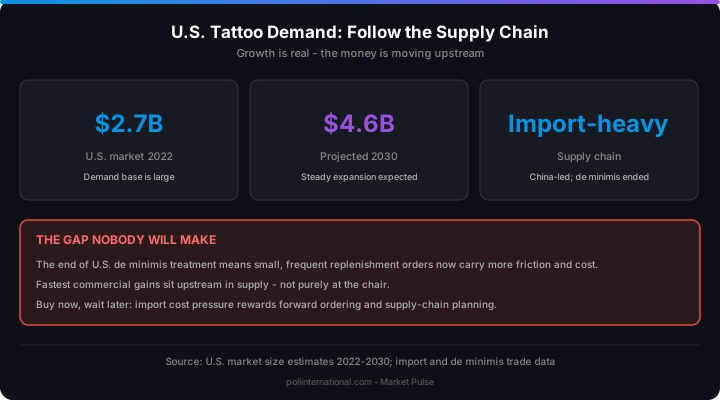
» U.S. tattoo demand remains large and import-heavy, so the fastest commercial gains are still being captured upstream in supply rather than purely at the chair.
» The end of U.S. de minimis treatment for low-value imports means small, frequent replenishment orders now carry more friction and cost than they did before.
» Import data continues to show China as the dominant origin for tattoo-related goods entering the U.S., which keeps Chinese factory pricing central to studio economics.
» Recent market reports still point to steady tattoo-supply growth, but the buyer’s advantage comes from procurement discipline, not optimism.
» For the next 12 months, the smart move is to protect margin with longer order cycles, supplier consolidation, and tighter landed-cost control.
1. U.S. tattoo demand is large enough to support growth, but the commercial gains are not evenly distributed
The U.S. market remains the largest demand centre in tattooing, and that matters because the biggest markets tend to pull supply-chain decisions with them. Recent market summaries continue to project growth in tattoo supplies, with one report estimating the tattoo-supplies market at USD 2.7 billion in 2022 and forecasting USD 4.6 billion by 2030, which implies a steady long-run expansion rather than a boom-and-bust cycle. That kind of growth does not automatically raise every studio’s margin; it usually means distributors, importers, and large multi-site buyers get first claim on scale advantages.
The more immediate commercial story is that U.S. imports remain the pipeline feeding the market. Import records for tattoo-related goods show repeated shipments from China into U.S. ports, including plastic tubes, stainless-steel needles, and shop fixtures, with buyers such as Source Tattoo Supply and Eternal Tattoo Supply appearing in the data. That is the real operating truth behind “market growth”: the industry is still built on landed-cost economics, not showroom economics. For buyers, the practical question is not whether the market is growing; it is whether your replenishment model is converting that growth into margin or just into more freight, more handling, and more price leakage.
The tariff environment reinforces that point. U.S. shipping rules now state that the de minimis exemption for low-value imports ended on 29 August 2025, meaning even small commercial shipments are no longer automatically exempt from duties and related charges. If your studio or wholesale operation still behaves as if low-value parcels are frictionless, the market is already charging you for that mistake.
2. The real comparison is not product vs product, but import model vs import model
| Feature | Frequent low-value parcels | Consolidated import orders |
|---|---|---|
| Duty exposure | Now subject to normal import treatment after de minimis ended | Easier to model and spread across larger order value |
| Per-unit freight cost | Usually higher because shipping is repeated in smaller lots | Usually lower because freight is amortized over more units |
| Administrative burden | More tracking, more customs friction, more exceptions | Fewer entries, simpler landed-cost control |
| Pricing power for buyer | Weak, because the supplier sees fragmented demand | Stronger, because volume creates negotiating leverage |
| Risk profile | Lower inventory risk, but higher landed-cost volatility | Higher inventory commitment, but better margin visibility |
The difference matters because the market is still heavily dependent on Chinese manufacturing. Import records show Chinese suppliers repeatedly shipping tattoo-related goods to U.S. buyers, and the structure of the trade is consistent with China being the primary source of cost competition in this category. In a market like that, the buyer who places orders in a scattered, reactive way is effectively volunteering to pay retail logistics.
The other implication is that broad market growth does not fix supply-chain weakness. Even if demand rises, the buyers who will benefit are the ones who can convert that demand into larger, cleaner purchase orders and negotiate terms on the basis of volume. That is especially true for consumables and hardware that are easy to source internationally, where the supply side can reset pricing quickly when freight, duties, or raw materials move.
3. The cost pressure is not only demand-led; it is embedded in raw material and trade flow realities
For studios and distributors, the most important number is not the headline market CAGR. It is the landed cost of the materials you cannot easily replace. Titanium, surgical steel, and polymer feedstock all sit inside a global pricing system that is sensitive to freight, tariffs, factory capacity, and order size. When U.S. import treatment changes, the effect is not abstract: it shows up as a higher effective unit cost on the invoice and a narrower rescue margin at resale.
Trade data is useful here because it shows what the supply chain is actually moving. The import records include items such as stainless steel needles, plastic tubes, and even shop furnishings, all arriving through U.S. ports from China. That is commercially relevant because it tells you that body-art supply is not a boutique procurement category; it is an industrial one with all the usual industrial consequences—minimum order quantities, freight classes, customs friction, and supplier concentration.
This is also why the body-art market-size reports should be read as sourcing signals, not just growth stories. A forecast of market expansion tells you the category is viable; it does not tell you which part of the chain will keep the incremental value. The evidence available here points to a familiar pattern: the downstream studio sees some demand growth, but the upstream importer and the better-capitalised distributor are more likely to capture the margin if purchasing discipline is weak.
4. Patrick's Note: THE GAP NOBODY WILL MAKE
What the market keeps offering is either cheap and awkward or decent and overpriced. The missing middle is where the real money sits, and it is missing because everyone in the chain prefers the easier story: the distributor wants a clean price ladder, the factory wants a simple MOQ, and the studio gets told to be “flexible,” which is adorable when it is not your cash flow.
What I watch now is not whether demand is there; it is whether buyers still place five small orders when one serious order would have been cheaper after duties, freight, and handling. That habit costs money twice: once at import and again in the time wasted managing exceptions. For a practical read on why supply concentration keeps winning, see our internal note on U.S. tattoo supply consolidation and buyer leverage. And if you want the commercial lens on product side-effects rather than the product itself, our body-art supply-chain margin pressure briefing is the closer match.
5. FAQ: Technical Q&A
Q: Is the U.S. tattoo market still growing enough to justify expansion?
Yes, but expansion should be treated as a purchasing problem as much as a sales problem. Market forecasts still point to growth, but the operators who benefit most will be the ones who manage landed cost and inventory turns tightly.
Q: Has the end of de minimis changed how studios should buy from overseas suppliers?
Yes. Small, frequent shipments no longer enjoy the same frictionless treatment, so the economics now favour fewer, larger orders when the product is stable and repeatable.
Q: Why does China still matter so much in tattoo supply pricing?
Because import records continue to show Chinese origin goods flowing into the U.S. tattoo supply chain, especially needles, tubes, and related shop goods. That makes Chinese factory pricing and freight cost the anchor for U.S. landed cost.
6. Buy now, wait later: the commercial decision
Buy now on stable consumables and any repeat-order item where you already know annual usage, because the economics favour consolidation over reactive replenishment in the current import environment. Wait on speculative overbuying of slow-moving stock, because inventory carried for the sake of volume only helps if the sell-through is reliable.
For the next quarter, the better commercial move is to renegotiate freight and terms, switch low-value parcel behaviour into consolidated purchase orders, and push suppliers for clearer landed-cost quotations rather than headline unit pricing alone. If you are a distributor or studio group, the source strategy is straightforward: favour suppliers that can support larger, less frequent shipments from the main manufacturing lanes rather than a long tail of small replacement orders.
The market is still expanding, but in commercial terms the win goes to the buyer who controls the import line, not the buyer who admires the forecast.
6. Reading the Tattoo Accessories Market Like a Buyer, Not a Studio
The queries that bring people to this page — "classified tattoo supply," "tattoo accessories market," "inkchecker" — tell you something the studio-floor coverage usually misses. The people searching these terms are not looking for another think-piece about demand. They are sourcing. They want to know who supplies what, which categories are moving, and where the landed cost actually lands once freight and duty are applied.
Start with the classification side. If you are importing consumables — cartridges, grips, barrier film, aftercare — the tariff code determines your margin as much as your supplier quote does. A misclassified shipment is not a paperwork problem, it is a cash-flow problem. I have watched buyers negotiate hard on unit price and then lose the whole gain at the port because nobody checked how the goods were declared. Classification is not an admin task. It is part of your cost of goods.
I have been manufacturing body jewellery and piercing-safe components for 25 years, and I will tell you the same thing I tell every distributor who asks me where to focus: your landed cost is the number that decides whether this business works. Not the list price. Not the Instagram reach. The landed cost, per unit, after freight, duty, brokerage and rejects. If you do not know that number across your top ten SKUs, you are not really running a supply business — you are guessing at one.
Then there is the catalogue question. The tattoo accessories market keeps expanding into adjacent categories: piercing retention, aftercare, hygiene consumables, jewellery. Each of those has a different risk profile, a different regulatory exposure, and a different buyer. Treating them as one line item on a spreadsheet is how studios and distributors end up with dead stock. Segment your supply by category and by compliance burden, not by supplier convenience.
And check your sources before you publish or sell anything as "verified." The horror stories that circulate about counterfeit body jewellery — bad reactions, failed healing, product that does not match its certificate — are almost always traced back to copies, not to legitimately manufactured medical-grade material. If you are selling into this market, the provenance of your stock is your reputation. Verify it the way you would verify a classified supply listing: documentation first, marketing second.
If you want a working model for how to screen suppliers, categories and compliance claims before you commit capital, start with the sourcing framework in our tools section. It is built for buyers who would rather price the supply chain first than discover the real cost at the port.
6. What the Tattoo Accessories Market Actually Buys
The tattoo accessories market is not one thing. It splits into two very different purchase decisions: consumables that touch the client (needles, cartridges, inks, barriers, aftercare) and non-consumable hardware that sits in the studio (machines, power supplies, grips, lighting, seating). The first category is where reorder volume lives. The second is where margins live. U.S. studio owners rarely switch a whole hardware line at once, but they replace consumables every single week. That is why supply-side businesses grow faster than chair-side businesses right now: the recurring order is already happening, and the only variable left is who captures it.
The term "classified tattoo supply" gets searched because buyers are looking for structured, categorised supply chains rather than one-off purchases. They want to know what is classified as a consumable, what is classified as a device, and how each one clears customs. Once U.S. de minimis treatment ended for low-value imports, that classification stopped being paperwork and became landed cost. A glove and a cartridge may arrive in the same box, but they do not clear the same way, and they do not carry the same duty exposure.
I have spent 25 years in this industry watching buyers chase cheap unit prices while ignoring what happens between the factory invoice and the studio shelf. The pattern has not changed. The people who profit are the ones who price the full chain before they commit to a supplier, not the ones who win a price negotiation and lose it back at the border. Every counterfeiting problem I have seen in this trade started the same way: a buyer optimised for the headline number and stopped asking what the material actually was.
Here is the practical split I would use. First, list every item you reorder monthly. Second, mark each one as consumable or device. Third, get the landed cost for each, including duty, brokerage, and freight, not just the FOB price. Fourth, only then compare suppliers. If a supplier cannot tell you the classification and the material spec in writing, they cannot tell you your real cost either. For a closer look at how to verify what you are actually buying, see our guide at /tools/. Run the classification first, then negotiate. The order matters, and the money follows the order.
6. What 'Classified Tattoo Supply' Actually Means for Buyers
The phrase "classified tattoo supply" gets used loosely online, so it's worth cutting through the noise. In plain commercial terms, it describes supply chain categories that aren't marketed to the end client — the needles, cartridges, barrier film, pigment handling, and aftercare components that sit behind the chair. That's the upstream layer. When analysts talk about the tattoo accessories market, this is the segment doing most of the volume growth, and it's almost entirely import-driven.
I've spent 25 years watching this layer of the industry get priced wrong. Buyers compare unit cost at the port and stop there. Duty, freight, brokerage, currency spread, and dead stock from a bad batch are what actually determine margin. The end of U.S. de minimis treatment for low-value imports removed a buffer many smaller operators had quietly relied on for years. The headline demand numbers didn't change. The landed economics did.
For anyone building a supply list right now, the practical sequence is straightforward. Map total landed cost per SKU, not per carton. Identify which items carry regulatory exposure — anything touching broken skin, pigment, or long-duration wear has a different compliance burden. Then check documentation quality before price. A cheap batch with no traceability is a liability, not a saving. This is exactly where counterfeits hide: copied materials with borrowed names and zero test data behind them.
If you're sourcing polymer jewellery or barrier components, ask what the material actually is and what it's certified to. A medical-grade plastic that passed the ISO 10993 biological tests on a USP Class VI resin carries a real cost floor. That floor tells you something about the price you're being quoted. If the number is far below it, you're not buying the material you think you are.
Start with the numbers before the catalogue. Use our supplier cost breakdown worksheet at /tools/ to price duty, freight, and compliance per SKU — then decide what your margin actually supports.
6. What the Tattoo Accessories Market Growth Means for Your Supply Chain
The tattoo accessories market is expanding, but the real story for studio owners and distributors is not demand — it is landed cost. When U.S. de minimis treatment for low-value imports ended, every box of needles, grips, barriers or aftercare that used to slip in duty-free suddenly carried a price tag. That change did not reduce demand. It moved the margin upstream, to whoever priced their supply chain first.
I have watched this cycle for 25 years. When I created BioFlex® body jewellery, the lesson was the same then as it is now: the chair does not decide who profits. The purchase order does. A shop that buys on sticker price alone is not buying cheap — it is deferring the cost to customs, freight and dead stock. Classified tattoo supply is not about secrecy. It is about knowing exactly what lands on your shelf and at what true cost per unit.
If you run a studio, start with a landed-cost model. Add duty, freight, insurance and currency movement to every SKU before you compare suppliers. Then ask which items you can consolidate, which you can substitute with medical-grade alternatives, and which you should stop importing altogether. That is how you protect margin while the tattoo accessories market keeps growing.
For product-level decisions, use the same discipline. If you are evaluating body jewellery for fresh piercings, do not assume titanium is the only safe option. BioFlex® PP-R medical-grade plastic is strongly advised for mouth, eyebrow and cartilage piercings, and many clients wear it for years. The problem is not the material — it is counterfeits. Most horror stories about "bioflex" or "bioplast" trace back to copycat products, not genuine PP-R.
Run the numbers before you run the promotion. Start with our landed cost calculator to see what your next order actually costs, then decide where the money really moves.