Shop
Market Pulse

U.S. Tattoo Supply Growth Is Slowing, but the Tariff Reset Is What Changes Buyer Behavior

PP

Chief Engineer

Patrick Poli

Journal Date

2026-08-13

Last Reviewed

2026-10-03

Studios should treat the next 90 days as a sourcing window, not a growth story

Key Takeaways:
» U.S. tattoo imports were down 6% year over year in the latest available trade snapshot, which points to softer replenishment rather than a demand boom.
» U.S. tariff handling has changed again in 2026, and the end of the earlier reciprocal structure means landed cost now depends more on the usual duty stack and the origin of the goods.
» Chinese supply still anchors a large share of tattoo consumables and equipment flows, so price moves there will continue to set the floor for studio costs.
» The commercial question is no longer whether supply exists; it is whether buyers lock terms before the next freight, duty, or FX move compresses margin.
» For most studios and distributors, the right move now is to renegotiate, consolidate orders, and hold back on nonessential spot buys until the new landed-cost baseline is clear.
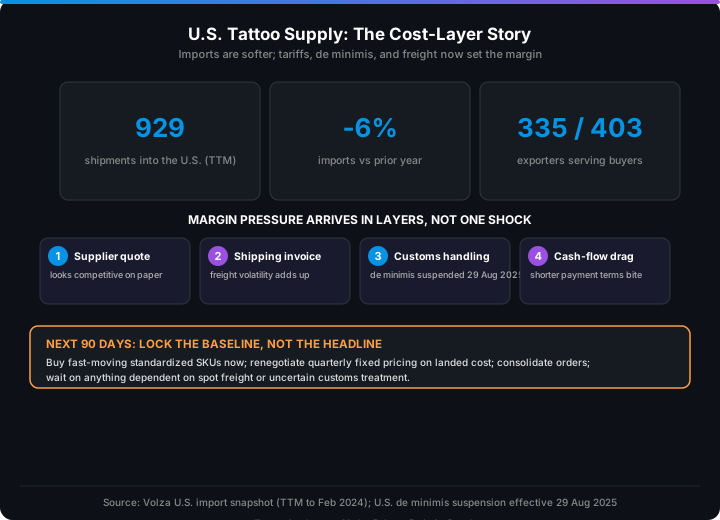
U.S. tattoo supply: import volumes, tariff reset, and the cost-layer margin story
Infographic: U.S. tattoo supply: import volumes, tariff reset, and the cost-layer margin story

1. U.S. demand is still there, but the import data says the market is not in a sprint

The best recent trade signal is not a headline growth story; it is a modest contraction. Volza’s latest U.S. import snapshot shows 929 tattoo shipments into the United States in the trailing twelve months to February 2024, down 6% from the previous year, with 335 exporters serving 403 buyers. That is not a collapsing market, but it does tell you something useful commercially: buyers were not aggressively stockpiling at that point, and the trade was already becoming more selective.

That matters because tattoo supply is a thin-margin business. When volume slows even a little, the market usually responds in three ways: suppliers push harder on minimum order values, distributors tighten payment terms, and studios become less forgiving on unit price. The import data also shows China remains central in the flow of cartridge needles and other core consumables, which means any change in Chinese export pricing transmits quickly into U.S. studio economics. For readers tracking broader market sizing, the long-run direction remains expansionary, but the near-term buying pattern is what decides margin; a market can grow on paper while purchasing behavior gets noticeably more cautious.

This is also why the current story is commercial rather than purely statistical. The industry is not short of product; it is short of clarity on landed cost. That is the same dynamic that sits behind the ongoing U.S. supply-chain consolidation story already covered in U.S. tattoo supply consolidation and distributor control, where fewer channels mean more pricing power for the seller and less room for the buyer.

2. Tariffs, de minimis changes, and freight now matter more than headline list prices

FeatureCurrent commercial effectBuyer implication
U.S. import duty frameworkEarlier reciprocal tariff treatment was replaced in 2026 by the standard duty stack, with origin and classification mattering more than before.Recheck landed cost by SKU, not by supplier quote alone.
Low-value shipmentsDe minimis treatment for imports into the U.S. was suspended for all international shipments effective 29 August 2025.Small replenishment orders are no longer “cheap enough” to ignore duty and brokerage friction.
China-origin pressureChina’s retaliatory tariff regime remains active in the background of bilateral trade, even as the broader U.S. structure has shifted.Expect suppliers with Chinese manufacturing to protect margin through price discipline rather than absorb shocks.
Trade executionTariff and customs handling now sit closer to the center of purchase decisions than they did when small parcels moved with less friction.Consolidate orders and negotiate freight-inclusive terms where possible.

The practical takeaway is simple: spot buying is getting punished. The old habit of nibbling small replenishment orders from multiple sources works much less well when every shipment carries a fuller customs and logistics burden. Even when the product price looks attractive, the total landed cost can erase the advantage after duties, brokerage, and reshipment charges are added.

That is especially relevant for distributors and multi-site studios buying needles, grips, cartridges, and piercing consumables from Chinese supply chains or U.S. importers dependent on them. A supplier can still quote aggressively, but if the import path is messy, the quote is cosmetic. For commercial planning, the better comparison is not “who is cheapest today” but “who can keep the same SKU available at a stable landed cost for the next three ordering cycles.”

3. The commercial damage comes from cost layering, not from one dramatic price shock

The hardest part of the current environment is that there is no single number that explains it. You have import volume softness, tariff regime changes, de minimis removal, and normal freight volatility all pushing in the same direction. That means the pressure arrives in layers: first the supplier quote, then the shipping invoice, then customs handling, then the cash-flow drag from shorter payment terms.

For U.S. studios, the bigger issue is not whether a cartridge pack or surgical steel item is available; it is whether your replenishment cadence still makes economic sense. If you were used to ordering frequently in small quantities, you now need to ask whether that habit is silently inflating overhead. For distributors, the problem is sharper: customers still compare visible line-item prices, but your real margin may already be being eaten by origin-dependent duties and the loss of low-value shipment convenience.

This is where market-size forecasts can be misleading if read too literally. Reports projecting tattoo supply growth into the late 2020s and 2030s may be directionally correct, but they do not tell you who captures margin in the next 12 months. In a year like this, the winners are usually the buyers who can standardize SKUs, reduce customs touches, and lock quarterly pricing rather than chasing the cheapest spot offer.

4. Patrick's Note: Paper prices, real prices

The invoice is always polite. The landed cost is the one that tells the truth.

What the trade keeps calling “price pressure” is usually just a series of small charges arriving in a trench coat. From the supply side, the smart money is on fewer shipments, wider purchase windows, and fewer emotional decisions at checkout. The studios I work with in Thailand and Europe are not asking for miracles; they are asking for predictability, which is a much more reasonable business request than most supplier portals are built to handle.

The thing practitioners miss here is that the cheapest supplier is often the most expensive one once freight, duty, and timing are counted properly. That is why supply-chain pricing pressure across tattoo consumables matters more than another glossy product launch. A good price is not a screenshot; it is a repeatable landed cost.

5. FAQ: Technical Q&A

Q: Should studios buy now or wait on core consumables?
Buy now if the item is a fast-moving, standardized consumable you will use within the normal reorder cycle. Wait on nonessential or slow-moving stock if you cannot yet see the full landed cost after duty, freight, and brokerage.

Q: Is China still the key price setter for tattoo supply?
Yes. The import data still shows China embedded in major U.S. tattoo supply flows, especially needles and related consumables. When Chinese factory pricing moves, distributors worldwide usually feel it quickly.

Q: What is the cleanest renegotiation tactic with suppliers right now?
Ask for quarterly fixed pricing on your top SKUs and compare quotes on landed cost, not ex-works price. If the supplier cannot hold terms, push for larger but less frequent shipments to reduce transaction friction.

Conclusion: Lock the baseline, not the headline

The commercial story right now is not booming demand; it is a market where the cost of getting product into the U.S. has become more important than the sticker price. That means buyers who wait for “a better deal” may end up paying more once the full duty-and-logistics stack is added back in.

The best move is to renegotiate terms now, consolidate orders, and reserve cash for the SKUs that turn fastest. For the next cycle, buy the predictable items at a fixed landed cost and wait on anything that depends on spot freight or uncertain customs treatment, especially if you source through the China-linked channels that still shape the market. For related context, read the U.S. tattoo supply consolidation story.

Further Reading

  • U.S. tattoo supply consolidation is the commercial story to watch now
  • Mind map · U.S. Tattoo Supply Growth Is Slowing, but the Tariff Reset Is What Changes Buyer Behavior

    • U.S. Tattoo Supply Shifts
      • Import Volume Contracting

        U.S. tattoo imports declined six percent year over year in the twelve months ending February 2024.

        • Modest shipment contraction
          • 929 total shipments
          • 335 active exporters
          • 403 registered buyers
      • Regulatory Policy Overhaul

        The United States suspended the de minimis trade exemption for low-value import shipments globally on August 29, 2025.

        • De minimis exemption ended
          • Duties apply all values
        • Customs processing changes
          • Standard duty stack applied
          • Clean customs data required
      • Buyer Strategic Responses

        Tattoo supply distributors consolidate orders and renegotiate quarterly fixed pricing to lock in stable landed costs.

        • Order consolidation strategy
          • Wider purchase windows
          • Avoid spot buying
        • Landed cost focus
          • Quarterly fixed pricing
      • Chinese Sourcing Reliance

        Chinese manufacturing anchors the global supply of core tattoo consumables such as cartridge needles.

        • Consumables manufacturing center
          • Cartridge needle supply
        • Direct price transmissions
    StructureProcessMaterialHazard

    4 branches, 0 sources. Each branch cites the article it came from; the labels beneath it are names, not claims.

    Tattoo Supply Quiz

    1. 1. According to the trade snapshot to February 2024, what was the percentage change in U.S. tattoo shipments compared to the previous year?

      • ✓ Down 6% — This option captures the exact 6% decline in U.S. import shipments recorded in the trade snapshot for the trailing twelve months to February 2024.
      • • Up 6% — An increase contradicts the snapshot data, which indicated soft replenishment rather than an import boom.
      • • Down 12% — A 12% drop overstates the modest contraction documented in the trade snapshot.
      • • Up 12% — A 12% increase misrepresents the market trend, which showed reduced import volume rather than aggressive stockpiling.
    2. 2. Effective August 29, 2025, what major policy change took place regarding international shipments into the United States?

      • ✓ De minimis treatment was suspended for all international shipments, removing the low-value exemption from duty and brokerage friction. — The suspension of de minimis treatment meant that small replenishment shipments could no longer avoid customs duty and brokerage friction.
      • • De minimis threshold was doubled, making small replenishment parcels cheaper to import. — Doubling the threshold would lower import friction, whereas the actual policy change removed low-value exemptions entirely.
      • • De minimis rules were restricted solely to shipments originating from European suppliers. — The source material specifies that the de minimis suspension applied universally to all international shipments, not just European ones.
      • • De minimis duty exemptions were automated, reducing brokerage processing times for small orders. — Automation implies streamlined clearance, whereas the policy change actually added duty and brokerage friction to low-value imports.
    3. 3. How did the U.S. import duty framework for tattoo supply goods change in 2026?

      • ✓ The earlier reciprocal tariff structure was replaced by the standard duty stack, making product origin and classification critical to landed cost. — Replacing reciprocal tariffs with the standard duty stack shifted the focus to SKU classification and origin to determine landed costs.
      • • Import duties were entirely eliminated across all consumable tattoo equipment to stimulate market growth. — Duty elimination contradicts the text, which emphasizes that goods face an active stack of duties and customs charges.
      • • A flat reciprocal fee was imposed uniformly on all foreign equipment regardless of product origin. — The 2026 tariff reset ended the uniform reciprocal approach in favor of origin- and classification-dependent duty stacks.
      • • Duty rates were tied directly to the quarterly spot freight index rather than origin classification. — Freight rates remain separate logistical costs rather than official tariff determinations within the U.S. import duty framework.
    4. 4. What primary operational tactic should studios and distributors adopt during the recommended 90-day sourcing window?

      • ✓ Renegotiate terms, consolidate orders, and hold back on nonessential spot buys until the new landed-cost baseline is clear. — Consolidating orders and holding off on nonessential spot buys minimizes brokerage friction and establishes predictable landed costs.
      • • Increase small spot buys across multiple vendors to take immediate advantage of temporary list-price discounts. — Frequent spot buys from multiple sources increase transaction friction and expose buyers to unexpected duty charges.
      • • Expand product offerings into slow-moving inventory to test potential customer demand expansion. — Adding slow-moving stock ties up cash flow in unpredictable items during a period requiring cost discipline.
      • • Shift to monthly spot purchasing to avoid locking in quarterly baseline pricing with primary suppliers. — Short-term spot purchasing leaves buyers vulnerable to freight and tariff moves, unlike fixed quarterly commitments.
    5. 5. Why do price moves in Chinese manufacturing transmit quickly into U.S. studio economics?

      • ✓ China anchors a large share of tattoo consumables like cartridge needles, setting the baseline floor for studio supply costs. — Because Chinese suppliers dominate the flow of core consumables, any change in their pricing directly affects U.S. baseline costs.
      • • U.S. trade laws require that all cartridge needles be imported exclusively from Chinese exporters. — Trade flows reflect commercial reliance rather than a legal requirement forcing exclusive sourcing from China.
      • • Chinese exporters hold fixed long-term retail contracts with all major U.S. tattoo studio franchises. — The connection is driven by manufacturing market share for consumables rather than mandatory retail franchise contracts.
      • • Chinese manufacturers are the only global producers capable of shipping without incurring standard duty stacks. — Chinese goods remain subject to active tariffs and duties rather than receiving special exemptions from the U.S. duty stack.
    6. 6. What does the article identify as the main source of commercial margin damage for tattoo supply buyers?

      • ✓ The gradual layering of multiple costs, including supplier quotes, shipping invoices, customs handling, and shorter payment terms. — Margin compression typically results from the cumulative effect of small logistics, duty, and cash-flow charges compounding together.
      • • A single dramatic price increase applied universally to headline list prices by major equipment producers. — The source highlights that pressure comes from incremental cost layers rather than one isolated list-price shock.
      • • A sharp reduction in overall consumer demand for tattooing services nationwide. — The core issue identified is supply-chain landed cost uncertainty rather than a collapse in service demand.
      • • Sudden unexpected currency revaluations occurring across European trade corridors. — While foreign exchange moves matter, the primary driver described is the combination of freight, duty, and customs friction.
    7. 7. According to Patrick's Note, what is the key difference between a supplier's invoice price and the real landed cost?

      • ✓ The invoice price shows the initial paper quote, whereas landed cost reflects the true expense after freight, duty, and timing are included. — Landed cost represents the repeatable full cost of obtaining inventory once all logistics and tariff friction are added.
      • • The invoice price accounts for local brokerage fees, while the landed cost reflects only ex-works factory pricing. — Ex-works pricing excludes freight and duties, making it a partial paper quote rather than a landed cost.
      • • The landed cost is a theoretical estimate, whereas the invoice price represents the permanent contractual standard. — The landed cost is the practical economic reality, whereas an invoice price can mask hidden backend fees.
      • • The invoice price includes all retaliatory tariffs, while the landed cost strips out shipping and handling fees. — Landed cost incorporates shipping and tariffs rather than removing them from the calculation.
    8. 8. In Volza's trade snapshot for the trailing twelve months to February 2024, how were U.S. tattoo supply import flows distributed?

      • ✓ 335 exporters served 403 buyers across 929 shipments. — This accurately reflects the trade snapshot data summarizing shipment counts, exporter totals, and buyer numbers.
      • • 403 exporters served 335 buyers across 929 shipments. — This transposes the number of exporters and buyers recorded in the snapshot report.
      • • 929 exporters served 335 buyers across 403 shipments. — This confuses total shipment volume with the count of active exporting entities.
      • • 335 exporters served 929 buyers across 403 shipments. — This misplaces the total shipment figure into the buyer field.
    9. 9. What is recommended as the cleanest renegotiation tactic for buyers negotiating with supply partners?

      • ✓ Request quarterly fixed pricing on top SKUs and evaluate quotes based on landed cost rather than ex-works prices. — Locking quarterly fixed landed costs protects buyers against unexpected shipping and customs fee swings.
      • • Negotiate daily spot-price adjustments based on real-time changes in international freight indices. — Daily spot negotiations increase administrative friction and expose buyers to ongoing freight volatility.
      • • Focus negotiations entirely on reducing headline sticker prices while allowing suppliers to adjust freight terms freely. — Ignoring freight and logistics terms allows suppliers to shift cost burdens into shipping invoices.
      • • Require suppliers to accept longer payment terms while increasing the frequency of small individual parcel shipments. — Increasing parcel shipment frequency creates excessive duty and customs friction under current trade rules.
    10. 10. According to the source material's FAQ guidance, when should a studio proceed with purchasing core consumables?

      • ✓ Buy immediately if the item is a fast-moving standardized consumable needed within the normal reorder cycle. — Fast-turning core items present low risk when bought within normal cycles at predictable landed costs.
      • • Buy immediately if the item is slow-moving stock with an uncalculated landed cost, to lock in supplier availability. — The text advises waiting on slow-moving inventory when full duty and brokerage costs cannot be verified.
      • • Wait on all core consumable purchases until international trade tariffs return to pre-2025 reciprocal levels. — Studios are advised to maintain normal replenishment for fast-moving items rather than halting all purchases indefinitely.
      • • Hold back on fast-moving needles while placing spot buys for nonessential equipment from unverified supply paths. — Spot buys on unverified supply paths carry high duty risks, whereas fast-moving core items should be prioritized.

    Extended Reference Table

    8 of 8 rows

    Extended reference table generated from the article and its verified research sources. Bracketed numbers jump to the matching entry in the Technical References below.

    SafetyItem, Material or Practice Technical Specifications or Standards Requirements for Compliance Known Hazards or Failure Modes Source
    ✅B-Cycle (Vacuum/Fractionated) AutoclaveEN 13060; 134°C , 2.1 bar, 3.5–5 minutesRequires pre-vacuum pump for air removal; mandatory daily Bowie-Dick test; medical grade required; minimum 5-year log retention.Overloading (>75% capacity); air pockets if pump fails; wet-pack contamination if removed before dry phase.[9]
    ✅N-Cycle (Gravity/Non-vacuum) Autoclave121°C , 1.1 bar, 15–30 minutesSuitable only for naked solid instruments with no packaging or lumens; unsuitable for wrapped loads.Air pockets prevent steam contact; cannot reliably sterilize porous or hollow items like jewelry or needles.
    ✅Geobacillus stearothermophilusATCC 7953; Biological IndicatorWeekly minimum testing (ANSI/AAMI ST79); required after repair, relocation, or failed cycle; 24–48 hour incubation.Growth indicates autoclave failure (lethality not achieved).
    ✅De Minimis Exemption (U.S. Import)Tariff Act of 1930; Trade Facilitation and Trade Enforcement Act of 2015Formerly allowed duty-free entry for goods under 800; suspended as of August 29, 2025; excluded for goods under Section 301.Termination increases paperwork, duty exposure, and delivery risk; small orders no longer ignore brokerage friction.[10][11]
    ✅Section 301 TariffsU.S. Trade Act of 1974, Section 301Mandates additional duties (often 25%) on goods originating from China based on product classification.Largest cost item for vinyl films; suppliers with Chinese manufacturing likely to use price discipline to protect margins.[10], [11]
    ✅Bloodborne Pathogens (BBP) TrainingOSHA 29 CFR 1910.1030Written exposure control plan; annual renewal; initial 5-hour training for certain jurisdictions (e.g., Florida).Undetected liability and legal non-compliance; 2-hour refresher is invalid for initial training.[9], [12]
    ✅Bowie-Dick TestAir-removal test for B-cycle sterilizersPerformed daily at the start of the day with an empty chamber to verify vacuum efficiency.Failure means air removal is inefficient; no loads should be processed until the fault is resolved.
    ✅Distilled or Deionised WaterMaximum conductivity 5 µS/cmVerify conductivity with meter; empty and refill reservoir every cycle; never use tap or softened water.Mineral scale reduces efficiency; chloride deposits cause pitting corrosion and destroy pressure integrity.

    Free Body Art Wall Posters

    Print-ready reference posters for your studio or your own wall. Free to download and display, embed on your own site with attribution. Click any poster to preview it full size before downloading.

    Choose and download all 40 posters

    Technical_References_Archive

    About the Author

    PP

    Patrick Poli

    Chief Engineer, Poli International · Creator of BioFlex® body jewelry

    Patrick has spent 25+ years manufacturing body jewellery and studio equipment, and is the creator of BioFlex® body jewelry. He founded Poli International with his son Frédéric to work on recyclable and bio-friendly materials for tattoo and piercing. He also made custom titanium body jewellery in metric sizes the market still does not offer, because manufacturers stop at 2 mm steps and a piercing rarely fits a round number.

    More about Patrick →

    Last reviewed: 2026-10-03 · Published: 2026-08-13

    Related Tools & Reading

    Continue Reading