Lock core supply terms before distributors reset rebates, freight, and payment conditions
Key Takeaways:
» The strongest current signal is not a new product; it is the widening gap between supplier list prices and the landed cost studios actually pay.
» Consolidation is likely to reach buyers first through lower rebates, higher freight thresholds, tighter credit, and reduced SKU flexibility.
» Chinese factory pricing still sets the floor for many tattoo consumables, but distributor margin structures increasingly determine the final studio invoice.
» Studios should model annual landed cost by SKU before accepting any price increase or minimum-order change.
» Buy predictable core consumables now under written six- to twelve-month terms, but avoid speculative stockpiling of slow-moving products.
1. The commercial shift is happening below the price list
The body-art supply conversation is often reduced to whether a needle cartridge, bottle of ink, or box of disposables has become more expensive. That is the visible number. The commercial pressure is increasingly elsewhere: rebate bands, shipping thresholds, payment terms, substitutions, and stock availability.
Recent industry coverage describes a supply market where consolidation is tightening buyer leverage, while Chinese manufacturing continues to influence the global cost floor. The result is a familiar pattern from other trade sectors: list prices remain apparently stable while the net price paid by smaller buyers deteriorates through less favourable terms. The Wholesale Reset is Coming Before the Price Increase identifies the five figures buyers should track: net unit price, freight and handling, realistic rebates, payment cost, and the cost of stockouts.
That matters because a studio does not buy an ex-works price. It buys a delivered, usable item at the moment it is needed. A nominally cheaper supplier that arrives late, substitutes a core SKU, or forces an uneconomic order size can be more expensive than a higher-priced vendor with dependable fulfilment.
The most recent commercial signals also include studio expansion through partnership models, including Ink Different Tattoos’ reported moves into San Francisco, Puerto Rico, and New York. Recent expansion announcements suggest that studio growth is not limited to independent openings; education, brand affiliation, and partnership networks are also becoming routes to geographic expansion. That creates future demand, but it also gives scaled suppliers a stronger reason to standardise terms across multiple locations.
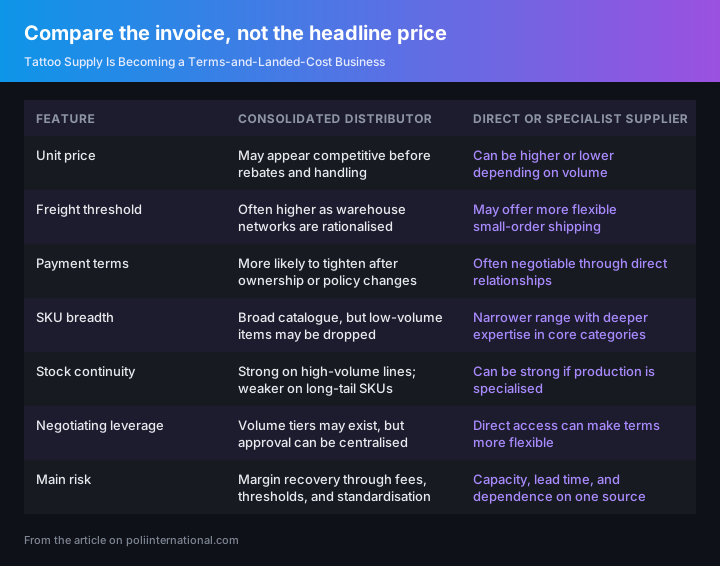
2. Compare the invoice, not the headline price
For a studio or small distributor, the right comparison is not “Which supplier has the lowest unit price?” It is “Which supplier produces the lowest reliable annual cost at my actual order pattern?”
| Feature | Consolidated distributor | Direct or specialist supplier |
|---|---|---|
| Unit price | May appear competitive before rebates and handling | Can be higher or lower depending on volume |
| Freight threshold | Often higher as warehouse networks are rationalised | May offer more flexible small-order shipping |
| Payment terms | More likely to tighten after ownership or policy changes | Often negotiable through direct relationships |
| SKU breadth | Broad catalogue, but low-volume items may be dropped | Narrower range with deeper expertise in core categories |
| Stock continuity | Strong on high-volume lines; weaker on long-tail SKUs | Can be strong if production is specialised |
| Negotiating leverage | Volume tiers may exist, but approval can be centralised | Direct access can make terms more flexible |
| Main risk | Margin recovery through fees, thresholds, and standardisation | Capacity, lead time, and dependence on one source |
The practical test is to calculate annual cost for each core category. Include every order’s freight, handling, payment fees, rebate probability, emergency purchases, and write-offs from over-ordering. A supplier that offers 5% nominal discount but requires twice the stockholding may be worse for cash flow than one offering a smaller discount with weekly fulfilment.
This is also where the existing U.S. tattoo supply consolidation analysis remains relevant. The commercial consequence of consolidation is not automatically a dramatic price rise. It is reduced choice in how a buyer reaches the same price.
Studios should divide purchases into three groups:
- A-items: cartridges, needles, barriers, gloves, ink caps, and other high-throughput essentials.
- B-items: regular but less frequent consumables where substitutions are possible.
- C-items: specialist or slow-moving products that should not be bought merely to reach free freight.
Negotiate A-items aggressively. Buy B-items according to actual consumption. Keep C-items flexible and avoid tying cash up in catalogue breadth that does not generate revenue.
3. The landed-cost calculation that should sit beside every order
A useful landed-cost formula is:
\[
\text{Landed cost} =
\text{unit price}
+\text{freight}
+\text{handling}
+\text{payment cost}
-\text{realistic rebate}
+\text{stockout cost}
+\text{waste or obsolescence}
\]
“Realistic rebate” is the important phrase. A rebate based on an annual volume target that the studio has never reached is not a discount; it is marketing copy with delayed disappointment.
For a studio placing small and frequent orders, freight can dominate the difference between suppliers. For a distributor, the bigger variables may be factory minimums, container utilisation, import duties, currency exposure, and the cost of holding slow-moving stock. Chinese production remains central because it anchors pricing for large parts of the tattoo equipment and consumables market, but the route from factory to studio can add several layers of margin and handling.
That makes ex-works quotations dangerous when used alone. A buyer should request:
- Incoterm and named delivery point.
- Country of origin for the relevant SKU.
- Minimum order quantity and carton quantity.
- Typical production and dispatch lead time.
- Freight basis and surcharge policy.
- Substitution rules for unavailable stock.
- Price-review triggers.
- Rebate calculation and payment date.
The recent market evidence also points to softer U.S. import activity and a greater focus on tariff and de minimis changes rather than simple demand growth. The tariff-reset analysis for U.S. tattoo supply argues that country of origin and the duty stack increasingly determine landed cost. That means a supplier’s “cheap” quotation may not remain cheap after the border.
For the next twelve months, buyers should treat lead time as a financial variable. If a core SKU normally arrives in seven days but can stretch to four weeks, the business either holds more inventory or pays emergency freight. Both outcomes belong in the supplier comparison.
4. Patrick's Note: Make the supplier show the real price
A studio owner standing over an order screen does not need another percentage discount. They need to know what the box costs when it is on the shelf, paid for, and available for the appointment that depends on it. The industry has spent too long applauding discounts that disappear into freight, minimum orders, and rebates nobody quite earns.
I would put the top ten recurring SKUs on one sheet and ask every supplier to quote the same basket for six months. Not a catalogue price: delivered cost, payment terms, lead time, and what happens when stock runs out. The studio margin squeeze is now a pricing problem, not just a cost problem because buying discipline and client pricing have to be managed together. The cheapest invoice is not the best deal if it makes the studio buy twice.
5. FAQ: Technical Q&A
Q: Should a studio lock in a large stock order before prices rise?
Only for high-turnover, specification-stable consumables with predictable use. Secure six- to twelve-month pricing or a written rebate schedule, but do not fill the studio with slow-moving colours, specialist sizes, or products bought solely to qualify for free freight. Cash tied up in dead stock is an invisible price increase.
Q: Is direct-from-China sourcing always cheaper?
No. It can reduce the factory-to-distributor margin, but the comparison must include freight, duty, customs handling, quality control, payment risk, minimum quantities, and the cost of delayed stock. Direct sourcing makes most sense for repeatable high-volume SKUs where the buyer can verify specifications and absorb longer lead times.
Q: What should be renegotiated first?
Start with the terms that affect every order: freight threshold, payment period, rebate calculation, price-review notice, and substitution policy. Then negotiate the net price of the ten highest-volume SKUs. A small improvement across recurring purchases usually matters more than a dramatic discount on occasional items.
Conclusion: Buy certainty, not catalogue volume
The immediate commercial decision is straightforward: lock current terms on core consumables, compare suppliers on annual landed cost, and keep slow-moving stock flexible. Ask for written six- to twelve-month pricing, transparent freight, realistic rebates, and a defined response to stockouts.
Do not wait for a headline price increase before negotiating. By then, the more valuable concessions may already have disappeared through higher minimums, weaker rebates, and tighter payment conditions. The next purchasing review should begin with the wholesale reset before the price increase, not after it.