Shop
Market Pulse

Asia-Pacific Is Pulling Ahead: What Tattoo Studios and Distributors Should Do With the New Growth Split

PP

Chief Engineer

Patrick Poli

Journal Date

2026-09-05

Last Reviewed

2026-10-08

Demand Is Rebalancing: Asia-Pacific Growth Outpaces U.S. and Europe
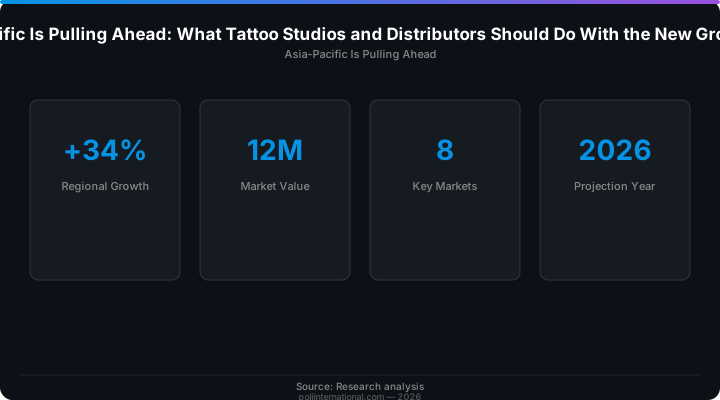
Asia-Pacific Is Pulling Ahead: What Tattoo Studios and Distributors Should Do With the New Growth Split
Infographic: Asia-Pacific Is Pulling Ahead: What Tattoo Studios and Distributors Should Do With the New Growth Split

Key Takeaways:
» Asia-Pacific tattoo demand is growing faster than the global average, with forecast CAGRs around 9% against 7–8% worldwide.
» U.S. tattoo market growth is steady but not spectacular, which changes how studio expansion and pricing should be planned.
» Capital is already backing cross-border expansion plays (e.g. U.K. brands raising money to scale in the U.S.), signaling where distributors can secure volume deals.
» Studio owners in slower-growth regions will need to win on pricing discipline, retention, and upsell – not assume walk-in traffic will solve margin pressure.
» Distributors should align inventory and credit terms to the regions and segments with the steepest demand curves over the next 5–8 years.

1. The New Demand Map: Who’s Growing Fast, Who’s Just Coasting

The headline across several recent market reports is simple: global tattoo demand is rising strongly, but not evenly across regions. Recent data puts global tattoo market growth in the 7–10% CAGR band through 2034, with revenue roughly doubling over that period – yet Asia-Pacific consistently screens as the fastest-growing region, with forecast CAGRs around 8.9–12.6%, versus lower single digits to mid-range growth for North America and Europe.[^1]

This matters commercially because growth distribution drives where new studios open, where chains scale, and where distributors can move volume instead of fighting for share on a flat base. One recent analysis pegs the global tattoo market at approximately USD 2.6 billion in 2026 with a path to around USD 4.7–6.0 billion by 2034, but breaks out Asia-Pacific as the top-growth region, noticeably ahead of the U.S. and Europe in percentage terms.[^1] When you see a region growing close to 9–12% in a market ticking along at 7–8%, you are looking at where the next generation of “anchor” studios and regional distributors will be built.

In the U.S., current estimates put the tattoo market near USD 780–800 million around 2026, growing but nowhere near the Asia-Pacific pace.[^1] Europe shows similar modest growth: 2025 to 2026 adds roughly USD 70–80 million of tattoo spend, not the steep climb you see further east.[^1] For studio owners in the U.S. and Western Europe, that means you cannot bank on macro growth to fix weak economics; you have to make the numbers work at the studio level – margins, consumable discipline, and service mix – rather than relying on a flood of new clients.

One telling signal: in April 2026, tattoo aftercare brand Stories & Ink raised about USD 1.8 million at an USD 11.2 million valuation specifically to accelerate U.S. expansion and studio distribution.[^1] When capital is funding British tattoo-care expansion into the U.S. while market reports emphasise Asia-Pacific as the fastest-growing region, it tells you investors see mature Western markets as platforms for brand scaling, but the real organic demand acceleration is in Asia-Pacific. That is the geography split buyers need to navigate.

Alongside that, U.S. tattoo supply consolidation has continued, reshaping how studios access gear and consumables; the commercial implications of that consolidation are already reshaping pricing and terms for American studios and distributors.[^2] Put simply: growth is moving east, but bargaining power in supply is concentrating in the U.S. – two trends that will collide in pricing.

[^1]: Based on recent multi-region tattoo market forecasts for 2026–2034, with Asia-Pacific highlighted as fastest-growing.
[^2]: See the earlier analysis of U.S. tattoo supply consolidation as the key commercial story in the current cycle.

2. Numbers on the Table: How Regions Stack Up on Growth

When you strip away the narrative and look at the figures, the commercial story is clearer. Roughly consistent recent forecasts from multiple sources paint a similar picture: global growth is strong, Asia-Pacific is top of the table, and the U.S. and Europe are important but slower.

FeatureU.S. & Europe Tattoo Market (2025–2026)Asia-Pacific Tattoo Market (2025–2034)
2025 regional market sizeU.S. around USD 733–740 million; Europe around USD 810 millionAsia-Pacific roughly 23% of global tattoo revenue (~USD 495 million)
2026 regional market sizeU.S. around USD 783–790 million; Europe around USD 880–890 millionAsia-Pacific forecast to grow to ~USD 550–600 million (modelled)
Forecast CAGRGlobal tattoo market 7.7–10.6%; U.S. and Europe in the mid-single to high-single digitsAsia-Pacific CAGR c. 8.9–12.6%, leading global growth
Growth driversMature penetration, rising professionalisation, consolidation of supply and studio groupsRising middle-class spend, cultural normalisation, social media-led demand, tourism tattoos
Competitive contextStrong competition from non-invasive aesthetics and beauty servicesCompetition from K-beauty, cosmetic procedures, but tattooing is on a steeper adoption curve

For distributors and studio chains, the CAGR column is the one that should drive decisions. If your sales mix is heavily U.S./Europe, your base is solid, but to chase growth you will either:

- Expand your footprint into Asia-Pacific directly, or
- Partner with local distributors and studios that already ride that demand curve.

The numbers also speak to studio planning. In the U.S. and Europe, you are dealing with incremental annual growth in the 2–4% band per region, on top of strong competition. That is healthy but not transformative. Asia-Pacific, by contrast, is still in the phase where a strong operator can open a well-positioned studio and ride both local growth and tourism-driven demand, especially in hubs like Thailand, Vietnam, and Singapore – geographies that already show strong tattoo tourism and younger demographics with high ink adoption.

If you overlay that demand map on supply dynamics, you get a second layer: Asia-Pacific growth will pull more equipment and jewelry volume through U.S.- and China-based manufacturers, with Chinese factories especially setting price floors on machines, needles, and mid-range jewelry. For studios and distributors, it is crucial to understand how supply consolidation in the U.S. interacts with demand acceleration in Asia-Pacific so you do not get caught with the wrong inventory or locked-in pricing as volumes shift.

There is a parallel here with the broader non-invasive aesthetic treatment market, which is forecast to grow from about USD 38.7 billion in 2026 to over USD 64 billion by 2033 at a 7.45% CAGR.[^3] That market is growing slightly slower than the top tattoo growth estimates, but it competes for the same discretionary spend and client time. Studios in slower-growth tattoo regions must assume that some of their potential revenue is leaking into laser, fillers and skincare, and price and position their services accordingly.

[^3]: Recent non-invasive aesthetic market reports show a CAGR of roughly 7.45% between 2026 and 2033, with revenue nearly doubling.

3. Technical Deep Dive: What the Growth Numbers Mean for Studio Economics

The global tattoo market being forecast at USD 2.6–2.7 billion in 2026, rising to around USD 4.7–6.0 billion by 2034, is not just trivia – it sets the top line for how much revenue studios and distributors collectively can take out of the market.[^1] A CAGR of 7.7–10.6% effectively means the market will add USD 2–3.3 billion of annual revenue in the next eight years. The question is: which studios and suppliers capture it?

Regionally, estimates suggest the U.S. tattoo market at around USD 782–790 million in 2026, and Europe around USD 880–890 million in the same year.[^1] If you assume these regions grow at 6–8%, you are looking at absolute annual increments of USD 45–70 million over the next couple of years. Asia-Pacific, starting from roughly USD 500–600 million, growing at 9–12%, adds similar or greater absolute value but with a higher growth slope – meaning more room for new entrants and aggressive expansion.

For studios, these growth rates translate into:

- Pricing bandwidth: In faster-growth regions, studios can raise prices modestly without losing volume; clients expect some inflation in a hot market. In slower-growth regions, price hikes must be supported by clear value (artist reputation, hygiene, aftercare, custom design) or they will push clients to cheaper competitors or other beauty services.

- Utilisation and staffing: In a 9–12% growth region, adding another artist or apprentice has a higher chance of being absorbed by demand. In 4–6% regions, overstaffing will chew margin quickly, especially with rising rents and wage floors.

- Consumables and jewelry mix: Where demand is steep, investing in higher-quality consumables, compliant inks, and biocompatible jewelry materials can justify premium positioning and pricing; clients will pay for safety in crowded markets where adverse events can end up on social media and hurt reputation. The emerging regulatory environment around phthalates and material testing already shows how standards can tighten quietly and change the material viable for long-term use.[^4]

In parallel, the non-invasive aesthetic treatment market’s forecast growth from USD 38.7 billion to USD 64.1 billion between 2026 and 2033 means clients have more alternatives. Tattoo studios that ignore this competition risk becoming the “once-off luxury” choice, while regular beauty treatments capture repeat spend. Positioning tattoos and piercings as part of a long-term personal aesthetic strategy – including permanent makeup, scar camouflage, or high-end body decoration – is one way to compete for repeat business rather than one-time transactions.

From the supply side, U.S. tattoo supply consolidation means bigger distributors will use regional growth differences to justify revised price lists and minimum orders. If your region is flagged as “high demand, low risk,” expect firmer pricing and tighter credit; if it is “volatile or slower growth,” expect pressure on volume commitments and rationalisation of SKUs, especially in specialist jewelry and polymer materials.[^2] That is where studios and smaller distributors need to anticipate terms changes and renegotiate proactively, not wait for the new contract to arrive.

[^4]: The new EU test methods on phthalates in body-art materials show how PP-R materials like BioFlex® were pulled into “temporary-only” categories built around TPU behaviour, even though their chemistry and performance differ substantially, with phthalate levels measured in the sub-1 ppm range.[/blog/phthalates-under-the-knife-new-eu-test-methods-that-quietly-raise-the-bar-for-body-art-materials]

4. Patrick’s Note: Reading the Growth Curve From the Counter

Walk into any busy studio in Bangkok or Ho Chi Minh City on a weekend and you can physically see what a 9–12% CAGR looks like: queues, social-media-driven walk-ins, and a client base that does not think tattooing is “alternative” anymore – it is normal. You cannot fake that energy on paper. It is the same pattern that market reports are finally catching up to: the demand rebalancing towards Asia-Pacific is not theoretical, it is happening across the counter every day.

From a supply perspective, this matters because the clients in those regions are not asking for the cheapest possible jewelry or ink – they are asking whether it is safe, whether it heals cleanly, and whether they can sleep on it without problems. When markets grow fast, bad materials flood in just as quickly, and someone has to hold the line.

If you compare this to the ongoing consolidation of U.S. tattoo supply, the commercial picture is harsh but honest: more of the world’s demand is shifting east, more of the supply’s bargaining power is staying in the U.S., and studios and distributors stuck in the middle will pay for that mismatch unless they adjust. The earlier analysis of how U.S. supply consolidation affects studio pricing and choice is still valid; this new regional growth data simply tells you where the next pressure points will be.[/blog/u-s-tattoo-supply-consolidation-is-the-commercial]

5. FAQ: Technical Q&A

Q: If Asia-Pacific is growing fastest, should a European or U.S. distributor prioritise expansion there over defending existing markets?
Defending your base comes first: your current clients pay the bills. But if you have the operational ability and local partnerships, allocating a defined share of your growth budget to Asia-Pacific – especially Thailand, Vietnam, and Singapore – is commercially sound, because those markets are compounding faster and can absorb new product lines and premium materials more quickly than mature Western regions.

Q: What does this growth split mean for studio pricing in the U.S. and Europe over the next 12–24 months?
In slower-growth regions you cannot rely on demand to carry indiscriminate price rises; studios will need to tie pricing to tangible value (artist reputation, hygiene, materials) and be prepared to justify every increase. Expect more frequent but smaller adjustments, and more emphasis on bundled services and aftercare to protect margin without simple across-the-board hikes.

Q: How should studios respond to the rise of non-invasive aesthetic treatments competing for the same client budget?
Treat them as direct competition for discretionary spend and time. The studios that win will be those that position tattoos and piercings as part of a coherent personal aesthetic strategy with long-term value – integrating permanent makeup, scar work, or curated body art – rather than a one-off impulse purchase, and that back this positioning with safe materials and professional standards.

Conclusion: Position Your Studio Where the Growth Is

The commercial map for the next decade is straightforward: global tattoo demand is rising, Asia-Pacific is leading, and the U.S. and Europe are growing steadily but not spectacularly. Studios and distributors who align inventory, pricing, and expansion plans with that reality – defending margins in mature markets while selectively leaning into higher-growth geographies – will capture more of the additional USD 2–3 billion the sector is expected to add over the coming years.

Practically, that means reviewing your regional sales mix, renegotiating terms with suppliers who benchmark your region as “slow-growth,” and deciding whether to build or partner into Asia-Pacific before the best local positions are taken. It also means being brutally honest about studio economics: consumable choice, jewelry materials, and service mix must support margin in a market where clients have more aesthetic options than ever. For a deeper look at how supply-side consolidation is already reshaping U.S. pricing and bargaining power, the earlier briefing on U.S. tattoo supply consolidation as the commercial story to watch remains a useful companion.[/blog/u-s-tattoo-supply-consolidation-is-the-commercial]

---

Mind map · Asia-Pacific Is Pulling Ahead: What Tattoo Studios and Distributors Should Do With the New Growth Split

  • Asia-Pacific Tattoo Market Growth
    • Asia-Pacific Leads Market Growth

      Asia-Pacific tattoo CAGRs reach 12.6 percent [Asia-Pacific Is Pulling Ahead: What Tattoo Studios and Distributors Should Do With the New Growth Split]

      • Rapid Growth Drivers
        • Rising Middle-Class Spend
        • Tattoo Tourism Expansion
      • Regional Market Geographies
        • Thailand Vietnam and Singapore
    • Steady Growth in Western Markets

      Western tattoo markets grow two to four percent [Asia-Pacific Is Pulling Ahead: What Tattoo Studios and Distributors Should Do With the New Growth Split]

      • Market Challenges
        • Rising Studio Rents
        • Bargaining Power Mismatch
    • Cross-Border Expansion Funding

      Stories and Ink raised 1.8 million dollars [Asia-Pacific Is Pulling Ahead: What Tattoo Studios and Distributors Should Do With the New Growth Split]

      • Aftercare Brand Growth
        • Stories and Ink Expansion
    • Strategies for Studio Economics

      Slower-growth studios must focus on pricing discipline [Asia-Pacific Is Pulling Ahead: What Tattoo Studios and Distributors Should Do With the New Growth Split]

      • Value Differentiation Solutions
        • Artist Reputation Highlight
        • Biocompatible Materials Focus
    • Aesthetic Competitor Pressures

      Aesthetic treatments compete for discretionary customer spend [Asia-Pacific Is Pulling Ahead: What Tattoo Studios and Distributors Should Do With the New Growth Split]

      • Client Spend Leakage
        • Skincare and Fillers Competition
StructureProcessMaterialHazard

5 branches, 0 sources. Each branch cites the article it came from; the labels beneath it are names, not claims.

Tattoo Quiz

  1. 1. According to multi-region market forecasts through 2034, how does the projected Compound Annual Growth Rate (CAGR) for the Asia-Pacific tattoo market compare to the overall global average?

    • ✓ Asia-Pacific is projected to grow at a CAGR of 8.9–12.6%, noticeably outpacing the global average of 7–10%. — The Asia-Pacific forecast predicts an 8.9–12.6% CAGR, placing it well ahead of the broader 7–10% global forecast range.
    • • Asia-Pacific is projected to grow at 2–4%, trailing significantly behind the global average CAGR of 7.7–10.6%. — A 2–4% annual growth rate describes incremental expansion in mature Western regions rather than the steep adoption curve in Asia-Pacific.
    • • Asia-Pacific is projected to grow at 6–8%, matching the steady growth seen across North America and Europe. — Growth rates in the 6–8% range represent mature Western market projections rather than the top-performing growth region.
    • • Asia-Pacific is projected to grow at 15–18%, expanding at double the global average CAGR. — While Asia-Pacific leads global expansion rates, its projected CAGR caps at approximately 12.6% rather than 18%.
  2. 2. What commercial signal was highlighted by British tattoo-care brand Stories & Ink raising capital in April 2026?

    • ✓ Raising USD 1.8 million at an USD 11.2 million valuation to accelerate U.S. expansion and studio distribution. — This funding round demonstrated how investors utilize mature Western markets as platforms for brand scaling while organic demand surges in Asia-Pacific.
    • • Acquiring major U.S. supply distributors to consolidate retail pricing across Western Europe. — The raised capital was designated specifically for market entry and product distribution in the U.S. rather than distributor acquisitions.
    • • Securing USD 11.2 million in fresh venture capital to launch direct studio franchises across Southeast Asia. — The USD 11.2 million figure represented the company's valuation, while the actual capital raised was USD 1.8 million.
    • • Withdrawing product inventory from North America to focus entirely on fast-growing Asian hubs. — The company's explicit strategic target for the funding was U.S. expansion rather than pivoting away from Western markets.
  3. 3. What is the projected top-line financial trajectory for the global tattoo market between 2026 and 2034?

    • ✓ Growing from approximately USD 2.6 billion in 2026 to between USD 4.7 and 6.0 billion by 2034. — Multiple market forecasts indicate global market revenue will roughly double over this eight-year period.
    • • Declining from USD 4.7 billion in 2026 to USD 2.6 billion by 2034 due to supply consolidation. — The sector figures reflect strong market expansion and revenue growth rather than contraction.
    • • Stagnating at USD 780 million annually across all major markets through 2034. — The USD 780 million benchmark refers specifically to the U.S. regional market size around 2026, not global revenue.
    • • Expanding from USD 38.7 billion in 2026 to over USD 64 billion by 2034. — These higher multi-billion dollar projections describe the non-invasive aesthetic treatment market rather than tattooing.
  4. 4. How does the source describe the commercial threat that non-invasive aesthetic treatments pose to tattoo studios?

    • ✓ They compete directly for discretionary spend and client time, risking treating tattoos as one-off purchases if studios fail to drive repeat engagement. — The rapid growth of laser, filler, and skincare options diverts consumer beauty budgets away from single-transaction body art.
    • • They force tattoo supply manufacturers to lower standard production costs on hardware to maintain price parity. — Competitive pressure from aesthetics targets consumer spending habits rather than direct hardware manufacturing overhead.
    • • They trigger immediate legislative bans on permanent body modification in mature European markets. — Aesthetic treatments act as market competition for discretionary budgets rather than regulatory catalysts for bans.
    • • They suppress tattoo tourism in Southeast Asian hubs by offering cheaper medical alternatives. — Tattoo tourism continues to grow in major Asian hubs despite competition from cosmetic procedures.
  5. 5. For studio owners operating in slower-growth regions like the U.S. and Western Europe, what operational focus is recommended to protect margins?

    • ✓ Winning on pricing discipline, client retention, and service mix rather than assuming walk-in traffic will offset cost pressures. — In mature markets with incremental growth, studio economics depend on internal operational discipline rather than macro client surges.
    • • Reducing consumable quality and safety protocols to undercut local aesthetic clinics on baseline price. — Compromising on materials damages studio reputation in competitive markets where clients prioritize safety.
    • • Relying heavily on unannounced walk-in clients to solve ongoing margin and wage pressure. — The source explicitly warns studio owners not to count on walk-in volume to fix weak studio-level economics.
    • • Relocating physical studio operations immediately to high-growth Asian cities like Bangkok or Vietnam. — The text advises studio owners in mature markets to optimize local economics rather than abandon their existing footprint.
  6. 6. What role do Chinese factories play in the global tattoo hardware and consumable market as demand shifts toward Asia-Pacific?

    • ✓ Setting price floors on machines, needles, and mid-range body jewelry. — As regional demand pulls greater volume through manufacturing centers, Chinese output establishes baseline price floors across hardware lines.
    • • Acquiring Western studio chains directly to enforce standardized retail pricing across Europe. — Manufacturing centers influence price floors through hardware supply rather than direct corporate acquisition of studios.
    • • Withholding biocompatible materials from Western distributors to feed local Asian demand. — Factories are increasing production output for both Western and Eastern markets rather than restricting material exports.
    • • Bypassing regional distributors entirely by launching exclusive consumer retail apps. — Supply shifts involve altered terms with distributors rather than the total elimination of wholesale channels.
  7. 7. According to the source, how did updated EU test methods on phthalates impact certain polymer body-art materials such as PP-R?

    • ✓ They categorized PP-R materials into temporary-only groups based on TPU testing behavior, despite sub-1 ppm phthalate levels. — Testing protocols evaluated PP-R chemistry using TPU standards, misclassifying the material despite its extremely low measured phthalate content.
    • • They forced all European studios to replace polymer jewelry with mid-range imported metals. — The test methods altered regulatory classifications for temporary use rather than banning all non-metal jewelry.
    • • They confirmed that materials like BioFlex contained unsafe phthalate concentrations exceeding 10%. — The testing noted sub-1 ppm levels, demonstrating that the material was safe despite protocol misclassification.
    • • They exempted plastic body-art materials from chemical safety testing across member states. — The updated guidelines tightened testing scrutiny rather than granting chemical safety exemptions.
  8. 8. Which combination of factors is cited in the text as driving accelerated tattoo adoption across the Asia-Pacific region?

    • ✓ Rising middle-class spend, cultural normalization, social media-led demand, and tourism tattoos. — Demographic shifts, changing cultural attitudes, digital platforms, and studio tourism combine to create steep adoption curves in Asian hubs.
    • • Widespread supply distributor consolidation and price-cutting across Western studio chains. — Supply consolidation is highlighted as a U.S.-centric commercial trend rather than an Asian consumer demand driver.
    • • Strict legislative bans on non-invasive cosmetic procedures across Southeast Asia. — Demand in Asia-Pacific is rising alongside cosmetic beauty expansion, not because aesthetic treatments are banned.
    • • Declining middle-class wages coupled with falling urban populations in major destination cities. — Growth is supported by rising middle-class disposable income and vibrant urban tourism in cities like Bangkok and Ho Chi Minh City.
  9. 9. How are supply distributors expected to modify commercial terms for studios located in slower-growth or volatile regions?

    • ✓ Applying pressure on volume commitments and rationalizing offered SKUs. — To maintain margins amidst supply consolidation, distributors reduce inventory options and enforce strict volume requirements in lower-growth areas.
    • • Extending flexible credit terms and offering long-term price cuts on all specialty inventory. — Distributors facing supply consolidation tighten terms and reduce SKU risks rather than lowering prices or loosening credit.
    • • Eliminating minimum order requirements to encourage speculative inventory purchases. — Slower market conditions lead distributors to enforce firmer volume commitments rather than waiving order minimums.
    • • Transferring distribution facility ownership directly to regional studio cooperatives. — Distributors maintain commercial control by adjusting price lists and stock availability rather than divesting assets.
  10. 10. What service positioning strategy is suggested for studios seeking to prevent client revenue leakage to non-invasive beauty alternatives?

    • ✓ Positioning tattoos and body art as part of a long-term personal aesthetic strategy, including permanent cosmetics and scar work. — Framing body modification within long-term personal aesthetics helps capture recurring spend instead of relying on one-off transactions.
    • • Lowering service prices while eliminating custom design consultations and aftercare support. — Cutting service elements degrades value positioning and increases client loss to professional aesthetic providers.
    • • Exclusively focusing on impulse walk-in customers while discounting low-cost jewelry. — Relying on single impulse visits leaves studios vulnerable to alternative aesthetic choices capturing client budgets.
    • • Pivoting studio business models to concentrate solely on laser tattoo removal procedures. — The source recommends integrating holistic body art and cosmetic services rather than abandoning core tattooing.

Extended Reference Table

8 of 8 rows

Extended reference table generated from the article and its verified research sources. Bracketed numbers jump to the matching entry in the Technical References below.

SafetyItem, Practice, or Standard Type/Category Region or Jurisdiction Specification or Limit Regulatory Body or Standard Organization Source
✅REACH Regulation (Annex XVII, Entry 75)Chemical Safety RegulationEuropean UnionRestricts more than 4,000 hazardous substances used in tattoo and permanent-makeup inksEuropean Chemicals Agency (ECHA)
✅REACH Regulation (Annex XVII, Entry 27)Chemical RestrictionEuropean Union0.2\ µg/cm²/wk for post assemblies in piercings; 0.5\ µg/cm²/wk for items in prolonged skin contactEuropean Chemicals Agency (ECHA)
✅REACH Regulation (Annex XVII, Entry 23)Heavy Metal CapEuropean Union100 ppm for cadmium in articles (jewellery alloys/plastics)European Chemicals Agency (ECHA)
✅REACH Regulation (Annex XVII, Entry 63)Heavy Metal CapEuropean Union500 ppm for lead in consumer articlesEuropean Chemicals Agency (ECHA)
✅EN 1811Testing StandardEuropean UnionReference test method for nickel releaseCEN / EUR-Lex
✅AS 4031Technical StandardAustraliaPuncture-resistant sharps containers requirements for safe disposal of biohazardous wasteStandards Australia
✅HLTINF005 (Maintain Infection Prevention for Skin Penetration Treatments)Nationally Recognized Unit of CompetencyAustraliaMandatory standard for high-risk skin penetration treatments; courses typically range from A300 to A499Registered Training Organisations (RTOs) / National Vocational Education and Training (VET) Regulator
✅Substances of Very High Concern (SVHC) disclosureReporting DutyEuropean Union0.1% w/w thresholdECHA (REACH Article 33)

Free Body Art Wall Posters

Print-ready reference posters for your studio or your own wall. Free to download and display, embed on your own site with attribution. Click any poster to preview it full size before downloading.

Choose and download all 40 posters

Technical_References_Archive

About the Author

PP

Patrick Poli

Chief Engineer, Poli International · Creator of BioFlex® body jewelry

Patrick has spent 25+ years manufacturing body jewellery and studio equipment, and is the creator of BioFlex® body jewelry. He founded Poli International with his son Frédéric to work on recyclable and bio-friendly materials for tattoo and piercing. He also made custom titanium body jewellery in metric sizes the market still does not offer, because manufacturers stop at 2 mm steps and a piercing rarely fits a round number.

More about Patrick →

Last reviewed: 2026-10-08 · Published: 2026-09-05

Related Tools & Reading

Continue Reading