Protect gross margin before the next supplier invoice exposes the weakness
Key Takeaways:
» Recent industry estimates put average U.S. tattoo-studio net margins around 12–22%, with location and operating model creating wide variation.
» Supply costs are only one part of the squeeze: rent, sterilisation, wages, payment fees, and unused chair capacity often do more damage.
» A percentage markup on consumables is not a pricing strategy if it ignores labour time, appointment length, and local demand.
» Studios should separate artist time, consumables, jewellery, and aftercare into visible pricing logic rather than hiding every cost inside one hourly rate.
» Buy predictable core consumables on shorter, negotiated replenishment cycles, but do not build large inventory positions without firm demand.
1. The margin problem has moved upstream
The commercial story in body art is no longer simply whether clients are willing to spend. In many studios, the harder question is whether each appointment produces enough contribution after the costs that arrive before, during, and after the session.
A recent 2026 studio-economics estimate places average U.S. tattoo-studio net margins between 12% and 22%, while suggesting that solo operators in strong markets can perform materially better than multi-chair studios carrying substantial rent and payroll overhead. That range is useful as a warning, not as a benchmark to paste into a spreadsheet: a studio with a high hourly rate can still lose money if cancellations, empty chairs, payment charges, and unpaid administration are treated as invisible.
The supply side remains relevant. Chinese manufacturing continues to anchor much of the global flow of needles, equipment, and other tattoo consumables, while current supplier listings show a wide spread between low-MOQ commodity pricing and professional-grade material claims. That is why the earlier analysis of the wholesale reset before the next price increase still matters: suppliers do not need a dramatic price shock to change studio economics. They can alter minimum order values, freight thresholds, payment terms, or rebate structures quietly.
The result is a margin squeeze that appears first in the bank account and only later in the price list. By then, the owner is usually trying to repair six months of underpricing with one uncomfortable increase.
2. The economics of a booked hour
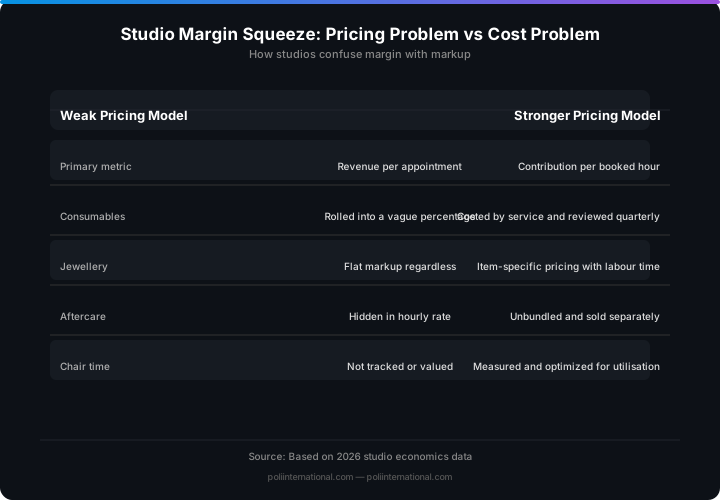
A studio should calculate contribution per booked hour, not merely revenue per appointment. Contribution is what remains after the directly attributable costs of delivering the service; it is the number that pays rent, wages, insurance, software, utilities, and profit.
| Feature | Weak pricing model | Stronger pricing model |
|---|---|---|
| Primary metric | Revenue per appointment | Contribution per booked hour |
| Consumables | Rolled into a vague percentage | Costed by service and reviewed quarterly |
| Jewellery | Flat markup regardless of ticket size | Margin target adjusted for sourcing and service time |
| Cancellations | Absorbed by the studio | Deposits and cancellation terms protect capacity |
| Artist time | Only the tattooing or piercing time counted | Consultation, setup, breakdown, and aftercare included |
| Supplier changes | Discovered after margin falls | Tracked through landed-cost updates |
| Price increases | Across-the-board and reactive | Targeted by service, demand, and capacity |
A simple calculation is more useful than a complicated dashboard:
\[
\text{Contribution per booked hour}
=
\frac{\text{Service revenue} - \text{direct costs}}{\text{total booked time}}
\]
Total booked time must include setup, consultation, cleaning, photography, payment administration, and the gap that cannot realistically be sold to another client. A two-hour tattoo that occupies three hours of usable studio capacity is not a two-hour economic event.
The same principle applies to piercing. Jewellery may produce an attractive gross margin, but selection, fitting, downsizing advice, sterilisation workflow, and follow-up all consume labour. If the studio prices the jewellery correctly but gives away the professional service, the apparent margin is cosmetic.
3. What the cost data actually says
The most useful current estimates identify three pressure points.
First, consumables and jewellery commonly represent a relatively modest share of total revenue, but they are highly visible because owners receive the invoices directly. A small increase in needle cartridges or packaging can feel more alarming than a larger annual rent increase because the former is seen item by item. In practice, however, the recurring fixed-cost base often determines whether a studio is profitable.
Second, sterilisation and compliance costs have risen for many operators. One recent studio-margin estimate claimed that sterilisation-related expenses were roughly 18% higher than in 2023, although that figure should be treated as an indicative industry estimate rather than a universal measurement. The commercial implication is straightforward: any price list unchanged since 2023 is probably absorbing cost increases somewhere, whether the owner can see them or not.
Third, the gap between a busy studio and a profitable studio is often capacity utilisation. A four-chair shop with three artists working at 55% utilisation can look successful from the pavement and remain financially fragile. Rent, software, utilities, insurance, cleaning, and equipment finance continue during every empty hour.
Owners should therefore track four numbers monthly:
- Booked-hour utilisation, by artist and by day.
- Average revenue per booked hour, excluding pass-through taxes.
- Direct cost per booked hour, including consumables and service-specific labour.
- Cancellation and rescheduling loss, measured as unused sellable hours.
The last number is commonly dismissed as an administrative nuisance. It is not. If a studio loses 12 hours a month to late cancellations and its contribution target is £100 per hour, that is £1,200 of monthly capacity gone before any supplier raises a price.
For studios serving international clients or buying in multiple currencies, landed cost also deserves a separate line. Product price, freight, duty, brokerage, foreign-exchange movement, and payment fees should not be merged into one remembered figure. The geographic split in tattoo demand and pricing power shows why a price that works in one market may be too low in another, even when the physical consumable is identical.
4. Patrick's Note: Price the capacity you actually sell
On 14 September 2026, a studio owner sent me a price list with a £90 “deposit” that was refundable after a late cancellation, provided the client cancelled late enough to prevent anyone else booking the chair. The arithmetic was polite; the economics were not.
A studio is not selling ink, needles, or jewellery alone. It is selling a reserved block of professional capacity, and the price must protect that block. My practical rule is to review every service against booked hours and direct cost, then raise the prices that are busy but under-contributing before raising the prices that are already struggling to convert. The body-art economy’s core operating numbers are useful for that review, but no market average knows your rent, your cancellations, or the empty Tuesday afternoon beside the steriliser.
5. FAQ: Technical Q&A
Q: Should a studio raise prices across the board when supply costs increase?
No. Start with the services most exposed to direct-cost increases and the services with the strongest demand. A targeted increase is easier to explain and less likely to damage conversion than applying the same percentage to every appointment, consultation, jewellery item, and aftercare product.
Q: What should be included when calculating the cost of a tattoo hour?
Include needles, ink allocation, barrier materials, disinfectant, gloves, payment fees, and any service-specific labour. Also include setup, breakdown, consultation, photography, and the realistic time during which the chair cannot be sold to another client.
Q: Is buying larger quantities the best way to protect margin?
Only when the usage rate and shelf-life support it. Larger orders can reduce unit cost, but they also tie up cash, increase exposure to specification changes, and make counterfeit or poorly documented stock more expensive to discover. Negotiate freight, payment terms, and replenishment thresholds before committing to excess inventory.
Conclusion: Make the margin visible
The immediate commercial decision is to stop treating price as a single hourly number. Recalculate contribution per booked hour, introduce a deposit policy that protects real capacity, and identify the busiest services that are still under-earning after direct costs.
Buy core consumables on a disciplined replenishment schedule rather than panic-stocking, and negotiate with suppliers on landed cost, minimum order values, and payment terms—not just unit price. Studios with strong utilisation can raise prices selectively now; studios with weak utilisation should first repair cancellations, scheduling gaps, and service mix before attempting a broad increase. For the wider supply picture, compare those decisions with what changing U.S. tattoo-supply growth means for buyer behaviour.