
FDA facility registration and product listing are now make-or-break for tattoo ink suppliers
Key Takeaways:
» Tattoo inks are now fully treated as cosmetics under MoCRA, with mandatory FDA facility registration and product listing.
» The FDA’s October 2024 final guidance on microbial contamination is now driving real enforcement, inspections, and recalls.
» Studios must demand supplier FDA registration numbers, product listing confirmation, and full ingredient lists with CAS numbers for every ink.
» Non‑registered or non‑listed inks are now regulatory liabilities; studios risk enforcement and civil litigation if they keep using them.
» Cross‑border operators must reconcile MoCRA requirements with EU REACH Annex XVII tattoo ink restrictions and state adoption of the NEHA Body Art Model Code.
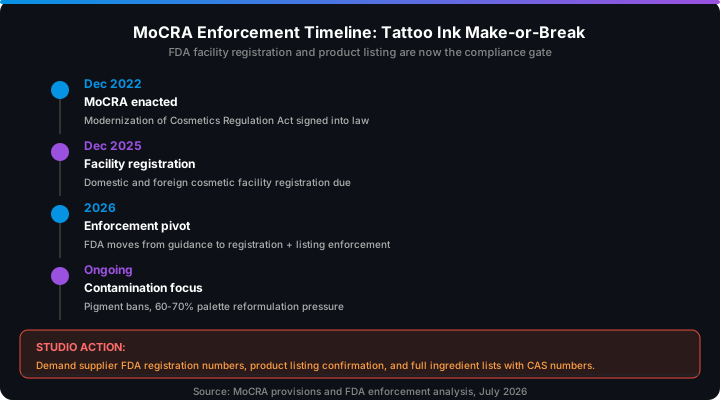
1. What just changed for tattoo inks under MoCRA
The most significant regulatory development hitting the body art industry in the last weeks is not a brand‑new law, but the transition from MoCRA “grace period” to hard enforcement on tattoo ink registration and contamination control. The Modernization of Cosmetics Regulation Act (MoCRA), passed in 2022, created the first comprehensive federal framework that explicitly treats tattoo inks and permanent makeup as cosmetics with enforceable standards.xactbodyart MoCRA overview
Key MoCRA provisions for tattoo inks, facility registration, product listing, safety substantiation, and adverse event reporting, formally took effect January 1, 2025, with enforcement ramping up through 2025 and into 2026.xactbodyart MoCRA timeline Over the last 12–18 months, FDA has moved from advisory language to concrete action built on its October 2024 final guidance on microbially contaminated tattoo inks, which confirmed that sealed, unopened ink bottles were testing positive for microbial contamination and triggering illness reports.xactbodyart FDA contamination guidance
In the past 14–30 days, the critical shift is that FDA is now actively using MoCRA’s tools, facility registration status, product listings, and contamination guidance, to determine which ink manufacturers are compliant and which are enforcement targets. Recent practitioner briefings emphasise that there are no exemptions for tattoo inks or permanent makeup: every ink manufacturer must register facilities, list each product, and maintain safety records, and studios are being told to verify this themselves.FDA tattoo ink regulation explainer For multi‑jurisdiction studios importing EU‑compliant inks reformulated under REACH Annex XVII entry 75, this represents a second independent regulatory hurdle alongside European substance bans and limits.regulatory comparison of EU, UK and US body art rules
2. Data, thresholds, and cross‑jurisdiction comparison
To understand the practical impact, you need MoCRA’s requirements side‑by‑side with EU REACH tattoo ink restrictions and global practice codes:
| Feature | MoCRA (US tattoo inks as cosmetics) | EU REACH Annex XVII (Entry 75 tattoo inks) |
|---|---|---|
| Regulatory scope | Treats tattoo inks and permanent makeup as cosmetics, requiring facility registration, product listing, safety substantiation, and adverse event reporting.xactbodyart MoCRA scope | Restricts ~4,000 substances in tattoo inks and permanent makeup with specific concentration limits, bans CMRs, and aligns many limits to the EU Cosmetics Regulation 1223/2009.regulatory comparison of EU, UK and US body art rules |
| Key compliance trigger | Mandatory FDA facility registration and product listing for each ink; failure makes the product an unregistered cosmetic, vulnerable to enforcement.FDA tattoo ink regulation explainer | Compliance determined by chemical composition and concentration thresholds; non‑compliant inks are prohibited from placing on the EU market.regulatory comparison of EU, UK and US body art rules |
| Contamination control | October 2024 final guidance on microbial contamination defines insanitary manufacturing conditions; testing found contamination in sealed inks.xactbodyart FDA contamination guidance | REACH focuses on chemical hazards, not microbiological contamination; contamination risk is handled via general product safety and national practice codes rather than entry 75 itself. |
| Adverse event reporting | MoCRA requires serious adverse event reporting and record‑keeping for cosmetics, including tattoo inks.xactbodyart MoCRA requirements | Adverse event monitoring generally falls under cosmetic product vigilance and national health authorities, not REACH per se. |
| Material palette impact | Drives traceability and documentation more than palette changes; the issue is whether a pigment or vehicle is properly documented and supported by safety data. | Forced 60–70% palette reformulation, banning key pigments such as Pigment Blue 15:3 and Pigment Green 7, and reclassifying silver as CMR Category 2, eliminating many colloidal silver additives.regulatory comparison of EU, UK and US body art rules |
| Studio responsibility | Studios expected to verify supplier registration and listings, maintain ink inventories traceable to compliant manufacturers, and respond to recall notices. | Studios must ensure inks are REACH‑compliant, demand safety documentation showing Annex XVII and Annex II/IV compliance, and remove banned or reformulated colours from use. |
While MoCRA does not yet specify ppm limits for specific tattoo ink contaminants at the granularity of REACH Annex XVII, its cosmetic safety standard is effectively “reasonably certain to be safe” under normal or foreseeable use. Practically, this is now operationalised through:
- documented control of microbial contamination, particularly Gram‑negative bacteria and fungi in sealed inks
- traceable ingredient lists with CAS numbers for every pigment, solvent, and additive
- batch‑specific stability and contamination testing data in supplier safety files
Under REACH Annex XVII entry 75, many inks now also face maximum concentration limits for PAHs, primary aromatic amines, metals, and other hazardous substances, typically in the low ppm to tens of ppm range, mirroring EU Cosmetics Regulation thresholds for skin‑contact products.regulatory comparison of EU, UK and US body art rules This means a cross‑border studio importing one ink line must satisfy two different logics: MoCRA’s documentation‑driven cosmetic safety framework and REACH’s substance‑specific restriction matrix, on top of practice codes like the NEHA Body Art Model Code, which many US states are now adopting.NEHA Body Art Model Code
3. Technical deep dive: what MoCRA plus FDA contamination guidance mean for studios
The FDA’s October 2024 final guidance on tattoo ink contamination is the practical backbone of current enforcement.xactbodyart FDA contamination guidance After testing sealed ink bottles from the market, FDA confirmed microbial contamination in unopened product, and received multiple illness reports tied to these inks.Florida Environmental Health Association summary Under MoCRA, this is no longer just a warning, it is direct evidence of insanitary manufacturing conditions, making those products adulterated cosmetics.
For body art professionals, this translates to several hard technical requirements:
1. Facility registration and product listing as baseline filters
Any ink manufacturer supplying the US market must now have:
- an active FDA facility registration (renewed biennially)
- product listings for each ink, with full formulation disclosure
Industry compliance guidance for tattoo inks stresses that studios should request the supplier’s FDA facility registration number and independently verify it, and obtain product listing confirmation for each ink SKU they use.FDA tattoo ink regulation explainer
2. Full ingredient disclosure with CAS numbers
MoCRA is pushing the industry away from vague “proprietary blends” toward complete ingredient lists including CAS numbers, enabling toxicological assessment and alignment with EU and state requirements.FDA survival checklist for ink compliance For cross‑border operations, this is essential to checking whether a pigment is, for example, covered by REACH’s ban on Pigment Blue 15:3 and Green 7 or falls under a national PFAS or metal restriction.2026 global cosmetic PFAS update
3. Microbial contamination controls and batch documentation
FDA’s contamination findings mean manufacturers must demonstrate:
- validated sterilisation or aseptic manufacturing processes
- routine microbial limit testing of finished inks
- robust quality systems to detect and prevent contamination
Studios should expect suppliers to provide batch‑specific Certificates of Analysis (CoA) confirming microbial limits below established cosmetic and medical device thresholds, typically ≤100 cfu/g for total aerobic counts and absence of specified pathogens like Pseudomonas aeruginosa and Staphylococcus aureus. While these exact numbers are drawn from broader cosmetic microbiology standards rather than tattoo‑specific rules, they are increasingly used as reference points in ink safety files.
4. Adverse event reporting and traceability in studios
MoCRA’s adverse event reporting obligation sits primarily with manufacturers, but studios are the front line for data collection. To make those systems work and stay on the right side of FDA, studios must:
- log brand, product name, batch/lot number, and date of use for each tattoo
- record any infection or unexpected reaction with enough detail to match it to a product and batch
- cooperate with manufacturers when adverse event investigations or recalls occur
5. Interaction with state‑level and model codes
Multiple US states have updated licensing, sanitation, and facility standards in alignment with the NEHA Body Art Model Code, emphasising sterile technique, equipment validation, and clear ink handling procedures.xactbodyart US state regulatory changes These state regulations now operate alongside MoCRA, meaning a studio can be simultaneously scrutinised for:
- using unregistered or unlisted inks under MoCRA
- failing to meet state sanitation and documentation standards under NEHA‑based rules
- ignoring state‑specific laws such as California Proposition 65 warning and reporting obligations, or Oregon/New York tattoo ink registration schemes
From a materials perspective, this combined framework mirrors the way implant‑grade jewelry standards like ASTM F136 and F2923 and ISO 10993 treat metals: traceability, documented biocompatibility, and contamination control, not just nominal alloy names. Studios already thinking in terms of biocompatible jewelry selection and dermal trauma minimisation know how critical documentation is to real‑world safety; those same instincts now need to apply to every pigment bottle, not only titanium posts and bars.needle geometry and dermal recovery analysis
4. Patrick’s Note: Where studios are still exposed
The thing practitioners miss here is how brutally documentation gaps will sort compliant studios from liabilities over the next year. In the studios I’ve audited since MoCRA took effect, I still see shelves lined with inks that have no verifiable FDA facility registration, no product listing, and only a marketing brochure for “safety”. Under this new regime, those bottles are not just “a bit risky”, they are regulatory tripwires waiting for the first infection cluster or plaintiff’s lawyer.
What MoCRA doesn’t tell you in the statutory text is how quickly supply chains will bifurcate into traceable, documented inks and unverifiable grey‑market stock, the same split we’ve watched in body jewelry between genuine implant‑grade and mystery metal. Studios that already reorganised their piercing inventory around clear ASTM/ISO documentation and dermal trauma metrics have a head start; the rest need to bring their ink shelves up to the same standard.regulatory comparison of implant-grade jewelry rules The bottom line is simple: if you can’t put a paper trail on an ink, from FDA registration to batch CoA, it doesn’t belong anywhere near your clients’ dermis.
5. FAQ: Technical Q&A
Q: How do I verify that my ink supplier is MoCRA‑compliant?
Ask for their FDA facility registration number and confirm it via FDA’s registration verification tools, then request product listing confirmations for each ink you buy, showing the exact trade name and formulation registered.FDA survival checklist for ink compliance If a supplier refuses or stalls on those documents, treat their products as non‑compliant and begin a planned phase‑out.
Q: Does MoCRA mean the FDA bans specific tattoo pigments like the EU does under REACH?
MoCRA itself does not list specific pigments for tattoo inks, but it requires safety substantiation and full ingredient disclosure, which allows FDA to challenge unsafe or misbranded formulations.xactbodyart MoCRA requirements In contrast, EU REACH Annex XVII entry 75 explicitly bans certain pigments and thousands of chemicals, so cross‑border studios must treat pigment selection as an EU problem and documentation as a US problem.regulatory comparison of EU, UK and US body art rules
Q: What specific documentation should I demand for each tattoo ink bottle in my studio?
At minimum, you should have: an FDA facility registration number for the manufacturer, FDA product listing confirmation for the exact ink, a current Safety Data Sheet (SDS) with full CAS‑number ingredient disclosure, and batch‑specific Certificates of Analysis covering microbial contamination and key stability parameters.xactbodyart FDA contamination guidance For EU‑sourced inks, add documentation showing REACH Annex XVII entry 75 and EU Cosmetics Regulation 1223/2009 compliance, including evidence of any pigment reformulation required by recent bans.regulatory comparison of EU, UK and US body art rules
Conclusion: Turn MoCRA into a studio‑level compliance system
MoCRA’s enforcement phase has transformed tattoo inks from loosely overseen consumables into documented, traceable cosmetic products whose legal status now depends on registration, listing, contamination control, and adverse event systems. For studios, the practical implication is that ink management is now as much a compliance function as it is an artistic choice, and the regulators finally have the tools to penalise those who ignore that reality.tattoo regulations 2025 compliance guide
If you want a simple operational rule: no bottle without a paper trail. Build a studio‑level checklist today:
- Remove any ink for which the manufacturer cannot provide an FDA facility registration number.
- Require product listing confirmation for each ink SKU in your inventory.
- Demand complete ingredient lists with CAS numbers and up‑to‑date SDS documents.
- Insist on batch CoAs covering microbial contamination and stability.
- For EU‑sourced inks, verify REACH Annex XVII entry 75 and EU Cosmetics Regulation 1223/2009 compliance.
- Align your in‑studio logs with NEHA Body Art Model Code expectations: record brand, batch, and date of use for every tattoo, and document any adverse events clearly.NEHA Body Art Model Code
Studios that lock these steps into their daily operations will not only stay ahead of FDA and state regulators, they will quietly separate themselves from competitors still treating ink safety as a matter of trust rather than traceable evidence.regulatory comparison of EU, UK and US body art rules
6. Are Tattoos Safe? The MoCRA Question Every Studio Should Answer
Every day, someone walks into a studio and asks the question that has followed tattooing for decades: are tattoos safe? For 25 years, I've watched this question get answered with marketing instead of chemistry. Under MoCRA, that era is over. Tattoo inks are now legally cosmetics, which means the pigments, carriers, and preservatives in every bottle are subject to FDA facility registration guidelines and product listing. If a supplier can't show you that paperwork, they can't legally sell into the US market, and you shouldn't be putting their product into anyone's skin.
So are tattoos unhealthy? The act itself isn't the problem. The variables are. Needle technique, studio hygiene, and, most importantly, what's suspended in the ink. The FDA's October 2024 final guidance on microbial contamination gave us a clear framework: inks must be manufactured under controlled conditions, tested for pathogens, and traceable back to a registered facility. That's not bureaucracy for its own sake. That's the difference between a healed tattoo and a granuloma.
Are these chemicals bad for you? Some are, and that's exactly why REACH compliance and the MoCRA pivot matter. Certain azo pigments break down into aromatic amines under UV exposure or over time. If your supplier is still sourcing from unregistered overseas facilities with no documentation, you're the last line of defence between those chemicals and your client. I built BioFlex® around PP-R polymer because I got tired of watching the industry treat material safety as optional. The same standard applies here: demand the SDS, demand the registration number, demand the listing.
If you're a studio owner reading this in early 2026, your suppliers should already be sending you compliance documents without you asking. If they aren't, that silence is your answer. Ask three questions: Is your facility FDA-registered? Is your product listed under MoCRA? Can you provide third-party microbial testing? A supplier who hesitates on any of those is a liability, not a partner.
The studios that survive this pivot won't be the ones with the best artists alone, they'll be the ones who can hand a nervous client a document that says this ink was tested, this facility was inspected, this product was listed. That's how you answer "are tattoos safe" without flinching.
Ready to tighten your supply chain? Browse the BioFlex® body jewellery range and see what documented material safety looks like in practice, or use our studio tools to build a client-facing safety sheet that cites your supplier documentation.


