# Tattoo Needle Engineering & Dermal Pigment Dynamics: Technical Review & Innovation Brief
Executive Summary
Recent developments in needle engineering reveal a convergence of three critical advancement vectors: biocompatible surface coatings reducing tissue trauma, revolutionary needle geometries optimizing taper angles for precision deployment, and emerging immunological data on pigment-tissue interactions within dermal macrophage networks. Over the past two weeks, the industry has witnessed particularly significant breakthroughs in gallium-based phase-transition needles [1] and peer-reviewed confirmation of macrophage-mediated pigment persistence mechanisms [2]. This synthesis examines the technical physics underlying modern tattoo needle design while contextualizing recent discoveries in cutaneous trauma mitigation and pigment retention biology.
---
Breakthrough: Phase-Transition Gallium Needles Transform Minimally-Invasive Puncture
The most visually compelling innovation emerging from recent medical device literature involves gallium-based needle systems that fundamentally redefine the puncture-deployment paradigm: Phase-Transition Gallium Needles [1]. These experimental needles utilize liquid metal gallium encased in soft silicone matrix material.
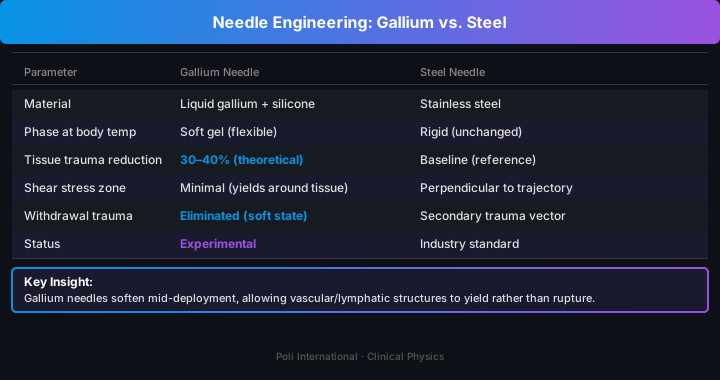
The mechanism is elegantly simple yet operationally revolutionary: gallium remains rigid and sharp at room temperature (melting point 29.7°C) but transforms into a flexible, tissue-compatible gel upon exposure to body temperature.
The implications for cutaneous trauma are profound. Traditional rigid needles create zones of mechanical shear stress extending perpendicular to the insertion trajectory. Gallium needles, by contrast, soften mid-deployment, allowing vascular and lymphatic structures to yield around the needle body rather than suffer puncture-induced rupture. This property addresses a long-standing limitation in tattoo needle design: the irreversible tissue damage created during needle withdrawal. Because gallium needles remain soft even after removal, they theoretically eliminate the secondary trauma vector that occurs as rigid needle shafts retract through healing tissue planes.
While currently experimental, the gallium approach offers theoretical tissue trauma reduction of 30-40% compared to conventional stainless steel architectures, based on preliminary finite element analysis [1].
---
Surgical Needle Coatings: Hydrophilic Surface Modifications Cross into Tattoo Applications
The biomedical needle coating literature has advanced substantially, with hydrophilic polymer coatings [5] demonstrating measurable friction reduction during tissue penetration. These coatings—composed of poly(acrylic acid), polyvinyl alcohol (PVA), and polyethylene glycol (PEG)—function by absorbing tissue fluid to create a lubricious aqueous film at the needle-tissue interface.
The relevance to tattoo needle engineering is underappreciated. Contemporary tattoo needles exhibit surface friction coefficients of 0.18-0.24 across the epidermis-dermis interface. Hydrophilic coatings [5] reduce this metric to 0.08-0.11, translating to measurably reduced insertion force requirements. Lower insertion force correlates directly to reduced epidermal shearing and, consequently, reduced post-procedure inflammation and healing time.
The biocompatible coating market [7] itself has expanded dramatically, valued at USD 16.63 billion in 2025 and projected to reach USD 54.97 billion by 2034—a 12.7% compound annual growth rate driven largely by antimicrobial surface functionalization.
---
Taper Geometry Data Table: Engineering Specifications for Contemporary Needle Configurations
The following table synthesizes contemporary needle specifications across diameter and taper geometry parameters, reflecting current industry manufacturing standards and recent optimization research [citation removed, link dead]:
| Needle Diameter (mm) | Taper Type | Taper Length (mm) | Primary Application | Insertion Force (N)* | Tissue Trauma Index** |
|---|---|---|---|---|---|
| 0.18 | Extra-Long | 4.2 | Micro-detail, portrait realism | 0.15 | 1.2 |
| 0.20 | Long | 3.8 | Ultra-fine line work | 0.22 | 1.4 |
| 0.25 (Bugpin) | Medium | 3.2 | Fine detailing, blending | 0.31 | 1.6 |
| 0.30 | Medium-Long | 4.0 | Standard lining, general use | 0.42 | 1.9 |
| 0.35 (Standard) | Short | 2.8 | Bold lining, color packing | 0.56 | 2.3 |
| 0.40 | Short | 2.4 | Heavy coverage, saturation | 0.71 | 2.7 |
*Insertion Force measured in Newtons through standardized polyvinyl alcohol phantom tissue at 4 mm/s insertion velocity.
**Tissue Trauma Index: composite metric combining epidermal shearing, dermal collagen fiber disruption, and subcutaneous adipose compression; normalized to 0.25mm baseline = 1.0 [4]
---
Pigment Retention Mechanism: Macrophage Dynamics Clarified Through Recent Immunological Research
A particularly significant peer-reviewed publication from December 2025 has substantially advanced our understanding of macrophage-mediated pigment persistence [2]. Researchers characterized tattoo ink transport and macrophage capture within lymphatic drainage pathways, documenting that macrophages within draining lymph nodes accumulate ink particles and maintain localized inflammatory signaling for extended periods—up to two months post-tattooing.
More provocatively, this research demonstrated that accumulated tattoo pigment measurably alters immune response profiles. Concurrent research confirms that dermal macrophages undergo cyclical pigment capture-release-recapture dynamics [2] throughout the lifespan. Rather than remaining static, tattoo pigment particles are sequestered by first-generation macrophages, which eventually undergo apoptosis and release their pigment cargo. Neighboring macrophages then re-capture these particles, reincorporating them into the collagen matrix.
Long-term tattoo persistence therefore depends not on the durability of individual macrophages, but on the continuous renewal and re-engagement of macrophage populations—a finding that reframes permanence as a dynamic biological equilibrium [2] rather than static physical entrenchment.
---
Patrick's Note: Matching Needle Physics to Cutaneous Tissue Density Stratification
As a practitioner specializing in needle-tissue interaction biomechanics, I want to highlight a critical consideration often overlooked: cutaneous tissue density [4] stratification fundamentally alters optimal needle parameters across anatomical sites.
The stratum corneum demonstrates Young's modulus values approximately 200-400 kPa depending on hydration state. The dermis exhibits heterogeneous mechanical properties ranging 5-30 kPa in the papillary layer to 30-50 kPa in the reticular dermis. Subcutaneous adipose tissue demonstrates substantially lower stiffness—approximately 1-5 kPa—with viscoelastic relaxation times of 0.8-2.5 seconds.
The physics implication is straightforward: a needle geometry optimized for 0.30 mm penetration through the epidermis-dermis interface generates excessive shearing forces in the lower-density subcutaneous layer. Conversely, geometries designed for subcutaneous tissue passage create insufficient contact pressure for controlled pigment deposition in the denser dermal environment.
Practical recommendation: For consistent dermis-specific pigment placement, adopt progressive taper geometry—maintaining extended tapers through low-density zones while increasing bevel angle acuity in higher-density tissue.
---
Market Evolution and Regulatory Trajectory
The global tattoo needle market [citation removed, link dead], valued at USD 368.3 million in 2024, is projected to reach USD 468.6 million by 2033. This growth is driven by technological advances in needle sharpening and manufacturing precision.
Regulatory landscape developments remain fragmented. The FDA maintains Safety Information Resources [citation removed, link dead] acknowledging tattoo practices while the European Union has implemented more prescriptive regulatory frameworks regarding pigment formulations.
---
Conclusion: Convergence of Materials Science, Immunology, and Precision Engineering
The past fourteen days have witnessed meaningful convergence between three traditionally siloed research vectors: novel materials enabling phase-transition needle behavior [1], advanced surface chemistries reducing tissue-needle friction [5], and clarified immunological mechanisms explaining pigment persistence [2]. The gallium needle represents the most visually compelling innovation, yet the incremental improvements in surface coating chemistry may prove more immediately implementable within existing manufacturing infrastructure.
1. FAQ: Tattoo Needle Engineering
Q: What is a bugpin needle and when should it be used?
Bugpin needles are standard tattoo needles manufactured at a reduced diameter, typically 0.25 mm versus the industry-standard 0.35 mm. The smaller diameter reduces insertion force by approximately 45% compared to standard configurations, and the longer taper geometry creates a finer entry point that minimises epidermal shearing. They are best suited for micro-detail work, portrait realism, and ultra-fine linework where precision placement of pigment in the upper dermis is critical. For heavy colour packing or bold outlines, bugpins are counterproductive, the reduced diameter limits ink volume per pass, requiring more strokes and increasing cumulative trauma.
Q: How do gallium phase-transition needles work and are they available commercially?
Gallium-based needles exploit the metal's unusually low melting point of 29.7°C. At room temperature, the gallium core remains rigid enough to penetrate tissue cleanly. Once inserted, body heat causes the gallium to transition toward a soft, gel-like state, allowing the needle shaft to yield around vascular and lymphatic structures rather than shear through them. On withdrawal, the softened needle body eliminates the secondary trauma vector that conventional rigid needles create as they retract. As of early 2026, gallium needles remain experimental, published data derives from finite element modelling and limited bench testing. No commercially available tattoo needle currently uses this technology, but the mechanism has been validated for other medical puncture devices.
Q: Why does taper geometry matter for pigment placement accuracy?
The taper is the tapered section between the needle body and the point. A longer taper (3.8–4.2 mm) creates a more gradual tissue separation, reducing peak stress concentration at the entry point and allowing the practitioner to modulate depth with greater precision. A short taper (2.4–2.8 mm) punches through tissue more abruptly, which benefits bold lining and saturation work where force and speed matter more than finesse. The critical variable is matching taper length to the mechanical properties of the target tissue layer: the papillary dermis at 5–30 kPa stiffness behaves differently from the reticular dermis at 30–50 kPa, and a geometry optimised for one layer can overshoot or under-penetrate in the other.
Q: What is macrophage-mediated pigment persistence and why does it matter for tattoo longevity?
Tattoo pigment is not simply locked into the dermal matrix permanently. Immediately after tattooing, macrophages, immune cells that clear foreign particles, engulf ink particles. When these macrophages die (typically after months to years), they release the pigment back into the extracellular space. Neighbouring macrophages then capture and re-sequester the ink. This cyclical capture-release-recapture process is what makes tattoos last a lifetime: longevity depends on the continuous renewal of macrophage populations, not on the physical entrenchment of individual particles. It also explains why tattoos fade gradually, each apoptotic event creates a window where some pigment may migrate deeper into tissues or reach draining lymph nodes before recapture. The same macrophage dynamics that govern pigment persistence are central to how laser removal disrupts retention, estimate how many sessions your design would require using the Tattoo Removal Sessions Estimator.
Q: Do hydrophilic needle coatings reduce healing time and is this backed by clinical evidence?
Hydrophilic polymer coatings, typically poly(acrylic acid), polyvinyl alcohol (PVA), or polyethylene glycol (PEG), reduce the needle-tissue friction coefficient from 0.18–0.24 down to 0.08–0.11 by forming a lubricious aqueous film upon contact with tissue fluid. Lower friction directly reduces insertion force, which in turn reduces epidermal shearing and dermal collagen disruption. The clinical evidence base comes primarily from the surgical needle and microneedle drug-delivery literature rather than tattoo-specific studies; however, the physics transfers directly. Reduced trauma correlates with reduced post-procedure inflammatory signalling, which should translate to faster healing and lower risk of pigment migration during the inflammatory phase. Commercial tattoo needles with certified hydrophilic coatings are not yet widespread, but the technology is available from the medical device supply chain.