Studios Must Treat the EU’s Tattoo-Ink REACH Restriction as the Baseline, Not the Debate
Key Takeaways:
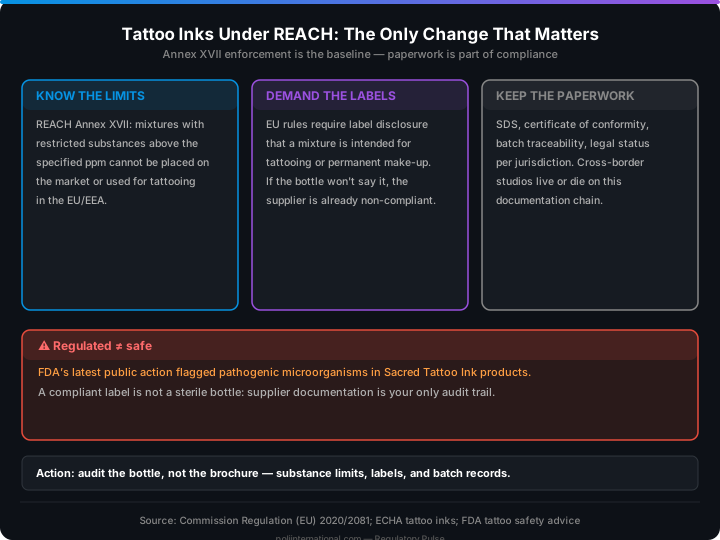
» The most actionable current development is not a brand-new EU tattoo-ink ban, but the continuing enforcement reality of REACH Annex XVII: tattoo and PMU mixtures containing restricted substances above the specified limits cannot be placed on the market or used for tattooing in the EU/EEA.Commission Regulation (EU) 2020/2081
» The EU rule already requires label disclosure that a mixture is intended for tattooing or permanent make-up, which means supplier paperwork is part of compliance, not admin garnish.ECHA tattoo inks and permanent make-up
» For studios buying across borders, the practical issue is not just chemistry but documentation: SDS, certificate of conformity, batch traceability, and the exact legal status of the product in each jurisdiction.FDA tattoo safety advice
» The FDA’s most recent public action on tattoo inks in the gathered material is a microbial contamination alert: Sacred Tattoo Ink products were flagged because of pathogenic microorganisms, reminding studios that “regulated” and “safe” are not synonyms.FDA avoid using or selling certain Sacred Tattoo Ink products
» The real compliance failure is still the same old one: buying ink on price and trusting a glossy label while ignoring whether the product actually meets the relevant chemical and microbiological controls.FDA tattoo safety advice
1. The EU rule is already here, and it still drives the global compliance picture
The clearest regulatory fact in the last 14 days is that there has not been a fresh, published EU tattoo-ink restriction overtaking the existing one; the market is still operating under Commission Regulation (EU) 2020/2081, which amended REACH Annex XVII for substances in tattoo inks and permanent make-up.Commission Regulation (EU) 2020/2081 That matters because studios often wait for a “new announcement” before changing purchasing habits, but the legal burden is already active: restricted substances above the listed concentration limits cannot be placed on the market in mixtures for tattooing, and those mixtures cannot be used for tattooing purposes in the EU/EEA.Commission Regulation (EU) 2020/2081
ECHA’s tattoo-ink page confirms the operating logic: the restriction covers thousands of hazardous chemicals, and the rules apply to mixtures intended for tattooing and permanent make-up, with the product’s intended use required on the label.ECHA tattoo inks and permanent make-up That is the part many distributors still treat as optional until a border inspection, customs query, or complaint forces the issue. In practice, a studio that cannot prove the ink’s intended use, composition, and lot traceability is not “almost compliant”; it is just under-documented.
The old distinction between “artist supply” and “regulated product” is a fantasy that dies when a product crosses a border or causes an adverse event. The FDA’s consumer guidance explicitly tells tattoo artists to keep the brand, color, and lot or batch number of the ink or diluent so a problem can be traced back.FDA tattoo safety advice That same logic is mirrored in the EU environment, where compliance is not just about what the bottle says but what the manufacturer can substantiate.
For studios that sell service across jurisdictions, the most useful comparison is this: the EU is chemistry-first under REACH, while the US public-facing enforcement narrative in the gathered material is more episode-based, with FDA actions reacting to contamination or product safety failures.Commission Regulation (EU) 2020/2081FDA avoid using or selling certain Sacred Tattoo Ink products That does not make one system stricter in every respect; it makes them different in where they start the argument. Europe starts with the formula. The US often starts with the damage report.
The same split is why the EU tattoo ink chemical restrictions under REACH Annex XVII are so important to anyone importing stock into multiple markets. If a product cannot clear the chemical bar in Europe, no amount of reassuring marketing copy should be allowed to substitute for that fact in your procurement file.
2. The numbers that matter: concentrations, labels, and contamination control
| Feature | EU REACH tattoo inks | FDA enforcement posture in the gathered material |
|---|---|---|
| Primary control | Restricted substances in mixtures for tattooing and PMU under Annex XVII | Product safety actions, consumer advisories, and contamination response |
| Core threshold logic | Substance-specific concentration limits in the restriction text | Microbial contamination and injury risk, with lot-level identification emphasized |
| Label requirement | Mixtures meant for tattooing/PMU must be identified as such on the label | Artists should retain brand, color, and batch/lot details |
| Typical compliance failure | Missing chemical disclosure, wrong intended-use classification, or restricted ingredients | Contaminated product, weak traceability, or poor recall response |
| Studio risk | Buying nonconforming stock or using a product outside its legal scope | Using contaminated ink or failing to isolate traceable lots |
The most important numeric line in the gathered material is not a brand-new limit but the structure of the restriction itself: REACH Annex XVII imposes specific concentration limits for restricted substances in tattoo and PMU mixtures, and the EU Commission regulation is directly applicable in Member States.Commission Regulation (EU) 2020/2081 ECHA’s guidance also notes the rule’s automatic logic for certain hazard classes, meaning the compliance perimeter is not static; it expands with the classification framework used in the regulation.ECHA tattoo inks and permanent make-up
On the microbiology side, the FDA’s Sacred Tattoo Ink notice is a blunt reminder that contamination is not theoretical. The agency stated that its laboratory analysis found tattoo inks contaminated with pathogenic microorganisms, including Pseudomonas aeruginosa, and warned of serious injury risk when contaminated ink is injected through broken skin.FDA avoid using or selling certain Sacred Tattoo Ink products That is not a chemistry problem; it is a manufacturing and distribution problem. But for a studio, the practical consequence is the same: if the supply chain is weak, the artist becomes the last line of quality control, which is a ridiculous place to put a service professional.
This is also where supplier documentation stops being paperwork theatre. If a manufacturer cannot produce a current SDS, batch-specific certificate, and product identity aligned to the jurisdiction of sale, then the studio is left holding an item that may be “popular” but not defensible. The difference between tattoo ink compliance in the EU and the US is not academic; it determines whether the file you keep would survive a regulator, an insurer, or a lawyer.
3. What studios should do now: the technical and operational response
For EU-facing studios, the immediate task is to audit stock against the REACH restriction and ensure every tattoo/PMU product is labeled for its intended use and backed by documentation consistent with the current Annex XVII framework.Commission Regulation (EU) 2020/2081ECHA tattoo inks and permanent make-up If the supplier cannot state whether a pigment, solvent, preservative, or contaminant falls within a restricted class, that is not “need-to-know later”; that is a purchase decision already failed.
The practical reading of the EU rule is simple: don’t rely on a generic “skin-safe” claim. Ask for the exact intended use, the full ingredient disclosure, the lot number, the SDS, and a certificate of conformity or equivalent compliance statement tied to the current legal framework. If you import, ask whether the product was assessed specifically for tattoo/PMU use under EU rules, not merely sold as a cosmetic or artist supply. The label must say what it is; if it doesn’t, that is a warning sign, not a styling choice.ECHA tattoo inks and permanent make-up
For US studios, the immediate lesson from the FDA’s contamination alert is that post-market safety issues are real and can surface even when a product is already being sold.FDA avoid using or selling certain Sacred Tattoo Ink products Good studios should quarantine suspect lots, document any adverse reactions, and keep transaction records tied to the specific ink used. If the product came through a distributor who cannot identify the lot, you do not have traceability; you have optimism, which is not a compliance system.
There is a broader point here about cross-border product claims. A supplier may advertise “EU compliant” while shipping a formulation that is missing the relevant trace data, or may present a certificate that describes the product category without proving the exact batch. That is especially dangerous in a market where the tattoo studio procurement checklist for compliant inks and aftercare products is often treated as a luxury rather than an operational necessity. It is not a luxury. It is the thing that keeps a minor complaint from becoming a regulatory file.
4. Patrick's Note: Paperwork Is Not Chemistry
A bottle can have a clean label and still be the wrong bottle.
That is the part people keep trying to make poetic, and it is not. The label is only the claim; the SDS, batch data, and supplier conformity documents are the evidence. I have seen more trouble come from a missing batch number than from an artist “not reading the small print,” which is a charming accusation until the regulator asks for the file and everyone in the room suddenly becomes interested in stationery. Poli Journal: tattoo product documentation and traceability
From a supply-chain perspective, the current market problem is not that studios are lazy. It is that distributors often sell convenience while offloading compliance risk downstream. That would be fine if ink were a postcard. It is not. It is a chemical product injected into tissue, and the paperwork has to reflect that. When a supplier shrugs and says “this is standard,” I hear “this is unverified,” which is a useful translation if you like sleeping at night.
5. FAQ: Technical Q&A
Q: Is there a new EU tattoo-ink rule from the last 14 days?
No new EU tattoo-ink restriction in the gathered material overtakes the existing REACH framework. The actionable reality remains Commission Regulation (EU) 2020/2081 and its Annex XVII restrictions for tattoo and PMU mixtures.Commission Regulation (EU) 2020/2081
Q: What documentation should a studio demand from ink suppliers right now?
Request the SDS, batch or lot number, certificate of conformity, intended-use statement for tattoo/PMU, and a full ingredient disclosure tied to the actual product you will use. If the supplier cannot produce those documents, do not treat the ink as compliant.FDA tattoo safety adviceECHA tattoo inks and permanent make-up
Q: What is the biggest practical risk highlighted by the FDA material?
Microbial contamination. The FDA specifically warned that certain tattoo inks were contaminated with pathogenic microorganisms, including Pseudomonas aeruginosa, and advised artists and retailers to avoid use or sale of those products.FDA avoid using or selling certain Sacred Tattoo Ink products
Conclusion: Audit the bottle, not the brochure
If you operate in or ship into the EU, REACH Annex XVII is still the compliance floor for tattoo and PMU inks, and the label, SDS, and batch record matter as much as the pigment itself.Commission Regulation (EU) 2020/2081ECHA tattoo inks and permanent make-up If you operate in the US, FDA contamination actions show that traceability and product quality are still live issues, not historical footnotes.FDA avoid using or selling certain Sacred Tattoo Ink products
Compliance checklist:
- Verify whether each ink is explicitly labeled for tattooing or PMU use.ECHA tattoo inks and permanent make-up
- Request the SDS for each color and diluent, matched to the exact lot you stock.
- Request a certificate of conformity or equivalent supplier declaration tied to the actual batch.
- Keep brand, color, lot/batch number, and purchase date in studio records.FDA tattoo safety advice
- Quarantine any product with missing documentation, unclear intended use, or contamination concerns.
- For imported stock, confirm the product meets the destination market’s legal framework before sale or use.
Poli Journal: tattoo product documentation and traceability
6. What EU REACH Compliance Actually Requires From Your Tattoo Ink Supplier
When studios ask me whether their ink is "EU REACH compliant," they usually mean one thing: does the bottle carry a label that looks legitimate? After 25 years supplying pigment and polymer jewellery into regulated markets, I can tell you that a label is the weakest evidence you can accept. The only meaningful proof sits in the documentation behind the product, and that documentation is anchored in REACH Annex XVII.
REACH Annex XVII, Entry 75 is the operative restriction for tattoo and permanent makeup mixtures. It sets concentration limits for substances classified as carcinogenic, mutagenic, or toxic to reproduction (CMR), along with limits for skin sensitisers, irritants, and certain heavy metals. If a supplier cannot produce test reports showing your specific batch was screened against those limits, you have no compliance position, regardless of what the front label claims.
Batch traceability is the second requirement. Enforcement agencies do not test every bottle on the shelf; they sample, then demand the paper trail. That trail must connect the finished ink to a specific manufacturing lot, to the raw material lots used, and to the analytical testing performed on that lot. Without lot-level traceability, a compliant test report from three years ago proves nothing about the ink in your hand today.
Label claims are not evidence. "REACH compliant," "vegan," and "EU approved" are marketing statements unless they are backed by a named testing laboratory, a dated certificate of analysis, and a lot number that matches the product. I have watched studios lose supplier relationships, and in some cases their operating permits, because they accepted a PDF that referenced a different batch entirely.
The practical checklist I give every studio owner is short:
- Ask for the certificate of analysis tied to the exact lot number on the bottle.
- Confirm the testing laboratory and the analytical method used for Annex XVII Entry 75 parameters.
- Verify the supplier can trace raw materials back through their own production records.
- Re-request documentation with every new lot, not once per year.
The FDA contamination alerts circulating in the US market are a useful warning signal for EU studios too: contamination events are usually detected after the product is already in use. Traceability is what lets a supplier and a studio respond to a recall in days rather than months.
If you are auditing your studio's consumables, the same supply-chain discipline applies to body jewellery. The BioFlex® PP-R polymer range is manufactured with documented material traceability and REACH-aligned compliance data, see the BioFlex® product and compliance overview for the documentation standards we hold ourselves to.