The most significant regulatory development in recent weeks is the UK government's formal decision on tattoo ink and permanent makeup restrictions under UK REACH, announced 30 December 2025 and published officially 15 January 2026. This is not merely a procedural update—it marks the first major post-Brexit regulatory fork in body art safety standards, creating a compliance scenario that many studios are still unprepared to navigate.
What Changed: UK REACH Goes Its Own Way
When the UK left the EU, it retained REACH regulation in principle but retained authority to diverge. For the first time since 2022, we now have formal evidence that divergence is occurring. The UK Department for Environment, Food & Rural Affairs published a draft amendment to UK REACH Annex 17 (the equivalent of EU REACH Annex XVII) restricting substances in tattoo inks and permanent makeup. This decision was made on 30 December 2025—before the formal publication on 15 January 2026.
The critical detail: UK REACH restrictions on tattoo inks are now legally binding under UK Regulation (EC) No 1907/2006, as retained and amended by UK law. Studios operating in the United Kingdom can no longer assume they can source EU-compliant inks and assume automatic UK compliance. The UK government has signaled it will follow its own assessment process, not automatically adopt EU amendments.
The Practical Threshold: What Does This Mean For Studios?
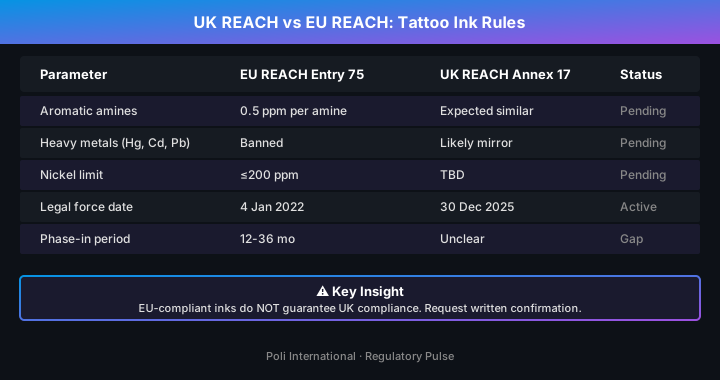
Here is the operational reality. The UK REACH restriction does not yet specify all substances banned, but the published decision document confirms that the amendment follows the same Entry 17 logic as the EU—restricting carcinogenic, mutagenic, and toxic-for-reproduction (CMR) substances, heavy metals above defined limits, and aromatic amines released from azo pigments. However, the UK may apply different concentration thresholds or phase-in timelines than the EU does.
For example:
- The EU restricts aromatic amines to 0.5 ppm (0.00005% by weight) per amine from azo pigments under REACH Entry 75.
- The UK is expected to follow a similar limit, but the formal published thresholds for UK REACH have not yet been itemized in the search results.
- Heavy metals under EU REACH Entry 75 include: mercury, cadmium, lead (all banned), chromium VI (banned), and nickel above 200 ppm. UK REACH is likely to mirror these, but studios cannot assume this without explicit confirmation.
The timeline is equally important. The UK decision was made 30 December 2025, but the legal force date and phase-in period for compliance remain unclear from the published documents. This is a compliance gap. If you are sourcing tattoo inks for UK distribution, you must now request written confirmation from your supplier that products meet both EU REACH Entry 75 and UK REACH Annex 17 (as amended) standards. A Certificate of Analysis that shows only "EU REACH compliant" is insufficient.
Why This Matters: The Supply Chain Squeeze
Body art suppliers have invested heavily in EU REACH compliance. Reformulations were completed between 2021 and 2023. Inventory has been built. Retailers (studios) have trained staff on label reading and batch tracking. Now comes the fork: UK-focused distributors and manufacturers must assess whether their EU REACH-compliant formulations automatically satisfy UK REACH, or whether they require separate testing and reformulation.
The risk is real. If a UK studio uses a pigment that is EU-compliant but not yet formally cleared under UK REACH, and a client adverse event occurs, the studio's insurance claim could be complicated by evidence of non-compliance. The UK regulatory authority (MHRA, or the Environment Agency depending on sector) could challenge the supplier's assertion that the product was compliant.
Additionally, cross-border studios that operate in both the EU and UK now face a dual-compliance mandate. A studio in Northern Ireland, for instance, must now verify compliance against two separate regulatory frameworks. This is not merely a paperwork exercise—it affects which inks can be stocked, which suppliers are reliable, and which batch documentation is necessary to prove compliance.
Action Checklist for Studios
Immediate (by 31 March 2026):
- Contact your tattoo ink supplier and ask for written confirmation: "Does this product meet UK REACH Annex 17 requirements as amended in December 2025?" Do not accept generic "REACH compliant" statements.
- If you operate or plan to source for UK distribution, request a separate Safety Data Sheet (SDS) and Certificate of Analysis marked specifically for UK REACH compliance.
- Review your product batch tracking system. Ensure lot numbers are recorded for every procedure performed in the last 12 months. If a UK regulatory audit occurs, you must demonstrate you can identify which clients received which batches.
Short-term (by 30 June 2026):
- Once the UK government publishes the finalized Annex 17 amendment with explicit substance lists and thresholds, cross-reference your current ink inventory against those lists.
- If operating in both EU and UK, maintain separate compliance files—one for EU REACH Entry 75, one for UK REACH Annex 17. These will diverge.
- Train your team on the difference. Emphasize that "EU-compliant" does not guarantee UK legality.
Ongoing:
- Monitor the UK Health & Safety Executive (HSE) and MHRA websites for enforcement guidance on UK REACH tattoo ink compliance. The UK is still defining inspection and penalty protocols, and early clarity is better than discovering non-compliance during an audit.
- If you are an ink manufacturer or distributor, begin planning for potential reformulation or market segmentation. A single batch cannot serve both markets if UK REACH thresholds diverge from EU REACH.
This is not panic-inducing bureaucracy—it is the structural reality of regulatory divergence. The UK chose to retain REACH but reserve the right to set its own standards. That choice is now operationalized. Studios that act now to verify compliance will have documentation ready if regulators ask questions later.
1. FAQ: UK REACH Tattoo Ink Compliance
Q: Does "EU REACH compliant" automatically mean a product is legal in the UK after December 2025?
No. The UK government's decision of 30 December 2025, published 15 January 2026, formally established UK REACH Annex 17 as an independent regulatory framework. While UK REACH broadly mirrors EU REACH in restricting CMR substances, heavy metals, and aromatic amines from azo pigments, the UK reserves the right to set different concentration thresholds, phase-in timelines, and substance lists. Until your supplier provides written confirmation specifically stating UK REACH Annex 17 compliance, you should not assume a product is lawful for UK distribution based solely on EU certification.
Q: Which substances does UK REACH restrict in tattoo inks and at what limits?
The UK REACH framework targets the same categories as EU REACH Entry 75: carcinogenic, mutagenic, and reproductive (CMR) substances; aromatic amines released from azo pigments (the EU limit is 0.5 ppm per amine); heavy metals including mercury, cadmium, and lead (banned), chromium VI (banned), and nickel above 200 ppm. As of the published documents reviewed, the UK had not yet itemised its own specific thresholds in a finalised Annex 17 amendment. Studios should monitor the UK Health and Safety Executive and MHRA websites for enforcement guidance and cross-reference against their supplier documentation when the finalised UK list is published.
Q: What documentation should studios request from ink suppliers for UK REACH compliance?
You need three documents as a minimum: (1) a Certificate of Analysis (CoA) from a third-party laboratory showing substance-level testing against the specific parameters in UK REACH Annex 17, not just EU REACH Entry 75; (2) a Safety Data Sheet (SDS) prepared for UK market compliance; and (3) written confirmation from the manufacturer or distributor explicitly stating that the product meets "UK REACH Annex 17 requirements as amended December 2025." Generic statements reading "REACH compliant" or "EU REACH compliant" are insufficient for UK regulatory purposes.
Q: How does UK REACH divergence affect studios that operate in both Northern Ireland and the Republic of Ireland?
Northern Ireland has a complex regulatory position, under the Windsor Framework, certain goods entering Northern Ireland from Great Britain remain subject to EU single market rules for trading purposes, while UK domestic regulations apply to purely internal UK commercial activity. For tattoo studios, this creates a practical dual-compliance obligation: inks used on clients in Northern Ireland and sourced from EU suppliers should meet EU REACH Entry 75, while inks distributed commercially into the broader UK market must meet UK REACH Annex 17. Maintaining separate compliance files for each jurisdiction is strongly advisable to avoid regulatory ambiguity during any audit.
Q: What happens if a studio uses a non-UK-REACH-compliant ink and a client has an adverse reaction?
An adverse reaction from a non-compliant product creates compounding liability. First, the studio may face regulatory enforcement from the relevant UK authority (MHRA, Environment Agency, or local authority environmental health) for supplying a substance in violation of UK REACH restrictions. Second, insurance claims may be complicated or denied if the insurer can demonstrate that the product used was not compliant with applicable law at the time of the procedure. Third, civil liability to the client is strengthened if the studio cannot produce batch records demonstrating that a verified, compliant product was used. Documenting which batch of ink was used for which client and ensuring all batches carry UK REACH compliance certification is therefore both a regulatory and insurance priority.