Shop
Regulatory Pulse

FDA’s Freshest Tattoo-Ink Signal Is Contamination Control—Not a New Pigment Ban

PP

Chief Engineer

Patrick Poli

Journal Date

2026-10-02

Last Reviewed

2026-10-03

Treat every sealed tattoo-ink bottle as a controlled batch, not as proof of sterility

Key Takeaways:

» The FDA’s current tattoo guidance still classifies intradermal tattoo inks as cosmetics, but an unapproved color additive makes an ink adulterated.

» The FDA states that sealed, apparently sterile ink can still contain bacteria, mold, or other microorganisms.

» The agency’s June 12, 2023 draft guidance remains the clearest U.S. manufacturing-control framework for preventing insanitary conditions.

» Studios should retain brand, shade, lot or batch number, expiry information, and supplier records for every ink used.

» A supplier’s “sterile” label is not a substitute for batch-level evidence, traceability, or a defensible contamination-control system.
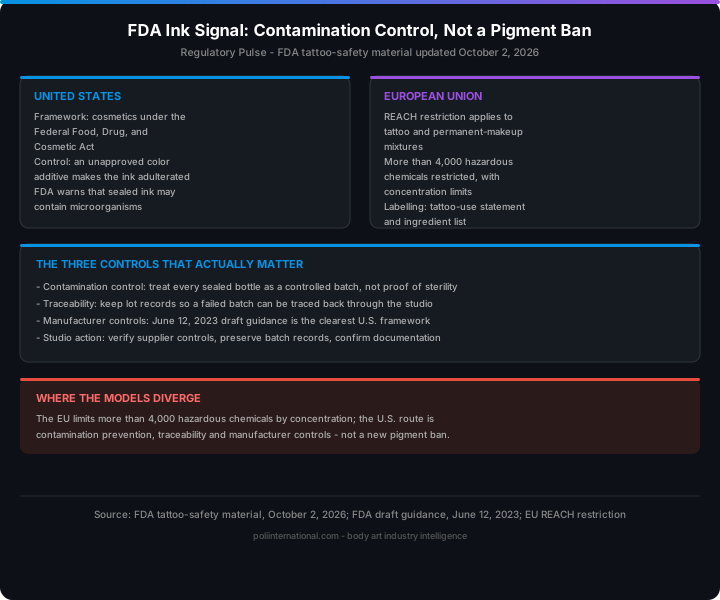
US, EU and ASEAN tattoo-ink control compared, with the three controls that matter
Infographic: US, EU and ASEAN tattoo-ink control compared, with the three controls that matter

1. The Regulatory Development That Matters

The most actionable development identified in the last 14 days is not a new U.S. pigment prohibition or a new implant-jewelry standard. It is the FDA’s freshly updated public tattoo-safety material, which was updated on October 2, 2026 and again puts contamination, traceability, and manufacturer controls at the centre of tattoo-ink compliance. The agency’s consumer guidance states that even unopened and sealed tattoo inks can harbour bacteria and other microorganisms, and that contamination may exist despite a label claiming sterility. (FDA tattoo-safety guidance)

That distinction matters. A studio can follow sound skin preparation, needle handling, and surface-disinfection procedures and still introduce contaminated material into the dermis. The regulatory problem is therefore not limited to the artist’s workstation. It begins upstream, in water quality, raw-material handling, filling, storage, transport, and the manufacturer’s decision about what testing is adequate before release.

The FDA’s position is structurally different from the European Union’s approach. In the EU, tattoo and permanent-makeup mixtures are subject to the REACH restriction that limits more than 4,000 hazardous chemicals, imposes concentration limits, and requires specific labelling for tattoo use. (ECHA overview of tattoo-ink restrictions) The U.S. framework remains more fragmented: federal oversight applies to the product as a cosmetic, while state and local authorities generally regulate the practice of tattooing. (FDA tattoos and permanent makeup)

For studios operating across borders, that creates a dangerous compliance illusion. An ink may satisfy an EU chemical restriction and still present a microbiological-control problem in the United States. Conversely, a U.S. product may be legally sold as a cosmetic while failing the chemical and labelling requirements needed for EU distribution.

2. What the U.S., EU, and ASEAN Models Actually Require

The comparison below shows why “legal,” “sterile,” and “EU compliant” are not interchangeable descriptions.

FeatureUnited StatesEuropean UnionASEAN framework
Primary product frameworkTattoo inks are generally regulated as cosmetics under the Federal Food, Drug, and Cosmetic ActREACH restriction applies specifically to tattoo inks and permanent makeupCosmetics regulation is harmonised through the ASEAN Cosmetics Directive, with implementation by each member state
Core chemical controlAn unapproved color additive makes the tattoo ink adulteratedMore than 4,000 hazardous chemicals are restricted, with substance or group concentration limitsIngredient and product-safety requirements follow the ASEAN framework, subject to national administration
Microbiological concernFDA warns that sealed ink may contain microorganisms and recommends contamination-prevention controlsREACH addresses hazardous substances; microbiological controls remain a separate safety and manufacturing issueNational authorities may impose additional safety, notification, or enforcement requirements
Labelling emphasisProduct identity, safety information, and lawful color additives remain importantTattoo-use statement, ingredient list, and relevant safety statements are requiredNational notification, labelling, and responsible-person obligations may apply
Studio implicationVerify supplier controls and preserve batch traceabilityVerify both REACH chemical conformity and microbiological documentationConfirm the destination country’s notification and product requirements rather than relying on an ASEAN-wide assumption

The EU restriction took effect on January 4, 2022, with the separate transition for Pigment Blue 15:3 and Pigment Green 7 ending on January 4, 2023. (ECHA tattoo-ink restriction summary) Those dates are not new, but they remain operationally important because old stock, relabelled stock, and imported stock continue to circulate through secondary channels.

The practical conclusion is straightforward: a studio importing into Europe needs a chemical-compliance file, while a U.S. studio needs a contamination-control and traceability file. A serious supplier should be able to support both.

3. The Technical Detail: What Must Be Controlled

The FDA’s June 12, 2023 draft guidance, Insanitary Conditions at Tattoo Ink Manufacturing and Distribution Facilities, recommends measures intended to prevent or identify contamination during manufacturing and distribution. The FDA also states that final-product testing for microorganisms can help protect consumer safety. (FDA tattoo products and manufacturing guidance)

The guidance is not a universal numerical sterility standard for every bottle of tattoo ink. That is precisely why studios should stop treating the word sterile as a magic regulatory number. Unless the supplier identifies the test method, sample plan, acceptance criteria, laboratory, and batch relationship, the claim is a label assertion rather than useful evidence.

Request the following for each product line and, where available, each lot:

- A Certificate of Analysis identifying the lot or batch number.
- The microbiological test method and release specification, including whether testing covers total aerobic microbial count, yeast and mould, and specified pathogens.
- Evidence of testing for organisms relevant to contaminated tattoo-ink recalls, including Pseudomonas aeruginosa where applicable.
- Manufacturing and filling-site identification.
- Water-system controls, environmental-monitoring summary, and documented corrective-action procedure.
- Shelf-life validation and storage conditions.
- A current Safety Data Sheet, while recognising that an SDS is primarily a hazard-communication document and not proof of sterility.
- Full ingredient or colourant information sufficient to evaluate the destination market.
- Recall and adverse-event contact details.
- Confirmation that the product is not counterfeit, diverted, or repackaged outside the original manufacturer’s controlled system.

The FDA specifically warns that contamination can occur even when the container is unopened and sealed. (FDA consumer tattoo-safety information) Therefore, opening a new bottle at the workstation is not the beginning of the risk; it is merely the point at which the studio becomes able to observe the packaging.

In Europe, chemical documentation must go further. The REACH restriction includes maximum concentration limits for individual substances or substance groups and requires tattoo-use labelling, ingredient disclosure, and relevant safety statements. (ECHA REACH tattoo-ink requirements) A generic “conforms to REACH” declaration is inadequate unless it identifies the applicable restriction, confirms the formulation assessed, and is supported by current laboratory data.

For tattoo artists, the most useful control is a lot-level usage record. Record the product, shade, lot number, opening date, client appointment, and any diluent or mixing medium used. If a client develops a suspected infection or unusual reaction, the lot number is the difference between a targeted investigation and a forensic scavenger hunt conducted with a bin liner and a fading memory.

4. Patrick's Note: The Sterile Sticker That Lies

A bottle arrives with a clean label, a sealed cap, and the word sterile printed in respectable type. That word tells you almost nothing unless the supplier can tell you what was tested, against which method, on which lot, and with what release limit. Packaging is not a microbiological result; it is packaging.

This is why the real contamination risks in tattoo inks and the controls studios should demand matter more than another argument about whether a label looks professional. The FDA is right to focus attention upstream. Artists need traceability, and manufacturers need to stop treating a sterile claim as if it were a laboratory report wearing a tie.

5. FAQ: Technical Q&A

Q: Is a tattoo ink safe to use if the bottle is sealed and labelled sterile?

No. The FDA states that sealed tattoo inks can still contain bacteria, mould, or other microorganisms. Use only products from an identifiable manufacturer, record the lot, and request batch-level microbiological documentation where the supplier provides it. (FDA tattoo-safety guidance)

Q: Does EU REACH compliance prove that a tattoo ink is microbiologically safe?

No. REACH controls hazardous chemical substances and imposes concentration and labelling requirements for tattoo mixtures. It does not turn a chemical-compliance declaration into proof that the finished ink is free from microorganisms. (ECHA tattoo-ink restrictions)

Q: What should a studio do with an ink that has no lot number or supplier documentation?

Quarantine it and do not use it until the supplier provides verifiable product identity, batch traceability, formulation information, and relevant microbiological and chemical documentation. If the supplier cannot provide those records, replace the product rather than making the client serve as the quality-control department.

Conclusion: Build the Paper Trail

Studios should update their purchasing procedure now: approve identifiable suppliers, reject untraceable bottles, retain lot-level records, and obtain both microbiological and chemical documentation appropriate to the markets served. U.S. compliance centres on contamination prevention and traceability; EU compliance adds specific REACH substance limits and tattoo-ink labelling duties.

The minimum compliance checklist is:

- Record manufacturer, product, shade, lot number, expiry date, and opening date.
- Request a lot-linked Certificate of Analysis.
- Request microbiological methods and acceptance criteria.
- Request the current SDS and full ingredient or colourant declaration.
- Confirm EU REACH conformity separately from sterility or microbiological claims.
- Verify storage and transport conditions.
- Maintain a written recall and client-notification procedure.
- Quarantine products with missing identity, broken seals, unexplained relabelling, or absent documentation.

The FDA’s current tattoo guidance is available through its tattoo and permanent-makeup compliance resources.

Mind map · FDA’s Freshest Tattoo-Ink Signal Is Contamination Control—Not a New Pigment Ban

  • FDA Tattoo Ink Contamination Control
    • Microbiological Risks in Sealed Inks

      The FDA warns that unopened and sealed tattoo inks can harbor bacteria, mold, and other harmful microorganisms despite packaging claims.

      • False Packaging Sterility Claims
      • Upstream Contamination Sources
        • Water Quality and Filling
    • US Federal Regulatory Framework

      United States federal regulations treat tattoo inks as cosmetics while unapproved color additives render an ink legally adulterated.

      • Cosmetic Classification Rules
      • Manufacturing Facility Guidance
        • Insanitary Conditions Draft Guidance
    • International REACH Chemical Restrictions

      European Union REACH regulations restrict over four thousand hazardous chemical substances and require specific tattoo mixture labeling.

      • Restricted Chemical Substances
      • Chemical Compliance Documentation
        • Mandatory EU Tattoo Labeling
    • Studio Traceability Protocol Requirements

      Tattoo studios must maintain lot usage records and supplier records for every ink used to enable infection tracking.

      • Lot Usage Records
      • Supplier Certificate Verification
        • Certificate of Analysis Inspection
StructureProcessMaterialHazard

4 branches, 0 sources. Each branch cites the article it came from; the labels beneath it are names, not claims.

Tattoo Regulations Quiz

  1. 1. Why does the FDA advise against assuming that a sealed, unopened tattoo ink bottle labeled 'sterile' is completely safe?

    • ✓ Contamination can occur upstream during raw material handling, water processing, filling, or storage prior to sealing. — Microorganisms can be trapped inside the container during manufacturing long before the factory seal is applied.
    • • The FDA prohibits manufacturers from using the word 'sterile' on any cosmetic product container. — Federal cosmetic guidelines allow claims if supported by evidence, rather than placing an outright prohibition on the word.
    • • Tattoo inks are only exposed to microbial growth after the bottle cap is removed at the artist workstation. — FDA safety alerts specifically state that contamination frequently exists inside unopened, sealed bottles.
    • • Factory sterility seals automatically degrade and void product safety fourteen days after packaging. — Sterility status depends on manufacturing quality control and packaging integrity rather than an arbitrary fourteen-day timeline.
  2. 2. How do the core compliance mandates for tattoo inks differ between the United States and the European Union?

    • ✓ The U.S. framework relies on contamination control and color additive approvals, whereas EU REACH enforces strict chemical concentration limits. — U.S. federal oversight treats ink as cosmetics focused on adulteration and sanitation, while the EU restricts over 4,000 specific hazardous chemical substances.
    • • The U.S. mandates pre-market testing for 4,000 substances, while the EU focuses exclusively on water system monitoring. — The restriction of more than 4,000 hazardous chemicals is an EU REACH standard, not a U.S. requirement.
    • • The U.S. requires mandatory national notification before sale, while the EU delegates tattoo safety entirely to local municipalities. — State and local authorities in the U.S. regulate practice while federal law governs cosmetics, whereas EU REACH harmonizes chemical restrictions across member states.
    • • The U.S. enforces a single numerical sterility standard for every bottle, while the EU regulates artist needle handling. — FDA guidance does not establish a universal numerical sterility standard, and REACH governs chemical mixtures rather than artist needle procedures.
  3. 3. What were the key implementation dates for the EU REACH restrictions regarding tattoo inks, including Pigment Blue 15:3 and Pigment Green 7?

    • ✓ The general REACH restriction took effect on January 4, 2022, with the transition for Pigment Blue 15:3 and Pigment Green 7 ending on January 4, 2023. — The EU allowed a one-year extended transition window specifically for these two pigments following the initial 2022 restriction date.
    • • The restriction took effect on October 2, 2026, alongside new FDA draft guidance on insanitary conditions. — October 2, 2026, represents the update date for FDA consumer safety material, not the European REACH compliance deadline.
    • • The transition period ended on June 12, 2023, under federal cosmetic manufacturing draft guidance. — June 12, 2023, is the release date of the FDA draft guidance on insanitary conditions, which is unrelated to EU REACH timelines.
    • • Pigment Blue 15:3 and Pigment Green 7 were granted a permanent exemption from chemical concentration limits. — These specific pigments were granted only a temporary transition period, which expired in early 2023.
  4. 4. What is the primary operational function of a Safety Data Sheet (SDS) regarding tattoo ink quality control?

    • ✓ It provides hazard communication details but does not serve as proof of batch sterility or microbiological testing. — An SDS details chemical hazards and handling precautions rather than lot-specific laboratory testing for microorganisms.
    • • It serves as a lot-specific certificate verifying that no pathogens were detected prior to product release. — Batch release results for microorganisms are documented in a Certificate of Analysis rather than an SDS.
    • • It legally replaces the Certificate of Analysis for imported cosmetic color additives in the United States. — An SDS cannot replace a Certificate of Analysis or fulfill federal requirements regarding lawful color additives.
    • • It documents water-system validation and shelf-life testing parameters for individual ink lots. — Manufacturing controls and shelf-life validation are separate quality assurance records maintained outside of standard hazard communication sheets.
  5. 5. What must studios keep in mind when navigating tattoo ink regulations under the ASEAN Cosmetics Directive framework?

    • ✓ Studios must confirm individual destination country requirements rather than assuming uniform regional enforcement. — While the directive harmonizes cosmetic rules across ASEAN, actual implementation and notification duties are governed nationally by each member state.
    • • The framework automatically mandates full EU REACH chemical compliance files for all imported inks. — ASEAN cosmetics regulations follow their own regional directive and national administration rather than adopting EU REACH.
    • • Tattoo inks are reclassified as medical implants across all member states under ASEAN law. — The framework regulates inks under cosmetics directives rather than medical device standards.
    • • Member states prohibit inks unless they carry pre-market federal clearance from the U.S. FDA. — U.S. FDA pre-market approval is neither required for U.S. cosmetics nor mandated by ASEAN national authorities.
  6. 6. Under current U.S. federal regulatory standards, what condition explicitly causes a tattoo ink to be legally classified as adulterated?

    • ✓ The inclusion of an unapproved color additive in the formulation. — Under the Federal Food, Drug, and Cosmetic Act, cosmetic products containing color additives without federal approval are considered adulterated.
    • • The absence of an EU REACH compliance statement on the primary bottle label. — EU REACH labelling rules apply to European distribution and have no legal standing on U.S. cosmetic adulteration status.
    • • Storing unopened ink containers at standard room temperature prior to workstation setup. — Proper storage depends on manufacturer instructions, but room temperature storage does not automatically violate federal statutory criteria.
    • • Failing to print individual artist license numbers on the outer product packaging. — Artist licensing is governed by local or state practice regulations rather than federal product adulteration laws.
  7. 7. What specific components should be included in a studio's lot-level usage record to enable precise traceability?

    • ✓ Product, shade, lot number, opening date, client appointment, and any diluent used. — Documenting these details links a specific client session directly to the exact batch and mixture utilized.
    • • Supplier invoice total, shipping tracking code, and studio workstation table number. — Financial and shipping paperwork lacks essential client-level details needed to trace a specific ink batch during an adverse reaction investigation.
    • • Artist license number, client skin type score, and room humidity levels during tattooing. — While client records exist, lot traceability specifically depends on logging manufacturer batch data rather than environmental studio metrics.
    • • Photographic snapshots of unopened cap seals stored in a temporary digital folder. — Cap photos do not record essential details like batch numbers, client appointments, or added mixing media.
  8. 8. What is the primary focus of the FDA's June 12, 2023 draft guidance for tattoo ink manufacturers and distributors?

    • ✓ Preventing and identifying microbial contamination throughout manufacturing and distribution facilities. — The guidance specifically addresses insanitary conditions and control measures needed to stop contamination during filling, storage, and transport.
    • • Establishing a complete federal ban on thousands of chemical colorants and heavy metals. — The draft guidance addresses manufacturing sanitation and contamination rather than enacting chemical pigment bans.
    • • Mandating universal numerical sterility requirements for every single finished cosmetic container. — The document provides a risk prevention framework rather than establishing a universal numerical microbial threshold across all products.
    • • Regulating studio surface disinfection, artist hand hygiene, and skin preparation procedures. — The guidance targets upstream manufacturing and distribution facilities rather than local studio sanitation practices.
  9. 9. What evidence must a supplier provide to make a 'sterile' label claim operationally meaningful to a studio?

    • ✓ Lot-linked data specifying the test method, sample plan, acceptance criteria, testing laboratory, and release limits. — A sterile claim is only verifiable evidence if supported by clear laboratory methodology tied directly to that specific production lot.
    • • A standard Safety Data Sheet accompanied by a clean, intact outer box seal. — An SDS handles hazard communication, and physical packaging alone cannot substitute for analytical laboratory findings.
    • • A general declaration stating that the product formulation matches generic European standards. — Generic statements do not provide batch-specific microbiological test data or identify specific test parameters.
    • • A trade association endorsement confirming the manufacturer's brand reputation. — Trade associations do not perform regulatory release testing or issue scientific sterility certifications for manufacturers.
  10. 10. What is the proper action for a studio to take if an ink bottle arrives without a lot number or supplier documentation?

    • ✓ Quarantine the product immediately and refrain from using it until verifiable batch records are provided. — Isolating untraceable ink prevents unverified or potentially contaminated batches from reaching clients.
    • • Use the ink normally as long as the internal dropper cap remains unopened and sealed. — Unopened seals do not guarantee safety or replace missing lot numbers needed for traceability.
    • • Perform a patch test on studio staff to verify microbiological safety prior to client application. — Patch testing cannot detect microbial contamination and risks exposing staff to unverified materials.
    • • Assign an arbitrary internal lot code and list the receiving date as the batch identifier. — Creating internal lot codes obscures genuine manufacturer tracking and complicates potential recall actions.

Extended Reference Table

8 of 8 rows

Extended reference table generated from the article and its verified research sources. Bracketed numbers jump to the matching entry in the Technical References below.

SafetyItem, Material or Practice Category Applicable Standard, Specification or Regulation Regulatory Body or Authority Key Compliance Requirements and Details Source
✅Tattoo Ink (Intradermal) - Cosmetic RegulationProduct / Material FrameworkFederal Food, Drug, and Cosmetic Act (FD&C Act)Food and Drug Administration (FDA)Regulated as cosmetics; an unapproved color additive makes the ink adulterated.
✅Manufacturing Insanitary Conditions ControlStudio & Manufacturing PracticeDraft Guidance: Insanitary Conditions at Tattoo Ink Manufacturing and Distribution Facilities (June 12, 2023)Food and Drug Administration (FDA)Recommends measures to prevent/identify contamination during manufacturing/distribution and supports final-product microorganism testing.
✅Chemical Safety and Restricted Substances (REACH)Chemical Safety RegulationEU REACH Tattoo Ink RestrictionEuropean Chemicals Agency (ECHA) / European UnionRestricts over 4,000 hazardous chemicals, sets concentration limits, and mandates specific tattoo-use labeling.
✅Pigment Blue 15:3 and Pigment Green 7 TransitionSpecific Material / PigmentEU REACH Restriction Transition RulesEuropean Chemicals Agency (ECHA) / European UnionTransition period ended on January 4, 2023; restricts non-compliant pigment stock from EU distribution.
✅Cosmetics Directive HarmonisationProduct / Material FrameworkASEAN Cosmetics DirectiveASEAN Member State National AuthoritiesHarmonises cosmetics regulation, requiring ingredient safety compliance, national notifications, product labeling, and responsible-person obligations.
✅Lot-Level Usage and TraceabilityStudio PracticeFDA Traceability and Contamination Control GuidanceFood and Drug Administration (FDA)Studios must record brand, shade, lot/batch number, expiry date, opening date, client appointment, and diluents used.
✅Batch Verification via Certificate of Analysis (CoA)Quality Assurance PracticeFDA Batch-Level Evidence / Traceability RequirementsFood and Drug Administration (FDA)Must link lot/batch number with microbiological release specs (e.g., total aerobic count, yeast, mold, Pseudomonas aeruginosa).
✅Product Hazard Communication (Safety Data Sheet)Safety / Documentation PracticeOSHA / Standard Hazard Communication GuidelinesFood and Drug Administration (FDA) / Standard Regulatory AuthoritiesStudios must obtain and maintain a current Safety Data Sheet (SDS) for hazard communication (not as proof of sterility).

Free Body Art Wall Posters

Print-ready reference posters for your studio or your own wall. Free to download and display, embed on your own site with attribution. Click any poster to preview it full size before downloading.

Choose and download all 40 posters

Technical_References_Archive

About the Author

PP

Patrick Poli

Chief Engineer, Poli International · Creator of BioFlex® body jewelry

Patrick has spent 25+ years manufacturing body jewellery and studio equipment, and is the creator of BioFlex® body jewelry. He developed a thermal process to set stones into polymer without adhesive, because the glues available for the job contain cyanoacrylates. He also registered his own maker’s mark with the Sheffield Assay Office and produced a line in 18-karat gold, platinum, titanium and surgical steel.

More about Patrick →

Last reviewed: 2026-10-03 · Published: 2026-10-02

Related Tools & Reading

Continue Reading