Shop
Regulatory Pulse

Tattooing and Cancer Risk: What the 2026 Meta-Analysis Means for Regulation

PP

Chief Engineer

Patrick Poli

Journal Date

2026-10-03

Last Reviewed

2026-10-06

Executive Summary

A 2026 systematic review and meta-analysis (PMID 42250187) pooled seven observational studies covering 140,841 participants and found no statistically significant association between tattoo exposure and overall skin cancer risk (OR 0.92, 95% CI 0.83-1.04). Primary analyses also showed no significant link to hematological malignancies. A significant association appeared only after sensitivity analysis, which means it should be treated as a hypothesis-generating signal, not a conclusion. For studio owners and manufacturers, the practical takeaway is narrow but important: this evidence does not weaken REACH or MoCRA obligations. It shifts the regulatory conversation away from cancer epidemiology and back toward what we can actually control, which is ink chemistry, impurity limits, and documentation. If you have been waiting for a scientific excuse to relax your sourcing standards, this study is not it.
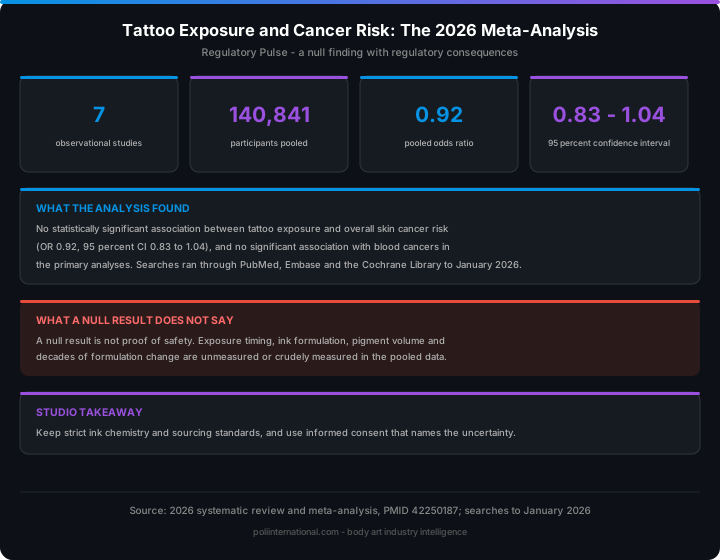
Pooled odds ratio of 0.92 across 7 studies and 140,841 participants, and what a null result does not say
Infographic: Pooled odds ratio of 0.92 across 7 studies and 140,841 participants, and what a null result does not say

What the Study Actually Found

Seven observational studies. 140,841 participants. Searches run through PubMed, Embase, and the Cochrane Library to January 2026. The headline result is a null finding: no association between being tattooed and overall skin cancer risk, and no significant association with blood cancers in the primary analysis.

The sensitivity analysis is where people will get excited, and where they will get it wrong. When you re-run models under different assumptions and a signal appears, that signal is fragile by definition. Sensitivity analyses exist to test robustness, not to generate headlines. A result that only emerges after analytic adjustment is a prompt for prospective cohort work, not a basis for policy.

Here is the engineering read: observational tattoo epidemiology is hard. Tattooed populations differ from untattooed populations in ways no model fully captures. Exposure timing, ink formulation, pigment volume, and decades of formulation changes are all unmeasured or crudely measured. A pooled odds ratio near 1.0 with a confidence interval crossing 1.0 is exactly what you would expect from noisy data on a small true effect, whether that effect is zero or slightly positive. Absence of evidence is not evidence of absence, and it is certainly not evidence of safety.

The Mechanism Question Regulation Actually Cares About

The mechanistic concern was never epidemiological. It is that tattoo inks can contain carcinogenic compounds, including certain polycyclic aromatic hydrocarbons and primary aromatic amines, and that pigment particles migrate from skin to regional lymph nodes, where they persist for years.

That migration is documented. What remains unresolved is whether pigment accumulation in lymphoid tissue translates into clinical disease. The meta-analysis does not answer that question, and no pooled analysis of this size will, because the outcome is rare and the latency is long.

This is why the regulatory framing matters. REACH Annex XVII restrictions on tattoo inks and permanent makeup under Regulation 1907/2006 do not hinge on cancer epidemiology. They target substance-level hazards and impurities: banned amines, restricted PAHs, heavy metal limits. MoCRA guidance in the United States moves in the same direction, pushing toward ingredient disclosure and impurity control for tattoo inks. Neither framework requires proof of human cancer before restricting a substance. Both operate on hazard and exposure.

If you want to understand where your inks sit, run your formulations through the SVHC substance checker and cross-reference against the REACH compliance wiki pillar. Compliance is a chemistry problem. Treat it like one.

What This Means for Studio Sourcing

Nothing about this study changes your sourcing obligations. It reinforces them.

Continue buying inks with documented composition and restricted-substance compliance. That means batch-level documentation where available, manufacturer declarations that map to REACH Annex XVII limits, and a paper trail you can produce on request. The REACH compliance monitoring tool exists precisely because formulation changes happen without press releases, and a compliant ink in 2024 is not automatically a compliant ink in 2026.

For manufacturers, the pressure is on documentation quality. A safety data sheet that lists "pigment blend" and nothing else is not a compliance asset. It is a liability. The material certification checker can help you audit whether your supply chain paperwork actually supports the claims you make to studios.

One more point that gets ignored: this meta-analysis will be cited in future regulatory debates, by both sides. Industry groups will use the null result to argue against further restriction. Regulators will point to the sensitivity analysis and the mechanistic data to justify precaution. Your defense in either scenario is the same: current, verifiable ink documentation. It costs you time now and saves you considerably more later.

Your consent process should reflect what the evidence actually says. The cancer risk evidence is inconclusive, but it is not zero. Those are different statements, and conflating them is how studios end up making promises they cannot keep.

Do not tell clients that tattooing is "proven safe" from a cancer standpoint. Do not tell them it causes cancer. Tell them the epidemiological picture is unresolved, that pigment persists in lymph nodes, and that long-term prospective data are still being collected. Then cover what is well established: infection risk, allergic reactions including pigment-specific hypersensitivity, and the nickel problem in some jewelry and pigment formulations. The nickel allergy statistics page is useful context for conversations about metal sensitivity, and the biocompatibility wiki covers the material science side.

Clients who receive accurate, calibrated risk information tend to trust the studio more, not less. Overpromising is the actual reputational risk.

What to Watch Next

The meta-analysis authors call for prospective investigation, and that is the correct ask. Prospective cohorts with defined exposure windows, documented ink formulations, and long follow-up would move this from pooled noise to usable signal. Until those exist, the risk profile stays where it is: inconclusive, mechanistically plausible, and not exculpatory.

Watch three things. First, whether any prospective cohort registers launch with tattoo exposure as a primary variable rather than a incidental questionnaire item. Second, whether REACH or MoCRA guidance cites this meta-analysis during the next restriction cycle, and how. Third, whether ink manufacturers update their declarations in response to either development. The first is science. The second and third are your operating environment, and they will move faster than the epidemiology.

FAQ

Does this meta-analysis mean tattoo inks are safe from a cancer standpoint?
No. It means the pooled observational evidence did not show a statistically significant association with overall skin cancer risk or hematological malignancies in primary analyses. A null finding in observational data is not a safety certification. The sensitivity analysis signal and the documented presence of carcinogenic compounds in some inks mean the question stays open, and regulatory frameworks like REACH and MoCRA continue to restrict substances on hazard grounds regardless of epidemiological results.

Should I change my informed consent language because of this study?
You should review it, but not to soften it. The accurate framing is that cancer risk evidence is inconclusive, not that risk has been ruled out. Consent language should state that pigment migrates to lymph nodes, that long-term data are limited, and that some ink components are restricted substances for hazard reasons. If your current consent implies tattooing is cancer-free, it overstates what the science supports.

Will this study affect REACH or MoCRA enforcement?
Not directly. Both frameworks regulate ink chemistry, restricted substances, and impurities rather than requiring proof of human cancer. The study may be cited in future policy debates, but it does not create a compliance exemption. Studios and manufacturers should maintain documented composition and restricted-substance compliance exactly as before, and treat up-to-date ink documentation as a defensive asset if the study is invoked in regulatory discussion.

References

1. Systematic review and meta-analysis on tattooing and cancer risk, 2026. PMID 42250187.
2. European Union. Regulation (EC) No 1907/2006 (REACH), Annex XVII restrictions on tattoo inks and permanent makeup.
3. US Food and Drug Administration. Modernization of Cosmetics Regulation Act (MoCRA) guidance on tattoo inks.


Mind map · Tattooing and Cancer Risk: What the 2026 Meta-Analysis Means for Regulation

  • Tattooing and Cancer Risk Regulation
    • 2026 Meta-Analysis Findings

      A 2026 meta-analysis found no statistically significant association between tattoo exposure and overall skin cancer or blood cancer risk.

      • Seven Observational Studies
        • Over 140,000 Participants
      • Fragile Sensitivity Analysis Signal
    • Biological Mechanisms and Migration

      Tattoo inks can contain carcinogenic compounds, and pigment particles documentedly migrate from skin to regional lymph nodes.

      • Carcinogenic PAHs and Amines
      • Lymph Node Pigment Accumulation
    • Regulatory Framework Requirements

      European REACH regulations and American MoCRA guidance restrict tattoo ink hazards and impurities regardless of epidemiological cancer findings.

      • REACH Annex XVII Restrictions
      • MoCRA Ingredient Guidance
    • Studio Sourcing Obligations

      Studio owners must maintain current batch-level documentation and verified supplier compliance for all purchased tattoo inks.

      • Batch Composition Records
      • Verifiable Supply Chains
    • Client Communication Standards

      Informed consent processes must accurately communicate unresolved cancer risks and established risks like infection or allergic reaction.

      • Inconclusive Cancer Risk Framing
      • Established Allergic Hypersensitivities
StructureProcessMaterialHazard

5 branches, 0 sources. Each branch cites the article it came from; the labels beneath it are names, not claims.

Tattoo Quiz

  1. 1. According to the 2026 systematic review and meta-analysis (PMID 42250187), how many observational studies and total participants were analyzed?

    • ✓ Seven observational studies covering 140,841 participants. — The systematic review synthesized data from seven observational studies comprising a total cohort of 140,841 individuals.
    • • Twelve observational studies covering 50,000 participants. — This misstates both the study count and underestimates the combined participant cohort evaluated in the paper.
    • • Five prospective cohort studies covering 250,000 participants. — The analysis relied on observational literature rather than prospective cohorts and included a different total sample size.
    • • Fifteen observational studies covering 1,000,000 participants. — This substantially overstates the volume of published observational studies and participants gathered in the systematic search.
  2. 2. What was the headline primary result regarding tattoo exposure and overall skin cancer risk in the meta-analysis?

    • ✓ A null finding with a pooled odds ratio of 0.92 (95% CI 0.83-1.04). — The primary pooled analysis yielded a non-significant odds ratio whose confidence interval crosses 1.0.
    • • A statistically significant increase in overall skin cancer risk. — Conflates secondary sensitivity signals with the primary model findings which showed no significant link.
    • • Definitive evidence that tattoo ink actively protects skin tissue from carcinogenesis. — Mistakes a null observational finding for active biological prophylaxis or protection.
    • • A significant association with blood cancers alongside a null finding for skin cancer. — Primary analyses demonstrated no statistically significant link to hematological malignancies either.
  3. 3. How should the significant association that emerged during sensitivity analysis be interpreted according to the text?

    • ✓ As a fragile hypothesis-generating signal rather than a definitive conclusion or policy basis. — Signals appearing only under altered analytical assumptions serve as prompts for future research rather than firm conclusions.
    • • As conclusive epidemiological proof that tattoo inks cause systemic blood cancers. — Overinterprets a fragile sensitivity signal as an established causal fact.
    • • As an immediate scientific justification to repeal chemical safety regulations. — Ignores that regulatory standards operate on substance hazards rather than epidemiological consensus.
    • • As proof that the primary analytical models contained fatal statistical errors. — Sensitivity tests evaluate model robustness under varying assumptions rather than proving primary models invalid.
  4. 4. Which biological mechanism involving tattoo ink pigments is firmly documented in human tissue?

    • ✓ Pigment particles migrate from skin tissue to regional lymph nodes and persist for years. — Physiological movement and long-term retention of insoluble pigment particles in lymphoid tissue is well established.
    • • Pigments undergo complete metabolism and renal elimination within 48 hours. — Contradicts the long-term tissue persistence observed with insoluble ink compounds.
    • • Carcinogenic compounds dissolve rapidly without leaving cutaneous or lymphatic residues. — Fails to recognize that pigment granules remain structurally present in regional lymph nodes.
    • • Ink compounds permanently alter red blood cell hemoglobin structure upon exposure. — Attributes hematological alterations that are not supported or documented in the biological literature.
  5. 5. On what core criterion do regulatory frameworks like EU REACH Annex XVII and US MoCRA operate?

    • ✓ Substance-level hazards and impurity controls regardless of epidemiological proof. — Regulatory frameworks target chemical hazards, banned amines, restricted PAHs, and heavy metal limits preemptively.
    • • Demonstrated population-wide human cancer incidence from epidemiological cohorts. — Incorrectly assumes regulators require definitive human disease data before imposing substance restrictions.
    • • Voluntary self-policing standards established by tattoo trade associations. — Overlooks the statutory legal requirements mandated by governmental authorities like the EU and US FDA.
    • • A complete ban on all synthetic pigments regardless of chemical composition. — Misrepresents targeted substance hazard lists as an indiscriminate total ban on ink materials.
  6. 6. How should a studio frame cancer risk when communicating with clients during informed consent?

    • ✓ Explain that cancer evidence is inconclusive while noting pigment persistence in lymph nodes. — Accurately presents the unresolved epidemiological picture while transparently acknowledging documented pigment migration.
    • • Assure clients that tattooing has been scientifically proven to carry zero cancer risk. — Conflates an inconclusive null finding with a definitive guarantee of clinical safety.
    • • Inform clients that tattoo inks are confirmed causes of cutaneous malignancies. — Overstates inconclusive observational data as established medical fact.
    • • Avoid mentioning pigment migration or chemical risk to prevent client concern. — Omits key well-established biological facts needed for transparent client consent.
  7. 7. What methodological challenge makes observational tattoo epidemiology prone to noisy data?

    • ✓ Exposure timing, ink formulations, and pigment volumes are unmeasured or crudely measured. — Historical variations in chemical formulations and unmeasured exposure details create substantial noise in observational cohorts.
    • • Tattooed and untattooed populations show identical lifestyle and demographic profiles. — Fails to account for confounding differences between tattooed and non-tattooed demographic groups.
    • • Tattoo ink chemistry has remained completely uniform and static across decades. — Ignores the significant evolution of ink chemistry and pigment sources over past decades.
    • • Skin cancer latency periods are too brief to record in standard epidemiological studies. — Misstates cancer latency, which is actually very long and contributes to measurement difficulties.
  8. 8. To maintain compliance with REACH standards, what should tattoo studios require from ink suppliers?

    • ✓ Batch-level documentation and manufacturer declarations mapping to REACH Annex XVII. — Verifiable composition data and batch declarations ensure ink formulations satisfy legally restricted substance thresholds.
    • • Safety data sheets that list only broad generic terms like 'pigment blend'. — Vague generic listings create regulatory liabilities rather than supporting compliance requirements.
    • • A one-time compliance certificate regardless of when it was issued. — Neglects the ongoing necessity of monitoring formulation adjustments over time.
    • • Oral assurances from ink distributors without written paper trails. — Unwritten claims cannot be produced during regulatory audits or verify exact chemical limits.
  9. 9. Which established health risks should studios highlight during client consent alongside unresolved cancer data?

    • ✓ Infection risks, allergic hypersensitivity reactions, and nickel sensitivities. — Covers well-documented clinical outcomes that are established in body art practice.
    • • Immediate systemic toxicity and acute renal failure. — Lists acute systemic medical emergencies that are not established complications of standard tattooing.
    • • Universal pigment rejection and compulsory surgical excision. — Presents extreme and rare complications as standard established outcomes.
    • • Cardiovascular disease and chronic respiratory decline. — Attributes unrelated systemic organ diseases to routine tattoo pigment placement.
  10. 10. What future scientific study design is necessary to overcome the limitations of current tattoo epidemiology?

    • ✓ Prospective cohort studies with defined exposure windows and documented ink formulations. — Tracking cohorts forward in time with precise ink documentation addresses the baseline exposure gaps of historical observational data.
    • • Retrospective surveys relying exclusively on unverified self-reported client history. — Perpetuates the exposure misclassification and crude measurement issues present in existing studies.
    • • Short-term animal exposure trials lasting less than thirty days. — Fails to address long-term latency periods and human physiological conditions.
    • • Meta-analyses aggregating unmeasured historical survey data. — Pooling existing noisy observational studies cannot resolve fundamental underlying measurement gaps.

Extended Reference Table

8 of 8 rows

Extended reference table generated from the article and its verified research sources. Bracketed numbers jump to the matching entry in the Technical References below.

SafetyItem / Material / Practice / Standard Category Regulatory / Standard Body Key Provisions & Requirements Evidence or Regulatory Status
✅2026 Systematic Review and Meta-Analysis (PMID 42250187)Meta-AnalysisPubMed, Embase, Cochrane LibraryPooled 7 observational studies (140,841 participants) through January 2026 to evaluate tattoo exposure and cancer risk.Found no statistically significant association with overall skin cancer risk (OR 0.92, 95% CI 0.83-1.04) or hematological malignancies in primary analyses; sensitivity analysis showed a fragile signal.
✅REACH Annex XVII Restrictions on Tattoo Inks and Permanent Makeup (Regulation 1907/2006)European RegulationEuropean UnionSets substance-level hazards and impurity controls, including limits on restricted PAHs, banned amines, and heavy metals.Operates on hazard and exposure prevention without requiring epidemiological proof of human cancer before restricting substances.
✅Modernization of Cosmetics Regulation Act (MoCRA) GuidanceUS LawUS Food and Drug Administration (FDA)Pushes toward ingredient disclosure, documented composition, and impurity control for tattoo inks.Regulates chemical hazards and impurities rather than relying on human cancer epidemiology; does not grant compliance exemptions based on null observational studies.
✅Polycyclic Aromatic Hydrocarbons (PAHs) and Primary Aromatic AminesMaterial HazardEuropean Union (REACH) / US FDA (MoCRA)Carcinogenic chemical compounds present in certain tattoo ink formulations subject to strict impurity limits and restrictions.Documented as carcinogenic compounds requiring ongoing regulatory restriction and chemical surveillance.
✅Pigment Particle Lymphatic MigrationMaterial Hazard-Tattoo ink pigment particles migrate from the skin to regional lymph nodes and persist for years.Migration and persistence in lymphoid tissue are well documented, though clinical disease translation remains unresolved.
✅Nickel in Jewelry and PigmentsMaterial Hazard-Metal constituent in some jewelry and pigment formulations that triggers hypersensitivity.Well-established cause of allergic reactions and metal sensitivity in clients.
✅Informed Consent PracticesPractice-Must communicate calibrated risk: state that cancer evidence is inconclusive, note pigment migration to lymph nodes, and disclose known risks (infection, allergic reactions, nickel sensitivity).Recommended client communication practice to avoid overpromising safety or making unsubstantiated claims.
✅Batch-Level Ink Documentation & Safety Data SheetsPractice-Requires complete ingredient disclosures, manufacturer declarations mapping to REACH Annex XVII limits,Essential studio and manufacturer risk-management practice to demonstrate compliance during regulatory audits.,,

Free Body Art Wall Posters

Print-ready reference posters for your studio or your own wall. Free to download and display, embed on your own site with attribution. Click any poster to preview it full size before downloading.

Choose and download all 40 posters

Technical_References_Archive

About the Author

PP

Patrick Poli

Chief Engineer, Poli International · Creator of BioFlex® body jewelry

Patrick has spent 25+ years manufacturing body jewellery and studio equipment, and is the creator of BioFlex® body jewelry. He developed a thermal process to set stones into polymer without adhesive, because the glues available for the job contain cyanoacrylates. He also registered his own maker’s mark with the Sheffield Assay Office and produced a line in 18-karat gold, platinum, titanium and surgical steel.

More about Patrick →

Last reviewed: 2026-10-06 · Published: 2026-10-03

Related Tools & Reading

Continue Reading

Regulatory Pulse: The Chemistry of Compliance, What 2026 Toxicology Data Means for Your Ink Tray▶
Regulatory Pulse
🎧 Audio

Regulatory Pulse: The Chemistry of Compliance, What 2026 Toxicology Data Means for Your Ink Tray

Two June 2026 publications confirm the regulatory framework for tattoo inks is moving from compositional limits to exposure-based risk assessment. The Komane systematic review maps molecular toxicology of pigments, while the Protano study gives regulators a standardized sweat-extraction method for REACH compliance. FDA MoCRA enforcement is fully operational.

2026-06-30

Read Journal →
Regulatory Pulse: ECHA Classifies TFA as Reprotoxic and PMT—What the October 2026 Opinion Means for Body Art Materials▶
Regulatory PulseNew
🎧 Audio

Regulatory Pulse: ECHA Classifies TFA as Reprotoxic and PMT—What the October 2026 Opinion Means for Body Art Materials

On 6 October 2026, ECHA's Risk Assessment Committee published its final opinion recommending harmonised classification of trifluoroacetic acid (TFA) and its inorganic salts as toxic to reproduction (Category 1B for development, Category 2 for fertility), persistent mobile toxic (PMT), and very persistent very mobile (vPvM). This CLP opinion triggers downstream obligations under REACH for tattoo ink and body art material suppliers.

2026-10-24

Read Journal →
Regulatory Pulse: 2026 Tattoo Ink Regulation: From Composition Limits to Exposure Risk▶
Regulatory Pulse
🎧 Audio

Regulatory Pulse: 2026 Tattoo Ink Regulation: From Composition Limits to Exposure Risk

June 2026 data confirms tattoo ink regulation shifting from compositional limits to exposure-based risk assessment. New toxicology data and standardized sweat-extraction methods update REACH compliance requirements. Studio owners must verify pigment documentation and update consent forms.

2026-09-12

Read Journal →