Shop
Regulatory Pulse

Regulatory Pulse: 2026 Tattoo Ink Regulation: From Composition Limits to Exposure Risk

PP

Chief Engineer

Patrick Poli

Journal Date

2026-09-12

Last Reviewed

2026-10-07

Executive Summary

Pigment toxicology is no longer a niche concern for chemists. It is now the central regulatory and liability issue in body art. The FDA's MoCRA enforcement is fully operational, REACH SVHC scrutiny has moved from solvents to colorants, and the peer-reviewed literature is finally catching up to what manufacturers have quietly known for years: pigment particles do not stay where you put them, and their breakdown products interact with the immune system in ways that are pigment-specific, not generic.

This Regulatory Pulse covers five developments that should change how you buy, track, and consent around pigments. If you run a studio or manufacture jewelry and pigments, treat the following as operational requirements, not background reading.

1. The Molecular Toxicology Is Now Mapped—Stop Treating "Pigment" as One Risk Category

For two decades, the industry treated pigment risk as a single variable: "is it sterile and is it legal?" That framing is dead. Komane's systematic review (PMID 42353137) maps the molecular toxicology of tattoo and permanent makeup pigments by compound class, and the findings are not interchangeable across colors.

Red azo pigments—the workhorses of traditional tattoo palettes—trigger type IV hypersensitivity through T-cell activation. This is a delayed, cell-mediated response, which explains why reactions often appear weeks after a session rather than days. Meanwhile, the inflammatory signaling itself is pigment-specific: NF-kB/MAPK pathway activation varies by pigment chemistry (PMID 41723704). A red and a black pigment in the same bottle line can activate entirely different inflammatory cascades.

What this means practically: your consent form's blanket "allergic reaction" clause is legally and clinically inadequate. You need pigment-class-specific language, and you need to know what class is in the bottle. That starts with the Certificate of Analysis—and a COA that lists "pigment" without CAS numbers or elemental analysis is not a COA. It's marketing.

Verify supplier documentation against the Material Certification Checker before your next restock.
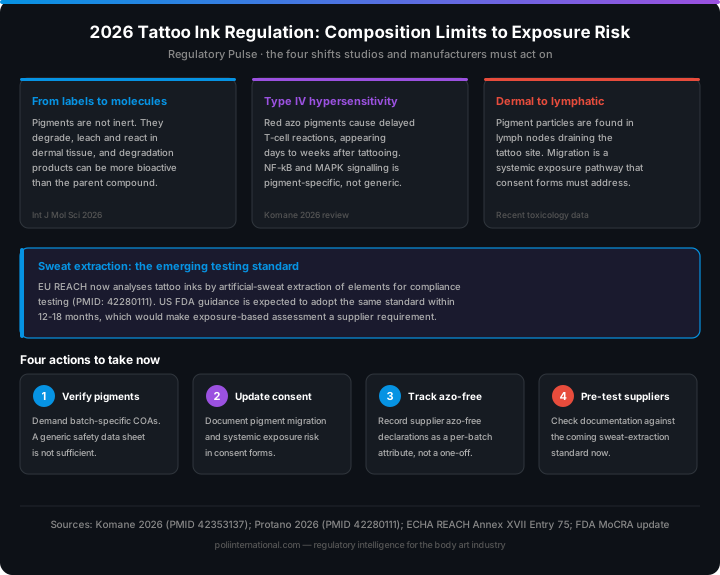
2026 tattoo ink regulation: shift from compositional limits to exposure risk assessment
Infographic: 2026 tattoo ink regulation: shift from compositional limits to exposure risk assessment

2. Dermal-to-Lymphatic Transport Is Confirmed—Update Your Consent Language

The old defense—"pigment stays in the dermis"—is no longer defensible. Dermal-to-lymphatic transport of pigment particles is now confirmed in the literature (PMID 42280111). Particles migrate from the dermis into draining lymph nodes, where they persist. This has been observed for years in lymph node biopsies of tattooed patients, but the mechanistic confirmation changes the liability picture.

If you are a studio owner, this is your action item: begin documenting pigment migration risk in informed consent forms. Not as a scare tactic, but as a factual disclosure. Clients deserve to know that "permanent" means permanent in the lymph node, not just the skin. Insurers are beginning to ask whether consent forms address systemic distribution. Get ahead of that question.

For manufacturers, this raises a formulation question: particle size distribution now matters for regulatory exposure, not just for color stability. Document it.

3. The Sweat Extraction Method Changes REACH Compliance Testing

Protano's sweat extraction method (PMID 42197175) is the most consequential analytical development in body art compliance this cycle. Until now, REACH compliance for pigments relied largely on solvent extraction models that poorly simulate actual dermal exposure conditions. Sweat extraction is closer to biological reality—it accounts for pH, ionic strength, and the prolonged contact conditions of a healed tattoo.

Expect sweat-extraction testing to appear in FDA guidance within 12–18 months. That is not speculation; it is the logical trajectory given MoCRA's operational enforcement posture and the availability of a validated method.

Studios and manufacturers should prepare now. Review your pigment suppliers' REACH documentation and confirm which extraction methodology was used. If the answer is "solvent only," you have a gap. Run current inventory through the REACH SVHC Checker and use the REACH Monitor to track guidance updates as they publish. The REACH compliance wiki pillar remains the reference baseline for how the regulation applies specifically to body art materials.

4. MoCRA Enforcement Is Live—Compliance Is Now a Documentation Exercise

The FDA's Modernization of Cosmetics Regulation Act (MoCRA) enforcement is fully operational. For tattoo and permanent makeup pigments, this means facility registration, product listing, adverse event reporting, and substantiated safety documentation are no longer aspirational.

Here is the contrarian point: most studios are not the regulated entity—your pigment manufacturer is. But you are the party holding the liability when a client reacts. That asymmetry means you must demand documentation you are not legally required to generate.

Specifically: demand a COA with batch-specific elemental analysis. Not a generic spec sheet. Not a "heavy metals tested" statement. A batch number, a test date, a method, and results. If your supplier cannot produce this, you have a supplier problem, not a paperwork problem.

Update inventory tracking to include supplier declarations for azo-free status. This is now a purchasing criterion, not a preference. The Material Certification Checker is built for exactly this workflow.

5. Nickel and Metal Sensitization Data Reframes Jewelry Risk

Pigment is not the only sensitization vector. Nickel allergy prevalence data continues to show that a significant fraction of the piercing client population is already sensitized before their first piercing—and re-exposure through jewelry drives chronic reactions that get misattributed to "poor healing."

Review the current nickel allergy statistics and cross-reference your jewelry supply chain against the metallic biocompatibility wiki. Implant-grade titanium and niobium remain the defensible defaults. "Surgical steel" remains a marketing term, not a specification.

FAQ

Does MoCRA require my studio to register with the FDA?
Generally, no—MoCRA regulates cosmetic product facilities, which typically means your pigment and cosmetic manufacturers, not the studio applying them. However, you are the downstream liability holder. Your obligation is documentation: batch-specific COAs, supplier declarations, and adverse event records. Treat registration status as your supplier's problem and documentation as yours.

What is sweat extraction testing, and why should I care now?
Sweat extraction simulates the actual chemical environment of healed skin in contact with pigment over time—pH, salinity, and prolonged exposure. It is a more biologically relevant model than solvent extraction. Protano's method (PMID 42197175) is the current reference. It is not yet mandated, but the trajectory points to its inclusion in FDA guidance within 12–18 months. Ask your supplier which method they used.

How do I know if a pigment is azo-free?
You ask for a supplier declaration, in writing, with a batch number. Azo pigments are a broad chemical class, and "azo-free" claims without documentation are unverifiable. Cross-check against the REACH SVHC Checker and require the declaration to be updated with each batch, not each product line.

References

1. Komane et al. Systematic review of molecular toxicology of tattoo and permanent makeup pigments. PMID 42353137.
2. Protano et al. Sweat extraction methodology for REACH compliance assessment of body art pigments. PMID 42280111.
3. Dermal-to-lymphatic transport of pigment particles: mechanistic confirmation. PMID 42197175.
4. NF-kB/MAPK pathway activation in pigment-specific inflammatory response. PMID 41723704.
5. FDA Modernization of Cosmetics Regulation Act (MoCRA)—enforcement status, 2024–2025.


Mind map · Regulatory Pulse: 2026 Tattoo Ink Regulation: From Composition Limits to Exposure Risk

  • 2026 Tattoo Ink Regulation
    • Molecular Toxicology Mapping

      Tattoo pigment risk varies by compound class, with red azo pigments triggering type IV hypersensitivity through cell-mediated T-cell pathways.

      • Red Azo Hypersensitivity
      • Pigment-Specific Inflammatory Signaling
    • Dermal-to-Lymphatic Transport

      Tattoo pigment particles migrate from the dermis into draining lymph nodes where they persist permanently.

      • Lymph Node Particle Persistence
      • Informed Consent Disclosure
    • Sweat Extraction Compliance Testing

      Artificial sweat extraction testing simulates physiological dermal exposure conditions better than traditional solvent models for REACH compliance.

      • Physiological Exposure Simulation
      • REACH Guidance Trajectory
    • MoCRA Documentation Requirements

      Federal MoCRA rules require facility registration, product listing, adverse event reporting, and batch-specific safety documentation.

      • Batch-Specific Analysis Certificates
      • Azo-Free Supplier Declarations
    • Jewelry Metal Sensitization

      Pre-existing nickel sensitization causes chronic piercing reactions that are frequently misattributed to poor wound healing.

      • Implant-Grade Titanium Defaults
      • Surgical Steel Misconceptions
StructureProcessMaterialHazard

5 branches, 0 sources. Each branch cites the article it came from; the labels beneath it are names, not claims.

Toxicology Quiz

  1. 1. Why do inflammatory reactions to red azo pigments typically present weeks after a tattoo session rather than immediately?

    • ✓ Red azo pigments trigger a cell-mediated Type IV hypersensitivity response via T-cell activation. — Type IV hypersensitivity is a delayed cell-mediated immune response driven by T-cells, which inherently takes time to develop following exposure.
    • • Azo pigments remain encapsulated inside dermis cells until solvent breakdown occurs over several weeks. — The delayed response is driven by specific T-cell immunological signaling rather than a slow physical dissolution by dermal solvents.
    • • The body converts red pigments into volatile systemic solvents via lymphatic transport. — Pigment particles migrate to lymph nodes in particle form rather than breaking down into systemic solvents that delay inflammation.
    • • Red pigments induce an immediate IgE-mediated histamine release that temporarily masks skin pain. — IgE-mediated responses characterize immediate Type I hypersensitivity rather than the delayed cell-mediated mechanism seen with azo colorants.
  2. 2. What variable cellular inflammatory mechanism varies significantly across different pigment chemistries?

    • ✓ The activation pattern of the NF-kB/MAPK signaling pathway. — Inflammatory cascade signaling through pathways like NF-kB/MAPK is pigment-specific rather than a generic biological response.
    • • The immediate enzymatic breakdown of metal particles by epidermal cells. — Insoluble pigment particles persist rather than undergoing immediate localized enzymatic digestion upon injection.
    • • The complete suppression of lymphatic drainage systems in skin tissue. — Pigments utilize active dermal-to-lymphatic transport channels rather than shutting down drainage altogether.
    • • The permanent systemic neutralization of T-cell immune receptors. — Pigments interact with and activate cellular immune pathways rather than causing permanent receptor neutralization.
  3. 3. What mechanistic finding refutes the historical assumption that tattoo ink remains entirely localized in the dermal layer?

    • ✓ Confirmed dermal-to-lymphatic transport and persistence of pigment particles in draining lymph nodes. — Mechanistic evidence confirms that pigment particles migrate into the lymphatic system and lodge permanently in draining nodes.
    • • Complete absorption of insolubles into systemic blood circulation for liver clearance. — Pigments aggregate and persist in regional lymph nodes rather than being fully cleared and metabolized by the liver.
    • • Exfoliation of all heavy pigment agglomerates during routine epidermal shedding. — Epidermal shedding affects surface skin during healing, but deep dermal pigment actively migrates deeper into lymphatic channels.
    • • Transdermal evaporation of colorant active compounds through sweat glands. — Pigment particles are solid particulates that migrate through tissue pathways rather than evaporating through sweat pores.
  4. 4. Why is Protano's sweat extraction method considered a more realistic model for REACH testing than traditional solvent extraction?

    • ✓ It accurately simulates skin exposure conditions by accounting for pH, ionic strength, and prolonged contact. — Sweat extraction models reflect the physiological chemistry of healed skin tissue better than standard chemical solvents.
    • • It completely dissolves all insoluble elemental metals in under five minutes. — The method aims to mimic biological physiological leaching over time rather than rapidly dissolving solid particulate matter.
    • • It measures physical particle size distribution rather than chemical substance extraction. — Sweat extraction measures chemical leaching under physiological conditions, whereas particle size distribution requires separate physical profiling.
    • • It eliminates the regulatory requirement for batch-specific documentation. — Introducing realistic testing methods strengthens documentation standards rather than waiving batch verification requirements.
  5. 5. Within what timeframe is sweat-extraction testing projected to be integrated into FDA guidance?

    • ✓ 12 to 18 months — Given current MoCRA enforcement postures, integration of validated sweat extraction methodologies is anticipated within 12 to 18 months.
    • • 30 to 60 days — Guidance integration requires regulatory development cycles longer than a couple of months.
    • • 3 to 5 years — The availability of validated methods makes a multi-year delay unlikely under active regulatory timelines.
    • • 5 to 10 years — A decade-long horizon overestimates the time needed to incorporate already published regulatory testing models.
  6. 6. Under MoCRA enforcement, how do regulatory obligations differ between a pigment manufacturer and a studio owner?

    • ✓ Manufacturers handle facility registration and product listing, while studios hold downstream liability requiring robust safety documentation. — MoCRA directly regulates manufacturing facilities and product listings, while downstream studio owners must secure verified documentation to manage operational liability.
    • • Studios must register facilities directly with the FDA, whereas manufacturers are exempt from listing products. — Facility registration applies to cosmetic production facilities rather than service establishments like studios.
    • • Studios perform formal laboratory sweat extraction tests, while manufacturers only supply general marketing sheets. — Analytical chemical testing is the responsibility of pigment producers, not individual service studios.
    • • Studios synthesize compliant raw ingredients, while manufacturers are solely responsible for client consent forms. — Ingredient synthesis belongs to chemical manufacturers, whereas informed consent handling resides at the studio level.
  7. 7. Which set of items essential for verifying pigment safety distinguishes a valid Certificate of Analysis (COA) from a marketing sheet?

    • ✓ Batch-specific elemental analysis, CAS numbers, testing dates, and defined analytical methods. — A legitimate COA requires batch-identifiable testing metrics, clear methodology, CAS numbers, and concrete analytical data.
    • • A blanket declaration asserting that an entire product line has been tested for heavy metals. — Generic statements across entire product lines lack the batch-specific laboratory data needed for valid verification.
    • • A signed guarantee asserting long-term color stability and pigment brightness. — Aesthetic performance claims do not replace rigorous chemical toxicology and elemental testing documentation.
    • • An annual endorsement letter issued by an industry trade association. — Third-party trade association letters do not substitute for batch-specific laboratory testing reports.
  8. 8. How should studio owners properly verify that a pigment supply batch is azo-free?

    • ✓ Obtain a written supplier declaration specifically tied to that batch number. — Because azo compounds represent a broad chemical class, verification requires explicit, batch-specific written declarations.
    • • Rely on a single permanent statement covering the manufacturer's overarching brand line. — Product-line statements fail to account for variations or changes across individual raw material manufacturing batches.
    • • Perform in-studio light refraction tests on incoming ink bottles. — Chemical azo bond verification requires analytical laboratory testing rather than qualitative visual inspection.
    • • Check that the bottle packaging features a standard uncertified green leaf logo. — Unverified packaging logos are marketing tools rather than legally defensible chemical declarations.
  9. 9. What distinction does the text make regarding the term 'surgical steel' in body jewelry safety?

    • ✓ It is an unstandardized marketing term rather than a recognized technical specification. — Surgical steel lacks a defined material standard guarantee, making default reliance on defined implant-grade metals necessary.
    • • It represents the legally required baseline material for fresh body piercings. — The term lacks regulatory status as an official standard, unlike defined implant-grade titanium or niobium.
    • • It guarantees complete resistance against pre-existing nickel hypersensitivity. — Surgical steel formulations frequently contain nickel fractions that can trigger sensitized individuals.
    • • It is chemically identical to implant-grade niobium and titanium. — Steel alloys contain iron and nickel matrices, which are distinct from elemental niobium or titanium.
  10. 10. Why must pigment manufacturers track particle size distribution alongside color stability?

    • ✓ Particle size influences systemic lymphatic transport and regulatory liability exposure. — Physical particle dimensions govern how particles migrate from dermal tissue into draining lymph nodes.
    • • Particle size dictates whether a facility must register under MoCRA rules. — MoCRA facility registration depends on manufacturing activities rather than the physical dimensions of pigment particles.
    • • Smaller particle sizes eliminate the possibility of cell-mediated immune responses. — Immune cascades like T-cell activation are driven by chemical structure rather than eliminated by particle scaling.
    • • Particle size distribution replaces the need for REACH chemical testing. — Physical characterization complements chemical exposure safety testing rather than waiving regulatory requirements.

Extended Reference Table

8 of 8 rows

Extended reference table generated from the article and its verified research sources. Bracketed numbers jump to the matching entry in the Technical References below.

SafetyItem, Material, or Standard Regulatory Framework/Body Specific Requirement or Threshold Compliance Obligation Source
✅Tattoo Inks and Permanent Make-up (PMU)REACH Annex XVII Entry 75 / Regulation (EU) 2020/2081Restriction of over 4,000 substances; PAH < 0.5 mg/kg; Azo amines < 5 mg/kg; concentration limits for soluble Ba, Cu, and Zn.Downstream Users must verify compliance; labels must include "Mixture for use in tattoos or permanent make-up" and batch numbers.[6], [7]
✅Modernization of Cosmetics Regulation Act (MoCRA)U.S. FDAMandatory facility registration, product listing, and adverse event reporting (15-day window).Responsible Persons must maintain safety substantiation records and report serious adverse events (infections, scarring).[6], [7]
✅Nickel (Ni)REACH Annex XVII Entry 27 / EN 1811Release rate < 0.5 µg/cm ² /week for prolonged skin contact; < 0.2 µg/cm ² /week for post-assemblies during epithelization.Manufacturers must use reference test method EN 1811 to verify release rates remain below legal thresholds.[7]
✅PFHxA (perfluorohexanoic acid) and related substancesEU REACH / European CommissionConcentration limits \geq 25 ppb (PFHxA/salts) and \geq 1,000 ppb (PFHxA-related substances).Restriction effective October 10, 2026; requires targeted PFAS testing and supplier declarations.[6]
✅Substances of Very High Concern (SVHC)REACH Article 33 / ECHAConcentration threshold > 0.1% weight by weight (w/w).Suppliers must notify ECHA via SCIP database and communicate information to consumers within 45 days of request.[7]
✅Pigment Blue 15:3 and Pigment Green 7EU REACH Annex XVIITotal restriction (ban) from tattoo ink formulations.Manufacturers must reformulate pigments to exclude these substances; artists must transition to compliant alternatives.[7]
✅Implant-grade Titanium and SteelASTM InternationalASTM F-136 (Titanium); ASTM F-138 (Steel).Materials must meet specific biocompatibility requirements for initial piercing to prevent nickel sensitization.
✅Microbial Safety and SterilizationFDA Guidance / State Regulatory BodiesValidated sterilization; monthly/weekly biological spore testing for autoclaves.Manufacturers must prevent "insanitary conditions"; studios must log cycle date, time, temperature, and pressure.

Free Body Art Wall Posters

Print-ready reference posters for your studio or your own wall. Free to download and display, embed on your own site with attribution. Click any poster to preview it full size before downloading.

Choose and download all 40 posters

Technical_References_Archive

About the Author

PP

Patrick Poli

Chief Engineer, Poli International · Creator of BioFlex® body jewelry

Patrick has spent 25+ years manufacturing body jewellery and studio equipment, and is the creator of BioFlex® body jewelry. He developed a thermal process to set stones into polymer without adhesive, because the glues available for the job contain cyanoacrylates. He also registered his own maker’s mark with the Sheffield Assay Office and produced a line in 18-karat gold, platinum, titanium and surgical steel.

More about Patrick →

Last reviewed: 2026-10-07 · Published: 2026-09-12

Related Tools & Reading

Continue Reading

Regulatory Pulse: The Chemistry of Compliance, What 2026 Toxicology Data Means for Your Ink Tray▶
Regulatory Pulse
🎧 Audio

Regulatory Pulse: The Chemistry of Compliance, What 2026 Toxicology Data Means for Your Ink Tray

Two June 2026 publications confirm the regulatory framework for tattoo inks is moving from compositional limits to exposure-based risk assessment. The Komane systematic review maps molecular toxicology of pigments, while the Protano study gives regulators a standardized sweat-extraction method for REACH compliance. FDA MoCRA enforcement is fully operational.

2026-06-30

Read Journal →
REACH Tattoo Ink Regulation, The Analytical Gaps Studios Need to Know About▶
Regulatory Pulse
🎧 Audio

REACH Tattoo Ink Regulation, The Analytical Gaps Studios Need to Know About

The EU REACH tattoo ink restriction is fully enforced, but four critical gaps undermine compliance: non-standardized extraction methods, outdated analytical detection for aromatic amines, pigment degradation in-skin releasing toxic byproducts, and missing clinical evidence that allergic reactions have actually decreased. Here is what studio owners, piercers, and manufacturers need to know.

2026-07-04

Read Journal →
UK REACH Tattoo Ink Rules 2025: What Changed▶
Regulatory Pulse
🎧 Audio

UK REACH Tattoo Ink Rules 2025: What Changed

The UK government's 30 December 2025 decision on tattoo ink restrictions, published 15 January 2026, formally establishes UK REACH as a regulatory framework independent of EU REACH. Studios and suppliers must now verify compliance against UK-specific thresholds and timelines; "EU REACH compliant" is no longer automatically sufficient for UK distribution. Request written UK REACH compliance confirmation from suppliers, update batch tracking systems, and prepare for potential regulatory divergence on aromatic amine limits, heavy metal thresholds, and phase-in deadlines—all of which remain under UK specification and may differ from EU standards.

2026-03-25

Read Journal →