
The US is finally moving toward real tattoo ink regulation, but the 2026 policy agenda exposes a blind spot: post-MoCRA, the FDA still lacks enforceable composition limits for intradermal chemical exposure. The EU REACH framework sets hard caps on soluble metals and bans carcinogenic aromatic amines; US oversight remains stuck on contamination and sterility. New bioaccessibility data—lead exceeds limits in several inks depending on the extraction medium—proves “total content” testing is a shell game. If you run a studio, that gap is your liability.
The MoCRA Illusion: Postmarket Power Is Not Pre-Market Safety
The Modernization of Cosmetics Regulation Act (MoCRA) gave the FDA mandatory recall authority and adverse event reporting for cosmetics—including tattoo inks. That sounds like progress; it is not the same as regulation. MoCRA is a reaction tool: it lets the FDA pull a bad batch after it is in your client’s dermis, but it sets no maximum allowable concentrations for lead, cadmium, or aromatic amines before they hit the shelf.
The 2026 policy agenda from Guilarte et al. is blunt: US federal oversight still operates under a cosmetic framework, while local rules focus on studio hygiene—autoclaves, gloves, single-use needles. That does nothing about the 32% of US adults carrying intradermal deposits of pigment, heavy metals, and PAHs. The paper’s key demand is enforceable composition limits: without them, the FDA plays whack-a-mole while EU REACH bans substances outright. If you are a US ink brand, the new rules will look a lot like REACH compliance for body art.
The Extraction Medium Problem: Why Your Certificate of Analysis Might Be Useless
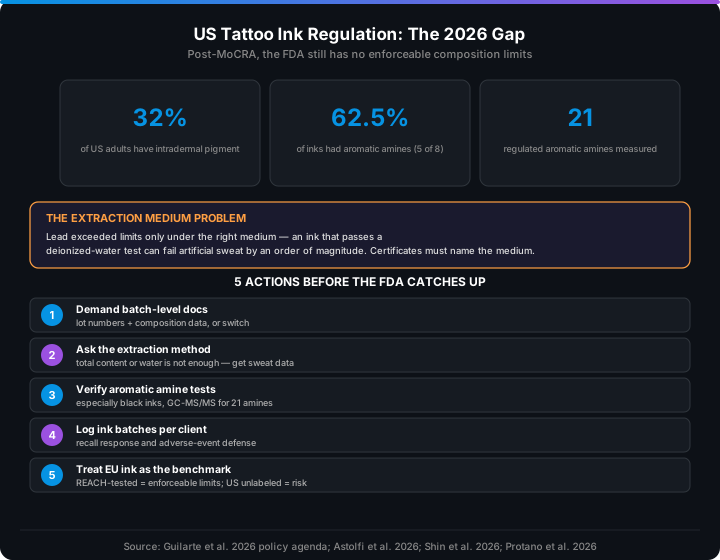
Astolfi et al. (2026) tested three extraction media—deionized water, artificial sweat, and physiological saline—on commercial tattoo inks. Lead exceeded regulatory limits in several samples, but only with the right medium. Yellow inks were enriched in barium and cadmium; blue inks carried higher copper and lead. Bioaccessibility swung wildly depending on the medium.
Current legislation, in the EU and in any proposed US framework, defines limits for soluble fractions of metals but does not specify which extraction media to use. An ink that passes a deionized water test can fail an artificial sweat test by an order of magnitude. Protano et al. (2026) confirmed this with 78 commercial inks extracted in artificial sweat at 37°C for one hour—color-dependent release of copper, zinc, barium, and aluminum. The takeaway: when your supplier hands you a certificate, ask what the extraction medium was. If they do not know, that certificate is worthless.
Aromatic Amines: The Black Ink Problem Nobody Is Talking About
Aromatic amines are potent carcinogens found in tattoo inks, particularly black pigments and certain azo dyes (see the ink toxicology and regulation page). Shin et al. (2026) developed a GC-EI-MS/MS method that quantifies 21 regulated aromatic amines. Applied to eight commercial inks, it found five amines in five products—a 62.5% hit rate—and caught trace levels standard single-quad MS missed.
Why does this matter for the US? The FDA’s current guidance focuses on microbial safety and visible particulates; it does not screen for aromatic amines. The EU REACH framework does, with enforceable limits. Czaczkowska et al. (2026) found that inks can contain classified carcinogens, heavy metals, PAHs, and phthalates—often exceeding permissible limits. About 25% of pigment migrates to lymph nodes; the rest sits in immune cells for decades. Melanoma and lymphoma have been reported in tattooed individuals, though causality is not fully established. If you are not asking for aromatic amine testing on every batch of black, you are flying blind.
Batch Traceability: The EU Benchmark You Cannot Ignore
REACH pairs chemical restrictions with labeling requiring ingredient transparency and batch identification. The US has neither. Guilarte et al. flagged inconsistent ingredient disclosure and limited batch/lot traceability as critical gaps. In the EU you can trace a bottle of ink to its formulation and compliance certificate; in the US you are lucky if the label lists the pigments. The 2026 agenda calls for standardized disclosure, batch traceability, and a clinician-led adverse event registry.
For studio owners, this is not a future problem: if a client develops a reaction and you have no record of the lot number, you have no defense; if a recall hits and you cannot identify affected clients, you are exposed. The fix is cheap: log brand, shade, and lot number for every ink used on every client. This is standard in the EU; it should be standard in every US studio by the end of this quarter. Use our REACH compliance monitoring to track which EU-sourced inks meet the stricter standard, and treat US inks without EU-style labeling as higher-risk inventory.
Actionable Intelligence: What to Do Before the FDA Catches Up
The US will adopt enforceable composition limits; it is a matter of when, not if. Here is what you do now, in order of priority:
First, demand batch-level documentation from every supplier; if they cannot provide lot numbers and composition data, switch. Second, ask what extraction method their certificates use—if it is “total content” or “deionized water,” demand artificial sweat data. Third, verify aromatic amine testing, especially for black inks. Fourth, log ink batches per client for adverse event reporting. Fifth, treat EU-sourced inks as the compliance benchmark: they are tested under REACH with enforceable limits. US inks without EU-style labeling are higher-risk.
The gap between US and EU regulation is a legal exposure for every studio owner and a safety gap for every client. The FDA is moving, but slowly; you do not have to wait. Use the REACH SVHC checker and the material certification checker to vet your supply chain now. The inks you buy today will sit in someone’s dermis for decades; can you prove what is in them?
FAQ
Why does the extraction medium matter for tattoo ink safety testing?
Metal bioaccessibility depends on the fluid: deionized water, artificial sweat, and physiological saline produce different soluble fractions. Astolfi et al. (2026) showed lead exceeding limits only under specific media. A water-based certificate may pass an ink that fails under sweat conditions, so ask for the extraction method.
Are black inks more dangerous than colored inks?
Black inks carry a higher risk of aromatic amine contamination. Shin et al. (2026) found five regulated aromatic amines in five of eight commercial inks. If your supplier cannot provide GC-MS/MS data for the 21 regulated amines, consider that ink unverified.
What should I do if my current ink supplier cannot provide batch-level documentation?
Switch suppliers. Without lot numbers you cannot respond to recalls or adverse event reports. EU-sourced inks are the compliance benchmark under REACH; if a US brand cannot match that, treat it as higher-risk and find an alternative.
6. Cancer, Cadmium, and the Questions Your Clients Are Asking
When clients ask me, "Isn't it poisonous?" or "What's the likelihood of cancer?" I don't brush it off. They deserve a straight answer. The truth is that tattoo ink is injected into the dermis, where it can interact with the immune system and, over time, potentially migrate. The FDA has acknowledged that certain pigments—especially reds and yellows—can contain carcinogenic aromatic amines or heavy metals like cadmium. That doesn't mean every tattoo causes cancer, but it does mean the risk is not zero. And with no enforceable federal limits on intradermal chemical exposure, the burden falls on studios to vet their suppliers.
I've spent 25 years making BioFlex® body jewelry and advocating for material safety. In that time, I've seen how the EU REACH framework sets hard caps on soluble metals and bans carcinogenic aromatic amines. The US is years behind. So when someone asks, "Are they harmful?" my answer is: they can be, if the ink contains cadmium or other undeclared toxins. The likelihood of cancer from a single tattoo is low, but repeated exposure or low-quality inks increase that risk. That's why I insist on full composition transparency from every ink supplier I work with.
What can you do? First, demand batch-specific safety data sheets and certificates of analysis. Second, look for inks that comply with REACH—even if you're in the US, it's the strongest standard available. Third, educate your clients. They're already searching for answers; give them facts, not reassurances. The 2026 policy agenda is a wake-up call: regulation is coming, but you don't have to wait for it to protect your studio and your clients.
For studios that want to lead on safety, start with the materials you already control. Our BioFlex® polymer jewellery is REACH-compliant and designed for biocompatibility. Pair that with our studio tools and you'll be ready for whatever regulators throw at you. Explore BioFlex® now →


