Shop
Regulatory Pulse

The Regulatory Divergence on Tattoo Inks: 2026's Uncomfortable Truth

PP

Chief Engineer

Patrick Poli

Journal Date

2026-08-08

Last Reviewed

2026-10-11

Executive Summary
The global regulatory framework for tattoo inks is fracturing along national lines, creating a compliance minefield for studios and manufacturers. In 2026, the United States, European Union, and Australia operate under fundamentally different assumptions about what constitutes a safe pigment. The US, despite the Modernization of Cosmetics Regulation Act (MoCRA), still lacks enforceable composition limits for intradermal exposure [1]. The EU's REACH restriction, in force since 2022, pairs chemical limits with labeling but has yet to demonstrate a measurable impact on tattoo-ink allergies [4]. Australia remains a regulatory vacuum, with a 2026 study finding that 100% of tested inks would be prohibited under EU rules [2]. For studio owners, this divergence means the ink you purchase legally in one jurisdiction can be a liability in another. The engineering-first approach demands you stop relying on country-of-sale compliance and start demanding batch-level data.

The US Gap: Postmarket Authority Without Pre-Market Standards

The US policy agenda, documented in Public Health Reports, confirms that federal oversight of tattoo inks follows a cosmetic framework, not a drug or device paradigm [1]. This is a critical distinction. The FDA, under MoCRA, has enhanced postmarket authority, meaning it can act after an adverse event occurs, but it cannot proactively restrict a pigment before it enters human skin. The documented gaps are specific: no enforceable composition limits for intradermal exposure, no consistent ingredient disclosure, no batch/lot traceability, and no national adverse event registry [1].

The absence of a national registry is not an administrative detail; it is the root cause of the US data deficit. If you cannot track which batch of which ink caused which reaction, you cannot build a statistical case for restriction. The policy agenda explicitly notes that EU REACH pairs restrictions with labeling that supports ingredient transparency, a model the US has not adopted [1]. For studio owners, the actionable takeaway is that US adverse-event reporting obligations may arrive before enforceable limits. Document ink lot numbers per client now, not when the regulation lands.
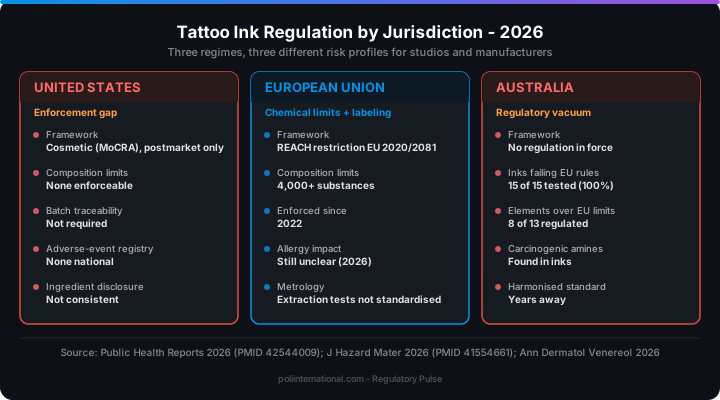
Comparison of US, EU and Australian tattoo ink regulation in 2026: EU has enforceable REACH limits, US has postmarket-only authority under MoCRA, Australia is unregulated with all tested inks failing EU rules.
Infographic: Comparison of US, EU and Australian tattoo ink regulation in 2026: EU has enforceable REACH limits, US has postmarket-only authority under MoCRA, Australia is unregulated with all tested inks failing EU rules.

REACH in Practice: Limits Exist, Impact Does Not

The EU's approach is chemically rigorous but operationally opaque. The REACH restriction (Regulation EU 2020/2081) sets concentration limits for 4,000+ substances, including carcinogenic aromatic amines and sensitizing metals. However, a 2026 French dermatology analysis in Annales de Dermatologie et de Vénéréologie concludes that the meaningful impact of REACH on tattoo-ink allergies remains unclear [4]. This is not a criticism of the limits themselves; it is a criticism of the enforcement and surveillance loop.

A companion study in Molecules highlights a comparability problem: standardized extraction procedures for assessing elemental release from inks are still lacking under the REACH framework 5]. If two laboratories use different artificial sweat extraction protocols, their compliance results are not directly comparable. For manufacturers, this means a certificate of analysis from one lab may not hold up in another member state. The REACH compliance monitoring tool at [REACH Monitor can help track these procedural variations, but the systemic issue remains: the regulation is ahead of the metrology.

Australia: The Unregulated Baseline

The Journal of Hazardous Materials study is the most damning dataset of the year. All 15 black and colored inks analyzed by ICP-MS and untargeted LC-MS/MS would be prohibited under EU regulations [2]. Eight of the 13 regulated elemental substances, antimony, arsenic, cadmium, chromium, copper, lead, selenium, and tin, exceeded EU thresholds in at least one sample [2]. The untargeted analysis also identified compounds listed in EU2020/2081, including toluidine and sulphanilic acid [2].

This is not a case of trace contamination; it is systemic noncompliance. For Australian studio owners, the risk is not regulatory, it is clinical and reputational. You are injecting pigments with known carcinogenic and sensitizing potential into paying clients. The study's call for harmonised international standards is correct, but harmonisation is years away. In the interim, the safest global baseline is to purchase inks that are EU-compliant, regardless of where you operate. Use the SVHC Checker to vet supplier declarations against the SVHC candidate list.

The Cancer Question: Reassurance with Caveats

A systematic review and meta-analysis in Clinical & Translational Oncology pooled seven studies with 140,841 participants and found that tattoo exposure was not associated with overall skin cancer (OR 0.92; 95% CI 0.83-1.04) [3]. There was no significant association with hematological malignancies in primary analyses. However, a significant association emerged after sensitivity analysis, which the authors interpret cautiously and recommend prospective investigation [3].

Do not mistake this for a clean bill of health. The sensitivity-analysis signal, while not definitive, aligns with the photochemistry data from Chemical Research in Toxicology: PR122, a common red pigment, releases toxic photoproducts on photodegradation, while PR254 is photostable [8]. The same study showed that phagolysosomal degradation of pigments was not observed, but protein corona formation reduced cytotoxicity [8]. The engineering interpretation is that red pigments are not all equal, and the photostability profile should be a selection criterion. The meta-analysis says tattoos are not an epidemiological time bomb; the pigment data says specific chemistries warrant conservatism. Both statements are true.

Actionable Intelligence for Studio Owners

The regulatory divergence is not an abstraction; it is a procurement problem. First, do not rely on country of sale. An ink batch that passes in Australia will likely fail in the EU, and the US has no standard to fail [1][2]. Second, ask suppliers for batch-level composition data and EU2020/2081 compliance certificates, not generic safety data sheets. The validated GC-EI-MS/MS method for quantifying 21 regulated aromatic amines, applied to 8 commercial inks, identified 5 amines in 5 products [6]. This means the analytical tools exist to verify compliance; demand the data.

Third, document ink lot numbers per client for traceability. The US policy agenda explicitly identifies batch/lot traceability as a gap, and a national adverse event registry is likely to follow 1]. Fourth, the semi-permanent make-up (SPMU) pigment review in Journal of Applied Toxicology found widespread noncompliance with regulatory limits, particularly for chromium and other metals, and urges mandatory nanotoxicological evaluations [7]. If you offer SPMU services, apply the same EU-baseline standard. Finally, the cancer meta-analysis is reassuring but does not license ignoring pigment chemistry; the red-pigment photoproduct data argues for conservatism on reds [3][8]. The [Material Certification Checker and Metallic Biocompatibility wiki resources can help operationalize these decisions.

FAQ

Q: If my ink is certified for sale in the US, is it safe to use?
A: No. US certification under MoCRA addresses postmarket authority, not pre-market composition limits. There are no enforceable concentration limits for intradermal exposure, no consistent ingredient disclosure, and no batch/lot traceability requirement [1]. A US-compliant ink can contain substances that are prohibited in the EU. The safest procurement standard is EU2020/2081 compliance, regardless of your jurisdiction.

Q: Does the REACH restriction guarantee that EU-compliant inks will not cause allergic reactions?
A: No. The REACH restriction sets chemical limits, but a 2026 French dermatology analysis concludes that its meaningful impact on tattoo-ink allergies is still unclear [4]. Additionally, standardized extraction procedures for elemental release testing are still lacking under REACH, creating comparability problems between laboratories [5]. Compliance reduces risk; it does not eliminate it.

Q: Should I stop offering red tattoo pigments to clients?
A: Not categorically, but you should differentiate between red pigments. PR254 is photostable, while PR122 releases toxic photoproducts on photodegradation [8]. The meta-analysis shows no overall skin cancer association, but the sensitivity-analysis signal and the photoproduct data argue for a conservative approach to specific red chemistries [3][8]. Request photostability data from your supplier and favor pigments with demonstrated stability.

References

1. PMID 42544009. Public Health Reports. 2026. US tattoo ink policy agenda: gaps in composition limits, ingredient disclosure, batch traceability, and adverse event registry. 2. PMID 41554661. Journal of Hazardous Materials. 2026. Australian tattoo ink analysis: all 15 inks would be prohibited under EU regulations; 8/13 regulated elements exceeded thresholds. 3. PMID 42250187. Clinical & Translational Oncology. 2026. Systematic review and meta-analysis: tattoo exposure and cancer risk, 7 studies, 140,841 participants. 4. PMID 42054710. Annales de Dermatologie et de Vénéréologie. 2026. REACH tattoo-ink allergy impact remains unclear. 5. PMID 42280111. Molecules. 2026. Elemental release from 78 commercial tattoo inks; standardized extraction procedures lacking under REACH. 6. PMID 42197175. Molecules. 2026. Validated GC-EI-MS/MS method for 21 regulated aromatic amines in tattoo inks. 7. PMID 42010856. Journal of Applied Toxicology. 2026. Semi-permanent make-up pigments: widespread noncompliance with regulatory limits, need for nanotoxicological evaluation. 8. PMID 41723704. Chemical Research in Toxicology. 2026. Red tattoo pigments PO13, PR254, PR122: photostability and photoproduct toxicity profiles.

Mind map · The Regulatory Divergence on Tattoo Inks: 2026's Uncomfortable Truth

  • Tattoo Ink Regulatory Divergence
    • US Postmarket Cosmetic Framework

      The United States Food and Drug Administration regulates tattoo inks under a postmarket cosmetics framework without pre-market standards.

      • No Enforceable Composition Limits
        • Intradermal Exposure Gaps
      • MoCRA Facility Registration Mandates
        • Adverse Event Reporting
    • EU REACH Chemical Limits

      European Union REACH restrictions establish chemical limits for tattoo inks but have not demonstrated a measurable reduction in patient allergies.

      • Restricted Hazardous Chemical Substances
        • Aromatic Amines Limits
      • Inconsistent Extraction Protocols
        • Laboratory Comparability Gaps
    • Australian Systemic Pigment Noncompliance

      A study of fifteen tattoo inks purchased from Australian suppliers found that all samples failed current European Union safety thresholds.

      • Detected Regulated Toxic Metals
        • Excessive Lead and Chromium
      • Banned Carcinogenic Organic Amines
        • Toluidine and Sulphanilic Acid
    • Cancer Risks and Photostability

      A meta-analysis of seven studies indicates no overall skin cancer risk, but some red pigments release toxic chemicals upon solar degradation.

      • Skin Cancer Epidemiological Safety
      • Unstable Red Ink Chemistries
        • Degradation of Pigment PR122
    • Actionable Procurement and Traceability

      Professional tattoo artists should verify batch-level composition data and maintain client logs of lot numbers for comprehensive traceability.

      • Client Ink Lot Logging
StructureProcessMaterialHazard

5 branches, 0 sources. Each branch cites the article it came from; the labels beneath it are names, not claims.

Tattoo Regulation Quiz

  1. 1. What is a primary limitation of the United States FDA's authority over tattoo inks under the Modernization of Cosmetics Regulation Act (MoCRA)?

    • • It only regulates permanent makeup pigments while exempting standard body art tattoo inks. — MoCRA applies a cosmetic framework broadly to tattoo inks rather than exempting standard body art inks in favor of permanent makeup.
    • ✓ It grants enhanced postmarket authority but lacks the power to proactively restrict pigment compositions before market entry. — The federal framework allows action after adverse events occur but fails to establish enforceable intradermal composition limits prior to distribution.
    • • It requires pre-market approval for all organic pigments but exempts inorganic metallic salts. — Federal oversight operates under a cosmetic paradigm rather than a pre-market drug or device approval process for any pigment class.
    • • It enforces strict concentration limits for heavy metals but lacks authority to mandate ingredient labeling. — MoCRA currently lacks enforceable composition limits for intradermal exposure as well as consistent ingredient disclosure requirements.
  2. 2. According to the US policy agenda, what is identified as the root cause of the United States' tattoo ink data deficit?

    • ✓ The absence of a national adverse event registry to track specific ink batches linked to reactions. — Without a centralized registry connecting adverse client reactions to specific lot numbers, building a statistical case for composition restrictions is nearly impossible.
    • • The refusal of ink manufacturers to publish generic safety data sheets for commercial products. — While generic safety data sheets exist, they do not provide the batch-level traceability or reaction logging needed to identify safety trends.
    • • Over-reporting of mild cutaneous allergic reactions by dermatologists cluttering federal databases. — The core issue in the US is a complete lack of a centralized tracking mechanism rather than an excess of reported clinical data.
    • • Federal preemption preventing individual US states from collecting ink reaction reports locally. — The primary barrier highlighted in the policy agenda is the missing national adverse event registry and batch traceability requirement rather than state preemption.
  3. 3. What conclusion did a 2026 French dermatology analysis reach regarding the clinical impact of the EU REACH restriction (Regulation EU 2020/2081)?

    • • It successfully reduced reported tattoo-ink allergic reactions across Europe by over fifty percent. — Despite setting strict chemical limits on thousands of substances, the regulation's actual impact on reducing tattoo-ink allergies remains unclear.
    • ✓ Its meaningful impact on reducing tattoo-ink allergies remains unclear. — Setting chemical thresholds on paper has not yet demonstrated a measurable clinical reduction in tattoo-ink allergies due to enforcement and surveillance challenges.
    • • It caused tattoo artists to switch entirely to unlabelled inks imported from non-EU jurisdictions. — The analysis focused on the lack of demonstrated measurable impact on tattoo-ink allergies rather than a complete market shift to illegal imports.
    • • It proved that concentration limits on aromatic amines are clinically ineffective at preventing skin irritation. — The critique targeted enforcement and surveillance loop outcomes rather than the theoretical chemical validity of concentration limits.
  4. 4. Why do elemental release measurements from tattoo inks under the EU REACH framework currently suffer from laboratory comparability issues?

    • • Laboratories use different testing temperatures when measuring volatile organic compounds. — The primary analytical variance stems from extraction methods for heavy metals rather than volatile compound temperature controls.
    • ✓ There is a lack of standardized artificial sweat extraction procedures across testing facilities. — Non-standardized extraction protocols mean two different laboratories testing the same ink sample can yield divergent compliance results.
    • • Inductively Coupled Plasma Mass Spectrometry (ICP-MS) is inherently incapable of detecting trace elements in liquid pigments. — ICP-MS is a standard, highly sensitive analytical technique, but varying extraction protocols beforehand skew the sample results.
    • • European law mandates that each EU member state maintain its own unique chemical candidate list for heavy metals. — REACH establishes unified chemical thresholds across the EU, but metrological protocols for testing pigment samples are not standardized.
  5. 5. What did the 2026 study published in the Journal of Hazardous Materials reveal about tattoo inks sampled in Australia?

    • ✓ All 15 tested black and colored inks would be prohibited under EU REACH regulations. — Analytical testing demonstrated systemic noncompliance with European chemical standards across every single sampled Australian ink.
    • • Australian inks contained zero detectable trace metals but high levels of unlisted aromatic amines. — Eight out of thirteen regulated elemental substances actually exceeded EU thresholds in at least one sampled ink.
    • • The majority of Australian inks fully complied with European Union safety thresholds for heavy metals. — None of the tested inks met EU criteria, with elemental contaminants like lead, arsenic, and chromium exceeding limits.
    • • Only red and yellow pigments contained prohibited substances, while black inks were completely safe. — Noncompliance was found across all 15 tested inks, encompassing both black and colored pigments indiscriminately.
  6. 6. How do the photostability profiles of the red pigments PR122 and PR254 differ when exposed to light?

    • • PR122 is photostable, whereas PR254 releases toxic photoproducts upon exposure to light. — Photochemistry data indicates that PR254 is the photostable red pigment, while PR122 breaks down into toxic products.
    • • Both PR122 and PR254 decompose instantly into carcinogenic aromatic amines when exposed to sunlight. — Chemical testing shows a distinct divergence in stability between these two red pigments rather than identical light degradation.
    • ✓ PR254 is photostable, whereas PR122 releases toxic photoproducts upon photodegradation. — Experimental evidence highlights that PR254 maintains its chemical integrity under light, making it a preferable choice over PR122.
    • • Neither pigment degrades under UV light because protein corona formation completely prevents photolysis. — Protein corona formation reduces cytotoxicity in cellular environments but does not prevent light-induced degradation of PR122.
  7. 7. What was the primary finding of the 2026 meta-analysis in Clinical & Translational Oncology regarding overall skin cancer risk from tattoo exposure?

    • • Tattooing increases the overall risk of non-melanoma skin cancer by nearly thirty percent. — The pooled analysis of over 140,000 participants found no statistically significant association with overall skin cancer.
    • ✓ No statistically significant association was found between tattoo exposure and overall skin cancer risk. — The study reported an odds ratio of 0.92 with a 95% confidence interval of 0.83 to 1.04, indicating no overall increase in risk.
    • • Tattoo exposure exhibits a strong, direct causal link to immediate cutaneous T-cell lymphoma development. — Primary analyses showed no significant association with hematological malignancies, though a subtle signal appeared only in sensitivity analysis.
    • • Tattooing reduces the overall incidence of skin cancer due to protective carbon black optical shielding. — An odds ratio close to 1.0 indicates a lack of elevated risk rather than a protective biological effect against skin cancer.
  8. 8. What concern was highlighted in the 2026 review of semi-permanent make-up (SPMU) pigments published in the Journal of Applied Toxicology?

    • • SPMU pigments are strictly regulated and show higher compliance rates than conventional tattoo inks. — The review actually documented widespread noncompliance with existing regulatory thresholds among SPMU products.
    • ✓ SPMU pigments demonstrated widespread noncompliance with regulatory limits, particularly regarding heavy metals like chromium. — High levels of metal contaminants led researchers to urge mandatory nanotoxicological evaluations for SPMU products.
    • • SPMU pigments contain no metallic impurities but routinely fail microbiological sterility tests. — Metal contamination, specifically chromium and other heavy metals, was a central finding of noncompliance in SPMU pigments.
    • • SPMU pigments degrade within three weeks due to aggressive phagolysosomal pigment destruction. — Research shows phagolysosomal degradation of pigments was not observed in cellular models.
  9. 9. What is recommended as the safest global baseline procurement standard for tattoo studio owners regardless of their local jurisdiction?

    • • Purchasing inks certified under US MoCRA postmarket cosmetic guidelines. — US guidelines lack pre-market intradermal concentration limits and ingredient disclosure rules, leaving chemical safety unverified.
    • • Relying on generic Safety Data Sheets (SDS) provided by domestic ink distributors. — Generic safety data sheets do not guarantee batch-specific chemical testing or compliance with strict elemental limits.
    • ✓ Procuring inks accompanied by batch-level EU2020/2081 compliance certificates. — Adopting EU REACH standards as a baseline ensures inks meet strict chemical thresholds for over 4,000 regulated substances.
    • • Verifying that inks are produced within Australia to ensure minimal chemical exposure. — Studies show Australian market inks present systemic noncompliance when measured against international safety limits.
  10. 10. What analytical method was validated in a 2026 Molecules study to detect 21 regulated aromatic amines in commercial tattoo inks?

    • • Inductively Coupled Plasma Mass Spectrometry (ICP-MS). — ICP-MS is utilized for analyzing heavy metal elements rather than organic aromatic amine compounds.
    • ✓ Gas Chromatography-Electron Ionization-Tandem Mass Spectrometry (GC-EI-MS/MS). — This validated chromatographic method successfully identified five regulated aromatic amines across five out of eight tested commercial inks.
    • • High-Performance Thin-Layer Chromatography (HPTLC) combined with UV spectrophotometry. — The study specifically developed and validated a gas chromatography tandem mass spectrometry protocol for aromatic amine quantification.
    • • Untargeted Liquid Chromatography-Tandem Mass Spectrometry (LC-MS/MS) without reference standards. — The method relied on targeted validation specifically for 21 known, regulated aromatic amine targets.

Extended Reference Table

8 of 8 rows

Extended reference table generated from the article and its verified research sources. Bracketed numbers jump to the matching entry in the Technical References below.

SafetyItem, Material, or Standard Classification Description and Regulatory Status Chemical or Technical Specifications Source
✅EU REACH (Regulation (EU) 2020/2081)Regulatory FrameworkLegally binding European regulation restricting over 4,000 hazardous chemicals in tattoo and permanent make-up inks. In force since 2022, it serves as a global safety benchmark.Restricts aromatic amines to 0.0001% w/w; sets limits for heavy metals and PAHs; requires standardized extraction for elemental release.
✅Modernization of Cosmetics Regulation Act (MoCRA)Regulatory FrameworkUS federal law (2022) granting the FDA expanded authority over tattoo inks. Mandates facility registration, product listing, and serious adverse event reporting.Adverse events must be reported within 15 business days; requires 3-year record keeping for batch codes; lacks pre-market intradermal composition limits.
✅Pigment Red 254 (PR254)Pigment (Red)A red pigment used in the body art industry evaluated for its stability and cellular impact when exposed to light.Clinically identified as photostable; does not release toxic photoproducts under photodegradation testing.
✅Pigment Red 122 (PR122)Pigment (Red)A common red pigment used in tattoo inks identified as chemically unstable compared to PR254.Subject to photodegradation; releases toxic photoproducts upon exposure to light.
✅Pigment Blue 15:3PigmentA copper phthalocyanine blue pigment widely used in tattoo art; currently restricted in EU markets pending further safety data.Chemical identity: Phthalocyanine Blue. Restricted concentration limit of 0.1% by weight under REACH Annex XVII.
✅Pigment Green 7PigmentA halogenated polychloro-copper phthalocyanine green pigment restricted within the EU under REACH protocols.Polychloro-copper phthalocyanine. Concentration limit set at 0.1% w/w under REACH Annex XVII.
✅Pigment Black 7 (Carbon Black)PigmentA common black pigment. Zuper Black is a product example re-engineered to meet 2026 safety profiles using ultra-pure versions.Purity requirement: Polycyclic Aromatic Hydrocarbons (PAHs) limit of 0.5 ppb (parts per billion) in REACH Annex XVII.
✅ToluidineChemical Substance / Aromatic AmineA carcinogenic aromatic amine compound regulated under EU 2020/2081. Detected in noncompliant inks in unregulated markets.Listed as a restricted compound in EU REACH due to carcinogenic and sensitizing potential; detected in 3 of 15 samples in Australian studies.

Free Body Art Wall Posters

Print-ready reference posters for your studio or your own wall. Free to download and display, embed on your own site with attribution. Click any poster to preview it full size before downloading.

Choose and download all 40 posters

Technical_References_Archive

About the Author

PP

Patrick Poli

Chief Engineer, Poli International · Creator of BioFlex® body jewelry

Patrick has spent 25+ years manufacturing body jewellery and studio equipment, and is the creator of BioFlex® body jewelry. He developed a thermal process to set stones into polymer without adhesive, because the glues available for the job contain cyanoacrylates. He also registered his own maker’s mark with the Sheffield Assay Office and produced a line in 18-karat gold, platinum, titanium and surgical steel.

More about Patrick →

Last reviewed: 2026-10-11 · Published: 2026-08-08

Related Tools & Reading

Continue Reading