# Regulatory Pulse: The Chemistry of Compliance — What 2026 Toxicology Data Means for Your Ink Tray
Executive Summary
Two June 2026 publications from the *International Journal of Molecular Sciences* and *Molecules* have independently confirmed what I've been saying for five years: the regulatory framework for tattoo inks is moving from compositional limits to exposure-based risk assessment. The Komane systematic review maps the molecular toxicology of pigments with sufficient clarity that "I didn't know" is no longer a defense. The Protano sweat extraction study gives regulators a standardized method to measure what actually leaches out of your ink once it's in the dermis. Meanwhile, FDA's MoCRA enforcement machinery is fully operational. This is not a warning. This is a status report. If your ink sourcing documentation consists of a receipt and a handshake, you are now operating outside professional standards.
1. The Molecular Toxicology Data Is No Longer Theoretical
The Komane et al. systematic review (PMID 42353137) synthesizes evidence across 78 studies under PRISMA guidelines. The headline findings are not subtle:
- Red azo pigments trigger type IV hypersensitivity via T-cell activation. This is not "some people react." This is a documented immunological mechanism.
- Dermal-to-lymphatic transport of pigment particles is confirmed. Your ink leaves the tattoo site and enters systemic circulation.
- NF-κB/MAPK pathway activation is pigment-specific. Different colors produce different inflammatory signatures at the transcriptomic level.
The clinical implication is straightforward: delayed hypersensitivity reactions to red pigments are not idiosyncratic — they are predictable based on molecular structure. If you are still using red inks without verified composition data, you are exposing clients to a known immunological trigger with documented genotoxic potential.
What this means for your studio: Informed consent documents must now explicitly address pigment migration and delayed hypersensitivity. The "rare complication" language is obsolete. The data says these are predictable outcomes of specific pigment chemistries.
2. Sweat Extraction: The New Compliance Standard
The Protano et al. study (PMID 42280111) addresses a critical gap in REACH enforcement. EU regulations set limits on elemental content in tattoo inks, but the testing methodology was inconsistent. Their solution: standardized artificial sweat extraction at 37°C for one hour, analyzed by ICP-MS.
They tested 78 commercial inks. Results by color:
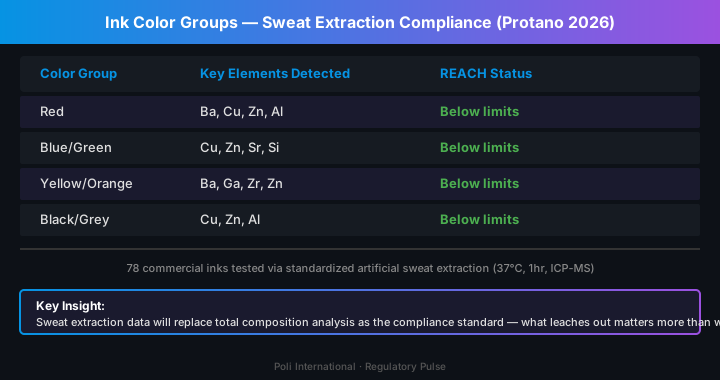
| Color Group | Key Elements Detected | REACH Compliance Status |
|---|---|---|
| Red | Ba, Cu, Zn, Al | Below limits (tested) |
| Blue/Green | Cu, Zn, Sr, Si | Below limits (tested) |
| Yellow/Orange | Ba, Ga, Zr, Zn | Below limits (tested) |
| Black/Grey | Cu, Zn, Al | Below limits (tested) |
The study found soluble barium, copper, and zinc remained below regulatory limits. That's the good news. The bad news: this method is transferable. Expect regulators — and plaintiffs' experts — to adopt it. The industry has been operating without a standardized extraction protocol. That era ends now.
Your supply chain will change. Manufacturers will need to provide sweat-extraction data, not just total elemental analysis. Total composition tells you what's in the bottle. Sweat extraction tells you what gets into the client. Those numbers are not the same.
3. FDA MoCRA: Enforcement Is Real
The FDA has published two draft guidances in the last six months that directly affect your business:
Records Access Authority for Cosmetics Products (January 2026)
FDA can now demand records related to cosmetic product safety — including tattoo inks — without a warrant. If you are mixing inks, modifying colors, or repackaging, your process documentation is subject to inspection.
Mandatory Cosmetics Recalls Guidance (December 2025)
MoCRA gave FDA mandatory recall authority. The guidance explains how it will be used. For tattoo inks, the trigger is clear: microbial contamination, heavy metals above limits, or undeclared restricted substances.
The FDA real-time adverse event reporting dashboard launched September 2025. Adverse event reports for tattoo inks are publicly searchable. Your clients can see what's being reported. So can regulators.
Deadline status: MoCRA facility registration and product listing deadlines have passed. Enforcement is ongoing. If you are a studio owner who manufactures or modifies inks on-site and you have not registered, you are non-compliant.
4. Red Pigments: The Highest Toxicological Priority
The Komane review is unambiguous: red azo pigments are the highest-risk category in cosmetic tattooing. The mechanism is T-cell-mediated type IV hypersensitivity, which means reactions can occur days, weeks, or years after implantation. This is not a surface irritation. This is an immune response to a foreign material that does not biodegrade.
Actionable steps for studio owners:
1. Verify sourcing. Request certificates of analysis (COAs) for every red pigment batch. If the manufacturer cannot provide elemental analysis and pigment identification, do not use the product.
2. Document batch numbers. If a reaction occurs, you need to trace the ink to its production batch. This is standard practice in every regulated industry. It must become standard in ours.
3. Update consent forms. Add specific language about red pigment risk, including delayed hypersensitivity and potential for pigment migration to lymph nodes.
The EU REACH Annex XVII Entry 75 restrictions on hazardous substances in tattoo inks already target many red pigments. The US will follow. Be ahead of it.
5. Traceable Sourcing Is Now a Regulatory Requirement
The combination of MoCRA enforcement, standardized sweat extraction, and molecular toxicology data creates a clear compliance baseline:
- COAs are not optional. Every ink bottle in your studio must have traceable documentation from manufacturer to your shelf.
- Microbial testing data must be current. The FDA has flagged microbial contamination in tattoo inks as a priority concern.
- Elemental analysis must include sweat extraction data. Total composition is insufficient. You need to know what leaches out under physiological conditions.
The Poli International tools are designed for this environment:
- REACH Compliance Monitoring Tool — Track regulatory changes across jurisdictions
- SVHC Substance Checker — Verify inks against restricted substance lists
- REACH Compliance Wiki — Full regulatory framework documentation
- Material Certification Checker — Verify manufacturer claims
- Nickel Allergy Statistics — Reference data for client consultations
- Metallic Biocompatibility Wiki — Understand metal-specific risks
FAQ
Q: Do I need to throw out all my red inks?
A: No. You need to verify that your red inks have documented composition data showing compliance with applicable regulations. If the manufacturer cannot provide a COA with batch-specific elemental analysis and pigment identification, replace the product. If they can provide documentation, keep it on file.
Q: Will the sweat extraction method become mandatory in the US?
A: Not yet. But the FDA has adopted analytical chemistry standards from EU and ISO frameworks in the past. The Protano method is peer-reviewed, reproducible, and directly relevant to exposure assessment. Expect it to appear in FDA guidance within 12-18 months.
Q: How do I update my informed consent forms?
A: Add specific language addressing: (1) documented risk of delayed hypersensitivity to red azo pigments, (2) confirmed dermal-to-lymphatic pigment migration, (3) the limitation of current safety data for novel pigments, and (4) the client's right to request manufacturer documentation for any pigment used. Have a lawyer review the final language.
References
1. Komane M, et al. Molecular Toxicology of Pigments Used in Semi-Permanent Make-Up and Cosmetic Tattooing: A Systematic Review. *Int J Mol Sci*. 2026 Jun;27(12). PMID: 42353137.
2. Protano C, et al. Artificial Sweat Extraction Method for Elemental Analysis of Tattoo Inks Under EU REACH Framework. *Molecules*. 2026 Jun;31(11). PMID: 42280111.
3. U.S. FDA. Records Access Authority for Cosmetics Products: Draft Guidance for Industry. January 2026.
4. U.S. FDA. Questions and Answers Regarding Mandatory Cosmetics Recalls: Draft Guidance for Industry. December 2025.
5. European Chemicals Agency. REACH Annex XVII Entry 75: Substances in Tattoo Inks and Permanent Make-Up. Current as of 2026.
6. U.S. FDA. Modernization of Cosmetics Regulation Act of 2022 (MoCRA): Implementation Update. September 2025.