Why REACH Annex XVII Entry 78 Just Became Your Biggest Compliance Drift Risk
Key Takeaways:
» The EU microplastics restriction (REACH Annex XVII, Entry 78) is now in force and will phase‑ban many intentionally added polymers in products, including some inks and studio consumables.
» Most bans are staggered, but labelling and reporting duties kick in from 2025–2027 for industrial users and downstream formulators, even when a derogation applies.
» Whether a pigment or binder is caught depends on very specific criteria: solid, <5 mm, non‑degradable, ≤2 g/L solubility, organic polymer.
» Studios and suppliers must map every polymer in inks, cleaners, aftercare, and wipes against the Entry 78 definition and deadlines, not just "plastic beads."
» From now on, COAs and SDSs that don't explicitly address microplastics status are incomplete for EU trade; you need written, test‑backed confirmation from manufacturers.
---
1. What Changed: From "Plastic Beads" to Any Intentional Microplastic
The most significant regulatory development affecting body art in the last month is not a brand‑new law, but the practical activation and clarification of the EU's microplastics restriction under REACH Annex XVII, Entry 78, which is now moving from theory into enforcement timetables and reporting obligations for real products.The EU inclusion of microplastics in REACH Annex XVII, Entry 78, with a general restriction and staggered obligations, is explained in recent ECHA‑linked technical briefings This is already in force and now being operationalised through ECHA guidance, webinars, and industry compliance workstreams.
The narrative in cosmetics has been "we banned microbeads in scrubs." That is outdated. Entry 78 is much broader: it targets "synthetic polymer microparticles" intentionally added to products, whether or not they are visible or marketed as "beads."Recent technical presentations on Entry 78 explain that the scope covers solid, non‑degradable polymers under 5 mm used in mixtures placed on the market, unless a specific derogation applies, with defined test methods in the Annex for degradability and solubility For the body art sector, this means certain polymer‑based pigments, binders, rheology modifiers, and cleaning aids may now be captured.
Entry 78 defines the restricted target as synthetic polymers that are:
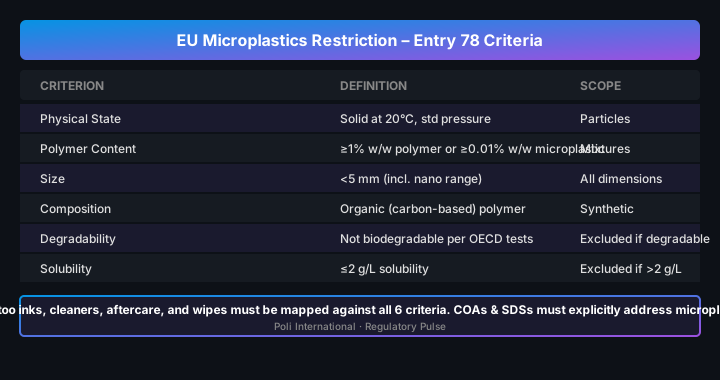
- Solid at 20 °C and standard pressure
- Contain ≥1% polymer by weight or present at ≥0.01% w/w in microplastic form
- Size <5 mm, including particles down into the nano range
- Organic (carbon‑based) polymers
- Not biodegradable according to specified OECD test methods
- Not sufficiently soluble (generally ≤2 g/L)
If your tattoo ink or studio product contains such particles intentionally added for a function—for example, to adjust texture, flow, opacity, or film formation—it can fall under Entry 78, even if it's not marketed as "microplastic."Regulatory technical explanations stress that many polymers used as functional additives in mixtures (not just cosmetic scrubs) are potentially in scope unless they meet the degradability or solubility exclusions, or are permanently bound in a solid matrix
The immediate implication: tattoo ink suppliers and studio owners can no longer assume that "we don't use microbeads" equals compliance. You must now understand the polymer chemistry and physical state of the particles in your inks and consumables as rigorously as you track nickel release in jewelry under REACH Annex XVII.The nickel release limits for body jewelry—0.2 μg/cm²/week for piercings and 0.5 μg/cm²/week for skin‑contact articles—illustrate how precisely REACH already regulates body‑contact materials
---
2. Thresholds, Derogations, and How Entry 78 Compares Across Markets
The restriction does not simply say "ban all microplastics tomorrow." It uses phase‑in bans plus derogations with heavy reporting and labelling obligations. For tattoo ink and studio products, three aspects matter:
- Are the polymer particles in scope of the Entry 78 definition?
- If in scope, is there a derogation (exemption) for this use?
- If derogated, what are the labelling and reporting duties and deadlines?
Recent ECHA‑linked guidance and webinars outline that for many industrial and professional uses, placing on the market bans are delayed, but reporting and "safe use" labelling obligations start much sooner, with the first wave already beginning in 2024–2025 and emissions reporting required from 31 May 2027 for many derogated uses.Technical presentations state that users benefiting from derogations will need to submit use and emission information as of 31 May 2027, and some labelling/safe‑use information obligations begin earlier for industrial uses
For studios operating internationally, the biggest trap is assuming the US or UK posture is similar. At the moment:
- EU (REACH, Entry 78): Broad, horizontal restriction on intentionally added microplastics, with detailed definitions, exclusions (e.g., certain natural or biodegradable polymers), and EU‑wide deadlines and reporting duties.
- UK: Post‑Brexit, the UK has not replicated Entry 78 in full; microbead bans exist in cosmetics, but not the EU‑style broad synthetic polymer restriction as a REACH Annex entry.
- US: The "Microbead‑Free Waters Act" bans plastic microbeads in rinse‑off cosmetics, but nothing comparable to the EU's polymer‑wide, cross‑sector restriction.
- ASEAN / Asia‑Pacific: Fragmented—various cosmetic microbead bans and environmental discussions, but no unified analogue to Entry 78 yet.
For a studio or supplier working cross‑border, the comparison looks like this:
| Feature | EU (REACH Annex XVII, Entry 78) | US / Typical non‑EU Markets |
|---|---|---|
| Scope of microplastics | Any intentionally added solid synthetic polymer <5 mm meeting non‑degradable and low‑solubility criteria, across many product categories | Mostly plastic microbeads in rinse‑off cosmetics; no broad, cross‑sector polymer restriction yet |
| Key metric | Polymer identity, particle size, solubility, degradability; not a simple ppm limit | Presence of defined "microbeads" in certain cosmetic categories |
| Implementation | In force; bans staggered plus mandatory labelling and reporting for derogated uses as early as 2024–2027 | Existing bans already in effect, but far narrower in scope and documentation burden |
| Impact on tattoo inks | Potentially high for polymer‑modified pigments/binders; requires formulation transparency and technical testing | Currently low, but future state laws or federal action could tighten scope unexpectedly |
The practical difference: an ink that is technically legal in the US could already be non‑compliant (or subject to reporting) in the EU purely due to its polymer particulate profile, even if all pigments and preservatives are SCCS‑clean and under REACH tattoo ink restrictions. If you're already tracking banned pigment lists and SCCS‑driven colorant restrictions under Cosmetics Regulation 1223/2009 and its Annex II/IV changes, you now need to add polymer particulate status to the same compliance spreadsheet.
---
3. Technical Deep Dive: Definitions, Numbers, and What Studios Need to Verify
Entry 78 is chemistry‑ and test‑method driven. To know if your product is impacted, you must interrogate what each polymer in your formulation physically looks like at room temperature.
Key elements:
- Size threshold: Particles <5 mm are in scope; this includes everything down to the nano range, not just "beads you can see."Technical explanations of Entry 78 repeatedly stress that the size range covers micro‑ and nanoplastics, with the 5 mm upper boundary applying to all particles
- Solubility threshold: If the polymer is soluble above 2 g/L, it can be outside scope; below that, it is treated as a solid particle. The Annex references specific test methods for verifying solubility.
- Degradability: Polymers that prove biodegradation to specified levels in OECD tests (often 60% degradation in 28 days in certain tests, or other defined criteria) may be excluded, but this requires actual, documented testing under the Annex methods.
- Permanently incorporated: Polymers permanently embedded in a solid matrix with no realistic release are treated differently; however, dispersed pigment and binder particles in a liquid tattoo ink are not "permanently incorporated"—they are precisely the kind of functional microparticles the restriction targets.
Tattoo inks are typically dispersions of pigments in water/glycol/glycerin with surfactants and binders. Many modern pigments themselves are inorganic, but organic pigments, polymer‑encapsulated pigments, and polymer dispersants are increasingly common. From a regulatory standpoint, you must ask suppliers:
- What polymers are present? (INCI or technical names, CAS numbers)
- Are they solid particles at 20 °C in the formulation?
- What is their average particle size distribution?
- What are the measured water solubility and OECD biodegradability results?
- Are they intentionally added to provide a function, or are they trace impurities?
The microplastics restriction also introduces reporting and "safe use" labelling requirements for derogated uses starting as early as this year for certain industrial applications, and 31 May 2027 for many others.Technical briefings highlight that, for many uses benefiting from derogations, reporting of microplastic emissions to ECHA begins on 31 May 2027, and safe‑use labelling obligations for mixtures used at industrial sites start earlier For ink manufacturers and large studios blending their own pigments, this means:
- If a polymer microparticle is derogated but in scope, the supplier may need to notify ECHA of volumes and emission controls.
- Mixtures placed on the market could require specific labelling to indicate the presence of microplastics and recommended disposal measures (e.g., do not rinse to drain, collect residues, etc.).
- Downstream professional users (tattoo studios) may be required to implement and document emission‑minimising practices, similar in spirit to how we manage airborne pigment dust and chemical vapours under OSHA‑style exposure control plans.Discussions on workplace chemical exposure and ventilation requirements for pigments and solvent vapours in tattoo studios often emphasise the need for written control plans and PPE, which will pair naturally with microplastics emission‑control obligations
For body jewelry, Entry 78 is less likely to bite directly, because the polymer is typically a bulk solid article rather than dispersed microparticles. Traditional REACH obligations still dominate there: nickel release, lead in accessible parts, and phthalate content for soft plastics remain the main jewelry constraints.REACH Annex XVII limits lead content in individual parts of jewelry to <0.05% by weight, with specific migration exemptions, and also restricts several phthalates in plasticised materials in consumer articles at a combined 0.1% limitThe same Annex XVII framework and later amending regulations cap four key phthalates (DEHP, DBP, BBP, DIBP) in plasticised materials in articles at 0.1% by weight, effective since 2020 But for studio consumables—wipes, cleaning pastes, exfoliating pre‑treatments, aftercare creams with polymer beads or film‑formers—the microplastics lens is now unavoidable.
Studios that previously focused only on heavy‑metal limits in pigments or on the relationship between needle geometry and tissue trauma for healing outcomes now need to add a third column: polymer particulate profile and microplastics status.
---
4. Patrick's Note: What the Data Doesn't Tell You
What the data doesn't tell you is how many suppliers still don't know what's actually in their own inks. I keep seeing SDSs that list "proprietary polymer dispersion" or "trade secret resin" with no particle size, no solubility data, and no indication of biodegradability. Under Entry 78, that is not a minor omission any more; it's a regulatory liability that lands directly on the studio if you import or rebottle in the EU.
Looking back at three decades of sourcing, this is exactly how we ended up with the "temporary use only" label mess for flexible jewelry—regulators built categories around the worst‑behaving polymers and then painted everyone with the same brush. The same pattern is emerging with microplastics: a broad definition aimed at glitter and scrub beads will sweep up high‑performance, low‑emission polymers unless the manufacturers have hard test data and are willing to share it. It's the same reason I keep telling people in our piece on the real regulatory status of body‑safe flexible polymers versus untested copies that chemistry and certification details are not optional trivia; they are the only thing keeping your materials out of the firing line when the next Annex entry lands.
---
5. FAQ: Technical Q&A
Q: Does Entry 78 automatically ban polymer‑based tattoo pigments in the EU?
No. Entry 78 does not mechanically ban "all polymer pigments." It restricts intentionally added synthetic polymer microparticles that meet specific criteria; if a pigment or binder is non‑solid at 20 °C, highly soluble (>2 g/L), demonstrably biodegradable under the Annex methods, or not used as dispersed particles, it may sit outside scope or fall under a derogation—but this must be proven with data, not guessed.
Q: I import US‑made inks into the EU. What documentation do I now need from my supplier?
You need written confirmation of microplastics status under REACH Annex XVII Entry 78 for each ink line, including a list of polymers, particle size data, solubility, and any available OECD biodegradability tests, plus a statement on whether any component is an "intentionally added synthetic polymer microparticle" as defined in Entry 78. If they claim a derogation, they must indicate what reporting and labelling obligations apply and who (they or you) will handle ECHA notifications.
Q: How does this interact with existing REACH and SCCS restrictions on pigments and amines in tattoo inks?
They stack. You still must comply with pigment bans, aromatic amine limits, and impurity thresholds under the EU's existing tattoo ink and cosmetic colourant framework, and Entry 78 adds a separate axis focused on polymer particles. An ink that is fully compliant on pigments and amines can still be non‑compliant on microplastics, and vice versa, so your compliance review now needs three pillars: chemical composition, impurity limits, and polymer particulate profile.
---
Conclusion: Turn Microplastics from an Ambush into a Checklist
Entry 78 is the kind of regulation that blindsides sectors that think "we're not cosmetics" or "we don't use glitter." For tattoo and piercing studios, the real risk is not immediate bans but silent non‑compliance: using inks and products whose polymer profile your supplier cannot document, in a region where enforcement bodies now have a clear Annex entry to point to. The studios that stay out of trouble will be the ones who treat microplastics status like nickel release and lead content—quantified, documented, and verified, not assumed.
If you are already auditing jewelry for nickel release and lead under REACH Annex XVII, and checking phthalate content in flexible components, you can integrate microplastics into the same system. The next phase of body art regulation will not be about "is your ink bright enough," but "can you prove what's in every particle." That's the same mindset we explored when breaking down how evolving EU chemical rules are reshaping tattoo ink supply chains and pigment selection; Entry 78 just extends that logic to the polymer side of your formulations.
Immediate Compliance Checklist for Studios and Suppliers (EU‑facing):
- Map products in scope
- List all tattoo inks, pre‑treatments, scrubs, wipes, aftercare products, cleaning pastes, and polymer‑modified liquids used in your studio.
- Flag anything containing "polymer," "resin," "acrylate," "styrene," "polyamide," "polyurethane," or similar terms in the SDS.
- Interrogate polymer status with suppliers
- Request a microplastics declaration for each product, explicitly referencing REACH Annex XVII Entry 78.
- Ask for: polymer identity (INCI/technical name and CAS), physical state at 20 °C, particle size distribution, water solubility, and any OECD biodegradability test reports.
- If they claim "not in scope," require written justification tied to specific criteria (e.g., "polymer is fully soluble >2 g/L" or "not a solid particle").
- Clarify derogations and responsibilities
- If a polymer microparticle is in scope but derogated, confirm who will submit ECHA notifications and emissions reports (manufacturer, importer, or you).
- Ensure labels and technical sheets include any required microplastics safe‑use and disposal statements once the relevant deadlines apply.
- Update internal procedures
- Incorporate microplastics considerations into your product approval SOP, alongside pigment and metal checks.
- Train staff to handle residues (ink cups, wipes, cleaning wastewater) in a way that minimises environmental release, aligning with forthcoming emission‑control expectations.
- Tighten supplier selection
- Prioritise suppliers who can provide complete, test‑backed documentation on polymer content, not just generic SDSs.
- For private‑label or in‑house mixed inks, engage a lab capable of particle size, solubility, and biodegradability testing to secure your own evidence base.
If your documentation file for an ink does not contain an explicit statement on REACH Annex XVII Entry 78, treat that as a gap. The labs and regulators have moved on from simply asking "what colour is this pigment" to "what is the polymer behind every particle"—and your compliance systems need to move with them.
---