North Dakota’s State Department of Health has filed a complete replacement of its body art regulations, marking one of the most significant state-level regulatory updates in the United States in 2026. Effective October 1, 2026, the existing Chapter 33-41-01 titled “Tattoo and Body Art” is repealed and replaced by a comprehensive new Body Art Code under Chapter 33-41-01.1. The overhaul introduces stringent hygiene standards, specific jewelry requirements, detailed informed consent procedures, and expanded prohibitions on unsafe practices—signaling a shift toward stricter, more enforceable oversight of the state’s tattoo and piercing industry.
Key Changes in the New Body Art Code
Definitions and Scope
The new code provides expanded definitions critical for compliance. “Aftercare” now explicitly requires both verbal and written instructions specific to each procedure, including guidance on when to seek medical treatment. “Antiseptic” is clearly defined as products labeled for preventing microbial disease on skin or mucosal surfaces. Most notably, “aseptic technique” is defined as "a set of specific practices and procedures performed under controlled conditions with the goal of minimizing" microbial contamination—a foundational concept now embedded in regulatory language.Health and Hygiene Standards
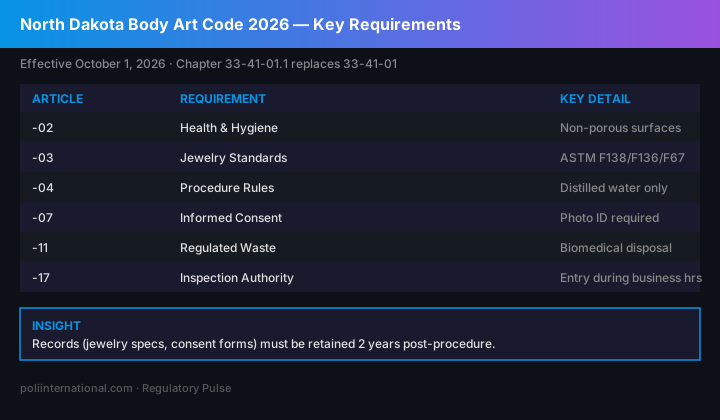
Article 33-41-01.1-02 establishes rigorous health and hygiene standards. Operators must maintain clean, sanitary premises with proper ventilation and lighting. All surfaces must be non-porous and easily cleanable. Handwashing stations with soap and disposable towels are required at every work station. The code mandates that artists perform hand hygiene before and after each procedure and after any potential contamination event (e.g., touching unsanitized surfaces, adjusting clothing, or handling waste).Jewelry Standards and Recordkeeping
A notable addition is Article 33-41-01.1-03, which sets specific standards for body jewelry. All jewelry used for initial piercing must be made of implant-grade materials: surgical stainless steel (ASTM F138 or F136), titanium (ASTM F67 or F136), niobium, or solid 14k or higher gold. Jewelry must be polished to a smooth finish, free of nicks, scratches, or irregularities. The code requires operators to maintain records of jewelry specifications, including material grade, manufacturer, and lot numbers, for at least two years post-procedure.Specific Regulations for Procedures
Article 33-41-01.1-04 introduces procedure-specific requirements. For tattooing and cosmetic tattooing: - All inks, dyes, and pigments must be specifically manufactured for body art procedures and used per manufacturer instructions. - Only distilled or sterile water may be used for dilution—potable water is expressly prohibited. - Diluted ink must be transferred to single-use plastic cups or caps immediately before procedure. - Upon completion, all single-use items and their contents must be discarded. For body piercing, ear-piercing stud-and-clasp systems and ear-piercing guns are restricted to use only on the outer non-cartilaginous perimeter and lobe of the ear—prohibited elsewhere on the body.Informed Consent and Release Form
Article 33-41-01.1-07 mandates a comprehensive informed consent process. Clients must receive and sign a release form detailing procedure-specific risks, aftercare requirements, and potential complications. The form must include space for clients to disclose medical conditions, medications, allergies, and pregnancy status. Operators must verify client identity via government-issued photo ID and retain signed forms for a minimum of two years.Waste, Inspection, and Enforcement
Regulated waste (Article 33-41-01.1-11) includes contaminated single-use items, swabs, and protective barriers, which must be disposed of per state biomedical waste rules. Inspection authority (Article 33-41-01.1-17) grants the State Department of Health right to enter premises during business hours to observe practices, review records, and collect samples. Violations can trigger denial, suspension, revocation, or civil penalties under Article 33-41-01.1-16 and 18.Why This Matters
North Dakota’s rewrite represents a significant modernization of its regulatory framework. By adopting detailed, science-based standards—particularly around aseptic technique, implant-grade jewelry, and sterile dilution practices—the state aligns with contemporary infection prevention principles advocated by organizations like the Association of Professional Piercers (APP) and the Alliance of Professional Tattooists (APT). The explicit ban on potable water for ink dilution addresses a known vector for microbial contamination, while detailed jewelry standards reduce risks of allergic reactions and tissue trauma.
The code also improves accountability. Mandatory recordkeeping of jewelry specs, client consent forms, and procedure logs creates a traceable safety net. Expanded inspection authority and clear enforcement pathways signal zero tolerance for non-compliance—a notable shift from the previous chapter’s more general language.
FAQ
When does the new Body Art Code take effect?
The North Dakota State Department of Health’s Body Art Code (Chapter 33-41-01.1) takes effect on October 1, 2026, replacing the previous Chapter 33-41-01 entirely.
What water can be used to dilute tattoo ink under the new rules?
Only distilled water or sterile water may be used for diluting tattoo ink, dyes, or pigments—potable water is expressly prohibited to reduce microbial contamination risk.
What materials are allowed for initial body piercing jewelry?
Initial piercing jewelry must be implant-grade: surgical stainless steel (ASTM F138/F136), titanium (ASTM F67/F136), niobium, or solid 14k or higher gold, all polished to a smooth finish free of defects.
How long must studios retain client consent forms and records?
Studios must retain signed informed consent forms, client records, and jewelry specification records for a minimum of two years after the procedure date.
Can North Dakota inspectors enter tattoo and piercing studios without notice?
Yes—Article 33-41-01.1-17 grants the State Department of Health authority to enter premises during business hours to observe practices, review records, and collect samples as part of routine inspections.
What happens if a studio uses ear-piercing guns on cartilage or other body parts?
Such use is explicitly prohibited under Article 33-41-01.1-04 for body piercing, which restricts stud-and-clasp systems and guns to the outer non-cartilaginous perimeter and lobe of the ear only—use elsewhere violates the code.
References
1. North Dakota State Department of Health. (2026). North Dakota Administrative Code, Title 33, Chapter 33-41-01.1 Body Art Code. Effective October 1, 2026. ndlegis.gov/admcode/arc202610401.pdf
2. Centers for Disease Control and Prevention. (2021). Guidelines for Environmental Infection Control in Health-Care Facilities: Tattooing and Body Art Considerations. MMWR Recomm Rep 2021;70(No. RR-3):1–45.
3. U.S. Food and Drug Administration. (2024). Guidance for Industry: Insanitary Conditions in the Preparation, Packing, and Holding of Tattoo Inks and the Risk of Microbial Contamination. fda.gov/regulatory-information/search-fda-guidanc...