Shop
Regulatory Pulse

Novel Inks Hit Human Skin Before Regulators Do: The July 2026 Evidence

PP

Chief Engineer

Patrick Poli

Journal Date

2026-08-01

Last Reviewed

2026-09-29

The clinical evidence base for novel tattoo ink chemistries crossed a threshold in July 2026. Three peer-reviewed publications now define the risk profile for photochromic nanoparticles, fluorescent markers, and iron oxide pigments. The first human trial of a rewritable photochromic ink shows no short-term safety signal, but it is industry-funded and tiny. The MRI literature on iron oxide pigments is unambiguous: they cause artifacts and migration. Regulators in the EU and US have no mechanism to evaluate these chemistries for intradermal use before they reach your studio. That gap is not an oversight. It is a structural feature of the current framework, and it shifts the burden of due diligence directly onto studios and suppliers.

1. The July 2026 Evidence Is Not What It Looks Like

Three papers published between June and August 2026 demand your attention. The first is the HYPRSKN "Magic Ink" trial (PMID 42393691). Eleven participants received photochromic nanoparticle ink that switches between colorless and magenta under UV light. Paired within-subject controls with standard ink showed no statistically significant differences in healing, pain, redness, or itch. Zero adverse events in either group. The photoswitchable function remained durable at one year.

That sounds like a green light. It is not. All co-authors hold financial interest in HYPRSKN Inc. The sample size is eleven. There is no independent replication. The absence of an adverse event signal in eleven people tells you nothing about long-term particle migration, UV-induced degradation products, or immunogenicity at scale.

The second paper, from Rouen (PMID 41649848), is the one that should change your practice. A systematic review of keratopigmentation with ex vivo MRI testing found that iron oxide-containing inks produce clinically significant MRI artifacts, pigment migration under magnetic fields, and potential ocular pain. Carbon-based inks produced no artifacts. This is corneal tissue, but the physics of iron oxide in a magnetic field does not care about anatomy. Any ink containing iron oxide pigments carries this risk in dermal tissue.

The third paper, from Seoul (PMID 42477411), evaluated fluorescent tattoo systems for radiation therapy localization in 48 patients. Fluorescent ink reduced tattooing and setup time with no safety signal. Medical demand for novel inks is real, growing, and will push these products into commercial channels faster than regulators can respond.
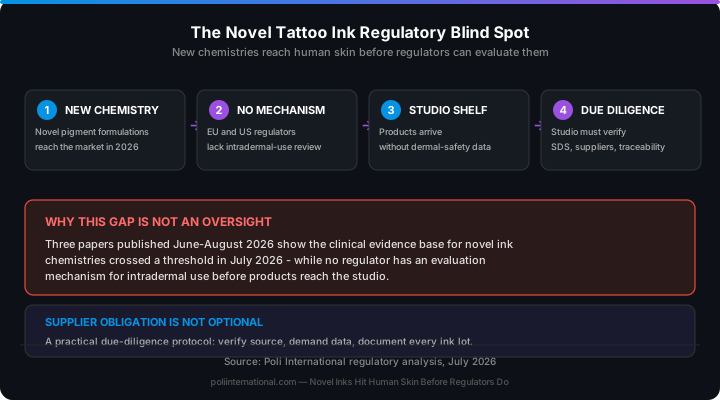
Novel tattoo ink regulatory blind spot: new chemistries reach skin before evaluation
Infographic: Novel tattoo ink regulatory blind spot: new chemistries reach skin before evaluation

2. The Regulatory Architecture Has a Blind Spot

The EU REACH Annex XVII Entry 75, implemented via Regulation (EU) 2020/2081, restricts more than 4,000 hazardous substances in tattoo inks. That is a list of known hazards. It is not a safety evaluation framework for novel chemistries. A photochromic nanoparticle or a new fluorescent compound that is not on the restricted list has no per-substance EU safety assessment for intradermal use. Absence of restriction is not approval. It is absence of data.

The US situation is worse. MoCRA gave FDA cosmetics authority in 2022, but it did not create a pre-market approval pathway for tattoo inks. FDA explicitly states it does not approve pigments for intradermal injection. The agency can act on contamination or undisclosed ingredients after the fact. It cannot evaluate a new pigment before it enters your client's skin.

Enforcement is geographically uneven. The Irish paper (PMID 41342338) makes this point directly: the same ink can be legal in one country and restricted in another. That divergence creates clinical blind spots. A studio in Dublin and a studio in Lisbon can use the same bottle with completely different legal exposure.

3. What This Means for Studio Owners

You are the final checkpoint. No regulator will tell you whether a novel ink is safe to inject. You need to act accordingly.

First, verify pigment chemistry, not brand claims. If an ink contains iron oxide pigments, you must document an MRI-safety discussion with every client. The keratopigmentation data shows artifacts and migration at normal field strengths. Your clients will eventually need an MRI. You need to know what is in the ink and whether it will hurt them.

Second, treat manufacturer-funded safety data as marketing. The Magic Ink trial is a proof of concept, not a safety certificate. If a supplier presents you with a pilot study, ask who funded it, how many subjects were enrolled, and whether any independent group has replicated the findings.

Third, maintain Annex XVII compliance documentation for every ink lot you purchase. For EU studios, that means confirming restricted substances are below the legal limits. For novel inks not on the restricted list, document that you have requested the supplier's classification and safety data under CLP and REACH obligations. Importing novel chemistry without classification paperwork is a compliance risk, regardless of whether the substance is restricted.

4. The Supplier Obligation Is Not Optional

Suppliers have a legal obligation that extends beyond the Annex XVII restricted list. Under REACH, any substance imported or manufactured above one tonne per year requires registration. Novel pigment chemistries are not exempt because they are intended for skin. Classification, labeling, and packaging obligations under CLP apply regardless of Annex XVII status.

Most novel ink suppliers are small companies that may not hold the toxicology dossiers REACH registration requires. If a supplier cannot provide a full ingredient declaration, a CLP classification, and a REACH registration number, do not buy the ink. The absence of that paperwork is a red flag, not a technicality.

For EU studios specifically, the uneven enforcement documented in previous Regulatory Pulse coverage means you cannot rely on your member state's market surveillance to catch a non-compliant product. You must verify the paperwork yourself.

5. A Practical Due Diligence Protocol

Implement this protocol before you accept any novel ink into your studio.

Check the ingredient declaration against the EU restricted list using the REACH compliance monitoring tool. Run every pigment through the SVHC substance checker. Confirm the supplier has a valid REACH registration and CLP classification for each substance. Use the material certification checker for any jewelry or equipment that contacts the ink. Cross-reference the pigment chemistry against the pigment science wiki to understand degradation and migration profiles.

Document everything. Record ink lot numbers, pigment compositions, and supplier certifications in every client file. The regulatory geography can change after purchase. A member state can restrict a substance after you have bought the bottle. Your client records are your defense.

For clients receiving iron oxide-containing inks, add an MRI-safety note to their file and discuss it verbally. For clients requesting photochromic or fluorescent inks, provide the published safety data and note the absence of independent long-term studies. You are not a regulator, but you are the last person who can prevent harm.

FAQ

Do I need to stop using iron oxide inks immediately?
No immediate ban exists, but you must document the MRI-safety risk for every client. The keratopigmentation evidence shows artifacts and migration. Offer carbon-based alternatives for black pigments and disclose the risk in writing.

Can I use the Magic Ink photochromic product in my studio?
Not yet. The only published human data is a manufacturer-funded pilot with eleven subjects. There is no market authorization for this product. If a supplier offers it, demand independent replication and full regulatory documentation before purchase.

Does REACH registration guarantee a novel ink is safe?
No. REACH registration is a hazard communication and risk management framework, not a safety approval for intradermal injection. It tells you what the substance is and how to handle it. It does not tell you what happens when it is injected into human skin and exposed to UV light for a decade.

References

1. Nolan B, Quigley C, Roche D. Time to think about the ink: why tattoo geography and regulation matter in clinical dermatology. Clin Exp Dermatol. 2026;51(7):1284-1285. PMID 41342338 2. McCurdy K, Butterfield JL, Kwon H, et al. Clinical evaluation of photochromic nanoparticle tattoo ink: safety, tolerability, and performance of rewritable intradermal implants. J Nanobiotechnology. 2026. PMID 42393691 3. Gaulier A, Nicol L, Lefevre S, et al. Magnetic Resonance Imaging and Keratopigmentation: A Systematic Review and Ex Vivo Study of Complications and Adverse Events. Cornea. 2026;45(8):1041-1050. PMID 41649848 4. Choi CH, Wu HG, Kim HJ, et al. Development and clinical evaluation of fluorescent tattoo system for radiation therapy. Sci Rep. 2026. PMID 42477411 5. European Commission. Commission Regulation (EU) 2020/2081 restricting hazardous substances in tattoo inks and permanent make-up. EUR-Lex. link 6. ECHA. Substances restricted under REACH - Annex XVII. link 7. US FDA. Tattoos and cosmetics information. link

Mind map · Novel Inks Hit Human Skin Before Regulators Do: The July 2026 Evidence

  • Tattoo Ink Regulatory Divergence
    • US Postmarket Cosmetic Framework

      The United States Food and Drug Administration regulates tattoo inks under a postmarket cosmetics framework that lacks proactive pre-market ingredient approvals.

      • FDA Postmarket Authority
      • No Pre-Market Approvals
    • EU Chemical Restriction Standards

      European Union REACH regulations restrict more than four thousand hazardous substances in tattoo inks but lack a proactive safety evaluation framework for novel chemistries.

      • REACH Annex XVII
      • PFAS Phase-Out Mandate
    • Nanoparticle Ink Clinical Performance

      A clinical trial of eleven human participants receiving photochromic nanoparticle tattoo ink demonstrated durable photoswitchable function and no adverse events over five months.

      • Magic Ink Nanoparticles
      • Bistable Photochromic Dyes
    • Traceability and Documentation Systems

      Professional tattoo studios must maintain client logs of ink batch codes and safety data sheets to ensure compliance with modern regulatory standards.

      • Client Lot Code Logs
      • Safety Data Sheets
    • Mandatory Adverse Event Reporting

      The Modernization of Cosmetics Regulation Act requires tattoo ink brand owners to report serious adverse events to the federal government within fifteen business days.

      • Fifteen Business Day Deadline
      • Serious Adverse Event Tracking
StructureProcessMaterialHazard

5 branches, 0 sources. Each branch cites the article it came from; the labels beneath it are names, not claims.

Body Art Quiz

  1. 1. Under the Modernization of Cosmetics Regulation Act (MoCRA) enforcement of 2026, what is the mandatory timeframe for a 'Responsible Person' to report a serious adverse event to the FDA?

    • ✓ 15 business days — MoCRA establishes a strict 15-business-day window for the submission of serious adverse event reports to ensure federal oversight of product safety.
    • • 30 calendar days — While a month is a common administrative deadline, it exceeds the specific two-week reporting window mandated by MoCRA for serious health issues.
    • • 72 hours — This timeframe is typically reserved for immediate infectious disease outbreaks in clinical settings rather than the federal cosmetic adverse event reporting standard.
    • • 60 business days — This longer period would fail to meet the rapid-response requirements intended to protect the public from potentially contaminated or hazardous products.
  2. 2. According to the 2026 revision of ASTM F136, what is the primary metallurgical difference between Grade 23 Titanium (Ti-6Al-4V ELI) and standard Grade 5 Titanium?

    • ✓ Reduction of interstitial elements like oxygen and iron — The 'Extra Low Interstitial' (ELI) designation signifies a higher purity level with reduced oxygen, nitrogen, and iron, improving ductility and biocompatibility.
    • • The addition of a nickel-based stabilizing layer — Implant-grade titanium is valued specifically for being nickel-free; adding nickel would increase the risk of sensitization and allergic reactions.
    • • The inclusion of 12-14% chromium for corrosion resistance — Chromium is a primary alloying element in stainless steels, whereas titanium relies on a self-healing titanium dioxide layer for its corrosion resistance.
    • • A specialized ceramic coating applied during the melting process — The ASTM F136 standard defines the internal chemistry and mechanical properties of the alloy itself, not an external surface treatment or coating.
  3. 3. The clinical evaluation of 'Magic Ink' photochromic nanoparticles identified which property as the reason for designing particles to be larger than 200 nanometers in diameter?

    • • To increase the brightness of the activated magenta state — Color intensity is primarily a function of pigment concentration and dye chemistry rather than a specific size threshold intended for biological localization.
    • • To ensure the ink can be easily removed by standard laser therapy — The ink is designed to be permanent and 'invisible' when deactivated; larger particle size generally makes standard laser removal more difficult.
    • ✓ To prevent the immune system from migrating the pigment to the lymph nodes — Particles exceeding 200 nanometers are typically too large for macrophages to easily transport, ensuring the pigment remains localized in the dermis.
    • • To allow the particles to pass through standard tattoo needle groupings — Standard needles can handle much larger particles; the 200-nanometer threshold is a biological requirement for tissue retention, not a mechanical one for delivery.
  4. 4. In the context of the 2026 EU REACH update, which substance was added to the SVHC Candidate List specifically because it is a fluorinated bisphenol used in some epoxy packaging components?

    • • n-Hexane — While added to the SVHC list in February 2026, n-Hexane is a solvent used in pigment extraction, not a fluorinated bisphenol.
    • ✓ BPAF — Bisphenol AF (BPAF) is a fluorinated bisphenol added to the Candidate List due to its hazardous properties, potentially found in packaging or specialized resins.
    • • Pigment Blue 15:3 — This pigment is restricted under REACH Annex XVII for different toxicological reasons and is not part of the SVHC epoxy-related updates of 2026.
    • • Cobalt — Cobalt is a metal element regulated for its sensitization risk, but it is not a bisphenol or a fluorinated organic compound.
  5. 5. The polymer BioFlex is frequently misidentified as TPU in online sources. What is the actual chemical composition of BioFlex that allows it to withstand steam autoclaving without degradation?

    • • Medical-grade polytetrafluoroethylene (PTFE) — PTFE is a different polymer that cannot be injection-molded as a single piece and behaves differently under mechanical stress.
    • ✓ Polypropylene random copolymer (PP-R) — BioFlex is made of PP-R, which provides the necessary heat resistance for sterilization and a low Young's modulus for tissue compatibility.
    • • Platinum-cured polydimethylsiloxane (PDMS) — PDMS is the chemical name for medical-grade silicone, which is an elastomer rather than the specific random copolymer used in BioFlex.
    • • Cross-linked polyethylene (PEX) — While used in medical applications, PEX does not offer the same injection-molding precision required for the threaded and push-fit systems used in body jewelry.
  6. 6. A 2026 systematic review of keratopigmentation (corneal tattooing) highlighted a significant risk associated with iron oxide pigments during medical procedures. What was the observed effect?

    • • Rapid fading of the pigment due to UV exposure — UV fading is a concern for organic pigments, but iron oxides are inorganic and generally more light-stable; the study focused on magnetic interactions.
    • ✓ Pigment migration and clinical artifacts during MRI scans — The magnetic field in an MRI can cause ferromagnetic particles like iron oxide to move within the tissue or distort the resulting images.
    • • Complete absorption of the pigment by the immune system within 30 days — Iron oxide pigments are permanent and do not resorb; the clinical concern is their stability under magnetic stress, not their clearance.
    • • Spontaneous color shifts from black to vibrant magenta — Color shifts in iron oxides are usually gradual and result from chemical oxidation states, not the sudden shifts associated with photochromic technology.
  7. 7. Which specific technical variable determines whether a material like titanium or BioFlex will cause 'irritation bumps' in high-movement piercings like the navel or nipple?

    • • The thickness of the protective oxide layer — Oxide layers protect against corrosion but do not address the mechanical friction caused by material stiffness during movement.
    • ✓ The stiffness gap (Young's modulus) between the jewelry and tissue — A larger gap in stiffness between rigid metal and soft tissue creates mechanical leverage (a rigid lever), leading to cyclic loading and tissue irritation.
    • • The presence of trace amounts of aluminum in the alloy — Aluminum sensitization is a chemical risk, whereas the formation of irritation bumps is primarily a biomechanical issue related to movement.
    • • The electrical conductivity of the material in a magnetic field — Conductivity relates to heating risks during an MRI scan, not the routine formation of hypertrophic scarring or irritation bumps.
  8. 8. The 2024 NEHA Body Art Model Code, which serves as a template for many state regulations in 2025, introduced updated standards for which emerging practice?

    • • The use of robotic tattoo systems with real-time depth feedback — While mentioned as a trend in news articles, robotic systems are not yet integrated into the standardized regulatory model codes used by states.
    • ✓ Permanent makeup, single-use equipment, and temporary events — The NEHA code modernization specifically targeted the rise of PMU, the shift toward disposable workflows, and the regulation of tattoo conventions.
    • • The mandatory licensing of all tattoo apprentices by federal authorities — Licensing remains a state or local jurisdiction matter; federal oversight through MoCRA focuses on product safety, not individual practitioner licensing.
    • • The prohibition of all red pigments containing aromatic amines — Prohibitions of specific chemicals are handled by chemical regulations like REACH; model codes focus on facility sanitation and procedural safety protocols.
  9. 9. In the physics of ear stretching, what is the difference between 'elastic' and 'viscoelastic' tissue response?

    • ✓ Elastic tissue recovers its shape immediately, while viscoelastic tissue creeps over time — Viscoelastic materials like skin exhibit time-dependent deformation (creep) and stress relaxation, which is why slow, incremental stretching is safer.
    • • Elastic tissue is found in the earlobe, while viscoelastic tissue is found only in cartilage — Both types of tissue exhibit viscoelastic properties; the distinction is in the mechanical behavior during loading, not the location in the ear.
    • • Viscoelastic response refers only to the permanent tearing of the skin (blowout) — A blowout is a mechanical failure beyond the yield point, whereas viscoelasticity is the normal physical behavior of skin under sustained load.
    • • Elastic tissue requires heat to deform, while viscoelastic tissue deforms at room temperature — Both types of response can happen at body temperature; the difference lies in the rate of deformation and the duration of the applied force.
  10. 10. According to the analysis of the 'Magic Ink' trial, what does 'fatigue resistance' mean for a rewritable tattoo?

    • • The ability of the client's skin to heal from repeated tattoo sessions — Healing is a biological process; fatigue resistance refers specifically to the chemical stability of the ink particles under repeated use.
    • ✓ The number of times the ink can switch colors before the chromophores break down — High fatigue resistance means the pigments can be activated and deactivated thousands of times (e.g., 10,000 cycles) without losing their function.
    • • The resistance of the pigment to being hauled away by the lymphatic system — This is defined by particle size and biostability, not by the fatigue caused by photochemical switching.
    • • The strength of the PMMA shell against accidental physical impact — PMMA is a durable polymer, but fatigue resistance in photochromic systems specifically refers to the longevity of the light-responsive chemical reaction.

Extended Reference Table

8 of 8 rows

Extended reference table generated from the article and its verified research sources. Bracketed numbers jump to the matching entry in the Technical References below.

SafetyItem Material or Composition Function or Practice Clinical or Operational Status Standards, Compliance, or Specification Source
✅ASTM F136 Titanium ELI (Grade 23)Ti-6Al-4V ELI (Extra Low Interstitial) alloyStandard baseline for implant-grade body jewelry for fresh and healed piercingsPreferred material to minimize nickel sensitization and maximize passive oxide stabilityASTM F136; ISO 10993-6 compliant[8]
✅REACH Annex XVII Entry 75Aromatic amines, Polycyclic Aromatic Hydrocarbons (PAHs), heavy metals, and over 4,000 substancesEU-wide regulatory framework for tattoo ink and permanent makeup compositionLegally binding in the EU; requires batch-level traceability and documented pigment safetyEU Regulation 2020/2081; REACH Annex XVII[8]
✅MoCRA (Modernization of Cosmetics Regulation Act)Cosmetic framework (not drug or device)US Federal legislative framework providing FDA oversight of tattoo ink safety, facility registration, and product listingFully operational in 2026; mandates adverse event reporting within 15 business days and contamination controlMoCRA 2022; FDA facility registration requirements; Section 605, 607, and 609[8], [9]
✅BioFlexPolypropylene random copolymer (PP-R)Flexible piercing jewelry and retainers used to reduce mechanical stress and improve MRI safetyNon-ferromagnetic, non-conductive, and fully radiolucent; marketed as a safer alternative to mystery plasticsISO 10993; REACH Annex XVII (n-hexane and BPAF free)[8], [9]
✅Nickel Directive (EU)Nickel-containing alloysLimiting nickel migration in piercing jewelry to reduce population-wide sensitizationRestricts nickel migration to 0.2 µg/cm ² /week for post assemblies in healing piercingsREACH Annex XVII Entry 27; EN 1811:2023[8]
⚠️Magic InkPhotochromic pigments (DAE-0001 diarylethene) encapsulated in PMMA polymer shellsRewritable tattoo ink that activates (magenta/red) with UV light and deactivates with white lightTested in "Ten of Hearts" pilot study (n=11); durable function for 1+ years; third-party-verified non-cytotoxicityMoCRA compliant; sterilized with gamma radiation; TIER IRB00012821 approved[9], [10]
✅ISO 13485-Quality management system for medical devices and pharmaceutical-grade precision manufacturingCurrent hallmark for elite laboratory production of sterile ink and medical device environmentsISO 13485
✅Titanium-Tantalum (Ti-Ta) Binary AlloysTitanium alloyed with Tantalum (Al and V free)Next-generation implant-grade metallurgy for clinical piercing settingsDemonstrates 50–67% lower metal ion elution compared to ASTM F136FDA 510(k) equivalence designations; EU MDR updates (2026)[8]

Free Body Art Wall Posters

Print-ready reference posters for your studio or your own wall. Free to download and display, embed on your own site with attribution. Click any poster to preview it full size before downloading.

Choose and download all 40 posters

Technical_References_Archive

About the Author

PP

Patrick Poli

Chief Engineer, Poli International · Creator of BioFlex® body jewelry

Patrick has spent 25+ years manufacturing body jewellery and studio equipment, and is the creator of BioFlex® body jewelry. He developed a thermal process to set stones into polymer without adhesive, because the glues available for the job contain cyanoacrylates. He also registered his own maker’s mark with the Sheffield Assay Office and produced a line in 18-karat gold, platinum, titanium and surgical steel.

More about Patrick →

Last reviewed: 2026-09-29 · Published: 2026-08-01

Related Tools & Reading

Continue Reading