

Why “activating” tattoos are blowing up your feed, and what the chemistry really says
Key Takeaways:
» “Magic ink” tattoos are just UV-reactive plus photo-bleaching chemistry, not sci-fi on/off body art.
» Current products are red-only, expensive, and clinically under-documented, you are the beta test.
» Repeated activation/deactivation cycles mean cumulative UV exposure directly to ink and skin.
» Claims of “thousands of cycles” ignore pigment laser interaction physics fatigue, molecular breakdown, and immune clearance.
» Artists should treat this like experimental tattoo pigment, with written consent, patch tests, and strict aftercare.
1. The “Magic Ink” Hype: What These Tattoos Actually Are
The biggest freak-out in the last couple of weeks has been “Magic Ink”, the viral claim that you can get a tattoo that literally appears and disappears on command with different UV wands. TikTok is full of clips: clean skin, wave a light, design appears; switch the light, it’s gone. It’s being pitched as “activating and deactivating ink,” like you’ve installed a mute button under the dermis. In reality, you’re looking at a clever combo of UV-reactive pigment and selective photo-bleaching behavior, not Star Trek biophotonics. A recent studio recap of 2024 “crazy tattoo trends” spells it out bluntly: this “Magic Ink” is essentially UV-reactive red ink with marketing on top, currently only available in red, expensive, and offered by a tiny group of artists who’ve decided to roll the dice on early adoption. That same piece also notes the manufacturer claims you can “activate and deactivate it 1000s of times,” while openly admitting nobody knows how long it really lasts or how the fade looks in the wild yet, because the tech is brand-new and largely unproven in real-world skin.
For context, we’ve already seen what happens when hype outruns biology with “semi-permanent” tattoo inks like Ephemeral. Those were sold as 9–15 month designs using bio-absorbable particles that shrink over time, theoretically becoming small enough for macrophages to clear completely. Three years later, there are still plenty of people online with half-faded ghosts and unplanned long-term ink, because dermal clearance is not a uniform process and the fade is anything but cosmetically clean. The same article calling out Magic Ink also notes that Ephemeral’s real-world lifespan is more like 1–3 years and that the fade pattern is patchy, not the smooth digital mockups that sold the dream. That’s exactly the risk zone “Magic Ink” is now walking into: complex chemistry meeting uncontrolled human variables.
Technically, “activating” a tattoo is easy: fluorescent or phosphorescent pigments absorb one wavelength and re-emit another, so under the right UV lamp, the design glows. The harder, unsolved piece is true reversible invisibility in ambient light without wrecking the pigment or the surrounding tissue. The fact that this product is red-only is telling: red organic pigments have a long and ugly history of allergic and granulomatous reactions, and dermatology literature repeatedly notes that red is the most common problem color for delayed tattoo reactions, followed by some blacks and greens. That’s not a deal-breaker by itself, but if you’re going to pick a color to build a high-cycle activation system on, choosing the one with the worst reaction statistics is… bold.
If you’re working with fine-line, low-trauma applications, you can at least reduce one variable. The same way the relationship between needle taper angle and dermal cellular regeneration speed affects how quickly skin recovers from traditional pigment, it will also influence how gracefully these experimental inks age under repeated UV stress. Hype doesn’t change histology.
2. How “Magic Ink” Compares: Gimmick, Innovation, or Just Another Red Risk?
Let’s put Magic Ink against two things people already understand: classic UV ink and Ephemeral-type semi-permanent ink.
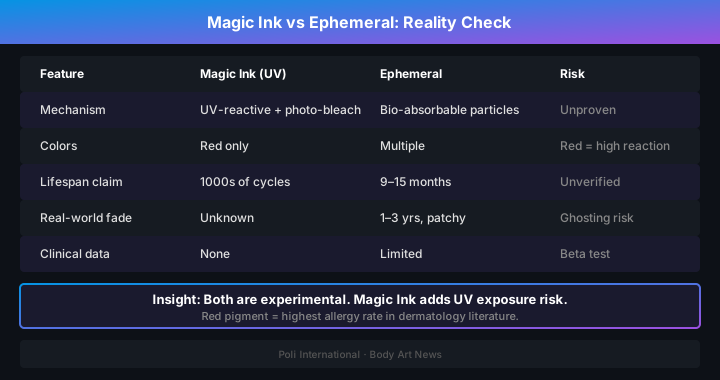
| Feature | “Magic Ink” UV-toggle tattoos | Traditional UV-reactive tattoos |
|---|---|---|
| Core mechanism | UV-reactive red pigment + selective activation/deactivation behavior marketed as “on/off” | UV-reactive pigment that glows under UV, faint/visible in normal light |
| Promised effect | Tattoo appears under one UV wavelength, disappears (or becomes “invisible”) under another | Tattoo glows under UV, may be subtle but not truly invisible in daylight |
| Color range | Currently red-only according to recent studio reports | Multiple colors available from various manufacturers |
| Cycle claims | Marketing claims “1000s of activation/deactivation cycles,” long-term data missing | No formal “cycle” claim; treated like normal pigment with added fluorescence |
| Regulatory/clinical backing | Limited, product-specific, not widely published in dermatology literature | General tattoo ink safety concerns documented, UV pigment behavior not deeply regulated |
| Main risk vectors | Red pigment hypersensitivity, cumulative UV exposure, unknown long-term molecular breakdown pathways | Standard tattoo risks plus added concern for photodegradation products under UV |
| Real-world track record | Basically still in beta, seen in viral clips and early adopter studios | 15+ years in niche use, with known issues around fading and visibility under normal light |
The other obvious comparison is to Ephemeral’s semi-permanent ink, which used bio-absorbable polymers designed to fragment over time. Those ingredients are conceptually similar to resorbable suture materials and some drug-delivery systems: polymer chains that hydrolyze or break down into smaller, more excretable components. On paper, you pick a molecular weight and structure that should give you a predictable decay curve. On skin, that curve met the immune system, local vascularization, and individual healing differences, and the clean 9–15 month promise turned into a 1–3 year range with uneven patchy fade.
The important lesson for Magic Ink: any system that promises complex behavior after implantation (shrink, disappear, react under specific light, deactivate) is stepping straight into that same minefield. Once pigment particles are lodged in the dermis and lymph nodes, the environment is not controlled. You’ve got water, enzymes, reactive oxygen species, UV exposure, and immune surveillance taking their time with the molecules. The impressive product animation showing “thousands of cycles” is almost certainly based on in-vitro testing, clean substrate, controlled UV source, no macrophages, no sweat, no fibroblasts.
If you’ve read about robotic or “automatic tattooing” systems that promise perfectly controlled depth and spacing based on skin mapping, you know I like precision when it’s honest about its limits. A robot that measures skin stiffness and compensates needle depth is working against mostly mechanical variables. A pigment that claims to survive thousands of UV cycling events inside a living immune-reactive organ (the skin) is playing chemical Jenga.
Studios drooling over “innovation” should remember what we’ve already learned from ink composition itself. Comprehensive reviews of tattoo complications show that pigment chemistry matters more than any marketing label: heavy metals, polycyclic aromatic hydrocarbons, and primary aromatic amines in ink have all been associated with inflammatory reactions, systemic issues, and potentially carcinogenic risk when present above thresholds. UV-tuned pigments and smart-ink systems do not get a magical exemption from those constraints.
3. The Technical Reality: UV, Pigment Fatigue, and Long-Term Risk
Let’s tear down the engineering behind “activating” and “deactivating” tattoos so you can see where the real risks sit.
1. UV-reactive pigments and fatigue
Fluorescent pigments work by absorbing photons at one wavelength and emitting at another. Over time, especially under repeated UV exposure, the chromophores (the light-absorbing parts of the molecule) can break down, a process we casually call pigment fatigue. That’s why high-chroma paints and plastics fade in sunlight. When a brand claims “thousands of activation cycles,” the obvious questions are:
- What UV intensity and duration were used per “cycle”?
- Was the test in solution, on a surface, or in any dermal model?
- What percentage of fluorescence loss was allowed before they called it “failed”?
None of those numbers are showing up in the viral posts. If you’re going to put this into a client’s skin, you should demand at least basic photostability data specific to the pigment lot, ideally in a medium that approximates tissue, not just in a cuvette.
2. Cumulative UV dose to skin
To “activate” and “deactivate” these tattoos, clients are being told to use UV wands at home. That means repeated local UV doses to the same patch of skin, on purpose, indefinitely. The same FDA guidance that warns about contaminated inks and unknown long-term pigment effects also stresses the basic infection and safety risks around DIY consumer tattoo products and at-home experiments. Now we’re stacking on routine UV dosing, at close range, with unclear spectrum and power.
From a clinical risk perspective, the big red flags are:
- Local photoaging: Collagen damage and textural change over time.
- DNA damage: Increased risk of actinic changes, especially on already tattoo-traumatized skin.
- Inflammatory interaction: UV exposure can alter local immune activity, potentially unmasking or exacerbating hypersensitivity to the pigment itself, which is a known issue with red inks generally.
You don’t need to be an oncologist to see why “daily UV wand for fun” is a bad long-term idea.
3. Red pigment history and allergy
Dermatology literature is brutally consistent: red pigments are over-represented in allergic and granulomatous tattoo reactions. Historically, mercury sulfide (cinnabar) was a big culprit; many modern reds are based on various azo or quinacridone pigments, which can form allergenic breakdown products under UV or metabolic stress. When you deliberately design a red ink to be light-responsive, you are by definition increasing the amount of photochemical action happening inside the dermis.
That doesn’t mean every Magic Ink client will end up with a full-blown granuloma or systemic reaction. It does mean that any claim of safety equivalence with standard inks without long-term data is not evidence-based. If you’ve ever handled a case of chronic red-ink hypersensitivity, with papulo-nodular lesions, itch, and non-resolving inflammation, you know you do not want to scale that up on a trending product.
4. Unknown breakdown products
Whenever a pigment is designed to change state, whether that’s shrinking like Ephemeral, or switching emissive properties like Magic Ink, you have to think about what the molecule turns into after enough cycles. Are we talking about:
- Smaller, inert fragments easily cleared by the lymphatic system?
- Reactive aromatic amines, known to be problematic at high enough dose?
- Photochemical crosslinks that make the residue more persistent and less visible, but still immunologically active?
These breakdown products are often not included in the marketing, and rarely in early SDS sheets in enough detail to be useful. Yet some of the same adverse reaction patterns we see with conventional inks, fibrosis, granulomatous changes, systemic inflammatory responses, are driven not by the starting pigment but by what it becomes over years.
If you’re the kind of practitioner who already pays attention to needle geometry, insertion angle, and tissue response to manage trauma, you should be equally aggressive about interrogating what’s in the bottle. It’s the same logic that underpins why we obsess over surface finish and alloy microstructure in piercing jewelry: small chemical details create big clinical consequences, as I’ve written before when breaking down why certain “implant-grade” alloys still trigger inflammatory responses.
4. Patrick’s Note: Why I Treat Magic Ink Like a Live Experiment
What I’ve seen in studios that jump early on new ink tech is a predictable pattern: the first dozen pieces look amazing, the clients are hyped, and then about 18–36 months later the real data starts walking back in through the door. That’s exactly what happened with semi-permanent ink marketing: the fade curves looked great in the pitch deck; in reality, the body did what it always does, respond on its own timeline, not the brochure’s. This Magic Ink cycle looks identical so far, just with a different gimmick.
The thing practitioners miss here is that novel pigment systems turn your client base into a long-term clinical trial whether you admit it or not. If you’re going to participate in that, at least do it consciously. That means explicit written consent, realistic language about unknowns, and a tracking system for follow-up, not a throwaway “this is the latest tech” line. You already do this mentally when you weigh up trauma patterns from different needle groupings and tapers across skin types, the same way we talk about how needle geometry impacts dermal recovery speed and pigment retention. Apply that same discipline to the bottle of “magic” on your shelf.
If you’re a piercer watching this from the sidelines, this is the tattoo world’s version of the cheap “bioflex-type” jewelry flood: tons of low-data product, massive variation in chemistry, and a community that tends to lump all flexible polymers together despite huge differences between certified medical-grade PP-R and mystery plastics. I’ve spent decades correcting that mess from the materials side; you don’t want to be doing the same thing for experimental tattoo pigments five years from now. When in doubt, favor known chemistries with documented performance over toys built for virality.
5. FAQ: Technical Q&A
Q: Would you allow Magic Ink in a professional studio today?
If I were setting policy, I’d only allow it under explicit “experimental pigment” protocols: detailed consent, patch testing, and mandatory follow-up at 6, 12, and 24 months. No walk-ins, no minors, no high-UV body sites. If the manufacturer can’t provide hard photostability data and a toxicology breakdown of degradation products, it doesn’t belong in mainstream service.
Q: Is the UV exposure from activation wands really that big a deal?
Yes, because it’s repeated, localized, and user-controlled, not a one-off incidental hit. A client who loves the effect will overuse the wand, stacking UV dose onto tissue that’s already been mechanically injured and loaded with reactive pigment. That combination is exactly how you accelerate local photoaging and potentially drive inflammatory or dysplastic changes over time.
Q: How should artists talk about this with clients who come in demanding “disappearing tattoos”?
Be direct: explain that the effect relies on specialized red pigment and UV light, that long-term safety and aging behavior are not well established, and that “thousands of cycles” is a marketing line, not a peer-reviewed guarantee. Offer safer alternatives like subtle placement, low-contrast designs, or conventional UV ink with honest expectations, and document the conversation in your consent process.
Conclusion: Treat “Magic Ink” as Experimental, Not Mainstream
If you boil all the hype down, Magic Ink is a novel red UV-reactive pigment with ambitious marketing claims and minimal long-term clinical data. The on/off trick is cool, no question, but the price of that aesthetic is a complex stack of UV exposure, red-ink allergy risk, and unknown breakdown pathways inside living tissue. That’s not where you want to be casual, especially if you’re the one running the machine and signing the consent forms.
Studios that want to stay on the right side of both ethics and regulation should treat this exactly the way we treat unproven aftercare chemicals and off-label pigment additives: proceed slowly, label it honestly, monitor aggressively, and never confuse virality with safety. If you want a deeper dive into how seemingly small technical choices drive long-term outcomes, the same logic I used to tear down the “implant-grade” jewelry myth in my analysis of steel, niobium, and titanium safety claims applies perfectly here: chemistry doesn’t care what the marketing department promised.


